Non Woven Bag Making Machinery: Guide to Technology, Production Process, and Benefits
Non woven bags have become a widely used packaging solution across retail stores, supermarkets, exhibitions, and commercial industries.
Their durability, lightweight structure, and reusable nature make them a practical alternative for carrying products and materials. Behind the production of these bags is specialized machinery designed to transform non woven fabric into finished bags efficiently and consistently.
Modern non woven bag making machinery has changed the manufacturing landscape by improving production speed, accuracy, and material utilization. As demand for reusable packaging continues to grow, understanding the technology, production methods, and advantages of these machines becomes increasingly important for manufacturers and industry professionals.
This guide explains the technology behind non woven bag production, the machinery involved, the manufacturing process, and the benefits these systems provide.
Understanding the Concept
Non woven bag making machinery refers to equipment designed to convert non woven fabric rolls into finished bags. Unlike traditional woven fabrics, non woven materials are created by bonding fibers together through heat, pressure, or chemical processes rather than weaving threads.
The machinery performs several tasks during production, including:
- Fabric feeding
- Folding
- Cutting
- Sealing
- Handle attachment
- Printing integration
- Quality inspection
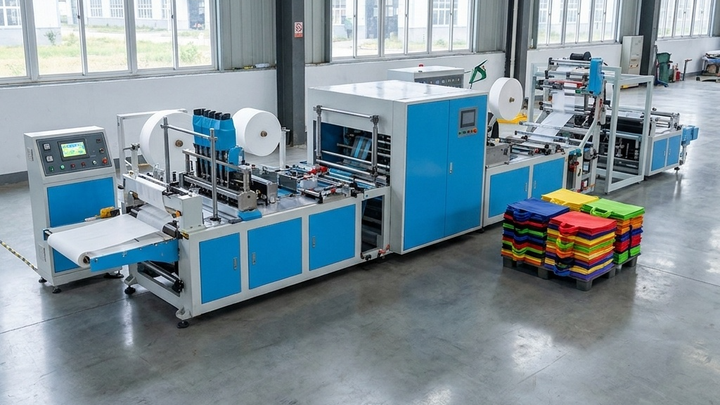
Modern industrial non woven bag making machinery combines multiple production functions into a single workflow. This reduces manual handling and improves consistency throughout the manufacturing process.
Many production facilities now rely on automated systems that can produce large quantities of bags while maintaining uniform dimensions and appearance.
Key Types or Categories
Several categories of machinery are used depending on the desired bag style and production requirements.
Fully Automatic Machinery
Fully automatic systems perform the entire production sequence with minimal operator intervention.
Key features include:
- Automatic feeding
- Automatic cutting
- Automated sealing
- Integrated handle formation
- Continuous production operation
These systems are commonly used in large-scale manufacturing environments.
Semi-Automatic Machinery
Semi-automatic equipment requires some manual involvement during specific production stages.
Common applications include:
- Smaller production facilities
- Customized bag production
- Lower production volumes
This category provides flexibility while still improving efficiency compared to manual methods.
Box Bag Production Machinery
Box bags feature reinforced structures and greater carrying capacity.
These machines are designed to create:
- Grocery bags
- Shopping bags
- Promotional bags
- Packaging bags
The finished products often include side gussets and flat bottoms for increased storage space.
Handle Loop Attachment Machinery
Some equipment specializes in attaching loop handles to preformed bags.
These systems improve production consistency and reduce manual assembly requirements.
Multi Functional Production Systems
Many facilities utilize multi functional non woven bag machinery capable of producing several bag styles using a single production platform.
This flexibility allows manufacturers to switch between:
- Vest bags
- Box bags
- D-cut bags
- Loop handle bags
- Customized promotional bags
The ability to create multiple designs increases operational versatility.
Important Subsections
Fabric Feeding System
The feeding system controls how non woven fabric enters the production line.
Accurate feeding helps ensure:
- Consistent dimensions
- Stable production speed
- Reduced material waste
- Improved product quality
Modern feeding systems use sensors to monitor fabric movement throughout the process.
Ultrasonic Sealing Technology
One of the most important innovations in bag production is automated ultrasonic bag welding technology.
Ultrasonic welding uses high-frequency vibrations to bond materials together without traditional stitching.
Benefits include:
- Strong seams
- Clean finishing
- Faster production
- Reduced material damage
This technology is commonly used in high-speed production environments.
Printing Integration
Many machines include integrated printing systems.
These systems allow manufacturers to apply:
- Brand logos
- Product information
- Promotional graphics
- Event messaging
Printing can occur during production, reducing additional processing steps.
Quality Monitoring Systems
Advanced machinery often includes monitoring components that identify production irregularities.
These systems help maintain:
- Accurate dimensions
- Proper sealing
- Consistent appearance
- Reliable production quality
How It Works
The non woven bag manufacturing process follows a structured sequence.
Step 1: Material Preparation
Production begins with rolls of non woven fabric.
The material is loaded into the feeding section of the machinery and aligned for processing.
Step 2: Fabric Feeding
The machine continuously feeds fabric through rollers.
Sensors monitor movement and maintain proper tension throughout production.
Step 3: Folding Process
The fabric is folded according to the desired bag design.
Different folding patterns are used for:
- D-cut bags
- Box bags
- Vest bags
- Loop handle bags
Accurate folding ensures uniform bag dimensions.
Step 4: Sealing and Bonding
The machine seals fabric edges using heat or ultrasonic welding.
Automated ultrasonic bag welding technology creates durable seams while maintaining a clean appearance.
This stage forms the basic structure of the bag.
Step 5: Cutting Operations
After sealing, the machinery cuts the material into individual bag units.
Computer-controlled systems help maintain precise dimensions throughout the process.
Step 6: Handle Formation
If required, handles are created and attached automatically.
Depending on the design, the machine may produce:
- D-cut handles
- Loop handles
- Reinforced handles
Step 7: Inspection and Collection
Finished bags pass through inspection stages before collection.
Quality checks verify:
- Proper sealing
- Correct dimensions
- Handle strength
- Overall appearance
The completed bags are then stacked and prepared for packaging.
Benefits and Advantages
Modern non woven bag making machinery provides numerous advantages for manufacturers and production facilities.
Higher Production Efficiency
Automated equipment significantly increases production output compared to manual methods.
Continuous operation allows manufacturers to produce large quantities within shorter production cycles.
Consistent Product Quality
Automation helps maintain uniformity across production batches.
Benefits include:
- Consistent dimensions
- Reliable sealing
- Uniform appearance
- Reduced production variation
Reduced Material Waste
Precision feeding and cutting systems improve material utilization.
Efficient material management contributes to more sustainable manufacturing practices.
Improved Production Speed
Modern industrial non woven bag making machinery is designed for high-speed operation.
Advanced automation minimizes delays between production stages.
Lower Manual Intervention
Automation reduces repetitive tasks and streamlines production workflows.
Operators can focus more on monitoring and quality management.
Production Flexibility
Multi functional non woven bag machinery supports multiple bag designs within a single production environment.
This flexibility allows manufacturers to respond efficiently to changing market requirements.
Real-World Examples or Applications
Non woven bags are used across many industries and commercial environments.
Retail Industry
Retail businesses use non woven bags for customer purchases and promotional activities.
These bags often feature printed branding and marketing messages.
Grocery Stores
Grocery retailers commonly use durable non woven bags for carrying food products and household items.
The strength of these bags supports repeated usage.
Trade Shows and Events
Event organizers distribute promotional materials in customized non woven bags.
These bags often display event branding and sponsor information.
Healthcare Facilities
Healthcare organizations utilize non woven products for packaging and transportation purposes.
Their lightweight structure and durability support various operational needs.
Educational Institutions
Schools and universities may use non woven bags during events, conferences, and student activities.
Customized printing helps strengthen institutional branding.
Important Factors to Understand
Several factors influence machinery selection and production performance.
Production Capacity
Manufacturers should evaluate expected output requirements before selecting machinery.
Higher-capacity systems are often suitable for large-scale production operations.
Material Compatibility
Different machines may support different grades and thicknesses of non woven fabric.
Material compatibility affects production quality and efficiency.
Automation Level
Automation requirements vary depending on production goals.
Facilities should consider:
- Production volume
- Workforce availability
- Product variety
- Operational complexity
Maintenance Requirements
Regular maintenance supports reliable operation and consistent production quality.
Important maintenance activities include:
- Roller inspection
- Sensor calibration
- Welding system checks
- Lubrication procedures
Energy Efficiency
Energy-efficient machinery can help reduce operational expenses while supporting sustainable manufacturing practices.
Future Trends and Industry Insights
The non woven bag manufacturing sector continues evolving through technological innovation and production improvements.
Increased Automation
Future machinery is expected to incorporate higher levels of intelligent automation.
These advancements may improve production precision and operational efficiency.
Smart Monitoring Systems
Advanced monitoring technologies are becoming more common.
Potential developments include:
- Real-time production tracking
- Predictive maintenance
- Automated diagnostics
- Enhanced quality control
Improved Ultrasonic Welding
Automated ultrasonic bag welding technology continues advancing.
Future systems may provide even greater sealing precision and production speed.
Flexible Manufacturing Platforms
Manufacturers increasingly seek machinery capable of producing multiple bag styles without extensive equipment modifications.
This trend supports operational adaptability and efficient production management.
Sustainable Manufacturing Practices
Growing attention to environmental responsibility encourages improvements in material utilization and production efficiency.
Future machinery designs will likely focus on reducing waste while maximizing output quality.
Conclusion
Non woven bag making machinery plays a vital role in modern packaging production. These systems transform non woven fabric into durable and reusable bags through a combination of feeding, folding, sealing, cutting, and handle attachment processes.
Technologies such as automated ultrasonic bag welding technology have improved production quality and efficiency, while industrial non woven bag making machinery supports large-scale manufacturing requirements. In addition, multi functional non woven bag machinery provides flexibility by enabling the production of various bag designs within a single production environment.
As automation, intelligent monitoring, and manufacturing efficiency continue advancing, non woven bag production technology is expected to become even more capable and adaptable. Understanding these machines, their production processes, and their advantages helps provide valuable insight into one of today's most important packaging manufacturing sectors.