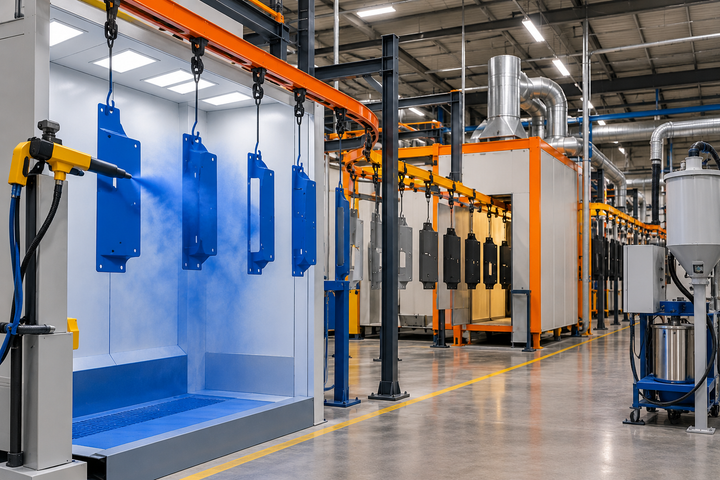
Exploring Powder Coating Line Machinery: Modern Systems
Powder coating line machinery plays an important role in modern manufacturing and industrial finishing operations.
These systems apply a protective and decorative coating to metal and other compatible materials using a dry powder application process. Compared to many traditional finishing methods, powder coating systems are known for durability, consistency, and efficient material utilization.
Today, powder coating line machinery is widely used in automotive manufacturing, metal fabrication, construction materials, appliances, industrial equipment, furniture production, and many other sectors. As manufacturing technology continues to advance, modern powder coating lines incorporate automation, process monitoring, and improved energy management to support production efficiency.
Understanding how powder coating line machinery works, its major components, applications, and future developments can help businesses and industry professionals better understand this important manufacturing technology.
Quick Facts About Powder Coating Line Machinery
| Feature | Description |
|---|---|
| Primary Purpose | Surface coating and finishing |
| Coating Method | Electrostatic powder application |
| Common Materials | Steel, aluminum, metal alloys |
| Industry Usage | Manufacturing and fabrication |
| Production Type | Manual, semi-automatic, automatic |
| Key Benefit | Durable surface finishing |
| Typical Process | Cleaning, coating, curing |
| Automation Capability | High |
What Is Powder Coating Line Machinery?
Powder coating line machinery refers to a complete production system designed to apply powder coatings to manufactured components and finished products.
The process uses electrically charged powder particles that adhere to grounded surfaces. The coated products then move through a curing stage where heat helps create a durable and uniform finish.
Modern powder coating lines can handle everything from small components to large industrial structures, depending on system design and production requirements.
Understanding the Powder Coating Process
The powder coating process involves several coordinated stages.
Surface Preparation
The surface must be cleaned before coating.
Typical preparation activities include:
- Removing dust
- Eliminating oils and grease
- Surface treatment
- Rinsing procedures
Powder Application
Electrostatic spray equipment applies powder particles to the product surface.
Curing Process
Heat cures the powder coating, creating a durable finished layer.
Cooling Stage
The coated component cools before inspection and handling.
Powder Coating Line Process Flow
| Process Stage | Purpose |
|---|---|
| Pre-Treatment | Surface cleaning and preparation |
| Drying | Moisture removal |
| Powder Application | Coating deposition |
| Curing | Finish formation |
| Cooling | Product stabilization |
| Inspection | Quality verification |
Key Components of Powder Coating Line Machinery
Pre-Treatment System
This section prepares surfaces before coating.
Conveyor System
The conveyor moves products through each stage of production.
Powder Spray Booth
The spray booth provides a controlled environment for powder application.
Powder Recovery System
Recovers excess powder for potential reuse and process efficiency.
Curing Oven
The oven applies controlled heat to cure the coating.
Control System
Controls production parameters and system operation.
Powder Coating Line Machinery Architecture
Material Handling System
Responsible for moving products throughout the production line.
Surface Preparation Section
Ensures proper surface condition before coating.
Coating Application Zone
Applies electrostatically charged powder particles.
Powder Collection System
Captures overspray and maintains cleanliness.
Thermal Curing Section
Provides controlled curing temperatures.
Inspection Area
Verifies coating quality and consistency.
Types of Powder Coating Line Machinery
Manual Powder Coating Lines
Suitable for smaller production environments.
Characteristics
- Flexible operation
- Lower production volume
- Greater operator involvement
Semi-Automatic Powder Coating Lines
Combine manual control with automation.
Characteristics
- Improved consistency
- Moderate production capacity
- Flexible workflow
Fully Automatic Powder Coating Lines
Designed for high-volume production.
Characteristics
- Automated product movement
- Consistent coating quality
- High throughput capability
Batch Powder Coating Systems
Used for smaller production runs.
Continuous Powder Coating Systems
Designed for uninterrupted production flow.
Powder Coating System Comparison
| System Type | Production Volume | Automation Level |
|---|---|---|
| Manual | Lower | Low |
| Semi-Automatic | Moderate | Medium |
| Automatic | High | High |
| Batch System | Flexible | Varies |
| Continuous Line | Very High | High |
How Powder Coating Line Machinery Works
Step 1: Product Loading
Components are loaded onto the conveyor system.
Step 2: Surface Preparation
Cleaning and treatment prepare surfaces for coating.
Step 3: Drying
Moisture is removed before coating application.
Step 4: Powder Application
Electrostatic equipment applies powder to the product.
Step 5: Curing
Heat transforms the powder into a durable finish.
Step 6: Cooling and Inspection
Finished products cool and undergo quality checks.
Powder Coating Line Capacity Comparison
| Production Capacity | Typical Application |
|---|---|
| Small Capacity | Custom fabrication |
| Medium Capacity | General manufacturing |
| Large Capacity | Industrial production |
| High-Volume Capacity | Mass manufacturing |
Benefits of Modern Powder Coating Systems
Consistent Coating Quality
Automated systems help maintain uniform finishes.
Improved Production Efficiency
Continuous operation supports higher throughput.
Durable Surface Protection
Powder coatings provide strong resistance to wear and environmental exposure.
Reduced Material Waste
Recovery systems help improve material utilization.
Automation Integration
Modern systems can integrate advanced controls and monitoring technologies.
Industries Using Powder Coating Line Machinery
Automotive Manufacturing
Vehicle components frequently use powder-coated finishes.
Construction Materials
Structural products often require protective coatings.
Industrial Equipment
Machinery components benefit from durable surface finishes.
Furniture Manufacturing
Metal furniture frequently uses powder coating technology.
Appliance Manufacturing
Many household appliances incorporate powder-coated components.
Industry Applications Table
| Industry | Common Components |
|---|---|
| Automotive | Frames, brackets, wheels |
| Construction | Panels, railings |
| Appliances | Housings, enclosures |
| Furniture | Metal frames |
| Industrial Equipment | Structural components |
Environmental Considerations
Environmental performance has become increasingly important in manufacturing operations.
Efficient Powder Utilization
Powder recovery systems help reduce material loss.
Reduced Volatile Emissions
Powder coating processes generally produce lower volatile emissions compared to some liquid coating technologies.
Improved Resource Efficiency
Modern systems focus on optimized energy and material usage.
Sustainable Manufacturing Practices
Manufacturers increasingly integrate environmentally conscious production strategies.
Energy Consumption Factors
| Factor | Impact on Efficiency |
|---|---|
| Oven Design | Influences energy usage |
| Conveyor Speed | Affects production efficiency |
| Recovery Systems | Improves material utilization |
| Automation Controls | Supports process optimization |
| Thermal Insulation | Reduces energy loss |
Noise and Operating Environment
Operating environments influence production performance.
Production Facilities
Powder coating lines are commonly installed in industrial manufacturing facilities.
Ventilation Requirements
Proper airflow supports equipment performance and workplace conditions.
Temperature Control
Stable operating conditions contribute to process consistency.
Equipment Layout
Efficient facility design supports workflow optimization.
Industry Standards and Safety
Electrical Safety
Equipment must operate according to applicable electrical requirements.
Ventilation Systems
Proper ventilation helps manage airborne particles.
Fire Prevention Measures
Manufacturing facilities implement appropriate safety procedures.
Process Monitoring
Monitoring systems support consistent operation.
Operator Safety
Protective equipment and operational procedures contribute to workplace safety.
Common Challenges and Solutions
| Challenge | Practical Solution |
|---|---|
| Surface Contamination | Improve pre-treatment processes |
| Uneven Coating | Optimize spray parameters |
| Material Waste | Utilize recovery systems |
| Production Delays | Improve workflow planning |
| Energy Usage | Enhance thermal efficiency |
| Quality Variations | Strengthen process monitoring |
Maintenance Schedule
| Maintenance Task | Frequency | Purpose |
|---|---|---|
| Inspect Spray Equipment | Daily | Maintain coating quality |
| Check Conveyor System | Weekly | Ensure smooth movement |
| Clean Recovery System | Weekly | Improve powder collection |
| Inspect Oven Components | Monthly | Maintain curing performance |
| Verify Control Systems | Monthly | Support reliable operation |
| Comprehensive Inspection | Periodically | Identify potential issues |
Best Practices for Powder Coating Operations
- Maintain consistent surface preparation procedures.
- Monitor curing temperatures regularly.
- Inspect spray equipment routinely.
- Optimize powder recovery systems.
- Follow preventive maintenance schedules.
- Train operators on process requirements.
Expert Insights
Manufacturing professionals often consider surface preparation the most important stage of the powder coating process. Even advanced coating equipment depends on proper cleaning and preparation to achieve consistent results.
Experts also emphasize automation, process monitoring, and preventive maintenance as key factors supporting long-term production efficiency and coating quality.
Key Facts About Powder Coating Line Machinery
- Powder coating lines combine multiple production stages into a coordinated system.
- Automated systems support consistent coating quality.
- Recovery systems improve material utilization.
- Modern equipment increasingly incorporates digital monitoring technologies.
- Powder coating is widely used across manufacturing industries.
Future Trends and Industry Insights
Smart Manufacturing Integration
Production systems increasingly connect with digital monitoring platforms.
Advanced Automation
Automation continues expanding throughout coating operations.
Improved Energy Management
Future systems are expected to focus on greater efficiency.
Data-Driven Process Control
Real-time monitoring supports process optimization.
Enhanced Powder Recovery Technologies
Manufacturers continue improving material utilization systems.
Frequently Asked Questions
What is powder coating line machinery?
A production system used to apply powder coatings to manufactured products.
What industries use powder coating systems?
Automotive, construction, furniture, appliance, and industrial manufacturing sectors.
What is a powder spray booth?
A controlled environment where powder is applied to products.
Why is surface preparation important?
Proper preparation supports coating adhesion and finish quality.
What is a curing oven?
Equipment that applies heat to cure the powder coating.
What does a powder recovery system do?
It collects excess powder and supports efficient material utilization.
What are the main types of powder coating lines?
Manual, semi-automatic, automatic, batch, and continuous systems.
Why is automation important?
Automation improves consistency and production efficiency.
How does a conveyor system help?
It moves products through each stage of production.
What future trends are shaping the industry?
Smart manufacturing, automation, digital monitoring, and improved energy management.
Conclusion
Powder coating line machinery has become an essential technology in modern manufacturing. By combining surface preparation, powder application, curing, recovery, and inspection into an integrated process, these systems help manufacturers achieve durable and consistent finishes.
As automation, smart manufacturing, and efficiency-focused technologies continue to advance, powder coating line machinery is expected to play an even greater role in supporting modern industrial production and surface finishing operations.