Robotic Welding Machines: Complete Guide to Automation, Precision, and Industrial Welding
Robotic welding machines are changing the way modern industries handle metal joining and fabrication. These machines combine robotic movement with advanced welding technology to perform welding tasks with high precision and consistency.
Today, robotic systems are widely used in industries such as automotive manufacturing, heavy machinery production, aerospace engineering, and metal fabrication. Many factories rely on industrial welding automation to improve accuracy and maintain steady production quality.
This guide explains robotic welding machines in simple language, including their working process, major types, benefits, applications, and common questions.
Explanation: What Are Robotic Welding Machines?
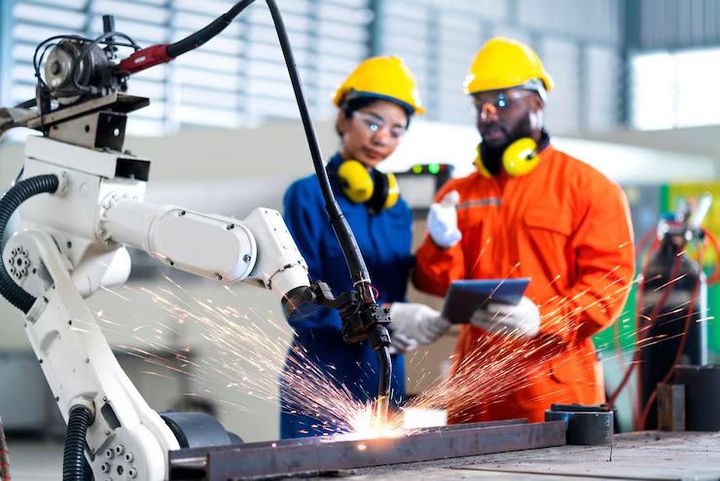
A robotic welding machine is an automated system designed to perform welding operations with minimal human involvement. Instead of manually holding a welding torch, a robotic arm controls the movement and positioning during the welding process.
These systems are programmed to repeat the same welding path accurately many times.
How Robotic Welding Works
The process usually follows these steps:
- Metal parts are placed in position
- The robotic arm moves toward the welding area
- The welding torch creates heat to join the metals
- Sensors monitor positioning and movement
- The robot completes the weld based on programmed instructions
Many robotic systems use automated welding equipment to ensure consistent results even during long production cycles.
Main Components of a Robotic Welding System
Robotic Arm
The robotic arm controls movement and positioning during welding.
Welding Torch
This tool generates heat to fuse metal parts together.
Controller Unit
The controller acts as the system’s brain and manages robotic movement.
Sensors
Sensors help maintain precision and detect alignment issues.
Safety Enclosures
Protective barriers help create a safer working environment.
Types of Robotic Welding Machines
Different robotic welding systems are designed for different industrial tasks.
1. Arc Welding Robots
These are among the most commonly used robotic welding machines.
How They Work
An electric arc generates heat between the electrode and the metal surface.
Common Uses
- Automotive frames
- Steel structures
- Industrial machinery
2. Spot Welding Robots
Spot welding robots join metal sheets at specific points.
Key Features
- Fast welding process
- Suitable for sheet metal work
- Common in automotive production
3. Laser Welding Robots
These systems use a concentrated laser beam for welding.
Advantages
- Very precise welding
- Minimal heat distortion
- Suitable for delicate components
Laser welding systems are often used in advanced precision welding technology applications.
4. MIG Welding Robots
MIG stands for Metal Inert Gas welding.
Features
- Continuous wire feeding
- Smooth welding operation
- Suitable for thick materials
5. TIG Welding Robots
TIG welding uses a non-consumable tungsten electrode.
Features
- High-quality weld appearance
- Better control for thin metals
- Common in aerospace and stainless steel work
Benefits of Robotic Welding Machines
Robotic welding systems provide several important advantages in industrial environments.
1. High Precision
Robots repeat the same movement accurately every time. This improves weld quality and consistency.
2. Faster Production
Automated systems can operate continuously with fewer interruptions.
3. Improved Safety
Robots handle high heat and hazardous welding environments, reducing direct human exposure.
4. Consistent Results
Industrial welding automation helps maintain uniform welding quality across large production runs.
5. Reduced Material Waste
Accurate welding minimizes unnecessary material usage.
6. Better Efficiency
Factories can maintain stable production with fewer manual adjustments.
Applications of Robotic Welding Machines
Robotic welding is used in many industries because of its speed and reliability.
Automotive Industry
Robots weld car frames, doors, and exhaust systems.
Aerospace Industry
Precision welding technology is important for aircraft components.
Construction Equipment
Heavy machinery parts require strong and consistent welds.
Shipbuilding
Large metal structures benefit from automated welding systems.
Electronics and Metal Fabrication
Small and delicate metal components often require accurate robotic welding.
Challenges and Limitations
Although robotic welding machines provide many advantages, there are also some challenges.
High Setup Complexity
Programming and system configuration require careful planning.
Maintenance Requirements
Robotic systems need regular inspection and calibration.
Skilled Supervision
Operators must understand machine operation and safety procedures.
Limited Flexibility for Small Tasks
For very small custom projects, manual welding may sometimes be more practical.
Safety in Robotic Welding
Safety remains very important in automated welding environments.
Common Safety Measures
- Protective barriers around robotic cells
- Emergency stop systems
- Proper ventilation for welding fumes
- Routine equipment inspection
- Operator training programs
Future Trends in Robotic Welding
Robotic welding technology continues to evolve rapidly.
Smarter Automation
Advanced sensors and machine learning improve welding accuracy.
Better Energy Efficiency
Modern systems focus on reducing power consumption.
Improved Human-Robot Collaboration
Some systems are designed to safely work alongside human operators.
Enhanced Precision
Future precision welding technology may provide even finer control for complex components.
FAQs About Robotic Welding Machines
What is a robotic welding machine?
It is an automated system that performs welding tasks using robotic movement and programmed instructions.
Where are robotic welding machines used?
They are commonly used in automotive, aerospace, construction, and manufacturing industries.
What is industrial welding automation?
Industrial welding automation refers to using machines and robotic systems to perform welding with minimal manual involvement.
Are robotic welding systems accurate?
Yes, robotic systems provide high precision and consistent welding quality.
What industries use precision welding technology?
Industries such as aerospace, electronics, and automotive manufacturing often use precision welding technology.
Can robotic welding improve safety?
Yes, robots reduce direct human exposure to heat, sparks, and hazardous fumes.
Conclusion
Robotic welding machines are becoming essential in modern manufacturing and industrial production. They improve precision, consistency, and workplace safety while supporting faster production processes.
From automotive factories to aerospace engineering, these systems play a major role in industrial welding automation. As technology continues to advance, robotic welding will become even smarter, more efficient, and more precise in the future.