Industrial Ready Mix Concrete Plant Systems: Operational Insights Guide
Industrial ready mix concrete plant systems are large-scale facilities designed to produce concrete efficiently, consistently, and in controlled conditions. These plants combine cement, aggregates, water, and additives using automated or semi-automated systems to create concrete mixtures for construction projects of different sizes. Unlike manual mixing methods, industrial systems focus on precision, productivity, and quality consistency. They are widely used in infrastructure development, commercial construction, manufacturing facilities, and residential projects where reliable concrete supply is essential.
This comparison matters globally because construction activity continues to expand across many regions due to urban growth, industrial development, and infrastructure modernization. According to global construction research, the demand for efficient material production systems has increased as builders aim to reduce waste, improve operational control, and meet sustainability expectations. Over the past year, many construction companies have also focused on digital monitoring, automated batching, and energy-efficient operations to improve productivity while maintaining environmental standards. As a result, understanding the differences between plant systems has become increasingly important for businesses and project planners worldwide.
The real-world impact of ready mix concrete systems extends far beyond industrial facilities. Reliable concrete production affects the durability of roads, bridges, buildings, transportation hubs, and public infrastructure used daily by millions of people. Poorly managed systems can lead to delays, material waste, and inconsistent quality, while efficient systems support safer and more predictable construction outcomes. Because these plants influence both project timelines and operational costs, they affect contractors, engineers, developers, investors, and suppliers across international markets. Understanding who benefits most from different systems helps explain why careful comparison is necessary before selecting a plant model or operational structure.
Who It Affects & Problems It Solves
Industrial ready mix concrete plant systems affect a broad global audience connected to construction and infrastructure activities. Large construction firms depend on these systems for continuous material supply during complex projects, while small and medium contractors use them to maintain consistent quality standards without relying on manual mixing. Equipment operators, engineers, project managers, logistics coordinators, and maintenance teams are also directly influenced because plant efficiency shapes their daily operations. Even property developers and long-term infrastructure investors rely on stable concrete production systems to reduce operational uncertainty and support predictable project completion schedules.
Without clarity on this topic, many businesses across the world end up selecting plant systems that do not align with their production capacity, transportation requirements, or maintenance capabilities. Some organizations prioritize lower initial setup costs without considering long-term operating efficiency, while others invest heavily in advanced automation without having sufficient production demand. Inconsistent material flow, inaccurate batching, delayed maintenance, and poor environmental control are common operational challenges that can increase downtime and reduce project reliability. A detailed comparison helps decision-makers understand how plant design, automation level, mobility, and storage systems affect performance in different operating conditions.
A common global scenario involves a contractor choosing a plant with limited output capacity for a rapidly expanding construction schedule. Initially, the lower investment appears practical, but production bottlenecks soon create transportation delays and higher operating expenses. Another frequent mistake is underestimating maintenance requirements for automated systems, which can lead to unexpected shutdowns if staff training is insufficient. These operational issues highlight why industry updates and technological developments have become important factors when comparing modern ready mix concrete plant systems.
Recent Updates
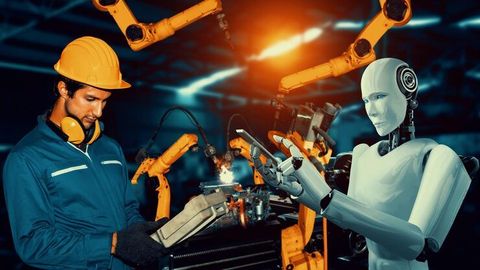
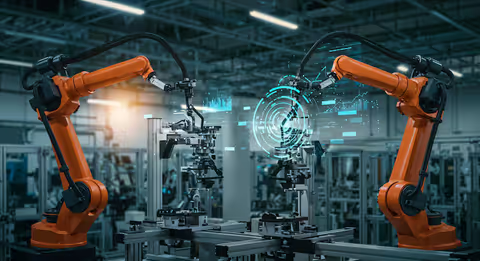
Over the past year, automation has become one of the most significant trends in industrial ready mix concrete operations. Many modern plants now include digital batching controls, automated moisture monitoring, and remote system diagnostics. These technologies help operators improve consistency while reducing material waste and manual intervention. Industry observers have noted that automated data tracking is increasingly being used to monitor production accuracy and maintenance schedules in real time.
In early 2025, sustainability improvements gained greater attention across global construction markets. Many plant operators began integrating energy-efficient motors, dust control systems, and water recycling processes into daily operations. Industry data suggests that environmental efficiency is now considered a practical operational requirement rather than only a long-term sustainability goal. As a result, plant comparisons increasingly include environmental performance alongside production capacity and operational speed.
Another important shift involves the growing popularity of mobile and modular plant systems. Construction companies working on temporary infrastructure or remote industrial projects often prefer modular systems because they can be transported and assembled more easily than permanent facilities. This flexibility helps organizations adapt to changing project locations without building entirely new production infrastructure for each assignment.
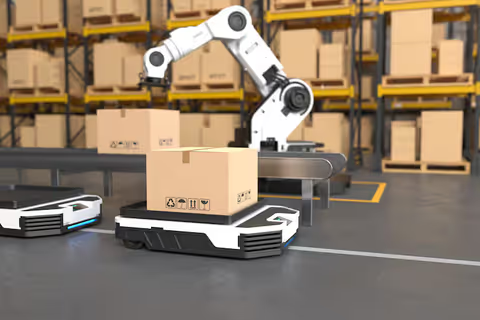
Digital integration has also expanded within logistics and fleet coordination systems. Many operators now connect concrete production scheduling with transportation management software to reduce delivery delays and improve timing accuracy. According to industry research, synchronized production and delivery operations can improve overall workflow efficiency while minimizing idle time at construction sites. These evolving trends provide useful context for comparing the operational strengths and limitations of different plant systems.
Comparison Table
The following table compares major industrial ready mix concrete plant systems using operational factors that matter universally across construction and infrastructure projects. These parameters influence efficiency, maintenance requirements, scalability, and long-term operational performance.
| Parameter | Stationary Plant | Mobile Plant | Modular Plant |
|---|---|---|---|
| Installation Time | Longer | Shorter | Moderate |
| Production Capacity | High | Medium | Medium to High |
| Relocation Flexibility | Limited | High | Moderate |
| Automation Integration | Advanced | Moderate | Advanced |
| Maintenance Complexity | Higher | Moderate | Moderate |
| Initial Setup Cost | Higher | Lower | Medium |
| Long-Term Efficiency | High | Moderate | High |
| Space Requirement | Large | Compact | Flexible |
| Transportation Needs | Limited after setup | Frequent | Moderate |
| Suitable Project Duration | Long-term | Short-term | Medium to Long-term |
| Environmental Controls | Advanced | Moderate | Advanced |
| Scalability | High | Limited | Flexible |
The table shows that no single system is universally superior in every situation. Stationary plants generally support higher production and advanced automation, while mobile systems prioritize flexibility and faster deployment. Modular plants often balance scalability with operational adaptability, making them suitable for organizations managing changing project demands. These operational patterns also connect closely to broader industry regulations and practical planning considerations.
Regulations & Practical Guidance
In most countries, industrial ready mix concrete plants operate under environmental, safety, and quality-control requirements intended to reduce operational risks and maintain construction standards. Internationally, regulators and industry organizations typically focus on dust management, wastewater handling, worker safety, and material quality consistency. Many jurisdictions also require regular equipment inspections and operational documentation to ensure batching accuracy and environmental compliance throughout production activities.
Financial and operational governance also play an important role in plant management. Globally, construction firms are increasingly expected to maintain transparent maintenance schedules, production records, and environmental monitoring systems. Automated data logging has become more common because it supports operational accountability and helps businesses identify efficiency problems earlier. While exact requirements vary depending on local regulations, most industrial operators benefit from adopting internationally recognized safety and quality management practices.
Which Option Suits Your Situation?
A large construction company managing long-term infrastructure development may benefit from a stationary plant system because higher production capacity and advanced automation can support continuous operations more effectively. These systems are often practical when projects require stable output over extended periods and where permanent operational infrastructure is financially justifiable.
A contractor working across multiple temporary project sites may find mobile plant systems more suitable. Faster transportation and shorter setup times can improve operational flexibility, particularly for organizations handling remote or rapidly changing construction environments. However, operators must also consider production limits and ongoing transportation logistics before selecting this approach.
Businesses expecting gradual expansion often prefer modular systems because they allow operational scaling without requiring a complete facility redesign. This flexibility can support companies balancing production growth with cautious investment planning. Modular systems may also simplify maintenance planning because components can often be upgraded individually.
Smaller organizations entering industrial concrete production should focus on balancing operational complexity with staffing capabilities. Highly automated systems may improve efficiency, but insufficient training can create maintenance difficulties and downtime risks. Careful evaluation of workforce readiness, production demand, and project duration helps create more sustainable operational decisions. These practical considerations naturally connect to the tools and resources commonly used to support plant management and operational planning.
Tools & Resources
Several globally accessible tools and professional resources help organizations evaluate and manage industrial ready mix concrete operations more effectively. These resources are widely used for operational planning, maintenance management, and production analysis across international construction markets.
Concrete Quality Control Software — Helps operators monitor batching accuracy, moisture levels, and production consistency during daily operations.
Fleet Management Platforms — Used to coordinate delivery schedules, vehicle tracking, and transportation timing between plants and construction sites.
Maintenance Scheduling Systems — Assist maintenance teams in planning inspections, tracking repairs, and reducing equipment downtime.
Construction Cost Estimation Tools — Support budgeting and project forecasting by analyzing material consumption and operational expenses.
Environmental Monitoring Applications — Help facilities track dust control, water usage, and energy efficiency metrics for sustainability management.
Industrial Safety Training Platforms — Provide operational safety guidance, workforce education, and compliance-focused training materials for plant staff.
Production Analytics Dashboards — Offer real-time operational insights that help managers evaluate efficiency, output trends, and equipment performance. These resources also support many of the questions businesses commonly ask when comparing industrial concrete plant systems.
Frequently Asked Questions
What is the main difference between stationary and mobile ready mix concrete plants?
Stationary plants are designed for long-term operations with higher production capacity and advanced automation features, while mobile plants prioritize portability and quicker installation. Stationary systems are commonly used for continuous large-scale projects, whereas mobile systems are practical for temporary or remote construction activities. The choice depends on project duration, transportation requirements, and expected production volume rather than one system being universally better.
Who should choose a modular concrete plant system?
Modular systems are often suitable for organizations that expect operational growth or changing project requirements over time. These plants provide flexibility because additional components can usually be integrated without redesigning the entire facility. Businesses managing medium-term projects or operating across multiple regions may find modular systems useful because they balance scalability, efficiency, and adaptability more effectively than some fixed or highly portable alternatives.
Are ready mix concrete plants generally subject to environmental regulations?
Yes, most jurisdictions globally apply environmental and operational standards to ready mix concrete plants. These regulations commonly focus on dust management, wastewater handling, worker safety, and production quality consistency. Many operators also maintain monitoring systems and maintenance documentation to demonstrate compliance with local operational expectations. Although regulations differ internationally, environmental accountability has become increasingly important across the global construction industry.
Is automation always the best option for concrete plant operations?
Automation can improve batching accuracy, reduce material waste, and support production efficiency, but it is not automatically the best solution for every organization. Highly automated systems require technical expertise, maintenance planning, and trained operators to function effectively. Smaller businesses with limited production needs may achieve better operational balance using partially automated systems that provide efficiency improvements without creating unnecessary operational complexity or maintenance expenses.
What production capacity should businesses consider before selecting a plant?
Production capacity should align with realistic project demand rather than maximum theoretical output. Businesses should evaluate average project size, expected delivery schedules, transportation capabilities, and maintenance downtime before selecting a plant system. Choosing a facility that is too small may create operational bottlenecks, while oversized systems can increase operating costs unnecessarily. Careful forecasting and long-term planning usually produce more sustainable operational outcomes.
Conclusion
Industrial ready mix concrete plant systems play an essential role in global construction and infrastructure development because they directly affect production efficiency, operational consistency, and project reliability. Stationary plants generally provide higher output and advanced automation, mobile systems prioritize flexibility and rapid deployment, and modular plants offer balanced scalability for evolving operational needs. Recent trends involving automation, sustainability, and digital logistics integration have also reshaped how businesses compare and manage these systems internationally.
The most suitable option depends on production demand, project duration, transportation needs, workforce capability, and long-term operational planning. Organizations that carefully evaluate these factors are more likely to achieve efficient operations while avoiding unnecessary costs or maintenance challenges. Instead of focusing only on initial investment size, decision-makers benefit from considering operational sustainability, scalability, and maintenance readiness together.