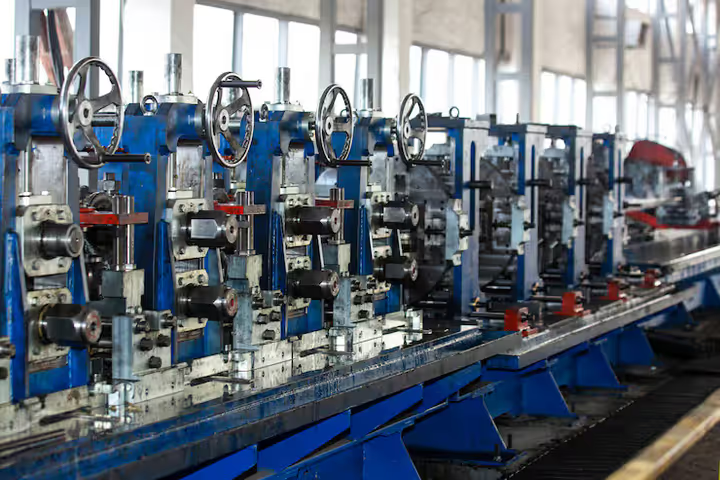
Explore Multi Mill Machines for Advanced Industrial Material Processing
Multi Mill Machines are versatile industrial processing systems designed to reduce particle size, mix materials, and improve the consistency of powders, granules, and other solid materials. These machines are widely used in pharmaceutical manufacturing, chemical processing, food production, cosmetics, and other industries where controlled material processing is required.
The main purpose of a Multi Mill Machine is to achieve uniform particle size through cutting, shearing, and impact actions. Unlike single-purpose milling equipment, a multi mill system can perform different processing functions by adjusting components such as blades, screens, and operating speeds.
Modern industrial operations use Multi Mill Machines because they help improve product consistency, support efficient production workflows, and maintain quality standards. They are especially important in industries where accurate particle control influences the performance, stability, and usability of final products.
Working Principle and Structure of Multi Mill Machines
A Multi Mill Machine operates through a rotating blade mechanism placed inside a processing chamber. Materials enter the chamber, where rotating knives create cutting and impact forces. The processed material moves through a selected screen that controls the final particle size.
The structure usually includes several integrated parts that work together to provide controlled processing.
Main Components of Multi Mill Machines
- Processing Chamber: The central area where material reduction takes place.
- Rotating Blades: Sharp cutting elements that create shearing and impact forces.
- Screens: Components that determine particle size output.
- Drive System: Provides rotational movement for the blade assembly.
- Control Panel: Allows operators to adjust operational parameters.
- Collection System: Collects processed material after milling.
The ability to change blade configurations and screen sizes allows these machines to handle different materials and processing requirements.
Importance of Multi Mill Machines in Industrial Applications
Multi Mill Machines play an important role in industries that require consistent material characteristics. Uniform particle size can improve mixing, compression, dissolution, and overall product performance.
In pharmaceutical manufacturing, these machines are commonly used for processing powders and granules used in tablets, capsules, and other formulations. In food processing, they support the preparation of ingredients requiring controlled texture and consistency.
Common Industrial Applications
- Pharmaceutical powder processing
- Chemical material preparation
- Food ingredient processing
- Cosmetic formulation preparation
- Herbal product manufacturing
- Laboratory material development
- Research and industrial testing environments
These machines help solve several processing challenges, including uneven particle distribution, inconsistent material flow, and difficulties in achieving repeatable production results.
Types of Multi Mill Machines
Different industries use various Multi Mill Machine designs depending on material characteristics and processing requirements.
| Type | Main Application | Key Characteristic |
|---|---|---|
| Vertical Multi Mill | Pharmaceutical and chemical processing | Compact structure with vertical material flow |
| Horizontal Multi Mill | Large-scale industrial processing | Suitable for continuous operations |
| Laboratory Multi Mill | Research and testing applications | Designed for smaller material quantities |
| Stainless Steel Multi Mill | Hygienic processing environments | Supports corrosion resistance and easy cleaning |
Each type is selected according to factors such as material properties, processing capacity, hygiene requirements, and operational conditions.
Key Features of Modern Multi Mill Machines
Recent industrial designs focus on improved control, safety, and processing accuracy. Manufacturers continue developing equipment with advanced engineering features to meet changing industry requirements.
Important Features
- Adjustable operating speed for different materials
- Interchangeable screens for particle control
- Stainless steel construction for hygienic applications
- Easy cleaning and maintenance design
- Reduced material contamination risk
- Improved operator safety mechanisms
- Compatibility with automated production systems
Automation has become an important development area in industrial machinery. Many modern systems integrate digital controls, monitoring sensors, and data collection features to improve process visibility.
Recent Trends and Developments in Multi Mill Technology
During 2025 and 2026, industrial processing equipment has continued moving toward automation, energy efficiency, and improved process monitoring. Companies in pharmaceutical and manufacturing sectors are adopting smart machinery concepts to improve consistency and operational control.
Recent Developments
- Integration of digital monitoring systems for operational tracking
- Greater focus on hygienic equipment design
- Development of energy-efficient motor systems
- Improved compatibility with automated manufacturing lines
- Use of advanced materials for longer equipment durability
Industry 4.0 technologies are influencing industrial machinery development by connecting equipment with production management platforms. These technologies allow better monitoring of machine performance and process conditions.
Factors to Consider When Understanding Multi Mill Machines
Selecting the right Multi Mill Machine depends on technical requirements rather than only equipment size. Different materials require different processing approaches.
Important Considerations
- Material type and physical properties
- Required particle size range
- Production capacity requirements
- Cleaning and maintenance requirements
- Automation compatibility
- Safety standards
- Industry-specific regulations
Understanding these factors helps organizations choose suitable processing technology for their applications.
Safety Standards and Industry Regulations
Multi Mill Machines used in industrial environments must follow relevant safety and quality guidelines. Regulations vary depending on the industry and location.
In pharmaceutical applications, equipment design often follows principles related to Good Manufacturing Practices (GMP). These guidelines help maintain hygiene, process control, and product quality.
Common Compliance Areas
- Machine safety requirements
- Material compatibility standards
- Hygiene and contamination control
- Electrical safety guidelines
- Workplace equipment regulations
Organizations should review applicable regional standards and industry requirements before integrating processing equipment into production environments.
Useful Tools and Learning Resources
Professionals working with Multi Mill Machines can use various resources to understand operation, maintenance, and industrial applications.
Helpful Resources
- Equipment operation manuals
- Industrial machinery training materials
- Pharmaceutical manufacturing guidelines
- Manufacturing automation platforms
- Engineering reference documents
- Technical journals related to material processing
Digital learning platforms and technical documentation help engineers, operators, and students improve their understanding of industrial milling technology.
Role of Multi Mill Machines in Modern Manufacturing
Modern manufacturing depends on accurate and repeatable processes. Multi Mill Machines support this requirement by providing controlled particle reduction and improved material preparation.
Industries such as pharmaceuticals and specialty chemicals require precise processing because material characteristics can affect final product quality. These machines provide flexibility by handling different materials through adjustable operating conditions.
The combination of mechanical engineering, automation, and process monitoring continues to expand the role of Multi Mill Machines in advanced manufacturing environments.
Frequently Asked Questions
What is a Multi Mill Machine used for?
A Multi Mill Machine is used for particle size reduction, mixing support, and processing of powders, granules, and solid materials in industries such as pharmaceuticals, chemicals, food, and cosmetics.
How does a Multi Mill Machine work?
It works by using rotating blades inside a processing chamber. The blades create cutting and impact forces, while screens control the final particle size of the processed material.
Which industries use Multi Mill Machines?
Common industries include pharmaceutical manufacturing, food processing, chemical production, cosmetics, herbal products, and research laboratories.
What materials can be processed with a Multi Mill Machine?
These machines can process many solid materials, including powders, granules, dry ingredients, and other materials suitable for controlled size reduction.
What maintenance practices are important for Multi Mill Machines?
Regular cleaning, inspection of blades and screens, checking mechanical components, and following manufacturer guidelines are important for reliable operation and equipment performance.
Conclusion
Multi Mill Machines are important industrial processing systems that provide controlled particle reduction, improved consistency, and flexible material handling. Their ability to support different applications makes them valuable across pharmaceutical, food, chemical, and manufacturing industries.
Advancements in automation, digital monitoring, and hygienic design are shaping the future of multi mill technology. Understanding their working principles, components, applications, and safety requirements helps industries select appropriate processing solutions and maintain efficient production environments.