Thermal Testing Equipment Explained: Testing Technologies, Equipment Types and Industrial Applications
Thermal testing equipment is used to measure how materials, components, and products respond to changes in temperature and heat transfer. These instruments help engineers understand properties such as thermal conductivity, heat capacity, thermal expansion, temperature resistance, and stability under heating or cooling conditions. They are used in manufacturing, construction, electronics, automotive engineering, aerospace, energy production, and scientific research.
Temperature can affect the strength, dimensions, electrical behavior, and durability of many materials. Metals may expand when heated, plastics may soften, electronic components may overheat, and insulating materials may lose effectiveness at elevated temperatures. Thermal testing helps manufacturers evaluate these behaviors under controlled conditions before materials or products are used in practical applications.
Thermal testing is a broad field rather than a single measurement technique. Some instruments measure temperature directly, while others determine how quickly heat moves through a material or how a substance changes when exposed to a controlled temperature program.
Why thermal testing matters
Thermal testing helps answer several practical questions. Does an insulating material slow heat transfer effectively? Can an electronic component operate within its intended temperature range? Will a metal part expand enough to affect its fit with another component? Does a plastic retain its properties after repeated heating?
These questions influence product design, manufacturing quality, energy efficiency, and operational safety. Testing results can help identify unsuitable materials, investigate production defects, compare material batches, and confirm whether a product meets specified requirements.
Thermal testing is also used during research and development. Engineers may compare different material formulations, evaluate coatings, investigate thermal degradation, or study the performance of components exposed to repeated temperature changes.
Main Thermal Testing Technologies
Thermal testing methods differ according to the property being measured, the sample type, and the required temperature range. Selecting the correct technique is important because one thermal measurement does not describe every aspect of a material's behavior.
Thermal conductivity testing
Thermal conductivity testing measures how readily heat passes through a material. Materials with high thermal conductivity transfer heat efficiently, while materials with low thermal conductivity are commonly used for insulation.
Common applications include building insulation, industrial furnace linings, heat exchanger materials, electronic cooling systems, and thermal barrier coatings.
Depending on the material, testing may use a guarded hot plate, heat flow meter, transient plane source instrument, or another method designed for the relevant sample and temperature range.
Differential scanning calorimetry (DSC)
Differential scanning calorimetry measures differences in heat flow between a sample and a reference while temperature is controlled. It can identify thermal transitions, melting behavior, crystallization, and certain reactions involving heat absorption or release.
DSC is widely used for polymers, pharmaceuticals, metals, chemicals, and composite materials. It can help determine whether a material undergoes a phase transition within a particular temperature range.
Thermogravimetric analysis (TGA)
Thermogravimetric analysis measures changes in a sample's mass as temperature changes or as the sample is held at a specified temperature. It is commonly used to study thermal decomposition, moisture loss, oxidation, and the proportion of certain material components.
For example, TGA can help researchers evaluate how a polymer loses mass during heating or how a material responds to different atmospheric conditions.
Thermal expansion testing
Thermal expansion testing measures changes in a material's dimensions as its temperature changes. Dilatometers are commonly used for this purpose.
The results are important in precision engineering, ceramics manufacturing, metal processing, glass production, and the design of components that must maintain suitable clearances across temperature changes.
Temperature cycling and thermal shock testing
Temperature cycling exposes a material or component to repeated heating and cooling. Thermal shock testing typically involves more abrupt temperature changes intended to examine resistance to rapid thermal stress.
These methods are used for electronic assemblies, automotive components, coatings, ceramics, and other products that may experience significant temperature variation during use.
Heat resistance and thermal stability testing
Thermal stability tests evaluate whether materials maintain their required characteristics when exposed to elevated temperatures over a defined period. Depending on the application, testing may examine discoloration, deformation, mass loss, chemical changes, or mechanical deterioration.
Heat resistance is especially relevant to electrical insulation, industrial seals, protective coatings, construction materials, and high-temperature equipment.
Types of Thermal Testing Equipment
Thermal testing instruments range from small laboratory analyzers to large environmental chambers and industrial test systems. Each type is designed for specific measurements and operating conditions.
Laboratory thermal analysis instruments
Laboratory instruments are commonly used to investigate the thermal properties of raw materials, samples, and finished products.
Differential scanning calorimeters measure heat-flow changes associated with material transitions.
Thermogravimetric analyzers track sample mass during controlled heating or cooling.
Dilatometers measure dimensional changes caused by temperature variation.
Thermal conductivity analyzers measure the rate at which heat passes through a sample.
Dynamic mechanical analyzers examine changes in material stiffness and damping under controlled temperature and mechanical loading.
These instruments are often used in materials research, product development, incoming material inspection, and laboratory quality control.
Environmental test chambers
Environmental chambers expose products to controlled temperatures and, in some models, humidity. Programmable systems can reproduce temperature profiles and maintain specified conditions for defined periods.
They are used to test electronic devices, automotive components, batteries, sensors, plastics, and industrial assemblies. Temperature cycling can reveal problems such as cracking, connection failure, deformation, or changes in electrical performance.
Some chambers are designed for low-temperature testing, while others operate at elevated temperatures. The operating range and chamber configuration must match the specimen and test procedure.
Industrial temperature measurement systems
Temperature measurement equipment monitors thermal conditions during manufacturing and testing. Common examples include thermocouples, resistance temperature detectors, infrared thermometers, and thermal imaging cameras.
Thermocouples measure temperature using an electrical response generated at the junction of different metals. Resistance temperature detectors measure changes in electrical resistance, while infrared instruments estimate surface temperature from emitted radiation.
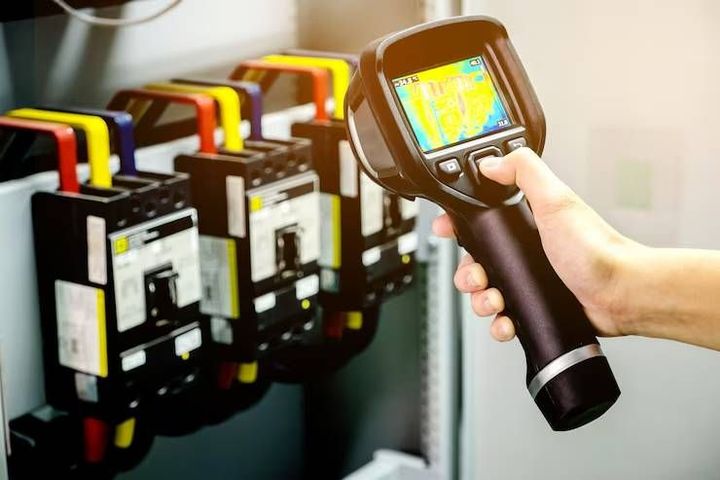
Thermal imaging cameras display temperature patterns across a surface. They are useful for identifying localized heating, uneven temperature distribution, and potential insulation problems, although surface emissivity and environmental conditions can affect the readings.
Thermal testing equipment comparison
Equipment type | Main measurement | Typical applications |
|---|---|---|
Differential scanning calorimeter | Heat-flow changes | Polymers, chemicals, material transitions |
Thermogravimetric analyzer | Mass changes during heating | Decomposition, oxidation, moisture loss |
Thermal conductivity analyzer | Heat transfer through materials | Insulation, construction, electronics |
Dilatometer | Dimensional changes | Metals, ceramics, glass |
Environmental chamber | Response to controlled temperatures | Electronics, automotive components |
Thermal imaging camera | Surface temperature patterns | Electrical inspection, equipment monitoring |
Temperature data logger | Temperature over time | Production monitoring, environmental testing |
The table provides a general overview. Specific instruments may support additional measurements depending on their design and accessories.
Manufacturing Processes and Industrial Applications
Thermal testing equipment supports manufacturing at several stages, including material development, process validation, quality inspection, and investigation of product failures.
How thermal testing equipment is manufactured
Manufacturing these instruments combines precision engineering, electronics, temperature control, measurement systems, and specialized software.
Mechanical design and fabrication: Equipment frames, sample holders, test chambers, insulation structures, and heating assemblies are designed to withstand the required operating temperatures and mechanical conditions. Components may be machined, formed, welded, or assembled from suitable materials.
Heating and cooling systems: Electrical heaters, cooling units, temperature controllers, and thermal insulation establish the required test environment. The system must control temperature within the limits specified for the intended measurement.
Sensors and measurement electronics: Thermocouples, resistance temperature detectors, load cells, displacement sensors, and electronic measurement circuits collect the data required by the test method.
Control software: Software regulates heating and cooling profiles, records sensor readings, and calculates relevant measurement results. Some systems also support automated test sequences and electronic reporting.
Calibration and performance verification: Instruments are checked against suitable reference standards or measurement procedures. Verification may include temperature accuracy, stability, uniformity, sensor response, and measurement repeatability.
The required checks depend on the instrument's purpose. A temperature chamber, for example, needs appropriate temperature mapping and uniformity assessment, while a thermal analyzer requires verification suited to the measurements it performs.
Industrial applications of thermal testing
Thermal testing equipment is used across numerous industries.
Automotive manufacturing: Evaluates components exposed to engine heat, changing outdoor temperatures, and repeated heating and cooling.
Electronics: Examines circuit boards, semiconductors, batteries, insulation, and heat-management materials.
Aerospace: Supports material characterization and testing of components exposed to demanding thermal environments.
Construction: Measures the thermal performance of insulation, roofing products, windows, and building materials.
Plastics and polymers: Evaluates melting behavior, glass transition, decomposition, and thermal stability.
Metal manufacturing: Studies heat-treatment effects, thermal expansion, and material behavior at elevated temperatures.
Energy production: Helps characterize insulation, thermal storage materials, and components used in energy systems.
Chemical processing: Examines heat-related reactions, material stability, and changes in composition during controlled heating.
Thermal testing can also help investigate failures. A component that deforms unexpectedly, an electronic assembly that overheats, or a coating that deteriorates may require thermal measurements to determine the conditions associated with the problem.
Recent Developments in Thermal Testing
Thermal testing continues to evolve through automation, improved sensor technology, digital data analysis, and growing interest in materials that operate under demanding temperature conditions. Developments from 2024 through 2026 reflect the increasing need to characterize advanced electronics, batteries, insulation, and materials used in electrified industrial systems.
Automation and digital data analysis
Modern thermal testing systems increasingly support programmable test sequences, automated data collection, and digital reporting. These capabilities help laboratories manage repeated tests and compare measurements across samples or production batches.
Software can also help identify unusual temperature patterns, compare results with defined limits, and organize records for quality assurance. Automated analysis still depends on valid test procedures, appropriate calibration, and correct interpretation of the results.
Battery and electronics testing
Electric vehicles, energy storage systems, and compact electronic devices create demanding thermal management requirements. Testing may examine temperature cycling, heat generation, material stability, and the performance of cooling or insulation components.
Battery testing requires particular attention to the test system's safety design, temperature control, and procedures for managing potential thermal runaway. The appropriate test depends on the battery chemistry, product design, and applicable safety requirements.
Advanced materials and thermal management
Research into high-performance polymers, ceramic materials, thermal interface materials, and advanced composites continues to create demand for specialized testing. Engineers need to understand how these materials conduct heat, expand, degrade, or change their mechanical properties across different temperatures.
Thermal imaging and distributed temperature sensors are also used to study heat patterns in equipment and production processes. These tools provide useful information, but accurate measurements require attention to sensor placement, surface properties, environmental conditions, and instrument limitations.
Laws, Standards, and Regulatory Considerations
Thermal testing may be governed by technical standards, product regulations, laboratory quality requirements, and workplace safety rules. The applicable requirements depend on the product, industry, testing purpose, and country in which the equipment is used.
Common thermal testing standards
Several recognized standards address thermal measurements and testing procedures.
ASTM E1461: Covers thermal diffusivity measurement using the laser flash method.
ASTM E1530: Addresses thermal resistance measurement of materials using a guarded heat flow meter apparatus.
ASTM E831: Covers linear thermal expansion measurement of solid materials using thermomechanical analysis.
ISO 11357: A series of standards addressing differential scanning calorimetry of polymers.
ISO 11358: A series of standards covering thermogravimetry of polymers.
IEC 60068: A family of environmental testing standards for electrotechnical products, including applicable temperature tests.
Each standard has a defined scope and may contain specific requirements for sample preparation, test conditions, measurement calculations, and reporting. Laboratories should confirm the applicable edition and procedure before conducting formal testing.
Regulatory considerations in India
In India, thermal testing laboratories and manufacturers may need to consider applicable Bureau of Indian Standards requirements, electrical safety rules, workplace regulations, and product-specific compliance requirements.
For example, testing equipment used with electrical products may need to meet relevant electrical safety and electromagnetic compatibility requirements. Environmental chambers used for batteries or other energy-storage products may also require specific safeguards according to the product and test conditions.
ISO/IEC 17025 is relevant to laboratories seeking to demonstrate technical competence in testing and calibration. Accreditation applies to the laboratory's approved scope and does not automatically establish the competence of every test it performs.
Thermal testing results may support regulatory conformity or product certification, but performing a thermal test alone does not establish complete compliance with all applicable requirements.
Tools and Resources
Thermal testing requires appropriate instruments, reference materials, measurement procedures, and data management practices. Selecting suitable resources helps ensure that results are meaningful and repeatable.
Common tools used in thermal testing
Temperature sensors: Thermocouples and resistance temperature detectors measure temperature at specified locations. Sensor selection depends on the required range, accuracy, response time, and environment.
Thermal data loggers: Record temperature readings over time, allowing users to review temperature cycles, operating conditions, and changes during testing.
Calibration references: Reference thermometers, calibrated sensors, and appropriate reference materials help establish or verify measurement performance.
Thermal analysis software: Processes data from instruments such as DSC and TGA systems and supports the interpretation of material transitions or mass changes.
Laboratory information management systems: Organize sample identification, test methods, instrument records, results, and quality documentation.
Factors to consider when choosing equipment
The selection process generally considers:
The material or product being tested.
The thermal property that needs to be measured.
The required temperature range and heating or cooling rate.
Sample size, shape, and preparation requirements.
Measurement accuracy, repeatability, and uncertainty.
Applicable standards and reporting requirements.
Safety controls, calibration needs, and data management capabilities.
Equipment should be selected according to the intended test rather than temperature range alone. Two instruments may operate at similar temperatures while measuring entirely different material properties.
Frequently Asked Questions
What is thermal testing equipment used for?
Thermal testing equipment measures how materials and products respond to heat and temperature changes. It is used to evaluate thermal conductivity, expansion, stability, heat capacity, and resistance to temperature cycling.
What are the main types of thermal testing equipment?
Common types include differential scanning calorimeters, thermogravimetric analyzers, thermal conductivity testers, dilatometers, environmental chambers, temperature sensors, and thermal imaging cameras. Each instrument measures different thermal properties or responses.
Which industries use thermal testing machines?
Automotive, aerospace, electronics, construction, plastics, metal manufacturing, chemical processing, and energy production are among the industries that use thermal testing. Applications include material selection, product development, quality inspection, and failure analysis.
What is the difference between thermal conductivity and thermal stability?
Thermal conductivity describes how readily heat passes through a material. Thermal stability describes how well a material maintains its characteristics when exposed to specified temperature conditions over time.
How often should thermal testing equipment be calibrated?
Calibration intervals depend on the instrument, its usage, measurement requirements, manufacturer guidance, and applicable quality procedures. Regular performance checks may also be necessary between calibrations.
Conclusion
Thermal testing equipment helps manufacturers and researchers understand how materials and products respond to heat and temperature changes. Different instruments measure properties such as thermal conductivity, expansion, heat-flow transitions, and thermal stability. Equipment selection depends on the material, intended application, measurement requirements, and relevant standards. Automation, digital monitoring, and advances in material testing continue to shape thermal testing across industrial sectors.