Industrial Machinery Components Explained: Essential Parts, Engineering Technologies, Global Suppliers and Manufacturing Applications
Industrial machinery components are the mechanical, electrical, hydraulic, pneumatic, and electronic parts used to construct and operate industrial equipment. These components support motion control, power transmission, material handling, process automation, and precision manufacturing across multiple industries.
Understanding industrial machinery components helps engineers, equipment designers, plant managers, and procurement teams evaluate machine architecture, component compatibility, maintenance requirements, and production performance. Advances in materials engineering, precision machining, and automation continue to influence how industrial components are designed and manufactured.
Context
What Are Industrial Machinery Components?
Industrial machinery components are individual parts or assemblies that perform specific functions within machines and production systems. They can transmit mechanical power, guide moving elements, support loads, regulate fluid movement, measure operating conditions, or control automated processes.
Some components are standardized and used across different equipment categories, while others are engineered for specific operating conditions. Selection depends on load capacity, rotational speed, temperature, vibration, chemical exposure, accuracy, and compatibility with surrounding equipment.
Common component categories include:
Mechanical components: Shafts, gears, bearings, couplings, fasteners, springs, and machine frames.
Power transmission components: Gearboxes, belts, chains, pulleys, and drive assemblies.
Fluid power components: Hydraulic cylinders, pumps, valves, pneumatic actuators, and fittings.
Electrical components: Motors, contactors, circuit breakers, power supplies, and wiring assemblies.
Control and sensing components: Programmable logic controllers, encoders, proximity sensors, and industrial switches.
Motion components: Linear guides, ball screws, lead screws, actuators, and servo-driven mechanisms.
Major Types of Industrial Machinery Components
Industrial machinery contains different component types depending on the machine's function, operating environment, and required output.
1. Bearings and Bushings
Bearings support rotating or moving shafts while reducing friction. Common types include ball bearings, roller bearings, thrust bearings, and spherical roller bearings. Bushings provide sliding support and are frequently used in mechanisms with oscillating or low-speed movement.
2. Gears and Gearboxes
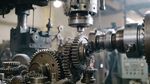
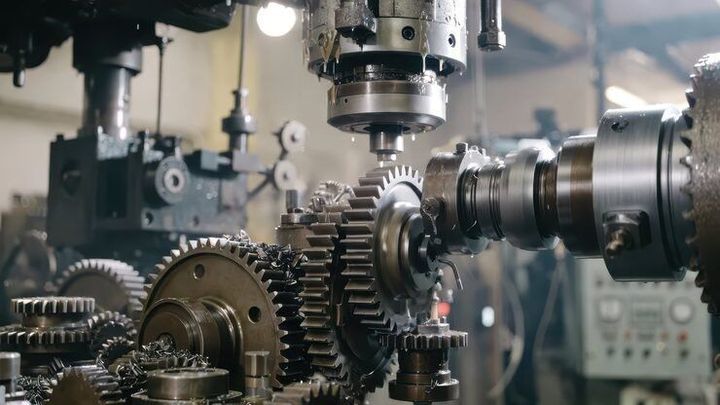
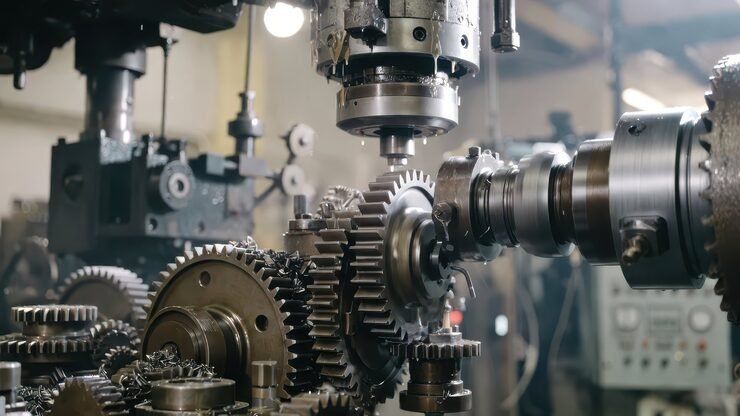
Gears transfer rotational motion and torque between shafts. Spur, helical, bevel, worm, and planetary gears are used in different transmission arrangements. Gearboxes combine gear stages to adjust output speed and torque for conveyors, mixers, machine tools, and processing equipment.
3. Shafts, Couplings, and Fasteners
Shafts transmit rotational power, while couplings connect shafts and accommodate specified levels of misalignment or vibration. Bolts, nuts, screws, pins, and retaining rings secure assemblies and support repeatable equipment installation.
4. Belts, Chains, and Pulleys
These components transmit motion between separated shafts or move materials through production systems. Belt drives are common in conveyors and ventilation equipment, while chain drives are used in applications requiring positive mechanical engagement.
5. Hydraulic and Pneumatic Components
Hydraulic systems use pressurized liquid to generate force and control movement. Pneumatic systems use compressed gas for actuation and material handling. Their components include cylinders, valves, pumps, compressors, regulators, filters, hoses, and connectors.
6. Motors and Drive Systems
Electric motors convert electrical energy into mechanical motion. Induction motors, synchronous motors, servo motors, and stepper motors are used according to torque, speed, positioning, and control requirements. Variable-frequency drives can regulate the speed of compatible AC motors.
7. Linear Motion and Guidance Components
Linear rails, guide blocks, ball screws, roller screws, and linear actuators support controlled movement along a defined path. They are important in CNC machinery, automated assembly systems, inspection equipment, and robotic workstations.
8. Sensors and Control Hardware
Sensors measure conditions such as temperature, pressure, position, vibration, and proximity. Controllers process signals and coordinate equipment functions, while encoders and feedback devices support motion accuracy and process monitoring.
Engineering Technologies Used in Industrial Components
Component development combines mechanical design, material selection, manufacturing engineering, and digital control.
Computer-aided design (CAD): Used to create component geometry, assemblies, and technical drawings.
Computer-aided engineering (CAE): Supports structural, thermal, vibration, and fluid-flow analysis.
Computer numerical control (CNC) machining: Produces accurately dimensioned components through automated cutting operations.
Additive manufacturing: Creates selected metal or polymer parts by building material in successive layers.
Heat treatment: Changes material properties such as hardness, strength, and wear resistance.
Surface engineering: Uses coatings, polishing, plating, or other treatments to modify surface performance.
Industrial automation: Coordinates component movement, sensing, and machine operation through controllers and drives.
Condition monitoring: Uses sensors and analytical software to identify developing equipment problems.
Comparison of Major Component Categories
| Component category | Primary function | Common materials or technologies | Typical applications |
|---|---|---|---|
| Bearings | Support motion and reduce friction | Bearing steel, ceramics, polymers | Motors, pumps, conveyors |
| Gears and gearboxes | Transfer torque and adjust speed | Alloy steel, precision cutting | Mixers, drives, machine tools |
| Shafts and couplings | Transmit rotational power | Carbon steel, alloy steel | Pumps, compressors, turbines |
| Hydraulic components | Generate and control fluid power | Steel, seals, hydraulic circuits | Presses, lifting systems |
| Pneumatic components | Control compressed-air movement | Aluminum, steel, polymers | Packaging and assembly lines |
| Motors and drives | Produce and regulate motion | Copper windings, magnetic materials, power electronics | Conveyors, robotics, machine tools |
| Linear guides | Support accurate linear movement | Hardened steel, rolling elements | CNC machines, automation |
| Sensors and controllers | Measure and coordinate operations | Electronic circuits, sensing elements | Process plants and automated equipment |
Importance of Industrial Machinery Components
Industrial components influence equipment reliability, operating accuracy, energy consumption, production consistency, and maintenance requirements. A poorly matched bearing, coupling, or drive can introduce vibration, heat, excessive wear, or unwanted motion into a machine.
Correct component selection also supports equipment compatibility. Dimensions, mounting patterns, shaft interfaces, electrical ratings, pressure limits, and control protocols must align with the overall machine design.
In automated manufacturing, components often operate as interconnected systems. A sensor detects a position, a controller evaluates the signal, a drive regulates motor movement, and a mechanical transmission converts that movement into a production action. Coordinating these elements is essential for predictable machine behavior.
Manufacturing Processes for Industrial Machinery Components
Industrial component manufacturing varies by material, geometry, accuracy requirements, and expected operating conditions.
1. Material Selection and Engineering Design
Engineers establish load requirements, environmental conditions, dimensional tolerances, and expected operating cycles. Materials may include carbon steel, stainless steel, aluminum alloys, copper, engineering plastics, ceramics, and specialized alloys.
Designers use CAD models and engineering analysis to evaluate dimensions, stress distribution, thermal behavior, and assembly interfaces before production begins.
2. Casting and Forging
Casting forms components by pouring molten material into a prepared mold. It is used for selected machine housings, pump bodies, gearbox cases, and complex shapes.
Forging shapes metal through compressive forces. Depending on the material and process, forged components can provide useful strength and fatigue resistance for shafts, gears, and other heavily loaded parts.
3. Machining and Precision Finishing
Turning, milling, drilling, grinding, and honing produce the required dimensions and surface characteristics. CNC equipment can execute repeatable machining operations for shafts, housings, gears, brackets, and precision interfaces.
Grinding and honing are used when particular surface finishes or dimensional tolerances are necessary. Inspection during machining helps identify deviations before components proceed to later stages.
4. Heat Treatment and Surface Processing
Heat treatment may include hardening, tempering, annealing, or case hardening. The selected process depends on the material and the component's required mechanical properties.
Surface treatments can include protective coatings, plating, polishing, nitriding, and other engineered methods. These processes may improve wear behavior, corrosion resistance, or surface hardness when properly specified.
5. Electrical and Electronic Assembly
Motors, sensors, control units, and drive systems require electrical assembly, wiring, insulation checks, and functional testing. Electronic components may also need protection against vibration, dust, moisture, or electromagnetic interference.
6. Assembly and Quality Inspection
Manufacturers assemble individual parts into functional units such as gearboxes, actuators, bearing housings, and motor-drive systems. Assembly procedures may include alignment, lubrication, torque-controlled fastening, seal installation, and clearance adjustment.
Inspection methods include dimensional measurement, material testing, surface inspection, vibration analysis, electrical testing, and operational trials. The appropriate methods depend on component criticality and applicable specifications.
7. Packaging, Identification, and Traceability
Finished components are identified through part numbers, batch records, drawings, material certificates, or other documentation where applicable. Protective packaging helps limit corrosion, contamination, and handling damage during transportation and storage.
Global Manufacturers and Suppliers
The industrial machinery component market includes specialized producers, automation technology companies, and diversified engineering groups. Their product ranges vary, so component selection should be based on the specific application rather than brand name alone.
Examples of established companies include:
SKF: Develops bearings, bearing units, seals, lubrication systems, and related rotating-equipment technologies.
Schaeffler: Produces rolling bearings, linear motion products, and mechanical transmission technologies.
NSK: Manufactures bearings, precision components, and linear motion products for industrial equipment.
NTN: Produces bearings, constant-velocity joints, and related mechanical components.
Timken: Focuses on engineered bearings and industrial motion-related products.
Bosch Rexroth: Supplies drive and control technologies, including hydraulic, electric drive, and linear motion systems.
Parker Hannifin: Develops motion and control technologies covering hydraulic, pneumatic, filtration, and related systems.
SMC Corporation: Specializes in pneumatic control equipment, actuators, valves, and automation components.
Festo: Develops pneumatic and electric automation technologies, including actuators and control products.
THK: Manufactures linear motion guides, ball screws, and other motion-related components.
igus: Produces polymer bearings, energy chains, and selected motion components.
SEW-EURODRIVE: Develops gearmotors, industrial gear units, and drive technologies.
ABB: Provides motors, drives, automation systems, and related industrial technologies.
Siemens: Supplies industrial automation hardware, motors, drives, and control technologies.
Mitsubishi Electric: Develops factory automation equipment, servo systems, motors, and programmable controllers.
When assessing suppliers, technical documentation, dimensional compatibility, material specifications, certification requirements, delivery consistency, and component traceability are important considerations. Engineers should also review the availability of replacement parts and the manufacturer's documented guidance for installation and operation.
Industrial Applications
Manufacturing and Machine Tools
CNC machines, milling equipment, lathes, and grinding systems use precision bearings, linear guides, ball screws, spindles, motors, encoders, and control units. Component rigidity and positioning accuracy influence the quality of machined products.
Material Handling and Packaging
Conveyor systems, automated storage equipment, filling lines, and packaging machines depend on motors, gearboxes, rollers, chains, pneumatic actuators, sensors, and safety interlocks. These components coordinate product movement and machine sequencing.
Mining and Mineral Processing
Crushers, screens, feeders, conveyors, and grinding mills use heavy-duty bearings, shafts, couplings, hydraulic systems, and abrasion-resistant parts. Dust, impact, vibration, and heavy loading influence component selection.
Energy and Power Generation
Turbines, generators, pumps, cooling systems, and auxiliary equipment use bearings, seals, couplings, valves, motors, and monitoring devices. Operating temperature, rotational speed, and reliability requirements can be especially important.
Automotive and Transportation Manufacturing
Production facilities use robotic actuators, gearboxes, servo motors, sensors, linear guides, and pneumatic tools for welding, assembly, inspection, and material transfer.
Food and Pharmaceutical Processing
Mixers, filling machines, conveyors, and processing systems may require corrosion-resistant materials, suitable seals, hygienic designs, and components compatible with cleaning procedures. Applicable hygiene and material requirements depend on the product and process.
Water and Chemical Processing
Pumps, mixers, dosing systems, and treatment equipment rely on impellers, mechanical seals, valves, bearings, motors, and instrumentation. Chemical compatibility, pressure ratings, temperature limits, and leakage control guide component specification.
Recent Developments in Industrial Machinery Components
Industrial component engineering increasingly combines mechanical hardware with digital monitoring and advanced manufacturing methods.
Smart condition monitoring: Vibration, temperature, current, and pressure sensors can provide data for detecting abnormal operating conditions. Analysis of these signals may support condition-based maintenance planning.
Energy-efficient motion systems: High-efficiency motors, improved gear designs, and suitable variable-speed control can help reduce energy use in applications where operating conditions permit.
Advanced materials and coatings: Engineered polymers, ceramic rolling elements, corrosion-resistant alloys, and specialized surface treatments are used in applications that require particular combinations of weight, durability, temperature resistance, or chemical compatibility.
Digital engineering and simulation: Digital models and simulation tools help engineers evaluate component stresses, thermal conditions, and assembly behavior before manufacturing or modifying equipment.
Additive manufacturing: Metal and polymer additive processes are used for selected prototypes, complex geometries, replacement parts, and specialized low-volume components when material properties and qualification requirements permit.
Connected automation: Industrial communication networks increasingly link sensors, drives, controllers, and monitoring systems. Interoperability, cybersecurity, and dependable data collection are important considerations in these installations.
Laws, Standards, and Policies
Industrial machinery components may be subject to different standards and regulatory requirements depending on their function, installation location, and industry.
Relevant frameworks can include:
ISO standards: Cover areas such as quality management, mechanical dimensions, vibration, and selected component specifications.
IEC standards: Address electrical equipment, motors, industrial control systems, and electrical safety.
ISO 12100: Provides principles for machinery safety and risk assessment.
ISO 13849: Addresses safety-related parts of machinery control systems.
IEC 60204-1: Covers electrical equipment of machines.
ATEX requirements: Apply to relevant equipment intended for use in potentially explosive atmospheres within the European regulatory framework.
Industry-specific requirements: Food processing, pharmaceutical production, pressure equipment, and hazardous-area installations may have additional rules.
Applicable requirements depend on the component, complete machine, intended use, and jurisdiction. Manufacturers and equipment integrators should verify the current editions and legal applicability of relevant standards before approving a design.
Tools and Resources
Several technical resources help engineers evaluate industrial machinery components and plan equipment integration.
CAD software: Supports part modeling, assembly design, and technical drawing preparation.
CAE and finite element analysis tools: Help assess stress, deformation, vibration, and thermal behavior.
Bearing and transmission calculators: Assist with preliminary checks of bearing life, gear ratios, shaft loads, and transmission requirements.
Electrical design software: Supports motor selection, circuit planning, and control panel documentation.
Industrial automation software: Configures programmable controllers, servo drives, sensors, and machine communication.
Metrology equipment: Coordinate measuring machines, micrometers, gauges, and laser measurement systems help verify component dimensions.
Manufacturer technical catalogs: Provide product dimensions, load ratings, installation instructions, material information, and compatibility details.
Maintenance monitoring tools: Vibration analyzers, thermal cameras, and lubrication analysis instruments help assess equipment condition.
Technical catalogs and engineering tools should be used alongside application-specific calculations, safety assessments, and qualified engineering judgment.
FAQs
1. What are the most common industrial machinery components?
Common components include bearings, gears, shafts, couplings, fasteners, motors, gearboxes, belts, chains, hydraulic valves, pneumatic actuators, sensors, and controllers. The exact combination depends on the machine's purpose.
2. Which materials are commonly used to manufacture machinery components?
Carbon steel, alloy steel, stainless steel, aluminum, copper, engineering plastics, ceramics, and specialized alloys are frequently used. Material choice depends on load, wear, corrosion, temperature, weight, and manufacturing requirements.
3. How do engineers select the correct machinery components?
Engineers evaluate load capacity, speed, torque, dimensional compatibility, operating environment, accuracy, electrical ratings, pressure limits, and applicable safety requirements. Manufacturer documentation and engineering calculations help confirm suitability.
4. What is the difference between mechanical and automation components?
Mechanical components transmit force, support loads, and guide movement. Automation components, such as sensors, controllers, and electronic drives, monitor conditions and coordinate machine behavior. Many industrial systems combine both categories.
5. How can component monitoring improve equipment reliability?
Monitoring vibration, temperature, pressure, and other operating parameters can help identify abnormal conditions before they cause major disruption. The effectiveness of monitoring depends on suitable sensors, appropriate thresholds, data interpretation, and a defined maintenance response.
Conclusion
Industrial machinery components form the foundation of modern production equipment, from simple transmission mechanisms to advanced automated manufacturing systems. Bearings, gears, shafts, actuators, motors, sensors, and controllers perform complementary functions that influence accuracy, operating stability, energy use, and equipment reliability.
Advances in precision manufacturing, materials engineering, automation, and condition monitoring continue to expand the capabilities of industrial components. Understanding component types, manufacturing processes, supplier capabilities, and applicable standards helps engineers develop equipment systems suited to their technical and operational requirements.