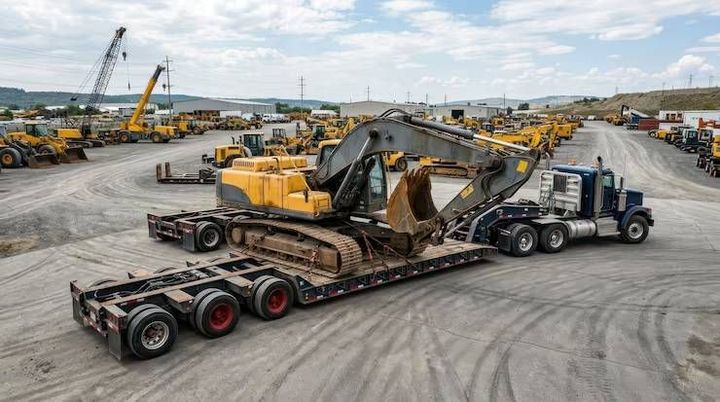
Heavy Industrial Equipment Explained: Equipment Types, Heavy Machinery, Manufacturing Processes, Technologies, Global Manufacturers, Suppliers and Industrial Applications
Heavy industrial equipment consists of large-scale machines and engineered systems designed to perform demanding tasks such as lifting, excavation, material handling, processing, fabrication, power generation, transportation, and large-scale manufacturing. Heavy industrial equipment is used where high load capacity, mechanical strength, continuous operation, and controlled performance are required.
These machines can range from cranes and industrial conveyors to heavy processing machinery, mining equipment, generators, compressors, pumps, fabrication machines, and automated production systems. Modern equipment increasingly combines mechanical engineering with hydraulics, electrical systems, sensors, automation, and digital monitoring.
What Is Heavy Industrial Equipment?
Heavy industrial equipment refers to large, high-capacity machinery designed for industrial environments where substantial loads, forces, materials, or production volumes must be handled.
Unlike general-purpose machinery, heavy equipment is commonly engineered for demanding operating conditions such as high loads, continuous duty cycles, abrasive materials, elevated temperatures, or harsh outdoor environments.
Typical categories include:
Heavy construction equipment
Mining machinery
Industrial cranes
Heavy material-handling systems
Large industrial pumps
Industrial compressors
Power-generation equipment
Heavy fabrication machinery
Industrial processing equipment
Large conveyors
Industrial boilers
Heavy automation systems
Why Heavy Industrial Equipment Matters
Heavy machinery provides the mechanical capability required for large-scale industrial operations. Equipment selection can influence production capacity, material movement, operating reliability, energy consumption, and workplace safety.
Common functions include:
Moving heavy materials
Lifting and positioning loads
Excavating and earthmoving
Crushing and processing materials
Transporting bulk products
Fabricating large components
Generating electrical power
Pumping industrial fluids
Compressing gases
Automating large-scale production
Major Types of Heavy Industrial Equipment
Heavy equipment is divided into categories according to its primary function.
Heavy Construction Equipment
Construction equipment is designed for excavation, grading, material movement, lifting, and infrastructure development.
Common machines include:
Excavators
Bulldozers
Wheel loaders
Motor graders
Scrapers
Pavers
Compactors
Heavy-duty dump trucks
Mining Equipment
Mining operations require equipment capable of handling large quantities of rock, ore, and other materials.
Examples include:
Mining excavators
Draglines
Haul trucks
Crushers
Drilling machines
Continuous miners
Bucket-wheel excavators
Conveyors
Industrial Cranes
Cranes are used to lift and position heavy loads.
Major types include:
Overhead cranes
Gantry cranes
Tower cranes
Mobile cranes
Jib cranes
Process cranes
Heavy-lift cranes
Crane selection depends on lifting capacity, span, lifting height, duty cycle, operating environment, and movement requirements.
Heavy Material Handling Equipment
Material-handling systems move raw materials, components, finished products, and bulk materials.
Equipment includes:
Belt conveyors
Chain conveyors
Screw conveyors
Bucket elevators
Stackers
Reclaimers
Industrial forklifts
Automated material-handling systems
Industrial Pumps
Heavy industrial pumps transport liquids through pipelines and processing systems.
Common types include:
Centrifugal pumps
Positive-displacement pumps
Axial-flow pumps
Mixed-flow pumps
Multistage pumps
Slurry pumps
They are used in water treatment, chemical processing, mining, power generation, oil and gas, and manufacturing.
Industrial Compressors
Compressors increase the pressure of gases for industrial processes.
Common types include:
Centrifugal compressors
Reciprocating compressors
Rotary screw compressors
Rotary vane compressors
Axial compressors
Applications include process plants, manufacturing facilities, energy infrastructure, and pneumatic systems.
Industrial Power Equipment
Large industrial facilities use power-generation and electrical equipment to support production.
Examples include:
Industrial generators
Gas turbines
Steam turbines
Industrial boilers
Transformers
Large electrical switchgear
Power distribution equipment
Heavy Fabrication Equipment
Fabrication machinery processes large metal components and structures.
Examples include:
Large CNC machines
Plate-cutting machines
Heavy press brakes
Industrial welding systems
Plate rolling machines
Plasma cutting systems
Laser cutting systems
Heavy machining centers
Heavy Industrial Equipment Technologies
Modern heavy machinery combines several engineering technologies.
Hydraulic Technology
Hydraulic systems use pressurized fluid to generate and control high mechanical forces.
Hydraulics are common in:
Excavators
Cranes
Presses
Mining equipment
Material-handling machinery
Mechanical Drive Systems
Mechanical drive systems transfer power from motors or engines to machine components.
They may include:
Gearboxes
Shafts
Couplings
Bearings
Chains
Belts
Electrical Drive Systems
Electric motors and variable-frequency drives control the movement of industrial machinery.
Electric drives can provide controlled speed, torque, acceleration, and braking.
Automation Technology
Industrial automation combines sensors, controllers, drives, actuators, and software.
A typical architecture is:
Sensors → Controller → Drive/Actuator → Machine → Process Feedback
Industrial IoT
Connected equipment can transmit operating information to centralized monitoring and analytics platforms.
Potential data includes:
Operating hours
Temperature
Pressure
Vibration
Motor current
Load
Energy consumption
Equipment status
Heavy Industrial Equipment Manufacturing Process
Manufacturing large industrial machinery involves engineering, fabrication, machining, assembly, testing, and system integration.
1. Engineering and Specification
Engineers define machine capacity, dimensions, operating loads, materials, power requirements, duty cycles, and environmental conditions.
2. Mechanical Design
Computer-aided design and engineering tools are used to develop machine structures, components, drive systems, hydraulic circuits, and mechanical interfaces.
3. Material Selection
Heavy equipment may use:
Carbon steel
Stainless steel
Alloy steel
Cast iron
Aluminum
Hardened steels
Specialized engineering materials
Material selection depends on strength, fatigue resistance, abrasion, corrosion, temperature, and weight requirements.
4. Structural Fabrication
Large frames, housings, beams, platforms, tanks, and machine structures are produced using:
Cutting
Bending
Rolling
Welding
Forming
Machining
5. Precision Machining
Critical components are machined using CNC lathes, milling machines, boring machines, grinders, and large machining centers.
6. Component Manufacturing
Gears, shafts, bearings, hydraulic components, electrical assemblies, and other parts are manufactured or sourced according to engineering specifications.
7. Surface Treatment
Heavy machinery may undergo:
Painting
Powder coating
Galvanizing
Heat treatment
Shot blasting
Corrosion protection
8. Mechanical Assembly
Major structures, drive systems, hydraulic systems, electrical components, and auxiliary equipment are assembled.
9. Automation Integration
Sensors, PLCs, control panels, variable-frequency drives, safety systems, and communication networks are integrated where required.
10. Testing and Commissioning
Equipment is tested under controlled conditions to verify mechanical operation, electrical systems, load handling, control functions, safety systems, and process performance.
Heavy Machinery Automation
Automation can improve control over large industrial machines while providing operators with more information about equipment status.
Automated systems may include:
PLCs
Industrial computers
Sensors
Variable-frequency drives
Servo drives
Hydraulic controls
Safety controllers
Human-machine interfaces
Industrial communication networks
Automation is increasingly used in mining, material handling, fabrication, manufacturing, and process industries.
Heavy Equipment Monitoring
Equipment monitoring systems collect information from machines during operation.
Sensors can monitor:
Vibration
Temperature
Pressure
Hydraulic conditions
Motor current
Lubrication conditions
Load
Speed
This information can support condition-based maintenance and help identify abnormal operating conditions.
Heavy Industrial Equipment Components
| Component | Primary Function |
|---|---|
| Engine or motor | Provides power |
| Gearbox | Controls speed and torque |
| Hydraulic system | Generates controlled mechanical force |
| Pump | Moves hydraulic or process fluids |
| Cylinder | Produces linear movement |
| Bearing | Supports rotating components |
| Shaft | Transfers mechanical power |
| Controller | Manages automated functions |
| Sensor | Measures operating conditions |
| Drive | Controls motor operation |
| Frame | Supports machine structure |
| Safety system | Protects people and equipment |
Industrial Applications
Heavy industrial equipment is used across numerous sectors.
Construction
Construction projects use excavators, cranes, loaders, graders, compactors, and other machinery for infrastructure development and material handling.
Mining
Mining operations use excavation, drilling, crushing, conveying, hauling, and processing equipment.
Manufacturing
Large manufacturing facilities use heavy presses, machining systems, material-handling equipment, automated assembly machinery, and industrial processing systems.
Steel and Metal Processing
Steel plants use furnaces, rolling mills, casting systems, cranes, conveyors, and heavy fabrication machinery.
Energy
Power facilities use turbines, generators, boilers, pumps, compressors, transformers, and cooling systems.
Chemical Processing
Chemical plants use reactors, pumps, compressors, heat exchangers, tanks, separation equipment, and process-control systems.
Ports and Logistics
Ports use cranes, container handling equipment, conveyors, reach stackers, and heavy transport machinery.
Oil and Gas
Oil and gas facilities use pumps, compressors, drilling equipment, processing machinery, lifting systems, and pipeline equipment.
Global Manufacturers and Suppliers
The heavy industrial equipment sector includes manufacturers specializing in individual machine categories and companies that provide complete engineered systems.
Supplier categories include:
Heavy machinery manufacturers
Construction equipment manufacturers
Mining equipment manufacturers
Industrial crane manufacturers
Material-handling equipment manufacturers
Industrial pump manufacturers
Compressor manufacturers
Power-generation equipment manufacturers
Heavy fabrication machinery manufacturers
Industrial automation companies
Process equipment manufacturers
Industrial equipment distributors
Engineering and system integration companies
When comparing manufacturers or suppliers, organizations commonly examine machine capacity, technical specifications, operating environment, automation capabilities, maintenance requirements, documentation, component availability, and system compatibility.
Factors to Consider When Selecting Heavy Industrial Equipment
Heavy equipment selection requires consideration of both machine performance and operating conditions.
Important factors include:
Required capacity
Maximum load
Duty cycle
Operating environment
Machine dimensions
Power requirements
Hydraulic requirements
Material characteristics
Required precision
Automation level
Safety requirements
Maintenance access
Spare-component availability
Integration with existing systems
Practical Heavy Industrial Equipment Selection Workflow
1. Define the Industrial Task
Identify whether the machine will be used for lifting, excavation, processing, conveying, fabrication, pumping, compression, power generation, or another function.
2. Establish Capacity Requirements
Determine load capacity, throughput, lifting capacity, pressure, flow rate, production volume, or other relevant performance parameters.
3. Evaluate the Operating Environment
Consider temperature, dust, moisture, chemicals, vibration, terrain, altitude, and other environmental conditions.
4. Select the Equipment Category
Identify the machine type that matches the required industrial operation.
5. Define Power Requirements
Evaluate electrical, hydraulic, pneumatic, diesel, gas, steam, or other power requirements.
6. Review Automation Requirements
Determine whether the equipment requires PLC control, sensors, remote monitoring, automated sequences, or integration with plant systems.
7. Evaluate Structural and Mechanical Requirements
Review machine dimensions, foundation requirements, load distribution, access, installation space, and structural limitations.
8. Verify Safety and Documentation
Check operating procedures, safety systems, technical documentation, inspection requirements, and applicable standards.
Heavy Equipment Technology Comparison
| Technology | Main Function | Typical Equipment |
|---|---|---|
| Hydraulic | High-force movement | Excavators, presses |
| Mechanical drive | Power transmission | Conveyors, mills |
| Electric drive | Controlled motion | Cranes, machinery |
| Automation | Process control | Production systems |
| Sensors | Measurement | All major equipment |
| Industrial IoT | Connectivity | Connected machinery |
| Machine vision | Inspection | Automated production |
| Remote monitoring | Equipment visibility | Mining and processing |
Future Trends in Heavy Industrial Equipment
Heavy machinery is increasingly incorporating automation, electrification, connected sensors, advanced controls, and data analytics.
Key developments include:
Electric heavy machinery
Autonomous equipment
Remote machine operation
AI-assisted monitoring
Digital twins
Industrial IoT connectivity
Automated material handling
Energy-efficient drives
Advanced condition monitoring
Predictive maintenance systems
Electrification is also becoming more relevant in equipment categories traditionally powered by combustion engines, particularly where operating conditions and infrastructure support electric systems.
Frequently Asked Questions
What is heavy industrial equipment?
Heavy industrial equipment consists of large-scale machinery designed for demanding industrial tasks such as lifting, excavation, processing, material handling, fabrication, pumping, compression, and power generation.
What are the main types of heavy industrial equipment?
Major categories include construction machinery, mining equipment, cranes, conveyors, industrial pumps, compressors, generators, boilers, fabrication machines, and processing equipment.
Which industries use heavy industrial equipment?
Construction, mining, manufacturing, energy, chemical processing, steel production, oil and gas, ports, logistics, and infrastructure projects use heavy industrial equipment.
How is heavy industrial equipment manufactured?
Manufacturing generally involves engineering, material selection, structural fabrication, machining, component production, assembly, surface treatment, automation integration, and testing.
How is heavy equipment automated?
Automation uses sensors, controllers, drives, hydraulic controls, industrial networks, safety systems, and software to control machine functions and monitor operating conditions.
Conclusion
Heavy industrial equipment provides the mechanical capacity required for demanding industrial operations. From mining machinery and cranes to heavy fabrication systems, pumps, compressors, conveyors, power equipment, and processing machinery, these systems support material movement, production, infrastructure, and large-scale industrial processes.
Selecting appropriate equipment requires evaluation of capacity, duty cycle, operating environment, power requirements, automation, safety, maintenance, and integration. Advances in electrification, industrial IoT, automation, remote monitoring, and machine intelligence are continuing to change how heavy machinery is designed, operated, and maintained.