Industrial Chillers Explained: Cooling Technologies, Chiller Types, Manufacturing Processes, Global Manufacturers, Suppliers and Industrial Applications
Industrial chillers are cooling systems designed to remove heat from equipment, liquids, production processes, and industrial environments. They are widely used in manufacturing plants, food processing facilities, pharmaceutical production, data centers, chemical industries, and commercial buildings.
Unlike ordinary air conditioners, industrial chillers are often designed to handle continuous operation, changing heat loads, and demanding industrial environments. They commonly circulate chilled water or another suitable fluid through equipment that generates heat. The warmed fluid returns to the chiller, where heat is removed before the fluid circulates through the system again.
Industrial cooling is important because excessive heat can affect product dimensions, chemical reactions, machinery performance, and production stability. A chiller provides controlled cooling that can be integrated with other process equipment, including heat exchangers, pumps, cooling towers, and automated temperature controls.
How industrial chillers work
Most industrial chillers use a refrigeration cycle to transfer heat from a process fluid to another medium, such as outdoor air or cooling water. A typical vapor-compression chiller contains four main components.
Evaporator: Transfers heat from the process fluid to the refrigerant, causing the refrigerant to evaporate.
Compressor: Raises the refrigerant's pressure and temperature so that heat can be released at a higher temperature.
Condenser: Transfers heat from the refrigerant to air or cooling water, allowing the refrigerant to condense.
Expansion device: Reduces the refrigerant's pressure before it returns to the evaporator.
The cycle repeats while cooling is required. Pumps circulate the chilled fluid, and control systems regulate temperatures, flow rates, and compressor operation according to the cooling demand.
Not every industrial chiller uses the same design. Absorption chillers use heat energy to drive a refrigeration process, while some specialized systems use alternative refrigeration arrangements suited to particular operating conditions.
Why temperature control matters
Different industrial processes require different cooling conditions. Plastic molding equipment may need consistent mold temperatures, while chemical processing may require precise control to manage reactions. Food production may use chilled water to cool products, and data centers use cooling systems to remove heat from servers and related equipment.
A chiller must therefore be selected according to the required cooling capacity, fluid temperature, operating environment, heat load, and process requirements. An unsuitable system may struggle to maintain temperatures or consume more energy than expected.
Main Types of Industrial Chillers
Industrial chillers are classified according to their heat-rejection method, refrigeration technology, and intended application. Each type has specific operating requirements and limitations.
Air-cooled chillers
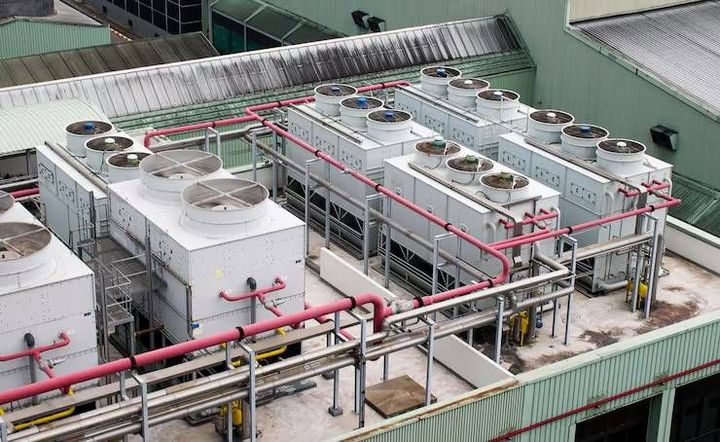
Air-cooled chillers release heat directly into the surrounding air through a condenser and fans. They generally do not require a cooling tower, which can simplify installation in facilities where water availability is limited.
These systems are commonly used in plastics manufacturing, light industrial production, commercial buildings, and facilities with moderate cooling requirements. Their performance can decline when outdoor temperatures become very high because the condenser must reject heat into warmer air.
Water-cooled chillers
Water-cooled chillers transfer heat to circulating water through a condenser. The warmed condenser water commonly flows to a cooling tower, where heat is released into the atmosphere.
These systems are used in large manufacturing plants, industrial complexes, central cooling systems, and facilities with substantial cooling loads. They may provide favorable energy performance under suitable conditions, but they require additional equipment, water management, and maintenance.
Absorption chillers
Absorption chillers use heat energy rather than a conventional electrically driven compressor as the main means of driving the refrigeration cycle. Common working-fluid combinations include water and lithium bromide, or ammonia and water, depending on the design.
They may be suitable where waste heat, steam, or another usable thermal source is available. Their operating characteristics differ from those of vapor-compression chillers, and the available heat source must match the system's requirements.
Screw, centrifugal, and scroll chillers
These categories describe compressor technologies used in many vapor-compression systems.
Screw chillers: Use rotating screw mechanisms to compress refrigerant and are commonly used for industrial and commercial cooling.
Centrifugal chillers: Use rotating impellers to compress refrigerant and are frequently found in large-capacity cooling installations.
Scroll chillers: Use interlocking spiral elements to compress refrigerant and are often used in smaller or modular cooling systems.
The appropriate compressor depends on the required capacity, operating range, part-load performance, maintenance requirements, and system configuration.
Comparing common industrial chiller types
Chiller type | Heat-rejection or cooling principle | Typical application |
|---|---|---|
Air-cooled | Heat released directly to air | Small and medium industrial facilities |
Water-cooled | Heat transferred to condenser water | Large industrial plants |
Absorption | Heat-driven refrigeration cycle | Facilities with suitable thermal energy |
Screw compressor | Rotary screw compression | Industrial process cooling |
Centrifugal compressor | Dynamic compression | Large cooling installations |
Scroll compressor | Scroll-based compression | Smaller or modular systems |
These categories can overlap. For example, a water-cooled chiller may use a screw or centrifugal compressor, so selection involves both the heat-rejection method and the refrigeration technology.
Industrial Chiller Manufacturing Processes
Manufacturing an industrial chiller involves mechanical engineering, refrigeration technology, electrical systems, heat-transfer design, and automated control. The production process varies according to the chiller's capacity, compressor type, refrigerant, and intended operating environment.
Design and component production
The design stage establishes the required cooling capacity, operating temperatures, pressure limits, heat-rejection method, and expected operating conditions. Engineers select the compressor, evaporator, condenser, expansion device, pumps, piping, and control components according to these requirements.
Heat exchangers are central to chiller performance. Their tubes, plates, fins, or other heat-transfer surfaces are manufactured from suitable materials and assembled to support effective heat transfer while meeting applicable pressure and corrosion requirements.
Assembly and refrigeration circuit installation
During assembly, the major components are mounted within a frame or enclosure. Refrigerant piping, fluid connections, electrical wiring, sensors, and control panels are installed according to the design specifications.
The refrigeration circuit must be assembled carefully to minimize contamination and leakage. Depending on the design, production may involve tube bending, brazing, welding, fastening, insulation, and protective surface treatment.
Testing and quality control
Before a chiller enters operation, manufacturers conduct appropriate inspections and functional tests. These may include pressure or leak testing, electrical safety checks, control-system verification, and performance testing under defined operating conditions.
Testing can evaluate cooling capacity, fluid temperatures, refrigerant pressures, electrical consumption, and protective shutdown functions. Results depend on the test conditions, measurement accuracy, and applicable product standards.
Importance and Industrial Applications
Industrial chillers support temperature-sensitive processes across many industries. Their role extends beyond comfort cooling because they often regulate the temperature of machinery, materials, and production fluids directly.
Major industrial applications
Plastic manufacturing: Chillers remove heat from molds, extruders, and other processing equipment. Stable cooling helps control production cycles and the dimensions of finished components.
Food and beverage production: Chilled water and refrigeration systems support product cooling, processing, and temperature management. Systems must be designed to meet relevant hygiene and food safety requirements.
Pharmaceutical manufacturing: Controlled cooling is used for selected production processes, equipment, and storage environments. Requirements depend on the product, process validation, and applicable quality standards.
Chemical processing: Chillers help regulate reaction temperatures and cool process fluids. The design must account for fluid compatibility, operating pressure, and potential chemical hazards.
Data centers: Chilled-water systems can remove heat from server rooms and associated equipment. Cooling arrangements depend on server density, environmental conditions, and facility design.
Metalworking and machine tools: Chillers may regulate the temperature of machine spindles, hydraulic systems, cutting processes, and other equipment that generates heat.
Factors that influence chiller performance
Several conditions determine how efficiently an industrial chiller operates:
Heat load and required cooling capacity.
Process-fluid flow rate and target temperature.
Outdoor temperature and condenser conditions.
Compressor efficiency and part-load operation.
Heat exchanger cleanliness and fluid quality.
Pump and fan energy consumption.
Maintenance practices and control-system settings.
A correctly sized system must account for both normal operation and relevant changes in production demand. Oversizing or undersizing can affect operating performance, temperature stability, and energy consumption.
Recent Developments in Industrial Chillers
Industrial cooling technology continues to develop in response to energy efficiency requirements, environmental considerations, and the growing demand for reliable temperature control. Developments across 2024–2026 include improved controls, variable-speed equipment, heat recovery, and refrigerants with lower global warming potential.
Energy efficiency and intelligent controls
Variable-speed compressors, pumps, and fans can adjust their output according to the cooling demand. Rather than operating continuously at a fixed speed, these components can respond to changing production loads when the system is designed for variable operation.
Digital monitoring systems can track temperatures, pressure, flow, and electricity consumption. Some systems use operating data to identify unusual performance, detect developing faults, and support maintenance planning.
Refrigerant developments
Refrigerant selection has become increasingly important because different refrigerants have different environmental, safety, and operating characteristics. Manufacturers are developing and adapting equipment for refrigerants with lower global warming potential, subject to application requirements and applicable regulations.
The suitability of a refrigerant depends on system design, pressure, toxicity, flammability, operating temperature, and local requirements. Changing refrigerants in an existing system without confirming compatibility can create safety and performance problems.
Heat recovery and system integration
Some industrial chillers can recover condenser heat for water heating or other suitable processes. This can reduce the need for separate heating equipment when the recovered heat is available at a useful temperature.
Integration with building management systems or industrial control platforms also allows cooling equipment to respond to changing production needs. The actual energy savings depend on the heat load, control strategy, equipment condition, and operating schedule.
Laws, Regulations, and Industry Standards
Industrial chillers are subject to requirements covering electrical safety, pressure equipment, refrigerant handling, energy performance, and environmental protection. Applicable requirements depend on the equipment design, installation location, refrigerant, and industrial application.
Regulatory considerations in India
Indian facilities may need to comply with applicable electrical safety requirements, factory safety rules, environmental regulations, and standards for pressure-containing equipment. Refrigeration systems using regulated substances may also be subject to requirements concerning refrigerant handling, emissions, and equipment maintenance.
The Bureau of Indian Standards (BIS) publishes standards relevant to refrigeration and cooling equipment. Depending on the equipment and application, manufacturers and facility operators may also need to consider applicable requirements associated with the Central Electricity Authority, the Ministry of Environment, Forest and Climate Change, and state pollution control authorities.
Requirements differ according to the equipment category and the regulations in force. Not every industrial chiller is subject to the same certification or approval process.
International standards and safety considerations
Commonly referenced standards include:
ISO 5149: Addresses safety and environmental requirements for refrigeration systems and heat pumps.
ASHRAE Standard 15: Covers safety requirements for refrigeration systems.
ASHRAE Standard 34: Classifies refrigerants according to safety considerations.
AHRI standards: Address performance ratings and testing for specified categories of refrigeration and cooling equipment.
These standards have different scopes and may be applied through local regulations, contracts, or industry specifications. Equipment selection and installation must follow the requirements applicable to the particular facility.
Tools and Resources for Industrial Chillers
Industrial cooling systems are assessed using engineering calculations, monitoring instruments, equipment documentation, and maintenance records. These resources help determine cooling requirements and evaluate operating conditions.
Common engineering and monitoring tools
Cooling-load calculators: Estimate the amount of heat that a chiller must remove based on process requirements, fluid flow, and temperature changes.
Temperature and pressure sensors: Monitor system conditions and help identify deviations from normal operating ranges.
Energy monitoring systems: Track electricity consumption and operating patterns to support energy management.
Refrigeration system software: Supports equipment selection, system configuration, and analysis of refrigeration performance.
Maintenance management systems: Record inspections, repairs, refrigerant-related activities, and component replacement histories.
Information needed when selecting a chiller
Factor | Information to assess |
|---|---|
Cooling capacity | Required heat removal under operating conditions |
Fluid temperature | Required supply and return temperatures |
Heat rejection | Availability of suitable air or cooling water |
Operating environment | Ambient temperature, humidity, and installation conditions |
Refrigerant | Safety classification and environmental characteristics |
Energy use | Compressor, pump, and fan requirements |
Maintenance | Access to components, cleaning, and inspection needs |
Equipment selection also involves reviewing manufacturer specifications, operating limits, installation requirements, and relevant testing documentation.
Frequently Asked Questions
What is an industrial chiller used for?
An industrial chiller removes heat from machinery, process fluids, and production equipment. It is used in manufacturing, food processing, pharmaceuticals, chemical production, data centers, and other applications requiring controlled temperatures.
What is the difference between air-cooled and water-cooled chillers?
Air-cooled chillers release heat directly into the surrounding air, while water-cooled chillers transfer heat to condenser water, often connected to a cooling tower. Their suitability depends on cooling demand, climate, water availability, installation conditions, and energy requirements.
How is industrial chiller capacity measured?
Cooling capacity is commonly expressed in kilowatts (kW), refrigeration tons (RT), or British thermal units per hour (BTU/h). The required capacity depends on the process heat load, fluid flow rate, temperature difference, and operating conditions.
Which refrigerants are used in industrial chillers?
Refrigerants vary by chiller design and application. Common examples include R-134a, R-1234ze, ammonia (R-717), and R-744 (carbon dioxide). Their suitability depends on equipment compatibility, safety requirements, operating conditions, and applicable environmental regulations.
How often should an industrial chiller be maintained?
Maintenance frequency depends on the manufacturer's instructions, operating hours, environmental conditions, and system design. Routine activities may include checking fluid flow, cleaning heat exchangers, inspecting electrical connections, monitoring refrigerant conditions, and verifying safety controls.
Conclusion
Industrial chillers provide controlled cooling for machinery, production processes, and temperature-sensitive applications across numerous industries. Air-cooled, water-cooled, and absorption systems use different technologies to meet varying operating requirements. Manufacturing quality, proper system sizing, maintenance, and compliance with relevant safety standards influence reliable operation. Developments in digital monitoring, variable-speed controls, and lower-impact refrigerants continue to shape industrial cooling technology.