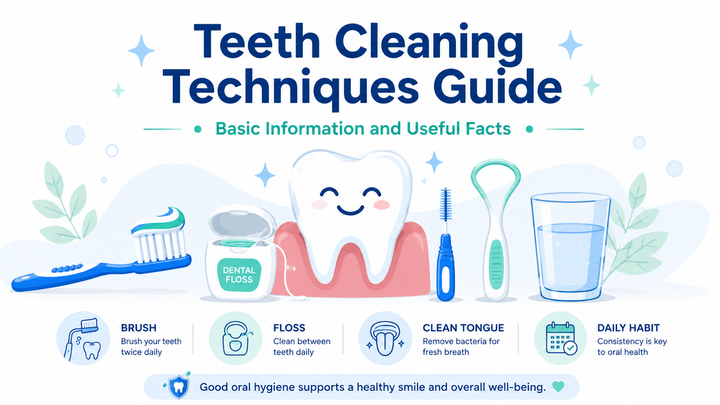
Teeth Cleaning Techniques Guide: Basic Information and Useful Facts
Teeth cleaning techniques are daily oral hygiene methods used to clean teeth, gums, tongue, and the spaces between teeth. These techniques include brushing, flossing, interdental cleaning, tongue cleaning, rinsing, and maintaining a steady oral care routine.
The topic exists because the mouth naturally contains bacteria. When food particles and bacteria stay on the teeth, they can form plaque. Plaque is a sticky layer that can collect on tooth surfaces and near the gumline. If it is not cleaned regularly, it may contribute to tooth decay, gum irritation, tartar formation, and bad breath.
Teeth cleaning is not only about brushing quickly. The method, timing, pressure, brush angle, and cleaning coverage all matter. A person may brush daily but still miss the back teeth, inner surfaces, gumline, or spaces between teeth.
Common teeth cleaning techniques include:
- Brushing with a soft-bristled toothbrush
- Cleaning between teeth with floss or interdental tools
- Cleaning the tongue gently
- Rinsing with water after meals
- Using fluoride toothpaste where suitable
- Replacing worn toothbrushes
- Tracking gum bleeding or persistent mouth discomfort
- Maintaining regular oral hygiene habits
These techniques support basic oral cleanliness and help people observe changes in their mouth more easily.
Why Teeth Cleaning Matters Today
Teeth cleaning matters because oral health affects eating, speaking, comfort, confidence, and daily well-being. The World Health Organization states that oral diseases affect nearly 3.7 billion people globally, and untreated tooth decay in permanent teeth is the most common health condition in the Global Burden of Disease 2021 data.
Oral health concerns can affect children, adults, older people, tobacco users, people with diabetes, people with dry mouth, and people with limited dental access. Poor oral hygiene may lead to plaque build-up, gum discomfort, mouth odour, tooth sensitivity, and visible deposits on teeth.
Teeth cleaning techniques help with:
- Removing food particles
- Reducing plaque build-up
- Cleaning the gumline
- Supporting gum hygiene
- Reducing tongue coating
- Maintaining fresher breath
- Improving daily oral care discipline
- Supporting better observation of oral changes
The WHO notes that oral diseases are largely preventable but remain a major health burden in many countries. It also lists poor oral hygiene and tobacco use among important risk factors for periodontal disease.
For general readers, the key point is simple: oral hygiene is a routine habit, not a one-time activity. Small daily steps can support cleaner teeth and gums when performed correctly and consistently.
Basic Teeth Cleaning Techniques
| Technique | Main Purpose | Simple Explanation |
|---|---|---|
| Brushing | Cleans tooth surfaces | Removes plaque and food particles from visible surfaces |
| Flossing | Cleans between teeth | Reaches spaces where brush bristles may not reach |
| Interdental cleaning | Cleans wider gaps | Useful where spacing or dental structure allows |
| Tongue cleaning | Reduces tongue coating | Helps clean residue from the tongue surface |
| Rinsing | Clears loose particles | Useful after meals when brushing is not possible |
| Gumline cleaning | Cleans near gums | Helps remove plaque from the tooth-gum border |
A complete routine should be gentle. Strong scrubbing is not better. It can irritate gums and may affect tooth surfaces over time. Good cleaning depends more on coverage, angle, and consistency than force.
Brushing Technique Explained
Brushing is the most common teeth cleaning method. It should cover all major tooth surfaces: outer sides, inner sides, chewing surfaces, and the gumline.
A simple brushing approach includes:
- Use a soft-bristled toothbrush.
- Place the brush at a slight angle toward the gumline.
- Use gentle circular or short strokes.
- Clean the outside surfaces of upper and lower teeth.
- Clean the inside surfaces carefully.
- Brush the chewing surfaces of back teeth.
- Avoid harsh pressure.
- Brush for about two minutes.
- Replace the toothbrush when bristles become worn.
Many people miss the same areas repeatedly, especially the back molars, the inner side of lower front teeth, and the gumline. A practical method is to divide the mouth into four parts and spend equal time on each area.
Fluoride toothpaste is commonly used in oral hygiene because fluoride supports enamel care. The Indian Dental Association provides public education material on fluoride and oral hygiene techniques.
Flossing and Interdental Cleaning
Flossing helps clean areas between teeth. These spaces can hold food particles and plaque that a toothbrush may not fully remove. Flossing should be done gently to avoid hurting the gums.
A basic flossing method includes:
- Hold the floss firmly but gently.
- Slide it between teeth without snapping it.
- Curve the floss around one tooth in a C-shape.
- Move it gently up and down.
- Repeat on the neighbouring tooth.
- Use a clean section for each space.
Some people may use interdental brushes, floss picks, or water-based cleaning tools depending on tooth spacing, braces, bridges, implants, or hand movement difficulty. The suitable method can vary from person to person, so ongoing concerns should be discussed with a qualified dental professional.
Tongue Cleaning and Rinsing
The tongue can collect coating, food residue, and bacteria. Gentle tongue cleaning may help reduce this coating and support mouth freshness. It can be done with a tongue cleaner or a toothbrush.
Tongue cleaning should not be forceful. Harsh scraping can irritate the tongue. A gentle back-to-front motion is usually enough for basic cleaning.
Rinsing with water after meals can help remove loose food particles. It is not a replacement for brushing or interdental cleaning, but it can support daily mouth cleanliness.
Helpful routine habits include:
- Drinking enough water
- Limiting frequent sugary snacks
- Avoiding tobacco
- Keeping toothbrushes clean and dry
- Not sharing toothbrushes
- Replacing old toothbrushes
- Watching for gum bleeding, swelling, or persistent bad breath
Recent Updates and Trends
Recent oral health awareness has focused on prevention, correct technique, gum health, and the link between oral health and overall well-being.
In March 2025, WHO updated its oral health fact sheet and highlighted that oral diseases affect nearly 3.7 billion people globally. This shows that oral hygiene remains a major public health topic.
World Oral Health Day 2025 used the campaign message “A Happy Mouth is… A Happy Mind.” FDI World Dental Federation launched the 2025 campaign in September 2024 to raise awareness of how poor oral health can affect quality of life and mental well-being.
For 2026, FDI launched “A Happy Mouth is… A Happy Life” as the final chapter of its three-year campaign cycle. The campaign focuses on caring for the mouth at every life stage.
Recent trends include:
- Greater awareness of gumline cleaning
- More use of brushing timers
- Increased focus on interdental cleaning
- Oral hygiene tracking through simple apps
- Wider discussion around fluoride toothpaste
- More public campaigns around oral health
- Family-based oral hygiene routines
- Stronger focus on tobacco-related oral risks
Simple Trend View
| Area | Earlier Focus | Current Direction |
|---|---|---|
| Brushing | Quick daily brushing | Technique-based brushing |
| Gum care | Often ignored | More gumline awareness |
| Interdental cleaning | Limited attention | More focus on spaces between teeth |
| Tongue cleaning | Optional habit | Included in wider hygiene routines |
| Tracking | Memory-based routine | Timers, charts, and reminders |
| Awareness | Dental issue response | Preventive daily hygiene |
Illustrative awareness graph:
2021: Basic brushing awareness ███
2022: Gum hygiene awareness ████
2023: Interdental cleaning attention █████
2024: Oral health and well-being link ██████
2025: Happy Mouth, Happy Mind campaign ███████
2026: Lifelong oral health messaging ████████
This graph is illustrative and shows general awareness direction, not a measured index.
Laws, Policies, and Oral Health Programs in India
Teeth cleaning techniques are personal hygiene practices, but the broader oral health topic is linked with public health programs, dental education, product standards, and professional guidance.
India has a National Oral Health Programme. The National Health Mission states that the Government of India initiated this programme to provide integrated and comprehensive oral health care through existing health care facilities.
This matters because oral hygiene education is not only a private concern. It is also part of public health awareness. School programs, community health activities, dental awareness camps, and primary health systems can all play a role in improving oral hygiene knowledge.
Relevant areas include:
- Public oral health education
- School-level oral hygiene awareness
- Tobacco-related oral health messaging
- Professional dental guidance
- Product quality standards for oral care items
- Community-level awareness through health systems
The Indian Dental Association also provides public-facing material on oral hygiene and related dental awareness topics.
Practical Teeth Cleaning Checklist
| Checkpoint | Why It Matters |
|---|---|
| Brush twice daily | Supports regular plaque removal |
| Use gentle pressure | Reduces gum irritation risk |
| Clean for about two minutes | Improves coverage |
| Clean between teeth | Reaches areas brush may miss |
| Clean the tongue gently | Reduces coating |
| Replace worn toothbrush | Maintains cleaning effectiveness |
| Use fluoride toothpaste where suitable | Supports enamel care |
| Avoid tobacco | Supports better oral health |
| Track gum bleeding | Helps identify concerns early |
| Discuss persistent symptoms | Supports timely professional guidance |
Helpful Tools and Resources
Useful tools for teeth cleaning include:
- Soft-bristled toothbrush
- Fluoride toothpaste
- Dental floss
- Interdental brush
- Tongue cleaner
- Brushing timer
- Oral hygiene checklist
- Family brushing chart
- Dental visit reminder template
- Food habit diary
- WHO oral health information
- National Oral Health Programme information
- Indian Dental Association public resources
- World Oral Health Day awareness material
Simple oral hygiene tracking template:
| Day | Morning Brushing | Night Brushing | Interdental Cleaning | Tongue Cleaning | Notes |
|---|---|---|---|---|---|
| Monday | Done | Done | Done | Done | Normal |
| Tuesday | Done | Done | Pending | Done | Mild gum bleeding |
| Wednesday | Done | Done | Done | Done | No concern |
Frequently Asked Questions
What is the most basic teeth cleaning technique?
The most basic technique is gentle brushing with a soft-bristled toothbrush and suitable toothpaste. Brushing should cover outer, inner, chewing, and gumline areas.
Is flossing needed if brushing is done daily?
Brushing cleans visible tooth surfaces, but flossing helps clean between teeth. These areas may hold plaque and food particles that a brush may not fully reach.
Is hard brushing better for cleaning teeth?
No. Hard brushing is not better. Gentle technique, proper angle, and full coverage are more useful than strong pressure.
How long should brushing take?
A common routine is about two minutes. Dividing the mouth into four sections can help cover all areas properly.
Is tongue cleaning useful?
Tongue cleaning may help reduce tongue coating and support mouth freshness. It should be done gently.
Can daily teeth cleaning replace dental review?
No. Daily cleaning supports oral hygiene, but persistent pain, bleeding, swelling, sensitivity, or bad breath should be discussed with a qualified dental professional.
Conclusion
Teeth cleaning techniques are simple daily habits that support oral hygiene. Brushing, flossing, interdental cleaning, tongue cleaning, rinsing, and gumline cleaning all have different roles.
The topic matters because oral diseases affect billions of people globally, and many oral concerns are linked with preventable risk factors such as poor oral hygiene and tobacco use. Current oral health campaigns also connect mouth health with overall well-being and quality of life.
For general readers, the safest practical message is clear: clean gently, clean regularly, cover all areas, use suitable tools, and discuss ongoing concerns with a qualified dental professional.