Plug-in Hybrid Cars India Guide: Explore Basics, Details, and Key Facts
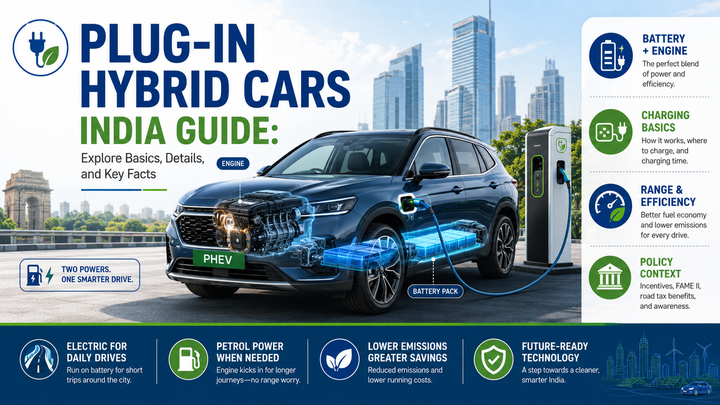
Plug-in hybrid cars, often called PHEVs, are vehicles that combine two energy systems: an internal combustion engine and an externally rechargeable battery with an electric motor. In simple terms, they sit between conventional fuel vehicles and full battery electric vehicles. They can run on electric power for shorter distances when charged, and they can also use the engine for longer journeys.
This category exists because many users are interested in electric mobility but may still be concerned about charging access, highway range planning, and daily reliability. A plug-in hybrid gives users a way to understand electric driving while keeping an additional energy source for extended travel.
In India, plug-in hybrid cars are still a smaller category compared with petrol vehicles, diesel vehicles, full EVs, and strong hybrids. However, the topic is becoming more visible because automakers are studying different routes toward lower-emission mobility. BYD India recently introduced its DM-i plug-in hybrid technology in India, and reports in June 2026 said the company plans to bring a plug-in hybrid SUV to India later in 2026.
A plug-in hybrid should not be confused with a normal strong hybrid. A strong hybrid uses a small battery that is charged by the engine and regenerative braking. A plug-in hybrid has a larger battery that can be charged from an external power point. This difference changes how the vehicle is used, how much electric driving is possible, and how important charging habits become.
Importance
Plug-in hybrid cars matter because India’s mobility needs are diverse. A single vehicle technology may not fit every user, city, route, or charging environment. Full EVs work well for many users with predictable routes and charging access. Strong hybrids help improve fuel efficiency without external charging. Plug-in hybrids combine parts of both formats.
For urban users, a plug-in hybrid may support more electric driving during short daily trips when the battery is charged regularly. For highway users, the engine can reduce dependence on charging stops. For apartment residents, the usefulness depends heavily on charging access at home, office, or nearby public locations.
The importance also comes from India’s changing charging environment. The government has been supporting public charging infrastructure under national clean mobility programs. A February 2026 government release stated that operational guidelines for EV public charging stations were issued under PM E-DRIVE, with a framework for charging infrastructure projects and participation by eligible public and private entities.
Plug-in hybrids also help explain why range numbers need careful interpretation. A claimed combined range is not the same as daily real-world range. Actual performance depends on battery charge, fuel level, traffic, temperature, driving style, road gradient, vehicle load, tyre pressure, and charging routine.
Plug-in Hybrid Basics
A plug-in hybrid car usually has these main parts:
| Component | Basic Role | Why It Matters |
|---|---|---|
| Battery pack | Stores electrical energy | Enables electric driving |
| Electric motor | Drives the wheels using battery power | Helps during city use and acceleration |
| Engine | Uses fuel for longer-distance support | Adds backup energy for extended routes |
| Charging port | Connects vehicle to external charging | Allows battery top-up |
| Regenerative braking | Recovers energy while slowing down | Improves energy efficiency |
| Control system | Manages engine and motor use | Balances performance and efficiency |
The key learning point is that a plug-in hybrid works best when users understand its dual nature. It is partly an EV and partly an engine-based vehicle. Its benefit depends on how often the battery is charged and how the vehicle is driven.
If a user rarely charges the battery, the plug-in hybrid may behave more like a conventional hybrid or engine-led vehicle. If the user charges regularly and drives shorter routes, the electric motor may handle a larger share of daily movement.
Recent Updates
The past year has brought more attention to plug-in hybrid technology in India. In June 2026, BYD India introduced its DM-i technology, described as an electric-first plug-in hybrid system that uses a petrol engine as support when needed. Automotive reports stated that the system has a claimed combined driving range above 1,200 km, but such figures should be treated as claimed values under specific conditions, not as guaranteed everyday results.
The Economic Times reported on June 10, 2026, that BYD plans to introduce its first plug-in hybrid SUV in India later in 2026, based on DM-i technology. This is relevant because India’s hybrid market has largely been associated with strong hybrids, while plug-in hybrids have had limited availability.
Autocar India also reported that the BYD Seal U is expected to become the first model to use the new plug-in hybrid system in India by the end of 2026. The report noted that the system can offer a claimed combined range above 1,200 km and EV-only capability depending on specification. These figures should be verified again when India-specific model details are officially released.
Another update is the continuing discussion around taxation. Full electric vehicles in India currently receive a lower GST rate than many hybrid categories. Hybrid vehicles can face higher GST plus compensation cess depending on vehicle classification. ClearTax notes that petrol hybrid vehicles with an electric motor may attract 28% GST plus 15% compensation cess, making the total tax incidence 43% in that category.
This policy gap matters because vehicle technology adoption is influenced not only by engineering but also by taxation, infrastructure, and local availability.
Laws or Policies
India’s vehicle policy environment treats full EVs and hybrids differently. Battery electric vehicles have received stronger central attention through programs focused on EV adoption and charging infrastructure. Plug-in hybrids may use external charging, but because they also contain an engine, they may not receive the same treatment as full EVs.
The PM E-DRIVE platform states that the Ministry of Heavy Industries introduced e-vouchers for eligible EV customers to avail demand incentives under the scheme. The portal explains that an Aadhaar face-authenticated e-voucher is generated through the scheme process.
For plug-in hybrid cars, readers should be careful. A plug-in hybrid is electrified, but it is not a full EV. Any incentive, GST treatment, state-level benefit, registration rule, or charging-related permission should be checked from official government documents and the vehicle’s final classification.
A simple policy comparison is helpful:
| Area | Full EV | Plug-in Hybrid |
|---|---|---|
| Main energy source | Battery electricity | Battery plus engine |
| External charging | Required | Useful and important |
| Engine included | No | Yes |
| Policy treatment | Often EV-focused | May differ by classification |
| Charging infrastructure benefit | Directly relevant | Relevant when battery is used often |
| Real-world outcome | Depends on charging access | Depends on charging and fuel use |
Charging rules also matter at the local level. Residential societies, office buildings, parking layouts, electrical load approvals, fire safety norms, and charger type can affect how practical a plug-in hybrid becomes. A user with reliable charging access may experience the vehicle differently from a user who depends only on public charging.
Tools and Resources
Readers exploring plug-in hybrid cars in India can use practical tools to make better sense of the category. These resources are not about promotion; they are for research, planning, and general awareness.
| Tool or Resource | How It Helps |
|---|---|
| Official automaker pages | Confirms specifications and technology details |
| Government policy portals | Helps track EV and charging rules |
| EV charging maps | Shows nearby public charging locations |
| Route planning apps | Helps understand highway travel planning |
| Range calculators | Explains how conditions affect range |
| Owner manuals | Provides safety and charging instructions |
| Battery care guides | Helps understand charging habits |
| Residential charging checklist | Helps review home or apartment readiness |
A simple research process can help avoid confusion:
- Check whether the vehicle is a full EV, strong hybrid, or plug-in hybrid.
- Review battery capacity and electric-only driving details from official sources.
- Understand charging connector type and charging time.
- Compare claimed figures with verified local tests when available.
- Review policy treatment from official government sources.
- Check whether regular charging access is practical.
- Study safety, warranty, and maintenance information from official documents.
Simple Usage Graph
The usefulness of a plug-in hybrid changes with the user’s driving and charging pattern.
Regular home charging       ██████████ Very helpful
Short daily city trips      █████████  Strong electric use potential
Mixed city and highway use  ████████   Balanced use case
Rare battery charging       ████       Lower plug-in benefit
Long highway-only driving   ██████     Engine support becomes important
This graph is only for explanation. Actual results depend on the vehicle, battery condition, road type, weather, traffic, and driving style.
Key Facts for General Readers
Plug-in hybrid cars are not the same as electric cars. They contain both a battery-powered system and an engine. This makes them flexible, but also more complex than a full EV or a conventional vehicle.
They need charging to deliver stronger electric-driving benefits. Without regular charging, users may not experience the full purpose of the plug-in system.
They can be useful where charging infrastructure is improving but not yet equally available everywhere. This is why some automakers describe plug-in hybrids as a transition technology.
They require careful range understanding. A high claimed combined range may include both battery and fuel-supported driving. Electric-only range is a separate figure and should be checked independently.
They may face different tax treatment from full EVs. In India, policy classification can materially affect how a vehicle category is positioned in the market.
FAQs
What is a plug-in hybrid car?
A plug-in hybrid car is a vehicle that uses both a rechargeable battery with an electric motor and an internal combustion engine. The battery can be charged from an external source, and the engine supports longer travel or higher energy demand.
How is a plug-in hybrid different from a strong hybrid?
A strong hybrid does not usually need external charging. It uses a smaller battery that is charged by the engine and regenerative braking. A plug-in hybrid has a larger battery and can be charged externally, which allows more electric driving when charged.
Are plug-in hybrid cars the same as EVs?
No. A full EV runs only on battery power and does not have an engine. A plug-in hybrid uses both battery power and an engine. It is an electrified vehicle, but not a pure battery electric vehicle.
Why are plug-in hybrids being discussed in India now?
They are being discussed because India’s charging infrastructure is developing and automakers are exploring multiple electrified technologies. BYD’s June 2026 introduction of DM-i technology in India has also increased attention around plug-in hybrid SUVs.
Do plug-in hybrids always give high range?
No. Range depends on battery charge, fuel level, driving style, traffic, climate, terrain, and vehicle load. Claimed range numbers are useful for comparison but should not be treated as fixed real-world results.
Conclusion
Plug-in hybrid cars in India are an important educational topic because they help explain the middle ground between full EVs and conventional vehicles. They combine electric driving with engine support, which can be useful for users who want cleaner mobility learning, flexible route planning, and reduced dependence on a single energy source.
Their practical value depends on charging access, driving pattern, policy treatment, and accurate understanding of range. A plug-in hybrid is not automatically the right format for every user, but it can make sense in situations where short electric trips and longer mixed-energy journeys are both common.
As India’s charging infrastructure expands and automakers introduce more electrified technologies, plug-in hybrids may become a more visible part of the mobility discussion. Readers should focus on verified specifications, official policy sources, charging readiness, and realistic usage patterns before forming conclusions.