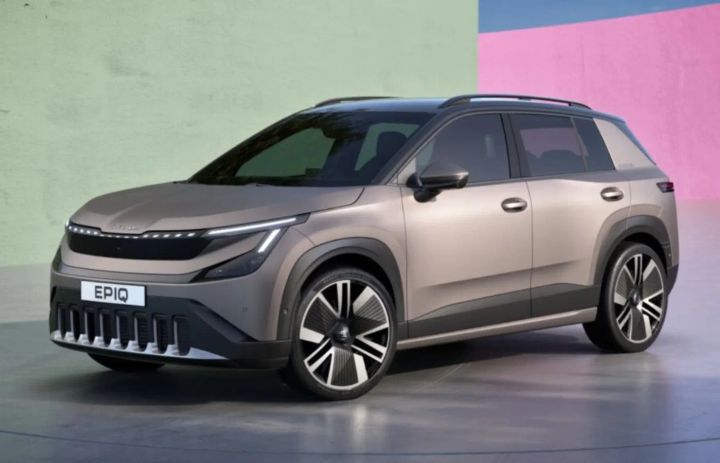
Skoda Epiq EV Complete Guide, Features, Overview and Key Details
The Skoda Epiq EV is a compact electric SUV crossover developed primarily for urban travel and everyday family use. It expands Skoda’s electric vehicle range with a smaller model positioned below larger electric SUVs such as the Elroq and Enyaq.
Skoda describes the Epiq as a city-focused electric crossover with practical interior space, digital technology and the brand’s Modern Solid design language. The manufacturer’s international website states that the vehicle has an electric driving range of more than 440 kilometres, although the final figure may differ according to the battery version, testing method, road conditions and regional configuration.
This guide explains what the Skoda Epiq is, why compact electric SUVs are becoming important, which features have been announced and how European electric vehicle regulations may affect its use.
What Is the Skoda Epiq EV?
The Skoda Epiq is a fully electric compact SUV crossover. It is intended to combine the raised seating position and flexible cabin associated with an SUV with dimensions suitable for congested roads and limited parking spaces.
Its development reflects a wider change in the automotive sector. Early electric vehicles were often designed either as small hatchbacks or as relatively large premium models. Manufacturers are now introducing more compact electric crossovers because they can address everyday requirements such as commuting, school journeys, shopping and regional travel.
The Epiq also introduces Skoda’s Modern Solid design approach in a smaller format. This design philosophy focuses on simple surfaces, functional elements, robust proportions and a more minimalist exterior.
Skoda initially presented the Epiq as a design study. The company later displayed a more production-oriented show car and stated that the global unveiling of the production model was scheduled for mid-2026. Specifications published before final regional homologation should therefore be treated as indicative until market-specific documentation becomes available.
Skoda Epiq EV Overview
| Category | Announced or Expected Information |
|---|---|
| Vehicle type | Fully electric compact SUV crossover |
| Primary use | Urban travel and everyday journeys |
| Design language | Skoda Modern Solid |
| Claimed driving range | More than 440 km, depending on configuration |
| Charging technology | AC and DC charging expected |
| Energy functions | V2L and V2H capability announced |
| Cabin approach | Practical layout with digital controls |
| Main market focus | Europe |
| Final specifications | May vary by country and model version |
The table reflects information available from Skoda’s international materials. Battery capacity, charging output, performance, dimensions and equipment can vary among different versions.
Why the Skoda Epiq Matters
Compact electric SUVs may play an important role in wider EV adoption. Larger electric vehicles can require more road space, larger batteries and greater energy consumption. A smaller crossover can reduce some of these limitations while retaining useful cabin flexibility.
The Epiq may be relevant to:
- Urban commuters seeking an electric vehicle with compact dimensions
- Families requiring practical passenger and luggage space
- Drivers who regularly travel between cities and nearby towns
- Households researching EV charging infrastructure
- People comparing vehicle insurance, automotive financing and battery warranty terms
- Fleet operators studying lower-emission urban mobility
Electric vehicles can also help reduce tailpipe emissions in populated areas. A battery-electric vehicle does not produce exhaust emissions while being driven. Its complete environmental impact, however, depends on electricity generation, battery production, vehicle manufacturing, driving efficiency and end-of-life recycling.
The model is also significant because it brings features such as bidirectional charging into the compact crossover category. Skoda has announced vehicle-to-load and vehicle-to-home functionality for the Epiq. These technologies allow the high-voltage battery to provide electricity to compatible external equipment or a suitably configured building.
Design and Exterior Details
The Epiq follows Skoda’s Modern Solid styling direction. Its appearance is expected to include clean body surfaces, prominent wheel arches, a high shoulder line and a compact SUV profile.
A major visual element is the front section. Instead of a conventional grille designed to cool an internal-combustion engine, the electric model uses a largely enclosed panel incorporating sensors and design elements.
The final design may vary between standard variants and special editions. Skoda has also presented an Epiq First Edition with contrasting details, black exterior lettering and distinctive accent elements. Equipment associated with a particular edition may not be included across the complete model range.
Aerodynamic efficiency is important for an electric vehicle because resistance affects energy use and driving range. Features such as smoother body panels, controlled airflow and carefully designed wheels can help improve efficiency, especially at higher speeds.
Interior, Practicality and Comfort
The cabin is expected to follow a simple and functional layout. Digital displays are likely to provide information about speed, battery level, estimated range, navigation and driver-assistance systems.
Skoda’s published feature information refers to electrically adjustable front seats, lumbar adjustment and a driver memory function on equipped versions. These functions may be limited to particular variants or optional equipment packages.
Practicality is a central part of the Epiq concept. A purpose-built electric platform can create additional cabin space because an electric drivetrain does not require the same engine, transmission and exhaust arrangement as a conventional vehicle.
Useful interior characteristics may include:
- Flexible storage areas
- Foldable rear seating
- Smartphone connectivity
- Navigation with charging information
- Climate-control functions
- USB charging points
- Driver-profile settings
- Digital vehicle information
Actual luggage volume and passenger-space measurements should be checked against the homologated specification sheet for each country.
Battery Range and Real-World Efficiency
Skoda states that the Epiq can provide more than 440 kilometres of electric range. This figure should not be interpreted as a guaranteed distance for every journey. Laboratory testing creates a standard method for comparison, but real-world results depend on several factors.
Important range variables include:
- Vehicle speed
- Ambient temperature
- Cabin heating or air-conditioning use
- Road gradient
- Passenger and luggage load
- Tyre pressure
- Traffic conditions
- Driving style
- Battery age
- Wheel and tyre configuration
Cold weather can reduce available range because the battery and cabin may require additional energy for heating. Frequent high-speed motorway driving can also increase electricity consumption because aerodynamic resistance rises rapidly with speed.
Regenerative braking may improve urban efficiency by recovering some energy when the vehicle slows down. The recovered electricity is returned to the battery rather than being lost entirely through conventional friction braking.
EV Charging and Bidirectional Technology
An electric vehicle can generally be charged using alternating-current equipment at a residence or workplace and direct-current equipment at public locations.
AC charging is commonly used when a vehicle remains parked for several hours. DC charging is designed for faster energy transfer during longer journeys. Final Epiq charging times will depend on battery size, charging output, battery temperature, charger capacity and software management.
Skoda has highlighted bidirectional charging as an important Epiq technology. Two relevant terms are:
- Vehicle-to-load: The battery supplies compatible external equipment.
- Vehicle-to-home: The battery can support a suitably equipped building through an approved energy-management system.
V2H operation requires compatible electrical hardware, professional installation and compliance with local grid rules. It cannot be assumed that every household charger will support the function.
Electric Vehicle Market Trends
Demand for battery-electric vehicles has continued to develop across Europe. ACEA reported that 1,880,370 battery-electric cars were registered in the European Union during 2025. They represented 17.4% of new-car registrations, compared with 13.6% during 2024.
By the first five months of 2026, battery-electric vehicles had reached a 20% share of new EU registrations, according to ACEA’s June 2026 update.
| EU Market Indicator | 2024 | 2025 |
| Battery-electric share | 13.6% | 17.4% |
| Battery-electric registrations | Not shown here | 1,880,370 |
| Market direction | Developing | Higher share |
These figures do not mean that adoption is identical in every country. Charging availability, taxation, electricity rates, household parking and national incentive programmes create substantial regional differences.
The European Alternative Fuels Observatory reported more than 1.15 million publicly accessible charging points in its June 2026 update, with infrastructure increasing by 19.1% compared with May 2025.
Recent Skoda Epiq Updates
The Epiq progressed from an early concept into a production-oriented vehicle programme. Skoda’s official Epiq page stated that the global unveiling of the production version was planned for mid-2026.
Recent information also highlights:
- A claimed range exceeding 440 kilometres
- Compact SUV crossover positioning
- Modern Solid exterior styling
- Vehicle-to-load technology
- Vehicle-to-home capability
- Digitally managed cabin functions
- Comfort equipment on selected versions
- First Edition exterior details
Because the vehicle is being introduced across different regions, announced features should be checked against local model documentation. Equipment shown in global images may represent a high-specification vehicle rather than the standard configuration.
There is also no confirmed indication in the cited global information that every international market, including India, will receive the Epiq at the same time. Market availability depends on Skoda’s regional planning, homologation, charging standards and manufacturing strategy.
European Laws and Policies Affecting the Epiq
Electric vehicles in Europe are influenced by safety rules, battery regulations, emissions policy, charging standards and national vehicle taxation.
One of the most relevant frameworks is the Alternative Fuels Infrastructure Regulation, also known as AFIR. It establishes mandatory national targets for publicly accessible charging infrastructure throughout the European Union.
From 2025, the framework requires fast-charging locations of at least 150 kW at intervals of no more than 60 kilometres along important sections of the EU’s main TEN-T transport corridors. The wider implementation schedule differs by corridor and vehicle category.
AFIR is intended to make cross-border electric travel more practical by increasing charger availability and improving access to payment and charging information.
Electric vehicles are also affected by the EU Battery Regulation. This framework addresses battery sustainability, supply-chain information, carbon-footprint reporting, recycling and material recovery. Requirements are introduced in stages and apply to manufacturers, battery producers and other economic operators.
Building regulations are another important area. The revised European Energy Performance of Buildings framework supports the installation of charging points and pre-cabling in certain new or extensively renovated buildings. The European Commission estimates that 60% to 85% of charging may take place at private locations by 2030.
National rules can additionally affect:
- Vehicle registration
- Road taxation
- Insurance requirements
- Residential charger installation
- Company-car taxation
- Parking access
- Environmental-zone eligibility
- Battery transport and recycling
Drivers should consult the official transport, taxation and energy authorities in their own country because these policies are not uniform across Europe.
Helpful Tools and Resources
Several digital resources can help drivers understand electric mobility and plan journeys.
- Skoda official website: Model information, technical specifications and regional availability
- Skoda vehicle application: Vehicle status, charging information and compatible remote functions
- European Alternative Fuels Observatory: Charging infrastructure data and national EV statistics
- EU transport portal: Information about AFIR and alternative-fuel policy
- Route-planning applications: Charging-stop planning based on route, range and charger availability
- Public charging maps: Connector type, charging output and location status
- Energy calculators: Estimated electricity use based on distance and vehicle efficiency
- Vehicle insurance comparison tools: Policy limits, battery protection and roadside assistance details
- Automotive financing calculators: Estimated instalments, interest rate and repayment period
- Home-energy applications: Electricity monitoring and scheduled charging
- Tyre-pressure monitoring tools: Support for efficiency and vehicle safety
Digital charger information can occasionally be delayed or incomplete. Drivers should verify important charging stops through more than one source before a long journey.
Frequently Asked Questions
Is the Skoda Epiq a fully electric vehicle?
Yes. The Epiq is presented by Skoda as a battery-electric compact SUV crossover. It does not use a petrol or diesel engine for propulsion.
What is the expected Skoda Epiq driving range?
Skoda states that the Epiq provides more than 440 kilometres of range. The final homologated figure may differ by battery version, wheel specification and regional configuration. Temperature, traffic, speed and climate-control use will also affect real-world distance.
Does the Skoda Epiq support bidirectional charging?
Skoda has announced V2L and V2H functions. V2L can supply compatible external devices, while V2H can transfer energy to a properly configured building. Availability may depend on the model version, charging equipment and local electricity rules.
Is the Skoda Epiq suitable for long journeys?
Its announced range suggests that regional and some longer journeys may be practical. Actual suitability will depend on charging availability, journey distance, weather, driving speed and the final charging specification.
Will the Skoda Epiq be available in India?
Skoda’s international information primarily presents the Epiq as a European-focused electric crossover. India-specific availability, variants and technical details should not be assumed until they are announced through Skoda’s official Indian channels.
Conclusion
The Skoda Epiq represents a new generation of compact electric SUVs designed around urban practicality, efficient packaging and connected automotive technology. Its announced range of more than 440 kilometres, compact crossover layout and bidirectional charging capability are among its most notable characteristics.
Its relevance also extends beyond the vehicle itself. Expanding European charging infrastructure, developing battery regulations and rising battery-electric registrations are changing how consumers evaluate electric mobility.
Final battery details, charging performance, driver-assistance equipment and regional availability may differ across markets. Readers should therefore rely on homologated specifications and official national documentation when the Epiq is introduced in their region.