Hyundai HE1i Electric SUV India – Explore Upcoming EV Details and Launch Timeline
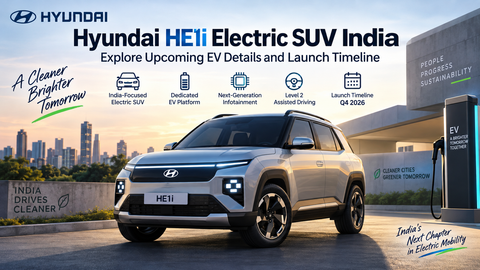
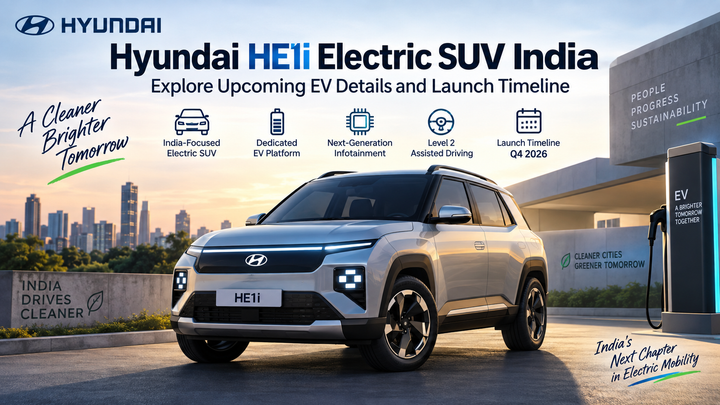
Hyundai is preparing another electric SUV specifically for the Indian market as it expands beyond the Creta Electric and IONIQ 5. Hyundai has officially confirmed that an all-new A-segment electric SUV developed for India is scheduled to arrive in the fourth quarter of 2026.
The company has not publicly announced the final production name. Automotive industry reports currently identify the project by its internal codename, HE1i. For this reason, HE1i should be understood as a development identifier rather than a confirmed showroom name.
Hyundai describes the upcoming vehicle as a localized electric SUV designed for India. It will use a dedicated electric vehicle architecture rather than simply being an electric version of an existing petrol or diesel Hyundai SUV. Hyundai has also confirmed a next-generation infotainment system and Level 2 assisted driving technology for the model.
Industry reporting provides additional details. Autocar India reports that HE1i is expected to use Hyundai's E-GMP (K) architecture, which is related to the platform used by the global Hyundai Inster. It also reports that standard-range and long-range configurations are planned. Hyundai has not yet disclosed the final India-spec battery capacities, certified driving range or motor output.
Hyundai HE1i: Confirmed Information vs Reported Details
Understanding what Hyundai has officially announced and what remains based on industry information is important when researching an upcoming electric vehicle.
| Area | Current Information | Status |
|---|---|---|
| Vehicle type | A-segment electric SUV for India | Confirmed |
| Launch timeline | Fourth quarter of 2026 | Confirmed |
| India-focused development | Yes | Confirmed |
| Dedicated EV platform | Yes | Confirmed |
| HE1i name | Internal codename | Industry reported |
| E-GMP (K) architecture | Expected | Industry reported |
| Level 2 assisted driving | Yes | Confirmed |
| Next-generation infotainment | Yes | Confirmed |
| Standard and long-range versions | Planned | Industry reported |
| Battery capacity | Not announced | Awaiting confirmation |
| Certified range | Not announced | Awaiting confirmation |
| Final production name | Not announced | Awaiting confirmation |
This distinction prevents global Hyundai Inster specifications from being incorrectly presented as specifications for the Indian HE1i.
Why the Hyundai HE1i Matters for India's EV Market
India's electric passenger vehicle segment is moving from a relatively narrow range of models toward a wider selection of compact and mid-size electric SUVs.
Hyundai currently participates in the Indian EV market through the Creta Electric and IONIQ 5. The upcoming smaller SUV will allow the company to address a different part of the market where compact dimensions, everyday range, charging accessibility and urban practicality can have greater importance.
Hyundai's global strategy also gives this vehicle broader significance. At its August 26, 2026 CEO Investor Day, the company said it plans more than 100 global vehicle launches or major updates by 2030, including 26 for India. The company specifically listed the new A-segment SUV EV among its upcoming products.
Hyundai Motor India has separately outlined major investment in manufacturing, electrification and future mobility through FY2030. Its long-term India programme includes 26 new products and variants, indicating that HE1i forms part of a much larger product strategy rather than being an isolated EV project.
For consumers researching an electric SUV, this matters because vehicle selection increasingly depends on more than battery capacity. EV charging infrastructure, battery warranty conditions, electric car insurance, connected technology and local manufacturing are also becoming important considerations.
Expected Platform and Battery Strategy
Hyundai has confirmed that its new India-focused electric SUV will use a dedicated EV platform. It has not publicly named that architecture in its recent Indian announcement.
Autocar India reports that the HE1i will use E-GMP (K), an architecture also associated with the Hyundai Inster available internationally. This suggests Hyundai is developing the Indian model around a platform designed primarily for battery-electric vehicles rather than converting an internal-combustion platform.
The same report states that two versions are planned:
- Standard-range configuration
- Long-range configuration
Exact Indian battery specifications remain undisclosed.
The international Hyundai Inster is sometimes used online as a reference for potential HE1i specifications. However, its battery capacities and WLTP figures should not automatically be applied to the Indian vehicle. Local battery chemistry, software calibration, testing standards, vehicle weight and equipment can lead to different certified figures.
Consumers comparing electric SUV range should therefore wait for India's official certification figures before drawing conclusions.
Localisation and Battery Cell Developments
Local manufacturing is an important part of Hyundai's EV strategy in India. Hyundai said in August 2026 that it aims to source around 90% of vehicle content in India by 2030 across its broader operations. The company works with more than 1,400 local suppliers and over 900 engineers in India.
Autocar reports that the HE1i programme was originally expected to use locally produced battery cells associated with Exide. According to its September 3, 2026 report, Hyundai is now expected to begin the programme using Svolt cells because the planned domestic cell production timeline changed. A transition toward locally produced cells may follow later.
This does not establish the final battery capacity, chemistry or battery warranty conditions for the production vehicle. Those details will need confirmation when Hyundai publishes the complete technical specifications.
Technology and Level 2 Assisted Driving
Technology is one of the few areas where Hyundai has already revealed meaningful information.
The company confirms that the upcoming electric SUV will include Level 2 assisted driving technology. Level 2 generally refers to systems that can combine functions such as steering assistance and acceleration or braking assistance under defined conditions.
It does not make the vehicle fully autonomous. The driver remains responsible for monitoring traffic, maintaining control and following road regulations.
Hyundai has also confirmed a next-generation infotainment system. The exact production interface and display configuration have not yet been detailed.
Hyundai has been expanding its connected-car ecosystem in India. In August 2026, the company reported more than 0.8 million cumulative connected Hyundai vehicles in the country and continued development of its software-defined vehicle strategy, including over-the-air technology.
This provides useful context for the type of digital ecosystem that may surround future Hyundai electric vehicles, although individual HE1i functions should only be considered final after the production specification is announced.
Recent Hyundai HE1i and EV Updates
Several developments during the past year have clarified Hyundai's direction.
| Date | Development |
|---|---|
| October 2025 | Hyundai outlined a broader India product roadmap extending to FY2030 |
| August 25, 2026 | Hyundai expanded charging access through Jio-bp integration |
| August 26, 2026 | Hyundai confirmed its India-focused A-segment EV for Q4 2026 |
| September 3, 2026 | Industry reporting detailed HE1i battery sourcing and two range configurations |
| September 9, 2026 | Hyundai reiterated plans for a localized mass-market SUV EV on a dedicated EV architecture |
The August 26 announcement is particularly important because it provides an official calendar window. Hyundai stated that the all-new electric SUV will arrive in India during the fourth quarter of 2026 and will feature next-generation infotainment and Level 2 assisted driving technology.
On September 9, 2026, Hyundai again referred to its upcoming localized mass-market SUV EV while announcing additional DC fast-charging infrastructure in New Delhi.
Together, these announcements indicate that the programme is progressing toward introduction rather than remaining a distant concept.
Hyundai's Expanding EV Charging Infrastructure
Public EV charging is becoming increasingly important as electric vehicles move beyond city-only usage.
On August 25, 2026, Hyundai announced integration with the Jio-bp pulse charging network. Hyundai stated that the addition of more than 7,000 Jio-bp charging points increased the charging locations accessible through the myHyundai app to more than 37,000 charging points across India.
Jio-bp's network covers more than 300 cities, while Hyundai also reported 183 operational proprietary DC fast-charging stations and plans to expand that network to 600 stations by 2030.
For an HE1i owner, charging experience will ultimately depend on the vehicle's charging architecture, battery size and supported DC charging rate. Those specifications have not yet been disclosed.
India EV Policies and Regulations
Electric passenger vehicles in India operate within several central and state-level regulatory frameworks.
One important central programme is the PM E-DRIVE Scheme, which supports India's broader transition toward electric mobility. Its eligible categories for direct demand incentives primarily cover electric two-wheelers, three-wheelers, ambulances, trucks, buses and other defined segments rather than privately registered electric passenger cars.
However, PM E-DRIVE also supports EV charging infrastructure, which can indirectly benefit electric car users. Government information published in August 2026 stated that ₹689 crore had been approved for deployment of 6,562 chargers through three oil marketing companies and nine states as of July 1, 2026.
The programme currently extends to March 31, 2028 for applicable components.
Electric vehicles also attract a 5% GST rate under the national GST framework.
Road tax and registration-related EV benefits can differ between states and may change over time. Consumers should therefore check their state's transport department and the Parivahan portal for current electric vehicle registration requirements.
Motor insurance regulations also apply to EVs. IRDAI states that third-party liability insurance is mandatory for vehicles operating on public roads in India. Electric car insurance can additionally include own-damage protection depending on the policy structure selected.
Helpful Tools and Resources for EV Research
Several official and established digital resources can help when evaluating the Hyundai HE1i after complete specifications are announced.
- Hyundai India website: Official specifications, battery information, warranty terms and launch announcements.
- myHyundai app: Hyundai's connected ecosystem and access to participating public EV charging locations.
- Parivahan portal: Electric vehicle registration and transport-related information.
- PM E-DRIVE portal: Central EV policy and charging infrastructure information.
- IRDAI portal: Motor and electric car insurance regulations.
- State transport department portals: Road tax and state EV policy information.
- Public charging applications: Useful for identifying charging stations and examining charger availability before long-distance journeys.
- Vehicle finance calculators: Helpful for understanding EV financing structures and repayment schedules once official vehicle information becomes available.
When evaluating an EV, combining these resources is more reliable than relying solely on preliminary specification reports.
Frequently Asked Questions
What is Hyundai HE1i?
HE1i is the codename reported for Hyundai's upcoming India-focused compact electric SUV. Hyundai itself currently describes the vehicle as an all-new A-segment SUV EV localized and designed for India. The final production name has not been announced.
When will the Hyundai HE1i launch in India?
Hyundai officially stated on August 26, 2026 that its new electric SUV for India is scheduled for the fourth quarter of 2026. Industry reporting has also indicated an introduction before the end of 2026.
What will be the Hyundai HE1i battery capacity and range?
Hyundai has not announced the India-spec battery capacities or certified driving range. Industry reports indicate standard-range and long-range versions, but exact specifications remain undisclosed. International Inster figures should not be treated as confirmed HE1i figures.
Will Hyundai HE1i have ADAS?
Yes. Hyundai has officially confirmed Level 2 assisted driving technology for its upcoming India-focused electric SUV. The complete list of individual driving-assistance functions has not yet been published.
Will Hyundai HE1i support public fast charging?
The final DC charging specification has not been announced. Hyundai is expanding its wider charging ecosystem, and its myHyundai platform currently provides access to more than 37,000 participating charging points following Jio-bp integration. Vehicle-specific charging capability will need confirmation with the production specifications.
Conclusion
The Hyundai HE1i represents an important next step in Hyundai's electric vehicle strategy for India. Unlike an electric conversion of an existing SUV, Hyundai has confirmed that its upcoming A-segment electric SUV will use a dedicated EV platform and will be localized and designed around the Indian market.
The fourth-quarter 2026 introduction, Level 2 assisted driving technology and next-generation infotainment system are already confirmed. Industry information further points toward the HE1i codename, E-GMP (K) architecture and standard-range and long-range versions.
However, the final vehicle name, battery capacity, electric SUV range, motor specifications, charging rate and detailed battery warranty remain undisclosed as of September 10, 2026.
Until Hyundai releases the complete production specification, these confirmed and reported details provide the clearest factual overview of what consumers can currently expect from Hyundai's upcoming India-focused electric SUV.