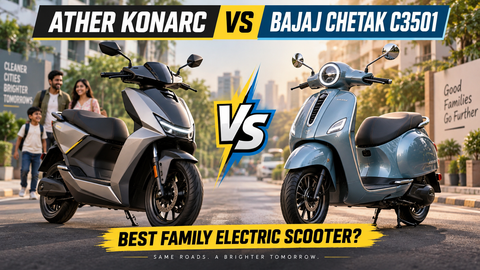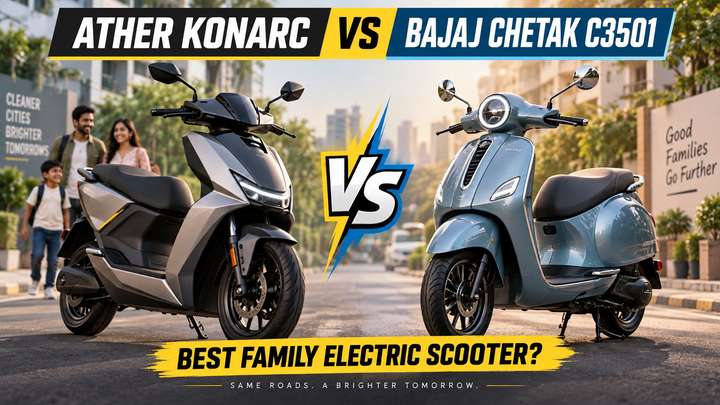
Ather Konarc vs Bajaj Chetak C3501 – Family Electric Scooter Guide
Electric scooters in India are increasingly being designed around everyday family requirements rather than only short solo commutes. Storage space, pillion comfort, predictable electric scooter range, charging convenience, safety technology and connected features have therefore become important comparison points.
The Ather Konarc and Bajaj Chetak C3501 represent two different interpretations of a modern family electric scooter.
Ather introduced the Konarc on August 29, 2026. The current Konarc S family includes three configurations identified by their IDC range: S 100, S 125 and S 161. Their respective battery capacities are 2.1 kWh, 2.7 kWh and 3.5 kWh. All three have a claimed top speed of 70 km/h.
The Bajaj Chetak C3501 is the flagship model within the current C35 family. Bajaj updated the Chetak portfolio on April 29, 2026, increasing the C3501's top speed to 80 km/h and adding integrated Google Maps along with other technology updates. It uses a 3.5 kWh battery and carries an IDC range figure of 153 km.
Rather than treating one specification as the deciding factor, a useful family electric scooter guide should examine how range, storage, charging, everyday usability and technology work together.
Ather Konarc vs Bajaj Chetak C3501: Key Facts
| Feature | Ather Konarc S 161 | Bajaj Chetak C3501 |
|---|---|---|
| Battery capacity | 3.5 kWh | 3.5 kWh |
| IDC range | 161 km | 153 km |
| Manufacturer's practical range figure | 130 km TrueRange | Not specified in the same format |
| Top speed | 70 km/h | 80 km/h |
| Under-seat storage | 31 litres | 35 litres |
| Home charging to 80% | 5 hr 40 min with standard 450W charger | 3 hours |
| Faster home charging arrangement | 3 hr 10 min with combined charging | Not required for stated 3-hour figure |
| Dashboard | 7-inch DeepView display | 5.5-inch touchscreen |
| Reverse assistance | Yes | Yes |
| Front brake | 220 mm disc | 200 mm disc |
| Rear brake | Drum | Drum |
| Body construction | Steel unibody | Metal body |
Ather states that the S 161 can achieve 161 km under IDC testing and publishes a 130 km TrueRange figure. Its 3.5 kWh configuration includes combined charging that can take the battery from 0 to 80% in around 3 hours 10 minutes.
Bajaj lists 153 km IDC range, 80 km/h top speed and approximately three hours for 0–80% charging on the current C3501.
Laboratory-certified range should not be treated as a guaranteed daily riding figure. Actual electric scooter range varies with rider and pillion weight, speed, acceleration, road gradient, weather, tyre pressure, traffic conditions and use of electrical functions.
Why This Comparison Matters for Family Riders
Family usage introduces requirements that may be less important for a scooter primarily ridden by one person.
Storage is a clear example. The Konarc provides a 31-litre boot across its current configurations. Ather also lists 2 litres of front storage with a mobile holder and USB charging arrangement.
The Chetak C3501 provides a larger 35-litre boot along with a 5-litre glovebox. Its dashboard can also store and display vehicle documents digitally.
This makes both models relevant for routine activities involving helmets, small bags, everyday essentials and local commuting.
Performance requirements can differ as well. The Chetak's 80 km/h stated maximum is higher than the Konarc's 70 km/h. The Konarc, however, concentrates on practical family characteristics including long-travel suspension, 14-inch front wheel, 12-inch rear wheel and a relatively long wheelbase for the Ather range.
For a family rider, the correct interpretation is not simply that a higher maximum speed is better. Low-speed control, suspension behaviour, braking response, pillion ergonomics and stability can matter more during everyday urban riding.
Range and Battery Insights
Battery capacity is one of the most searched aspects of an electric scooter comparison, but capacity alone does not determine range.
The Konarc S lineup demonstrates this clearly. Ather currently lists:
- Konarc S 100: 2.1 kWh battery, 100 km IDC and 80 km TrueRange
- Konarc S 125: 2.7 kWh battery, 125 km IDC and 100 km TrueRange
- Konarc S 161: 3.5 kWh battery, 161 km IDC and 130 km TrueRange
All three versions have IP67-rated motors and batteries. Peak motor output is 4 kW on the S 100 and 4.7 kW on the S 125 and S 161.
The Chetak C3501 uses a 3.5 kWh battery with a manufacturer-stated IDC range of 153 km. It also has an IP67-rated battery system.
For daily family commuting, riders should estimate their normal daily distance first and then maintain a practical battery reserve. A household travelling 25–40 km per day will evaluate range differently from someone regularly travelling 80–100 km.
Charging Infrastructure and Daily Convenience
Charging access can influence EV ownership as much as battery size.
Ather provides Ather Grid access on the S 125 and S 161 and lists public charging capability at up to approximately 15 km of additional range in 10 minutes under specified conditions. Grid access is shown as an additional arrangement for the S 100.
For home charging, the standard Konarc charger produces different 0–80% timings according to battery capacity. The figures are four hours for S 100, four hours 30 minutes for S 125 and five hours 40 minutes for S 161. A combined charging arrangement can reduce these figures to approximately two hours, two hours 25 minutes and three hours 10 minutes respectively.
Bajaj lists three hours from 0–80% for the C3501 and approximately four hours 25 minutes for a complete charge.
Home parking availability, electrical connection access and nearby public charging infrastructure should therefore form part of the evaluation.
Technology and Connected Features
Connected technology has become another major difference between contemporary electric scooters.
The higher Konarc S configurations include 4G LTE/GNSS connectivity, over-the-air updates, remote charging status, location functions, ride information, call and music controls and tow or theft notifications. The S 125 and S 161 use a 7-inch DeepView dashboard, while the S 100 uses a smaller 4.2-inch display.
The Chetak C3501 uses a 5.5-inch touchscreen. Its current feature set includes integrated Google Maps, keyless access, anti-theft alerts, overspeed alerts and digital document access. Bajaj also lists app functions such as live tracking, navigation, geofencing, trip information, remote immobilisation and vehicle diagnostics, although availability of some connected functions depends on the relevant digital package.
For family users sharing a scooter, location information, navigation and security notifications can provide meaningful practical value beyond entertainment functions.
Recent Electric Scooter Updates in 2026
The past year has produced significant changes for both products.
On April 29, 2026, Bajaj reorganised its electric scooter portfolio under the C Series nomenclature. The C3501 received integrated Google Maps and its stated top speed increased from 73 km/h to 80 km/h. Riding modes and hill-hold functionality also became part of the updated C35 range.
Ather then introduced the Konarc on August 29, 2026 as a family-focused scooter based on its newer EL architecture. The detailed specification page currently lists the S 100, S 125 and S 161 configurations.
There is one important point regarding future specifications. Ather's main Konarc page currently highlights an eventual figure of up to 200 km IDC while identifying the higher Z Line as launching later. The detailed specifications available today list the current S range up to 161 km IDC. Therefore, 161 km is the relevant figure when comparing the currently detailed S lineup with the C3501.
Electric two-wheelers also continue to form a significant part of India's EV transition. The PM E-DRIVE dashboard recorded more than 8.68 lakh registered and temporarily registered electric two-wheelers for FY 2026–27 as reflected in Vahan-linked data dated September 6, 2026.
Indian EV Rules and Government Policy
Electric scooters such as the Konarc and C3501 operate under India's motor vehicle framework when used on public roads.
Third-party motor insurance is mandatory for vehicles operating on public roads in India. IRDAI also states that new two-wheelers follow the applicable long-term third-party insurance structure. Riders should confirm current electric scooter insurance requirements and policy details through recognised regulatory and insurer channels.
Protective headgear requirements also apply to motorcycle riders and pillion riders under the Motor Vehicles Act, subject to legally defined exceptions. Additional rules apply when carrying young children. For a child between nine months and four years, the applicable rules include an appropriate safety harness and head protection; the motorcycle must not exceed 40 km/h while carrying a child up to four years as a pillion.
Government EV policy has also changed recently. The Ministry of Heavy Industries portal records an amendment dated August 10, 2026 covering enhancement of the PM E-DRIVE scheme outlay and extension of the electric two-wheeler timeline. The current scheme information indicates implementation through March 31, 2028 for applicable categories. Eligibility remains dependent on scheme conditions and approved vehicles, so the official PM E-DRIVE portal should be checked for current rules.
State-level road tax, registration treatment and EV programmes can vary, so local transport department information remains relevant.
Helpful Tools and Resources
For researching either scooter, useful resources include the official Ather Konarc specification portal, Ather mobile application, Ather Grid information, official Chetak website, Chetak application, Google Maps, Parivahan portal, Vahan registration records, PM E-DRIVE portal and IRDAI motor insurance guidance.
These resources can help users check charging locations, navigation, vehicle documentation, registration requirements, battery information, insurance rules and current EV policy details.
Family-Focused Comparison
| Family Requirement | Konarc S 161 | Chetak C3501 |
|---|---|---|
| Longer stated IDC range | Slight advantage | Close |
| Under-seat storage | 31 L | 35 L |
| Maximum speed | 70 km/h | 80 km/h |
| Connected navigation | Connected features available | Integrated Google Maps |
| Public charging ecosystem | Ather Grid compatible | Home-charging focused information |
| Practical range transparency | TrueRange figure published | IDC figure published |
| Reverse assistance | Available | Available |
| Metal construction | Steel unibody | Metal body |
| Family-oriented positioning | Strong | Strong |
The table should be treated as an information guide rather than a universal ranking. Rider height, pillion requirements, local roads, parking arrangement and charging availability can change which specification matters most.
Frequently Asked Questions
Is the Ather Konarc better than the Bajaj Chetak C3501 for families?
There is no single answer for every household. The Konarc S 161 provides a slightly higher IDC range figure and access to Ather's charging ecosystem, while the C3501 provides a higher stated top speed, larger boot and integrated Google Maps. The relevant choice depends on daily distance, pillion use, storage needs and charging access.
Which scooter has the longer electric scooter range?
The current Konarc S 161 carries a 161 km IDC figure, compared with 153 km IDC for the Chetak C3501. Ather additionally publishes a 130 km TrueRange figure for the S 161. Actual riding range varies with conditions.
Which has more storage space?
The Chetak C3501 has a 35-litre boot, while the Konarc has a 31-litre boot. Both also provide additional smaller storage areas for everyday items.
Which scooter charges faster?
Bajaj states approximately three hours for the C3501 to reach 80%. The Konarc S 161 requires approximately three hours 10 minutes to reach 80% when using its combined charging configuration, while its standard 450W arrangement takes longer.
What should a family check before selecting an electric scooter?
Important factors include realistic daily range, pillion comfort, storage, braking behaviour, home charging access, public charging availability, battery warranty terms, electric scooter insurance, registration requirements, connected technology and access to authorised technical support.
Conclusion
The Ather Konarc and Bajaj Chetak C3501 both reflect the shift toward practical, technology-enabled family electric scooters in India.
The Konarc S 161 emphasises range transparency, multiple battery configurations, Ather Grid compatibility, long-travel suspension and connected technology. The Chetak C3501 combines a 3.5 kWh battery, 153 km IDC range, 80 km/h top speed, 35-litre boot, touchscreen interface and integrated Google Maps.
For family use, specifications should be interpreted around the household's actual riding pattern rather than a single headline figure. Daily distance, pillion frequency, storage, home charging access, road conditions and preferred digital features provide a more useful framework for understanding which scooter fits a particular requirement.