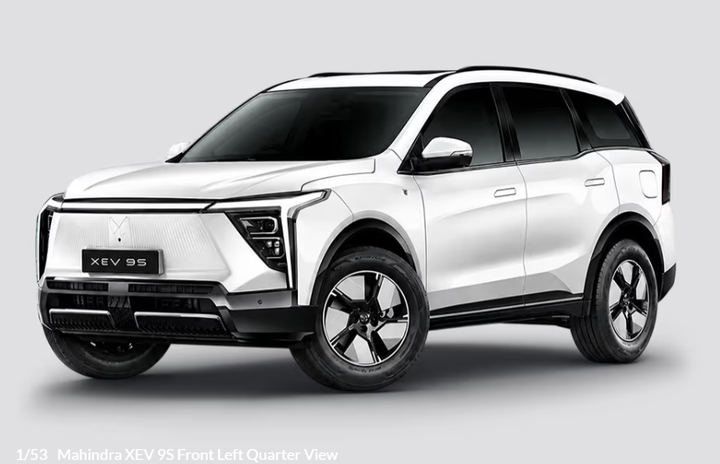
Mahindra XEV 9S Overview: Explore Features, Battery Basics, Range Details and Key Information
The Mahindra XEV 9S is an electric-origin 7-seater SUV developed for India’s growing electric vehicle market. It is built on Mahindra’s INGLO electric architecture and is positioned as a family-focused electric SUV with three-row seating, modern cabin technology, and battery-powered performance. Mahindra announced the XEV 9S on 27 November 2025 and described it as India’s first authentic electric-origin 7-seater SUV built on the INGLO platform.
The topic exists because electric vehicles are moving beyond small city cars. Indian users are now researching larger EVs that can support family travel, daily commuting, highway routes, connected features, charging planning, and safety expectations. A vehicle like the XEV 9S is important because it brings electric mobility into the larger SUV space, where cabin space and long-distance usability are major decision factors.
Unlike a conventional fuel-powered SUV, an electric SUV depends on a battery pack, electric motor, battery management system, charging system, software controls, and regenerative braking. These parts work together to create a quieter and more software-led driving experience. For a general reader, the XEV 9S can be understood as a large electric SUV designed around battery placement, cabin space, and digital vehicle systems.
| Area | Basic Explanation |
|---|---|
| Vehicle type | Electric-origin 7-seater SUV |
| Platform | INGLO electric architecture |
| Seating focus | Three-row family layout |
| Main technology areas | Battery, motor, software, charging, ADAS |
| Common user questions | Range, charging time, safety, cabin space, battery life |
Why the Mahindra XEV 9S Matters Today
The XEV 9S matters because it represents a shift in India’s EV market. Earlier, many electric cars were focused on compact urban mobility. Larger electric SUVs are now attracting attention because many households want more cabin space, better road presence, longer range potential, and improved charging confidence.
This topic affects families, daily commuters, fleet planners, EV researchers, insurance readers, automotive technology followers, and people comparing electric SUV basics. It is also useful for readers who want to understand how battery capacity, range, charging speed, safety systems, and software features are connected.
The XEV 9S also matters because India’s charging ecosystem is expanding. A larger electric SUV becomes more practical when users have access to better public charging infrastructure, route planning apps, home charging guidance, and clear EV policy information. The Ministry of Heavy Industries states that PM E-DRIVE includes charging infrastructure support, and a PIB update in April 2025 noted an allocation of ₹2,000 crore for public EV charging infrastructure.
For readers, the main benefit of studying this topic is clarity. EV information can be confusing because claimed range, real-world range, battery size, motor output, charging speed, and warranty terms are different things. A neutral guide helps separate facts from assumptions.
| Reader Need | Helpful Information |
|---|---|
| Family travel planning | Seating, cabin layout, storage, charging route |
| Daily commute | Range estimate, home charging routine, running pattern |
| Technology learning | Battery management, ADAS, connected features |
| Safety understanding | Airbags, driver assistance, structural platform |
| Ownership planning | Insurance terms, charging access, documentation |
Electric SUVs also solve some practical issues for users who want EV technology but do not want a small vehicle format. A three-row electric SUV can support larger households, school routes, office travel, weekend trips, and intercity movement when charging access is planned correctly.
Recent Updates and Market Trends
The most important recent update is the official unveiling of the Mahindra XEV 9S in November 2025. Mahindra’s press release describes the vehicle as a 7-seater electric SUV built on the INGLO platform, with a focus on space, quiet driving, and software-led features through MAIA.
Mahindra’s official electric SUV website also lists the XEV 9S alongside the XEV 9e, BE 6, INGLO, MAIA, Charge_iN, and the Me4U app, showing that the vehicle is part of a wider electric SUV ecosystem rather than a standalone model.
Public automotive data sources list the XEV 9S with multiple battery options. Autocar India reports 59 kWh, 70 kWh, and 79 kWh battery choices, with ARAI range figures of 521 km, 600 km, and 679 km respectively. These are certification figures and should be understood as test-condition values rather than guaranteed real-world results.
| Battery Option | Listed ARAI Range | Basic Interpretation |
|---|---|---|
| 59 kWh | 521 km | Entry battery configuration for regular usage patterns |
| 70 kWh | 600 km | Middle configuration with extended range potential |
| 79 kWh | 679 km | Larger battery option for higher range requirement |
A broader EV trend is the growth of dedicated electric platforms. A dedicated EV platform allows better battery placement, flat-floor design possibilities, improved cabin packaging, and software-focused architecture. This is different from adapting a fuel-powered vehicle platform for electric use.
Another trend is the rise of advanced driver assistance systems, connected vehicle dashboards, and app-based EV support. These technologies help users track range, charging, vehicle health, and route planning more easily. However, every feature should be checked through official variant documentation because features can differ by trim and software update.
Battery Basics and Range Explanation
Battery capacity is usually measured in kilowatt-hours, written as kWh. A larger kWh figure generally means the battery can store more energy, but range also depends on vehicle weight, motor efficiency, tyre size, road condition, driving speed, climate control use, and terrain.
Range should not be treated as one fixed number. A certified range is measured under controlled conditions. Real-world range may be lower or higher depending on usage. For example, steady urban driving with regenerative braking may support efficient energy use, while high-speed highway driving can use more energy.
| Factor | Effect on Range |
|---|---|
| Smooth acceleration | Helps efficiency |
| High-speed highway travel | Uses more battery energy |
| Heavy cabin cooling | Can reduce range |
| Hilly roads | Increase battery load |
| Correct tyre pressure | Supports efficiency |
| Excess luggage | May reduce efficiency |
A simple range-impact graph:
| Driving Condition | Relative Range Support |
|---|---|
| Balanced city driving | ██████████ |
| Mixed city and highway use | ████████ |
| Continuous high-speed route | ██████ |
| Hilly road with full load | █████ |
| Smooth route with planned charging | █████████ |
Charging is another important part of EV use. EVs can usually be charged through slower AC charging or faster DC charging, depending on vehicle support and charger availability. AC charging is often used for routine charging at a fixed location, while DC fast charging is useful during longer travel.
A user should understand these basic charging terms:
- AC charging: Slower, steady charging for regular use
- DC fast charging: Faster charging through compatible public chargers
- State of charge: Battery percentage level
- Battery management system: Software and hardware that monitors battery health
- Regenerative braking: Energy recovery during slowing down
Charging time can vary due to battery percentage, charger output, temperature, charging curve, and vehicle software. It is safer to describe charging in ranges or conditions rather than making one fixed claim for every situation.
Laws, Policies, and EV Governance in India
Electric vehicles in India are affected by registration rules, battery standards, charging infrastructure guidelines, safety testing programs, state-level EV policies, and central government schemes. For the XEV 9S, readers should understand that vehicle use is not only about the SUV. It is also connected with public charging access, compliance, insurance documentation, and transport department rules.
The PM E-DRIVE scheme is a major national policy connected with India’s electric mobility ecosystem. The official portal states that the scheme was launched through Gazette notification S.O. 4259(E) on 29 September 2024 and was implemented from 1 October 2024 to 31 March 2026. The portal lists eligible categories such as electric two-wheelers, three-wheelers, ambulances, trucks, buses, charging infrastructure, and testing agency upgrades.
A PIB release from April 2025 states that the scheme has an outlay of ₹10,900 crore over two years and that public charging infrastructure received a dedicated allocation. It also notes that 25,202 EV charging stations were installed in India as of 17 December 2024, based on information received from the Ministry of Power.
For electric SUV readers, this policy context is useful because charging infrastructure influences practical EV adoption. More public chargers can improve route confidence, especially for larger EVs used for family travel.
Important policy-related areas include:
- Vehicle registration through state transport systems
- Motor insurance documentation for electric vehicles
- Battery safety and certification standards
- Public charging infrastructure rules
- State-level EV policy benefits, where applicable
- Road tax and registration rules, which can vary by state
- Vehicle fitness and compliance documentation
Users should not assume automatic eligibility for any state or national benefit. EV-related rules depend on vehicle category, registration location, policy validity date, and official notifications.
Tools and Resources
Helpful tools make electric SUV research more practical. The XEV 9S topic can be studied through official pages, policy portals, range planning tools, charging maps, and vehicle documentation.
| Tool or Resource | Use |
|---|---|
| Official Mahindra EV page | Confirm model details and official updates |
| Vehicle manual | Understand controls, charging, alerts, and safety instructions |
| Charging station locator | Find compatible chargers on travel routes |
| EV route planner | Estimate stops for longer journeys |
| Range calculator | Understand how route and driving pattern affect range |
| EMI calculator | Review monthly payment scenarios without sales claims |
| Insurance document checklist | Understand policy terms and EV-specific coverage |
| State transport portal | Check registration and road rule information |
| PM E-DRIVE portal | Review national EV policy context |
| Battery care checklist | Learn basic charging and usage habits |
A simple research checklist for readers:
| Question | Why It Helps |
|---|---|
| Which battery option is being studied? | Range and performance depend on battery size |
| Which variant is being checked? | Features can differ by variant |
| What charger type is available nearby? | Daily convenience depends on charging access |
| What is the expected driving pattern? | City and highway usage affect range |
| What safety features are included? | Safety equipment can vary |
| What official documents are available? | Reduces confusion from unofficial claims |
Useful informational keywords for this topic include electric SUV, EV battery, range calculator, battery management system, charging infrastructure, vehicle insurance, EV finance, ADAS, connected car technology, and electric mobility policy.
Practical Tips and Safe Suggestions
The safest way to understand the Mahindra XEV 9S is to verify current details through official documents and reliable automotive data. Since EV specifications, variant features, software updates, and policy rules can change, readers should avoid relying only on social media posts or unverified summaries.
Useful EV learning suggestions:
- Compare battery size and certified range separately
- Check whether the charger near your location supports compatible charging
- Understand the difference between AC and DC charging
- Review insurance terms for battery-related coverage
- Keep tyre pressure within recommended levels
- Plan long trips with charging stops
- Learn how regenerative braking affects daily driving
- Read the official manual before using advanced features
- Use driver assistance systems as support, not as a replacement for attention
For a large electric SUV, planning matters more than assumptions. A family route, highway drive, hill route, or fully loaded cabin can affect energy use differently. Good planning includes charging availability, traffic conditions, weather, and spare travel time.
FAQs
What is the Mahindra XEV 9S?
The Mahindra XEV 9S is an electric-origin 7-seater SUV built on Mahindra’s INGLO platform. It is designed for users who want a larger electric SUV with three-row seating, battery-powered driving, connected technology, and modern EV features.
What battery options are reported for the Mahindra XEV 9S?
Public automotive reports list 59 kWh, 70 kWh, and 79 kWh battery options for the XEV 9S. The listed ARAI range figures are 521 km, 600 km, and 679 km respectively, depending on battery configuration.
Is the listed range the same as real-world range?
No. Certified range is measured under defined test conditions. Real-world range can change due to speed, traffic, road surface, air conditioning, passenger load, tyre pressure, driving style, and temperature.
Why is the INGLO platform important?
INGLO is Mahindra’s electric architecture used for its electric-origin SUVs. A dedicated EV architecture can support battery packaging, cabin space, software integration, and EV-specific vehicle design more effectively than a simple conversion approach.
What tools can help users understand EV ownership?
Useful tools include charging station locators, EV route planners, range calculators, vehicle manuals, insurance document checklists, state transport portals, and official policy websites such as the PM E-DRIVE portal.
Conclusion
The Mahindra XEV 9S is an important electric SUV topic because it brings together large-family mobility, EV battery technology, charging infrastructure, digital vehicle systems, and India’s electric mobility policy environment. It is not only a vehicle overview; it is also a guide to how larger EVs fit into daily transport and long-route planning.
For readers, the most useful approach is to focus on verified information: battery options, range figures, charging compatibility, official features, safety systems, and policy context. The XEV 9S should be understood through practical factors such as driving pattern, charging access, variant details, and documentation.
A neutral educational article should avoid exaggerated claims and focus on clear explanations. Electric SUVs can be useful when users understand how batteries, charging, range, software, insurance, and infrastructure work together. The Mahindra XEV 9S is a relevant example of this shift in India’s EV market.