Inverter AC Guide: Working, Features, Types and Maintenance Tips
An inverter air conditioner is a cooling and heating system, where supported, that adjusts compressor speed according to the room's thermal demand.
Unlike conventional fixed-speed air conditioners that generally cycle the compressor on and off, an inverter AC varies its output to maintain a more consistent indoor temperature and can reduce electricity consumption under suitable operating conditions.
Understanding inverter technology, cooling capacity, energy-efficiency ratings, refrigerants, and maintenance requirements helps households and businesses evaluate air conditioning systems for different climates, room sizes, and usage patterns.
Quick Facts About Inverter AC Systems
Feature | Description |
|---|---|
Primary function | Indoor temperature control |
Core technology | Variable-speed compressor operation |
Main components | Compressor, inverter drive, heat exchangers, fans, expansion device, and controls |
Common configurations | Split, window, and multi-split systems, depending on model availability |
Operating modes | Cooling, heating on heat-pump models, fan, and dehumidification modes where supported |
Energy consumption | Depends on load, climate, settings, efficiency, and operating duration |
Temperature control | Adjusts compressor output to match changing demand |
Common refrigerants | Vary by model and market, including R-32 and R-410A in some systems |
Maintenance priorities | Filter cleaning, coil care, drainage, and professional inspection |
Key selection factors | Cooling capacity, efficiency, room conditions, noise, and installation quality |
What Is an Inverter AC?
An inverter AC is an air conditioning system that uses electronic power conversion to regulate the speed of its compressor. The compressor is the component that circulates refrigerant through the refrigeration circuit, enabling heat to move from one location to another.
The inverter drive adjusts the electrical supply to the compressor motor, allowing cooling output to change with the heat entering the room. When the cooling demand is high, the compressor can operate at a higher speed; when demand falls, it can slow down rather than repeatedly stopping and restarting.
Inverter technology is available in several air conditioner configurations. The presence of an inverter does not automatically mean that every model has the same efficiency, comfort features, or operating range.
Why Inverter AC Technology Matters
Air conditioning can represent a substantial portion of electricity use in buildings, particularly in hot climates or spaces that require long operating hours. Compressor control affects how much energy a system consumes while maintaining the required indoor temperature.
An inverter AC can reduce repeated full-speed starts and adjust its output to match changing conditions. Its practical performance, however, depends on the building's insulation, outdoor temperature, equipment sizing, thermostat settings, and maintenance.
Important considerations include:
Temperature stability: Variable output can reduce noticeable temperature swings.
Energy management: Reduced compressor cycling may improve efficiency under partial-load conditions.
Operating comfort: Continuous lower-speed operation can help maintain a more consistent indoor environment.
Noise: Lower compressor and fan speeds may reduce operating noise, depending on the design.
Humidity management: Performance depends on coil temperature, airflow, run time, and the system's control strategy.
Long-term operation: Correct sizing and installation help the system operate within its intended performance range.
An inverter model should be evaluated using its verified efficiency ratings and operating specifications rather than the inverter label alone.
Understanding How Inverter AC Technology Works
Simple Explanation
An inverter AC works by adjusting the compressor's operating speed to match the amount of cooling required. The compressor does not need to run continuously at maximum capacity; it can slow down when the room approaches the target temperature and increase output when additional cooling is needed.
The inverter drive electronically controls the compressor motor. This makes variable-capacity operation possible and helps the system respond to changes in sunlight, occupancy, outdoor temperature, and other sources of heat.
How an Inverter AC Works
Step 1: The Indoor Unit Absorbs Heat
Warm indoor air passes over the evaporator coil. Refrigerant inside the coil absorbs heat as it changes state, cooling the air before the indoor fan circulates it back into the room.
Step 2: The Compressor Raises Refrigerant Pressure
The compressor receives refrigerant vapor from the evaporator and compresses it, increasing its pressure and temperature. In an inverter AC, the drive adjusts compressor speed according to the system's cooling demand and operating limits.
Step 3: The Outdoor Coil Releases Heat
The hot, high-pressure refrigerant flows through the condenser coil in the outdoor unit. The outdoor fan moves air across the coil, allowing heat to transfer to the outside environment.
Step 4: The Expansion Device Reduces Pressure
The refrigerant passes through an expansion device, where its pressure drops. This prepares it to absorb heat again in the indoor evaporator, continuing the refrigeration cycle.
Step 5: Sensors Adjust Cooling Output
Temperature sensors and electronic controls monitor operating conditions. The inverter drive changes compressor speed within its permitted range to match demand, while other controls help protect the system against abnormal operating conditions.
Inverter AC Working Process Table
Stage | Main Component | What Happens |
|---|---|---|
Heat absorption | Evaporator coil | Refrigerant absorbs indoor heat |
Compression | Variable-speed compressor | Refrigerant pressure and temperature increase |
Heat rejection | Condenser coil | Heat transfers to outdoor air |
Expansion | Expansion device | Refrigerant pressure decreases |
Regulation | Sensors and inverter drive | Compressor output adjusts to demand |
Air circulation | Indoor and outdoor fans | Air moves across the heat exchangers |
Architecture and Main Components of an Inverter AC
Variable-Speed Compressor
The compressor circulates refrigerant and enables the heat-transfer cycle. Its operating speed can vary within the manufacturer's permitted range, helping the system adapt to changing cooling loads.
Inverter Drive and Power Electronics
The inverter drive converts and regulates electrical power supplied to the compressor motor. It controls motor speed and torque while incorporating protective functions appropriate to the design.
Evaporator Coil
Located in the indoor unit, the evaporator transfers heat from room air to the refrigerant. Dust accumulation on the coil can restrict airflow and reduce heat-transfer performance.
Condenser Coil
The outdoor condenser transfers heat from the refrigerant to the outdoor environment. Its performance depends on adequate airflow, clean coil surfaces, and suitable installation clearances.
Expansion Device
The expansion device regulates refrigerant flow and reduces pressure before the refrigerant enters the evaporator. Many modern systems use electronic expansion valves, although the exact arrangement varies by model.
Sensors and Control Board
Sensors measure temperatures and, depending on the design, pressures, electrical conditions, or other operating variables. The control board processes these inputs to regulate compressor operation and coordinate system functions.
Indoor and Outdoor Fans
The fans move air across the heat exchangers. Fan speed may also be electronically controlled to support efficient operation, temperature regulation, and noise management.
Main Components of an Inverter AC
Component | Main Function | Maintenance Consideration |
|---|---|---|
Compressor | Circulates refrigerant | Requires qualified diagnosis if abnormal operation occurs |
Inverter drive | Regulates compressor motor operation | Protect against electrical and environmental damage |
Evaporator coil | Absorbs indoor heat | Keep airflow paths and coil surfaces clean |
Condenser coil | Releases heat outdoors | Maintain clear airflow and remove suitable surface debris |
Expansion device | Regulates refrigerant flow | Requires specialist diagnosis if malfunctioning |
Temperature sensors | Monitor system conditions | Faulty readings can affect operation |
Control board | Coordinates system functions | Electronic faults require qualified assessment |
Indoor fan | Circulates room air | Clean filters and inspect airflow |
Outdoor fan | Moves air through the condenser | Keep the surrounding area clear |
Air filters | Capture airborne particles | Clean according to manufacturer instructions |
Drainage system | Removes condensate | Check for obstructions and leakage |
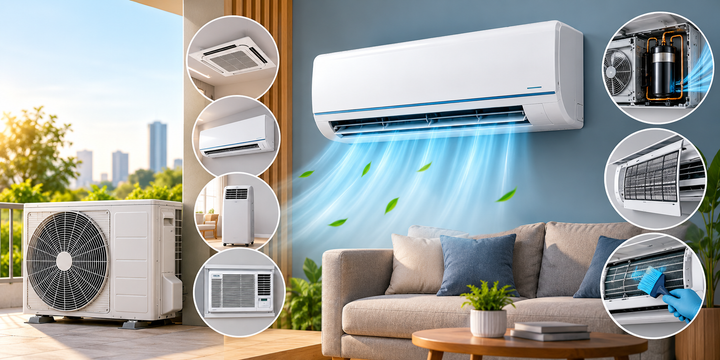
Types of Inverter AC Systems
Inverter technology describes compressor control, not a single physical AC design. The following categories distinguish common installation configurations from the cooling or heating capabilities of the equipment.
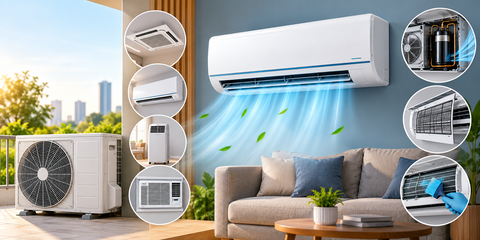
Inverter Split AC
A split inverter AC has an indoor unit and an outdoor unit connected by refrigerant piping and electrical connections. It is commonly used in bedrooms, living rooms, offices, and other individual spaces.
Advantages:
Indoor and outdoor components are separated.
Variable-speed compressor operation supports changing cooling demand.
Many models provide quiet indoor operation and multiple control modes.
Inverter Window AC
A window inverter AC houses its main refrigeration components in one integrated unit installed in a suitable window or wall opening. Availability varies by market.
Advantages:
Integrated construction can simplify some installation arrangements.
Variable-speed operation is available in selected models.
Suitable for certain rooms where a window-style unit is practical.
Multi-Split Inverter AC
A multi-split system connects multiple indoor units to a shared outdoor unit. Depending on the system design, the indoor units may serve separate rooms or zones with different temperature settings.
Advantages:
Multiple spaces can be served by a shared outdoor unit.
Individual indoor units may provide separate zone control.
Can reduce the number of outdoor units required.
Ducted Inverter AC
A ducted inverter system distributes conditioned air through ducts to multiple outlets. It is used in applications where concealed air distribution and more centralized room conditioning are desired.
Advantages:
Air can be distributed to several areas.
Indoor equipment can be concealed.
Variable-capacity operation can adapt to changing thermal demand when the controls support it.
Inverter Heat Pump AC
A heat-pump AC can reverse the refrigeration cycle to provide heating as well as cooling. Inverter control allows compressor output to adapt to the heating or cooling demand.
Advantages:
Provides cooling and heating in supported operating conditions.
Can reduce reliance on separate heating equipment.
Offers variable-capacity operation in both modes, depending on model design.
Inverter AC Type Comparison
Type | Installation Configuration | Typical Use | Main Consideration |
|---|---|---|---|
Split inverter AC | Separate indoor and outdoor units | Individual rooms | Requires suitable outdoor-unit placement |
Window inverter AC | Integrated unit | Individual rooms | Requires a compatible opening |
Multi-split inverter AC | Multiple indoor units connected to a shared outdoor unit | Multiple rooms | Indoor units may have shared capacity limits |
Ducted inverter AC | Central unit with ductwork | Multiple areas | Requires space for ducts and suitable air distribution |
Inverter heat pump AC | Varies by configuration | Cooling and heating | Heating performance depends on outdoor conditions and model |
These categories can overlap. For example, a split AC may also be a heat pump, and a ducted system may use inverter compressor technology.
Inverter AC Energy Efficiency and Operating Requirements
Cooling Capacity and Room Size
Cooling capacity describes how much heat an air conditioner can remove over a given period. It must be appropriate for the room's dimensions, ceiling height, insulation, window area, sunlight exposure, occupancy, and equipment heat loads.
An undersized AC may struggle to maintain the target temperature during hot weather. An oversized system may operate inefficiently or manage humidity poorly under some conditions, even if it has inverter technology. A room-specific cooling-load assessment is more reliable than choosing capacity from floor area alone.
Energy Efficiency Ratings
Energy efficiency ratings help compare air conditioners under defined test conditions. The relevant metric varies by country and equipment category.
In India, the Bureau of Energy Efficiency uses the Indian Seasonal Energy Efficiency Ratio (ISEER) for covered room air conditioners. Other markets may use seasonal efficiency ratings or standardized cooling-efficiency metrics appropriate to their regulations.
When comparing inverter AC models, check the rating label, annual energy consumption where provided, cooling capacity, and the rating's applicable validity period. A higher efficiency rating generally indicates better performance under the relevant test method, but actual electricity use also depends on operating conditions.
Electrical Supply
An inverter AC contains power electronics that regulate compressor operation. Its electrical requirements depend on the model, rated capacity, and local supply conditions.
The installation should use a suitable electrical circuit, protective devices, grounding, and wiring in accordance with the manufacturer's instructions and local electrical requirements. A qualified electrician should assess circuit suitability rather than relying on a generic assumption about power consumption.
Refrigerant Selection
Refrigerants transfer heat through the refrigeration cycle. The refrigerant used by an AC depends on its design and market.
R-32 and R-410A are found in some air conditioning systems, while other refrigerants are used in newer or region-specific equipment. Refrigerants differ in operating characteristics, environmental impact, and safety classification. Some are mildly flammable, so installation and servicing procedures must match the equipment's refrigerant and applicable safety requirements.
Installation Quality
Even an efficient inverter AC can perform poorly if installation is incorrect. Refrigerant piping, insulation, condensate drainage, outdoor-unit clearance, electrical connections, and commissioning all affect system performance.
The installer should follow the manufacturer's procedures for piping, leak testing, evacuation, refrigerant charging where necessary, and operational checks. Improper refrigerant handling can damage equipment and create safety or environmental risks.
Inverter AC vs Non-Inverter AC
The main difference between inverter and conventional fixed-speed AC systems is how compressor capacity is controlled. A fixed-speed compressor generally runs at its operating speed when cooling is required and stops when the thermostat is satisfied. An inverter compressor can vary its speed to match the load more closely.
Feature | Inverter AC | Fixed-Speed AC |
|---|---|---|
Compressor operation | Variable speed within design limits | Generally fixed operating speed |
Temperature regulation | Can maintain temperature with smaller output adjustments | Uses compressor on/off cycling |
Partial-load efficiency | Often advantageous under suitable conditions | Depends on cycling and system efficiency |
Startup behavior | Can ramp compressor output | Typically starts at its operating speed |
Noise | May operate more quietly at lower speeds | Cycling and operating speed can be more noticeable |
Purchase considerations | Electronics and model features affect complexity | Control arrangement may be simpler |
Maintenance | Requires attention to both refrigeration and electronic controls | Requires refrigeration and conventional control maintenance |
Actual energy use | Depends on load, sizing, and operating conditions | Also depends on load, sizing, and operating conditions |
An inverter AC is not automatically more economical in every situation. The difference in total ownership cost depends on usage, local electricity tariffs, installation requirements, equipment efficiency, and the initial purchase cost.
Benefits and Advantages of Inverter AC Systems
Potentially Lower Electricity Consumption
Variable-speed compressor operation can reduce energy waste associated with repeated starts and stops. Savings are most likely to depend on partial-load operation, equipment efficiency, and how long the system runs.
More Consistent Indoor Temperatures
An inverter AC can adjust its output as the cooling demand changes. This may reduce temperature swings associated with repeated compressor cycling.
Flexible Cooling Output
The system can respond to changes in sunlight, occupancy, outdoor temperature, and internal heat generation without always operating at full output.
Potentially Reduced Operating Noise
When cooling demand is low, the compressor and fans may run at lower speeds. Actual noise levels depend on the unit's design, mounting, airflow, and installation quality.
Support for Longer Operating Periods
Variable-speed control can be useful in spaces that need extended air conditioning, including homes, offices, and certain commercial environments. The value depends on the climate and the system's operating profile.
Heating Capability in Heat-Pump Models
An inverter heat-pump AC can provide heating as well as cooling. This can be useful in climates with both seasonal cooling and heating needs, subject to the equipment's operating limits.
Applications of Inverter AC Systems
Residential Buildings
Bedrooms, living rooms, and other occupied spaces can benefit from variable-capacity cooling when the AC is appropriately sized. Quiet operation and temperature stability may be useful where systems run for long periods.
Offices and Commercial Spaces
Offices often experience changing occupancy and equipment heat loads throughout the day. Inverter AC systems can adjust output as these loads change, although multi-zone or central systems may be more suitable for larger buildings.
Retail and Hospitality
Shops, hotels, restaurants, and similar facilities may have fluctuating occupancy, lighting loads, and door openings. System selection should account for these variations and the need to maintain comfortable indoor conditions.
Educational Facilities
Classrooms and administrative areas may require cooling that changes with occupancy and outdoor weather. Correct capacity, ventilation, and maintenance are important for consistent operation.
Small Commercial and Technical Rooms
Some equipment rooms and small commercial spaces require stable temperature control. The AC must be selected according to the equipment heat load, allowable temperature range, humidity requirements, and reliability needs. Standard comfort AC units are not automatically appropriate for critical environments.
Inverter AC Industry and Application Comparison
Application | Common Requirement | Selection Priority |
|---|---|---|
Bedroom | Quiet and consistent cooling | Noise, capacity, and efficiency |
Living room | Variable occupancy and heat gain | Cooling-load assessment |
Office | Changing daily cooling demand | Efficiency and control flexibility |
Retail space | Frequent occupancy changes | Capacity and air distribution |
Hotel room | Individual room comfort | Noise and room-level control |
Classroom | Occupancy-related heat loads | Capacity and ventilation |
Equipment room | Temperature control for electronics | Heat-load assessment and reliability |
An AC system does not replace fresh-air ventilation where ventilation is required. Indoor air quality must be addressed through suitable ventilation and filtration arrangements in addition to temperature control.
Industry Standards and Safety for Inverter AC Systems
Air conditioner safety and performance requirements vary by country, equipment configuration, refrigerant, and installation environment. Product standards address matters such as construction, electrical safety, cooling capacity, performance testing, and energy consumption.
IS 1391 for Room Air Conditioners
In India, IS 1391 covers room air conditioners, with Part 1 addressing unitary air conditioners and Part 2 addressing split air conditioners. The 2023 editions include requirements relevant to product construction, safety, and performance testing.
Bureau of Energy Efficiency Star Labelling
The Bureau of Energy Efficiency administers India's standards and labelling programme for covered room air conditioners. The label provides energy-performance information that helps consumers compare eligible models. Rating criteria and label validity should be checked for the specific model and applicable period.
ISO 16358 for Seasonal Performance
The ISO 16358 series establishes test and calculation methods for seasonal performance factors of specified air-cooled air conditioners and air-to-air heat pumps. Standardized testing helps compare equipment under defined conditions.
Refrigerant and Electrical Safety
Installation and maintenance must follow the equipment manufacturer's requirements and applicable electrical and refrigerant safety regulations. Refrigerant handling, electrical repairs, and work involving inverter power electronics should be performed by appropriately qualified technicians.
Common Inverter AC Problems and Solutions
Problem | Possible Cause | Recommended Action |
|---|---|---|
AC is not cooling effectively | Dirty filters, restricted airflow, unsuitable settings, or a refrigeration fault | Check settings and clean accessible filters; arrange diagnosis if the problem continues |
Electricity consumption seems high | High heat load, incorrect sizing, poor maintenance, or extended operation | Review operating settings, airflow, and equipment condition |
Water leaks from the indoor unit | Blocked drain, drainage installation issue, or coil icing | Stop operation if leakage is significant and arrange inspection |
Outdoor unit makes unusual noise | Loose components, fan obstruction, vibration, or mechanical fault | Switch off if the noise is severe and arrange professional inspection |
AC repeatedly stops operating | Protection controls, supply issues, sensor faults, or equipment malfunction | Record any displayed error code and request qualified diagnosis |
Cooling varies unexpectedly | Changing room load, sensor problems, or airflow restrictions | Check filters and settings; seek service if operation remains abnormal |
Indoor air feels humid | Incorrect sizing, short operating cycles, or unsuitable settings | Review sizing and operating conditions with a qualified technician |
Remote control does not operate the unit | Battery, signal, or control issue | Check the remote batteries and the manufacturer's troubleshooting instructions |
These symptoms do not establish a single diagnosis. Inverter ACs contain electrical and refrigeration components that may require specialized test equipment, so internal repairs should not be attempted without appropriate training.
How to Choose an Inverter AC
Selecting an inverter AC involves more than comparing advertised cooling capacity or energy ratings. The right system should match the room's calculated cooling demand, the local climate, operating schedule, electrical supply, and installation constraints.
Selection Factor | What to Check | Why It Matters |
|---|---|---|
Room cooling load | Room dimensions, ceiling height, sunlight, insulation, and occupancy | Determines appropriate cooling capacity |
Energy efficiency | Applicable seasonal rating and energy label | Supports meaningful efficiency comparisons |
Compressor range | Minimum and maximum operating capacity where specified | Indicates how the system adapts to changing loads |
Refrigerant | Refrigerant type and applicable safety requirements | Affects servicing, environmental impact, and installation |
Noise levels | Published indoor and outdoor sound ratings | Helps assess suitability for bedrooms and quiet spaces |
Operating climate | Rated cooling and heating limits | Affects performance during temperature extremes |
Filtration | Filter design and maintenance requirements | Helps manage particles passing through the AC |
Electrical requirements | Supply voltage, circuit capacity, and protective devices | Supports safe and reliable operation |
Installation conditions | Piping route, drainage, mounting, and outdoor airflow | Influences system performance and durability |
Warranty and support | Coverage terms and authorized technical support | Helps plan future maintenance and repairs |
Controls | Timer, sleep mode, remote control, and connectivity where available | Matches day-to-day operating preferences |
For Indian households, compare the current BEE star label and ISEER rating among models of comparable capacity. In other markets, use the local energy label and relevant seasonal performance metric. Compare specifications under the same rating framework rather than treating different regional ratings as directly interchangeable.
Inverter AC Maintenance Best Practices
Regular maintenance helps preserve airflow, heat transfer, drainage, and system reliability. The appropriate maintenance schedule depends on the operating environment, dust levels, usage, and manufacturer recommendations.
Clean the Air Filters
Inspect accessible indoor filters at the intervals specified in the user manual. Dust buildup can restrict airflow and reduce cooling performance. Washable filters should be cleaned and dried according to the manufacturer's instructions before being reinstalled.
Keep the Outdoor Unit Clear
Remove loose debris from around the outdoor unit and maintain the required clearance for air circulation. Do not place objects against the coil or obstruct the fan outlet. Electrical components and internal panels should remain untouched unless handled by a qualified technician.
Maintain the Heat Exchanger Coils
Dust and dirt on the indoor evaporator or outdoor condenser can reduce heat transfer. Coil cleaning methods must be compatible with the equipment and its materials. Deep cleaning, fin repair, and work requiring access to internal components may need professional attention.
Check Condensate Drainage
During cooling, moisture removed from indoor air drains away through the condensate system. Inspect for visible leakage and drainage problems. Persistent water leakage may indicate a blockage, installation fault, or icing that needs investigation.
Monitor Cooling Performance
Notice changes in cooling time, airflow, operating noise, and displayed fault codes. Comparing these observations with normal operation can help identify developing issues, although they cannot replace technical diagnosis.
Arrange Periodic Professional Inspection
A qualified technician can assess refrigerant-circuit condition, electrical connections, sensors, fan operation, and system performance. Refrigerant should not be added simply because cooling has declined; the underlying cause should be identified first.
Protect the Electrical Supply
Use electrical protection and grounding appropriate to the manufacturer's requirements and local regulations. Repeated power interruptions, abnormal electrical behavior, or burning smells require prompt attention. Switch off the equipment when it is safe to do so and arrange qualified inspection.
Limitations of Inverter AC Technology
Inverter technology offers variable-capacity operation, but it does not remove every limitation of conventional air conditioning.
Higher initial purchase cost may apply: The difference varies by market, capacity, configuration, and model.
Electronic controls add complexity: Inverter drives and control boards may require specialized diagnosis.
Efficiency depends on conditions: Actual energy use varies with outdoor temperature, room heat gain, setpoint, maintenance, and operating duration.
Incorrect sizing remains a problem: Variable-speed control cannot fully compensate for an AC that is unsuitable for the room's cooling load.
Extreme weather affects performance: Cooling or heating capacity can change outside the unit's rated operating conditions.
Maintenance is still necessary: Filters, coils, fans, and drainage require regular attention.
Refrigerants have environmental and safety considerations: Leakage prevention, correct handling, and suitable equipment design remain essential.
Power interruptions can affect operation: The unit must operate within its specified electrical supply conditions and may need appropriate protection against supply disturbances.
An inverter AC should therefore be judged by its complete design, tested performance, installation requirements, and suitability for the intended space.
Future Trends in Inverter AC Technology
More Advanced Compressor Control
Improved motor drives and control algorithms can help systems adapt compressor output to changing indoor and outdoor conditions. The practical benefit depends on the compressor's operating range and the quality of the overall system design.
Lower-Impact Refrigerants
Refrigerant selection is evolving in response to environmental regulations and climate considerations. Newer equipment may use refrigerants with lower global warming potential, subject to regional requirements and appropriate safety measures.
Connected Controls and Energy Monitoring
Some inverter AC models support remote monitoring, scheduling, and integration with connected-home systems. These features can help users manage operating schedules, although connectivity alone does not guarantee lower electricity consumption.
Better Seasonal Performance
Product development continues to focus on improving heat exchangers, fan motors, compressor control, and system-level efficiency. Standardized seasonal testing helps distinguish meaningful efficiency improvements from differences in marketing terminology.
Smarter Fault Detection
Electronic monitoring can help identify abnormal temperatures, operating conditions, and component faults. Diagnostic capabilities vary by model, and electronic alerts do not eliminate the need for qualified inspection.
Frequently Asked Questions About Inverter AC Systems
1. What is an inverter AC, and how does it work?
An inverter AC uses electronic controls to vary compressor speed according to cooling demand. It circulates refrigerant through an evaporation, compression, condensation, and expansion cycle to transfer heat out of the room.
2. Is an inverter AC more energy-efficient than a non-inverter AC?
An inverter AC can use less electricity when variable-speed operation matches the cooling load effectively. Actual performance depends on equipment efficiency, sizing, climate, thermostat settings, and operating duration.
3. Which inverter AC is suitable for a bedroom?
A suitable bedroom AC should match the room's cooling load and have appropriate noise ratings, airflow control, and energy efficiency. Room dimensions, sunlight, insulation, and occupancy should be considered before selecting its capacity.
4. What does a star rating mean for an inverter AC?
A star rating communicates energy performance under the applicable rating programme. In India, the BEE label includes efficiency information such as ISEER and other model details, allowing comparisons between eligible products under the relevant labelling rules.
5. Does an inverter AC cool a room faster?
Cooling speed depends on the unit's available cooling capacity, room heat load, airflow, and outdoor conditions. An inverter AC may increase compressor output when needed, but it is not necessarily faster than every fixed-speed model.
6. Can an inverter AC operate continuously?
An inverter AC can run for extended periods at variable compressor speeds when operating conditions permit. Continuous operation should remain within the manufacturer's specifications, with suitable maintenance and correct installation.
7. Which refrigerant is used in inverter AC systems?
The refrigerant varies by model and market. R-32 and R-410A are used in some systems, while other refrigerants may be found in newer equipment; the unit's nameplate identifies the specified refrigerant.
8. How often should an inverter AC be serviced?
Accessible air filters should be checked and cleaned according to the manufacturer's instructions and the level of dust in the environment. Professional maintenance frequency depends on usage, operating conditions, and the manufacturer's maintenance schedule.
9. Why is my inverter AC running but not cooling properly?
Possible causes include dirty filters, restricted airflow, unsuitable temperature settings, outdoor-unit obstruction, sensor problems, or a refrigeration fault. Check the user-accessible items described in the manual and arrange qualified diagnosis if the problem persists.
10. Can an inverter AC provide heating as well as cooling?
Yes, if it is designed as a heat-pump model with a reversing refrigeration cycle. A cooling-only inverter AC does not automatically provide heating, so the product specifications must confirm this capability.
Conclusion
An inverter AC adjusts compressor speed to match changing cooling demand, offering the potential for better energy efficiency, more consistent temperatures, and quieter operation under suitable conditions. Choosing the right model requires attention to cooling capacity, seasonal efficiency ratings, refrigerant, installation quality, and local operating conditions. Regular filter cleaning, unobstructed airflow, drainage checks, and qualified maintenance help preserve performance and reliability.