Discover Liquid Filling Machines for Advanced Packaging Line Performance
Liquid filling machines are industrial packaging systems designed to dispense liquids into containers with controlled speed, volume, and accuracy. These systems are widely used across industries including food processing, beverages, pharmaceuticals, cosmetics, chemicals, household products, and personal care manufacturing. Modern filling machines can handle products ranging from water and oils to syrups, detergents, creams, and sterile pharmaceutical liquids.
In recent years, the comparison and evaluation of liquid filling technologies have become increasingly important due to growing automation demands, sustainability goals, labor shortages, and stricter packaging quality standards. Manufacturers are focusing on improving production efficiency while reducing product waste, downtime, and operational errors. As packaging lines become more connected through smart manufacturing systems, liquid filling equipment now plays a critical role in maintaining consistent output and traceability.
Current trends include the adoption of sensor-based monitoring, servo-driven systems, clean-in-place (CIP) technology, and integration with Industrial Internet of Things (IIoT) platforms. Businesses are also exploring flexible filling systems capable of handling multiple container sizes and product viscosities without extensive line modifications. These developments are influencing packaging productivity, maintenance planning, and long-term operational efficiency across global manufacturing environments.
Who It Affects and What Problems It Solves
Liquid filling machines affect a broad range of industries that rely on packaged liquid products. Beverage producers use them for bottled drinks, dairy products, and flavored liquids. Pharmaceutical companies depend on precision filling systems for dosage accuracy and contamination control. Cosmetic manufacturers use filling machines for lotions, shampoos, perfumes, and creams, while chemical and household product companies apply them in detergent, cleaning fluid, and industrial liquid packaging.
The technology also impacts warehouse operations, logistics planning, packaging suppliers, maintenance teams, and quality assurance departments. Automated liquid filling systems can influence production scheduling, inventory management, and compliance monitoring. Small manufacturers may use semi-automatic systems for moderate production volumes, while large-scale operations often rely on fully automated high-speed filling lines integrated with capping, labeling, and inspection systems.
Common Problems Solved by Liquid Filling Machines
| Operational Challenge | How Filling Machines Help |
|---|---|
| Inconsistent product volume | Uses calibrated filling controls for accurate dispensing |
| Product wastage | Reduces spills, overfilling, and leakage |
| Slow packaging speed | Automates repetitive filling tasks |
| Labor-intensive operations | Minimizes manual handling requirements |
| Contamination risks | Supports hygienic and sterile filling processes |
| Packaging line downtime | Integrates monitoring and maintenance alerts |
| Container variability | Handles different bottle sizes and formats |
| Regulatory compliance issues | Enables traceability and batch consistency |
Advanced systems are especially valuable in environments where precision, sanitation, and production continuity are essential. In pharmaceutical and food manufacturing, even small inconsistencies can affect safety, shelf life, or regulatory compliance. Automated filling technology helps reduce these operational risks while improving production scalability.
Recent Updates and Industry Trends
The liquid filling machine industry has seen significant technological changes over the past year, particularly in automation, sustainability, and digital manufacturing integration.
Growth of Smart Packaging Lines
Manufacturers are increasingly deploying smart sensors and connected monitoring systems to improve real-time visibility across packaging operations. Modern filling equipment can now monitor fill accuracy, detect container misalignment, and automatically adjust operating parameters during production runs. These features help reduce downtime and improve predictive maintenance planning.
Rising Demand for Flexible Filling Systems
Consumer product companies are expanding product variations, packaging formats, and limited-edition releases. As a result, manufacturers are investing in flexible filling systems capable of quick format changes. Servo-controlled machines and modular platforms are becoming more common because they support rapid adjustments with reduced mechanical downtime.
Sustainability and Material Efficiency
Packaging sustainability remains a major focus area. Companies are attempting to reduce material waste, optimize container usage, and improve energy efficiency within production facilities. Filling systems are now being designed to minimize product loss during nozzle operation and cleaning cycles. Some equipment manufacturers are also developing systems compatible with recyclable and lightweight packaging materials.
Increased Use of Robotics and AI
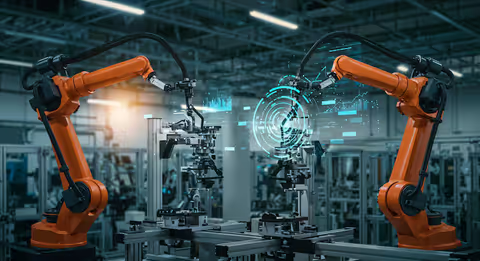
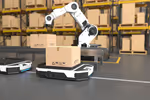
Robotics integration has expanded in high-volume packaging environments. Automated container handling, inspection systems, and machine learning-based quality checks are improving operational consistency. AI-supported systems can analyze production data to identify inefficiencies or predict maintenance needs before failures occur.
Hygienic and Sterile Packaging Improvements
Food, beverage, and pharmaceutical sectors continue to invest heavily in sanitary filling technologies. Aseptic filling systems, CIP technologies, and contamination-resistant machine designs are receiving increased attention due to stricter hygiene expectations and global supply chain quality requirements.
Comparison Table: Types of Liquid Filling Machines
| Filling Machine Type | Best For | Filling Method | Advantages | Limitations |
|---|---|---|---|---|
| Gravity Fillers | Water-like liquids | Gravity flow | Simple design, low maintenance | Limited for thick products |
| Piston Fillers | Thick liquids and creams | Piston displacement | High accuracy for viscous products | More cleaning requirements |
| Overflow Fillers | Transparent containers | Overflow mechanism | Uniform visual fill levels | Product recirculation needed |
| Pump Fillers | Diverse liquid viscosities | Pump-controlled | Flexible applications | Complex calibration |
| Vacuum Fillers | Glass bottles and specialty liquids | Vacuum pressure | Reduced spills and foaming | Slower operation |
| Net Weight Fillers | High-value liquids | Weight-based filling | Precise measurement | Higher equipment cost |
| Aseptic Fillers | Pharmaceutical and sterile products | Sterile environment filling | Hygiene-focused operations | Strict maintenance standards |
Performance Factors in Packaging Line Operations
Filling Accuracy
Accuracy directly affects product consistency, customer satisfaction, and regulatory compliance. High-speed production lines require precise control systems to maintain target fill volumes without overfilling or underfilling.
Production Speed
Packaging efficiency often depends on the balance between speed and accuracy. Fully automated rotary filling systems can process thousands of containers per hour, while smaller inline systems are better suited for medium-scale production.
Product Compatibility
Different liquid viscosities require different filling methods. Thin liquids like water behave differently compared to syrups, gels, oils, or foaming beverages. Selecting the correct filling technology helps maintain product integrity and packaging quality.
Maintenance Requirements
Routine cleaning and maintenance influence machine uptime and long-term reliability. Hygienic industries often prioritize easy-access machine designs and automated cleaning systems.
Integration Capability
Modern production facilities frequently connect filling systems with labeling machines, conveyor systems, inspection equipment, and warehouse management software. Integration capability has become a key purchasing and operational consideration.
Laws, Regulations, and Industry Policies
Liquid filling operations are influenced by packaging, safety, sanitation, environmental, and manufacturing regulations in many countries. The exact requirements vary by industry and product category.
Food and Beverage Regulations
Food-grade filling systems must comply with sanitation and contamination prevention standards. Regulatory agencies in multiple countries require manufacturers to follow hygiene protocols, traceability procedures, and safe material handling practices. Stainless steel contact surfaces, sterile piping systems, and cleaning validation procedures are commonly required.
Pharmaceutical Compliance
Pharmaceutical filling lines are typically subject to Good Manufacturing Practice (GMP) guidelines and strict documentation requirements. Sterile filling operations may require cleanroom environments, environmental monitoring, and batch tracking systems.
Environmental and Sustainability Policies
Governments and environmental agencies are encouraging manufacturers to reduce packaging waste and improve energy efficiency. Packaging lines increasingly incorporate recyclable materials, lightweight containers, and energy-efficient automation systems.
Worker Safety Regulations
Industrial filling operations must follow workplace safety rules involving machine guarding, electrical safety, chemical handling, and emergency shutdown procedures. Automation can reduce repetitive manual tasks, but operators still require proper training and monitoring.
Practical Guidance for Different Situations
| Manufacturing Situation | Recommended Approach |
|---|---|
| Small-scale startup production | Semi-automatic inline filling systems |
| High-volume beverage production | Rotary automated filling systems |
| Pharmaceutical packaging | Aseptic or sterile filling equipment |
| Thick cosmetic products | Piston filling systems |
| Multi-product operations | Flexible modular filling platforms |
| Sustainability-focused facilities | Energy-efficient and low-waste systems |
Tools and Resources for Liquid Filling Operations
Several tools and digital resources help manufacturers evaluate, operate, and optimize filling systems more effectively.
Production Monitoring Software
Manufacturing execution systems (MES) and packaging analytics platforms help track line performance, downtime, and production output. These systems improve visibility into operational efficiency.
Viscosity Measurement Tools
Viscosity testing equipment helps manufacturers determine which filling technology is suitable for a specific product type. Accurate viscosity data supports proper machine selection and calibration.
Preventive Maintenance Platforms
Digital maintenance management software allows facilities to schedule inspections, monitor spare parts, and track equipment performance trends over time.
Packaging Line Simulation Tools
Simulation software enables engineers to test line configurations and throughput scenarios before physical installation. This helps reduce costly production adjustments later.
Industry Standards and Technical Resources
Organizations related to packaging engineering, food safety, and industrial automation provide technical documentation, compliance guidance, and operational best practices for filling systems.
Useful Resource Categories
- Packaging automation software
- Production efficiency calculators
- Viscosity testing guides
- Industrial IoT dashboards
- Preventive maintenance templates
- Packaging line audit checklists
- Regulatory compliance documentation
- Energy consumption monitoring tools
Frequently Asked Questions
What is the main purpose of a liquid filling machine?
A liquid filling machine is designed to dispense precise amounts of liquid products into containers efficiently and consistently during packaging operations.
Which industries use liquid filling equipment the most?
Food and beverage, pharmaceuticals, cosmetics, chemicals, and household product industries are among the largest users of liquid filling systems.
How do companies choose the right filling machine?
Selection usually depends on production speed, liquid viscosity, container type, hygiene requirements, automation level, and budget considerations.
What is the difference between automatic and semi-automatic filling machines?
Semi-automatic systems require some operator involvement, while automatic systems handle filling processes with minimal manual intervention and higher production speeds.
Why is filling accuracy important in packaging?
Accurate filling reduces product waste, supports regulatory compliance, maintains product consistency, and helps improve consumer trust.
Conclusion
Liquid filling machines have become a central component of advanced packaging line performance across multiple industries. As manufacturing environments continue shifting toward automation, data-driven production, and sustainability-focused operations, filling technology is evolving beyond simple dispensing equipment into a connected operational system.
Recent developments in smart sensors, AI-assisted monitoring, servo controls, and hygienic engineering are improving efficiency, flexibility, and production reliability. Businesses are increasingly selecting filling technologies based not only on speed but also on integration capability, maintenance efficiency, sustainability performance, and regulatory compliance.
For organizations evaluating packaging upgrades, the most effective approach depends on product characteristics, operational scale, hygiene requirements, and long-term production goals. High-volume facilities may benefit from fully automated rotary systems, while flexible modular platforms can better support diversified product lines. Data from manufacturing and packaging sectors consistently shows that automation investments can improve consistency, reduce waste, and support scalable production strategies when properly implemented.