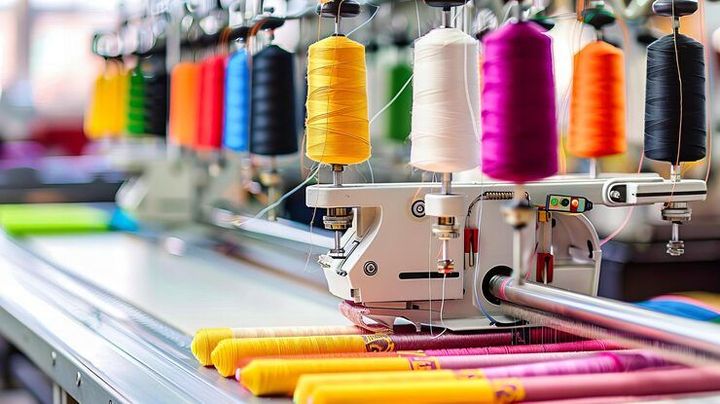
Textile Manufacturing Machines: Guide to Industrial Fabric Processing Systems
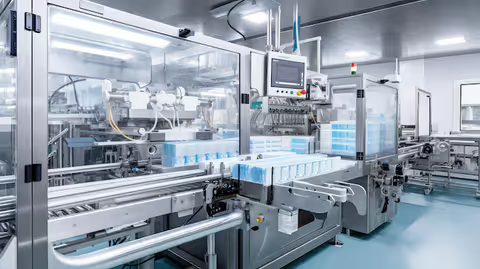
Textile manufacturing machines are specialized industrial systems used to transform raw fibers into yarn, fabric, and finished textile products. These machines play a critical role in modern textile production by improving efficiency, consistency, and production capacity.
The textile industry relies on a wide range of equipment to perform processes such as spinning, weaving, knitting, dyeing, printing, and finishing. As global demand for textiles continues to grow, manufacturers increasingly depend on advanced machinery and industrial automation equipment to maintain quality standards and optimize operations.
From small-scale production facilities to large industrial plants, textile manufacturing machines support the creation of clothing, home furnishings, technical textiles, automotive fabrics, and many other products used in daily life.
Understanding Textile Manufacturing Machines
Textile manufacturing machines are designed to handle different stages of textile production. Each machine performs a specific task, contributing to the overall manufacturing workflow.
The production process typically begins with fiber preparation and continues through yarn production, fabric formation, dyeing, finishing, and inspection. Modern machinery integrates sensors, digital controls, and automated systems to enhance productivity and reduce operational errors.
These machines are engineered to operate continuously while maintaining precision and uniformity across large production volumes.
Major Types of Textile Manufacturing Machines
Spinning Machines
- Convert natural or synthetic fibers into yarn
- Improve yarn strength and consistency
- Support high-volume production
- Commonly used in cotton, wool, and synthetic fiber processing
Weaving Machines
- Interlace yarns to create woven fabrics
- Produce various fabric patterns and structures
- Available in manual, semi-automatic, and automated configurations
- Widely used in apparel and industrial textiles
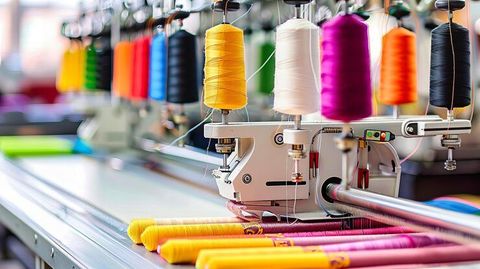
Knitting Machines
- Create fabrics through interconnected loops of yarn
- Produce stretchable and flexible textiles
- Used for garments, sportswear, and technical fabrics
- Available in circular and flat knitting designs
Dyeing Machines
- Apply color to fibers, yarns, or fabrics
- Ensure uniform color distribution
- Support various dyeing methods
- Improve production consistency
Printing Machines
- Transfer patterns, graphics, and designs onto textiles
- Utilize digital and conventional printing technologies
- Enable high-resolution textile decoration
- Support customized production requirements
Finishing Machines
- Enhance fabric appearance and performance
- Improve softness, durability, and texture
- Apply coatings and special treatments
- Prepare textiles for final use
Textile Manufacturing Process and Associated Machines
| Production Stage | Primary Machine Type | Main Function |
|---|---|---|
| Fiber Preparation | Opening and Cleaning Machines | Remove impurities and prepare fibers |
| Spinning | Spinning Machines | Convert fibers into yarn |
| Fabric Formation | Weaving or Knitting Machines | Produce fabric structures |
| Dyeing | Dyeing Equipment | Apply color treatments |
| Printing | Textile Printing Machines | Add patterns and graphics |
| Finishing | Finishing Machines | Improve fabric properties |
| Inspection | Quality Control Systems | Detect defects and ensure standards |
How Modern Textile Manufacturing Machines Work
Modern textile machinery incorporates advanced technologies that improve operational efficiency and production accuracy.
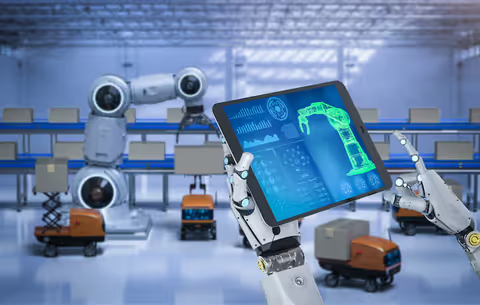
Digital controllers manage machine settings, while sensors monitor temperature, speed, tension, and material movement. Automated systems can adjust operating parameters in real time to maintain product quality.
Industrial automation equipment enables machine-to-machine communication, allowing production facilities to track performance and identify maintenance needs before equipment failures occur.
Many modern textile plants also use centralized monitoring systems that provide operators with production data through digital dashboards.
Importance of Textile Manufacturing Machines
Textile manufacturing machines are essential because they support large-scale production while maintaining quality and consistency.
Key Benefits
- Increased production efficiency
- Improved fabric quality
- Reduced material waste
- Enhanced workplace safety
- Greater production flexibility
- Better resource utilization
- Consistent product specifications
- Faster manufacturing cycles
Without modern machinery, meeting the demands of global textile markets would be significantly more challenging.
Real-World Applications
Textile manufacturing machines support numerous industries beyond apparel production.
Apparel Industry
- Shirts
- Trousers
- Sportswear
- Fashion garments
- Uniforms
Home Textile Industry
- Curtains
- Bedding products
- Upholstery fabrics
- Towels
- Decorative textiles
Automotive Industry
- Seat fabrics
- Interior coverings
- Airbag materials
- Acoustic insulation textiles
Healthcare Industry
- Medical fabrics
- Surgical textiles
- Protective clothing
- Hygiene products
Industrial Applications
- Geotextiles
- Filtration materials
- Protective fabrics
- Reinforcement textiles
These applications demonstrate the broad impact of textile machinery across multiple sectors.
Challenges Solved by Textile Manufacturing Machines
Modern machinery addresses several production challenges that manufacturers commonly face.
Production Challenges Addressed
- Inconsistent product quality
- Labor-intensive processes
- Material waste
- Production delays
- Limited scalability
- Complex fabric requirements
- Quality control issues
- Equipment reliability concerns
Advanced automation and monitoring technologies help manufacturers overcome these obstacles while improving overall productivity.
Key Components Found in Modern Textile Machinery
Most textile manufacturing machines contain several important components that ensure efficient operation.
Core Components
- Electric motors
- Drive systems
- Control panels
- Sensors and monitoring devices
- Feeding mechanisms
- Tension control systems
- Programmable logic controllers (PLCs)
- Human-machine interfaces (HMIs)
These components work together to maintain precision and operational stability.
Recent Trends and Developments (2025–2026)
The textile machinery industry has experienced significant technological advancement over the past year.
Smart Manufacturing Adoption (2025–2026)
Manufacturers are increasingly implementing Industry 4.0 technologies, enabling connected smart factories with real-time production monitoring and predictive maintenance capabilities.
AI-Assisted Quality Inspection (2025–2026)
Artificial intelligence systems are being integrated into inspection equipment to identify fabric defects more accurately and reduce manual inspection requirements.
Energy-Efficient Machinery (2025–2026)
Machine manufacturers continue developing equipment designed to reduce electricity consumption while maintaining production output.
Digital Textile Printing Expansion (2025–2026)
Digital textile printing technology is gaining wider adoption due to improved design flexibility, shorter production cycles, and reduced material waste.
Sustainable Manufacturing Technologies (2025–2026)
The industry is increasingly focusing on water-efficient dyeing systems, recycling technologies, and environmentally responsible production methods.
Regulations and Industry Standards
Textile manufacturers must comply with various regulations and standards depending on their operating regions and product categories.
Common Regulatory Areas
- Workplace safety requirements
- Environmental protection regulations
- Industrial emissions standards
- Energy efficiency guidelines
- Product quality specifications
- Chemical handling requirements
Important Industry Standards
- ISO 9001 Quality Management Systems
- ISO 14001 Environmental Management Systems
- ISO 45001 Occupational Health and Safety Management Systems
- Industry-specific textile testing standards
Compliance helps ensure safe operations and consistent product quality.
Useful Tools and Learning Resources
Professionals interested in textile machinery can benefit from various educational and technical resources.
Learning Resources
- Textile engineering textbooks
- Manufacturing technology publications
- Industrial automation courses
- Technical training programs
- Machinery manufacturer documentation
- Engineering research journals
Software and Digital Tools
- CAD textile design software
- Production monitoring platforms
- Manufacturing execution systems (MES)
- Predictive maintenance software
- Quality management systems
- Industrial automation platforms
These resources help operators, engineers, and managers stay informed about evolving technologies.
FAQs
What are textile manufacturing machines?
Textile manufacturing machines are industrial systems used to convert fibers into yarn, fabric, and finished textile products through processes such as spinning, weaving, knitting, dyeing, and finishing.
Why are automated textile machines important?
Automated machines improve production efficiency, reduce errors, enhance quality consistency, and support large-scale manufacturing operations.
What industries use textile manufacturing machines?
Industries including apparel, healthcare, automotive, home furnishings, construction, and industrial manufacturing rely on textile production equipment.
What is the difference between weaving and knitting machines?
Weaving machines interlace yarns at right angles to create woven fabrics, while knitting machines create fabrics using interconnected loops of yarn.
What are the latest developments in textile machinery?
Recent developments include AI-assisted inspection systems, Industry 4.0 integration, energy-efficient equipment, digital textile printing advancements, and sustainable manufacturing technologies.
Conclusion
Textile manufacturing machines form the foundation of modern textile production. They enable manufacturers to transform raw materials into high-quality textile products efficiently and consistently. From spinning and weaving to dyeing and finishing, each machine contributes to a complex production ecosystem that serves numerous industries worldwide.
Advances in industrial automation equipment, artificial intelligence, digital monitoring, and sustainable manufacturing technologies continue to reshape the textile sector. As production requirements evolve, textile manufacturing machines are becoming smarter, more efficient, and better equipped to support modern industrial demands while maintaining quality, productivity, and environmental responsibility.