Industrial CNC Machines: A Complete Guide to Precision Manufacturing
Industrial CNC machines are advanced manufacturing systems that use computer-controlled instructions to perform machining operations with high precision and consistency. CNC stands for Computer Numerical Control, a technology that automates the movement and operation of machine tools through programmed commands.
These machines are widely used across manufacturing sectors to produce components, parts, and assemblies with accurate dimensions and repeatable quality. From aerospace components to automotive parts and medical devices, CNC technology plays a critical role in modern industrial production.
The primary purpose of industrial CNC machines is to improve accuracy, reduce manual intervention, increase productivity, and support complex manufacturing requirements.
How Industrial CNC Machines Work
A CNC machine follows a digital program created using computer-aided design (CAD) and computer-aided manufacturing (CAM) software. The design is converted into machine-readable instructions known as G-code.
The machine controller interprets these instructions and directs motors, cutting tools, and workpiece movements accordingly.
The typical workflow includes:
Key Steps
- Creating a digital design using CAD software
- Converting the design into machining instructions through CAM software
- Loading the program into the CNC controller
- Securing raw material on the machine
- Executing machining operations automatically
- Inspecting the finished component for quality assurance
This automated process enables manufacturers to achieve consistent production results while minimizing human error.
Main Types of Industrial CNC Machines
Different CNC machines are designed for specific manufacturing operations.
| CNC Machine Type | Primary Function | Common Applications |
|---|---|---|
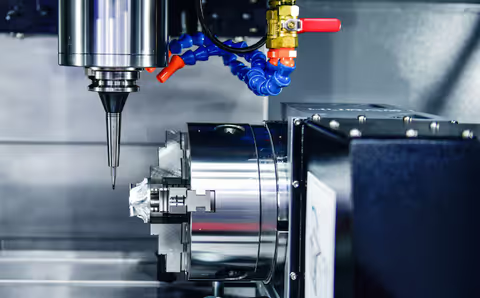
| CNC Milling Machine | Removes material using rotating cutters | Automotive parts, molds |
| CNC Lathe Machine | Rotates workpiece for cutting operations | Shafts, bushings, cylinders |
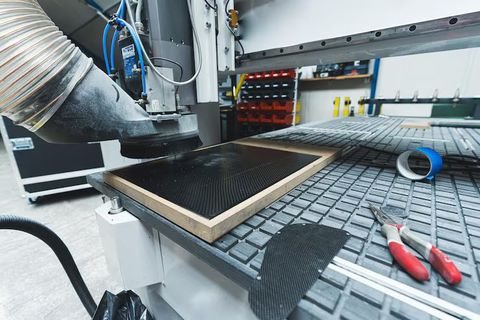
| CNC Router | Cuts and shapes materials | Woodworking, plastics |
| CNC Grinding Machine | Precision surface finishing | Aerospace components |
| CNC Plasma Cutter | Cuts conductive metals | Structural fabrication |
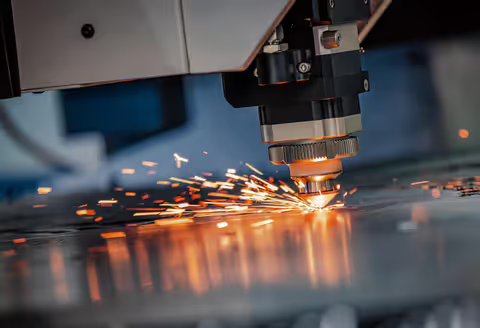
| CNC Laser Cutter | Uses laser beams for cutting | Sheet metal processing |
| CNC EDM Machine | Electrical discharge machining | Complex molds and dies |
Each machine type addresses specific production requirements and material processing needs.
Important Components of CNC Machines
Industrial CNC systems consist of several interconnected components that work together to achieve precise machining.
Major Components
- CNC controller unit
- Machine frame and structure
- Servo motors and drives
- Spindle system
- Cutting tools
- Tool changer mechanism
- Workholding fixtures
- Feedback sensors and encoders
- Human-machine interface (HMI)
- Cooling and lubrication systems
The integration of these components ensures efficient machine operation and reliable production performance.
Why Industrial CNC Machines Are Important
CNC technology has transformed manufacturing by enabling greater precision and automation.
Key Benefits
- High dimensional accuracy
- Consistent product quality
- Faster production cycles
- Reduced material waste
- Improved workplace safety
- Capability to produce complex geometries
- Enhanced production scalability
- Better utilization of manufacturing resources
Manufacturers increasingly rely on CNC machining systems to meet demanding quality standards and production schedules.
Industrial Applications of CNC Machines
Industrial CNC machines support a broad range of industries and manufacturing processes.
Common Applications
- Automotive component manufacturing
- Aerospace part production
- Medical device fabrication
- Electronics enclosure machining
- Industrial equipment manufacturing
- Energy sector components
- Defense manufacturing
- Tool and die production
- Metal fabrication operations
- Consumer product manufacturing
These applications demonstrate the versatility of CNC technology in producing precision-engineered products.
Problems Solved by CNC Technology
Traditional machining methods often face challenges related to accuracy, efficiency, and repeatability.
Challenges Addressed
- Inconsistent manual machining results
- Complex part manufacturing limitations
- Excessive production variability
- Extended production times
- High material scrap rates
- Difficulty maintaining quality standards
- Limited capability for intricate designs
By automating machining operations, CNC systems help organizations overcome these manufacturing obstacles while maintaining operational efficiency.
CNC Machines and Industrial Automation
Industrial automation equipment increasingly incorporates CNC technology as part of smart manufacturing strategies.
Modern CNC systems communicate with production software, robotic systems, and factory management platforms to create integrated manufacturing environments.
Automation Features
- Automated tool changing
- Robotic material handling
- Production monitoring systems
- Real-time machine diagnostics
- Predictive maintenance capabilities
- Remote machine supervision
- Digital workflow integration
These capabilities contribute to higher productivity and improved operational visibility.
Recent Trends and Developments (2025–2026)
The CNC machine industry continues to evolve with advancements in automation, artificial intelligence, and digital manufacturing technologies.
Emerging Trends
- Increased adoption of AI-assisted machining optimization
- Expansion of digital twin technology in manufacturing
- Enhanced machine connectivity through Industrial Internet of Things (IIoT)
- Greater use of predictive maintenance systems
- Integration of advanced analytics platforms
- Growth of hybrid manufacturing combining additive and subtractive processes
- Improved energy-efficient machine designs
- Expansion of cloud-based production monitoring
Developments During 2025–2026
- Manufacturers expanded smart factory implementations using connected CNC machining systems.
- AI-powered process monitoring became more widely integrated into production environments.
- Advanced sensor technologies improved machine health monitoring and predictive maintenance accuracy.
- Sustainability initiatives encouraged adoption of energy-efficient manufacturing equipment.
- Increased cybersecurity measures were implemented to protect connected industrial automation systems.
These developments continue to support the transition toward Industry 4.0 and data-driven manufacturing.
Standards, Regulations, and Compliance Considerations
Industrial CNC machine operations are often subject to safety, quality, and operational standards.
Important Standards
- ISO 9001 Quality Management Systems
- ISO 16090 Safety Requirements for Machine Tools
- ISO 13849 Machine Safety Standards
- IEC 60204 Electrical Safety Standards
- Occupational workplace safety regulations
- Environmental compliance requirements for manufacturing facilities
Organizations must ensure that CNC equipment operation aligns with applicable local and international regulations.
Useful Software, Tools, and Learning Resources
Several software platforms support CNC programming, design, simulation, and machine operation.
Popular CAD and CAM Platforms
- Autodesk Fusion
- SolidWorks
- Mastercam
- Siemens NX
- CATIA
- Creo
- GibbsCAM
- Edgecam
Learning Resources
- Manufacturing engineering textbooks
- Technical training institutes
- CNC programming certification courses
- Industrial automation workshops
- Machine tool manufacturer documentation
- Engineering research journals
- Professional manufacturing associations
Continuous learning helps operators and engineers stay updated with evolving CNC technologies.
Future Outlook of Industrial CNC Machines
The future of CNC machining is closely linked to digital transformation and smart manufacturing initiatives.
Manufacturers are expected to increase adoption of intelligent machining systems capable of autonomous optimization, real-time process adjustment, and advanced data analysis. As computing power and machine connectivity improve, CNC equipment will become more integrated with enterprise production ecosystems.
Emerging technologies such as artificial intelligence, machine learning, digital twins, and industrial cloud platforms are likely to further enhance precision manufacturing capabilities.
Organizations seeking higher productivity, quality control, and operational efficiency will continue to view CNC technology as a foundational element of advanced manufacturing strategies.
FAQs
What is an industrial CNC machine?
An industrial CNC machine is a computer-controlled manufacturing system that automates machining operations such as cutting, drilling, milling, turning, and grinding with high precision.
What industries use CNC machines?
Industries including automotive, aerospace, medical manufacturing, electronics, energy, defense, and industrial equipment production commonly use CNC machines.
What software is used for CNC machining?
CAD software creates digital designs, while CAM software generates machining instructions. Common examples include Fusion, SolidWorks, Mastercam, and Siemens NX.
How does CNC technology improve manufacturing quality?
CNC technology improves quality by reducing manual errors, maintaining consistent machining accuracy, and enabling repeatable production processes.
What is the difference between CNC milling and CNC turning?
CNC milling uses rotating cutting tools to remove material from a stationary workpiece, while CNC turning rotates the workpiece against a cutting tool to create cylindrical shapes.
Conclusion
Industrial CNC machines have become essential components of modern manufacturing. By combining computer control, automation, and precision engineering, these systems enable organizations to produce high-quality components efficiently and consistently. Their applications span numerous industries, from aerospace and automotive manufacturing to medical device production and industrial equipment fabrication.
As Industry 4.0 technologies continue to advance throughout 2025 and 2026, CNC machining systems are becoming smarter, more connected, and increasingly integrated with digital manufacturing environments. Understanding CNC technology, its capabilities, and its evolving role in industrial automation helps organizations and professionals navigate the future of precision manufacturing with greater confidence and efficiency.