Material Handling Equipment Company Explained: Equipment Types, Warehouse Systems & Industry Insights
Material handling is a fundamental part of warehouses, manufacturing plants, distribution centres, logistics operations, and industrial facilities. It involves the movement, storage, protection, identification, and control of materials throughout an operational environment.
A material handling equipment company typically develops, manufactures, integrates, distributes, or supports equipment used to move products and materials from one point to another. Depending on the industry, this may include conveyors, pallet trucks, forklifts, cranes, lifts, storage systems, automated equipment, and warehouse technologies.
Modern material handling has moved beyond simple transportation. Connected equipment, warehouse management software, robotics, sensors, automated storage, and data analytics are increasingly influencing how facilities manage material flow.
Understanding the different equipment categories and warehouse systems helps businesses, engineers, facility planners, and students understand how modern material movement works.
What Is a Material Handling Equipment Company?
A material handling equipment company is an organisation involved in developing or providing equipment and technologies designed for the movement and storage of materials.
The term can cover several types of organisations, including:
- Equipment manufacturers
- System integrators
- Warehouse automation companies
- Industrial equipment distributors
- Storage-system manufacturers
- Conveyor-system specialists
- Robotics and automation developers
- Material-flow technology providers
The exact product range varies considerably. Some companies focus on a single equipment category, while others develop complete material handling systems.
A complete system can combine mechanical equipment, automation technology, software, controls, sensors, and safety mechanisms.
Why Material Handling Equipment Matters
Efficient material movement affects many parts of an industrial operation.
Poorly designed material flow can contribute to:
- Unnecessary product movement
- Congested warehouse aisles
- Longer handling cycles
- Increased manual effort
- Storage inefficiencies
- Inventory inaccuracies
- Equipment downtime
- Workplace safety risks
A well-planned system attempts to move materials through the facility with fewer unnecessary steps.
The objective is not simply to move materials faster. It is to create a controlled flow that balances productivity, safety, space utilisation, equipment capability, and operational requirements.
Major Types of Material Handling Equipment
Material handling equipment can be divided into several broad categories.
Conveyors
Conveyors are widely used for continuous or semi-continuous movement of materials.
Common examples include:
- Belt conveyors
- Roller conveyors
- Chain conveyors
- Slat conveyors
- Screw conveyors
- Flexible conveyors
- Vertical conveyors
- Cleated conveyors
- Overhead conveyors
Conveyors are particularly useful when materials repeatedly travel between predefined points.
Forklifts
Forklifts are mobile industrial vehicles designed primarily for lifting and transporting palletised or other loads.
Common categories include:
- Counterbalance forklifts
- Reach trucks
- Order pickers
- Pallet stackers
- Electric forklifts
- Internal combustion forklifts
- Narrow-aisle trucks
The appropriate equipment depends on factors such as load characteristics, aisle width, lifting height, operating environment, and facility layout.
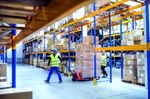
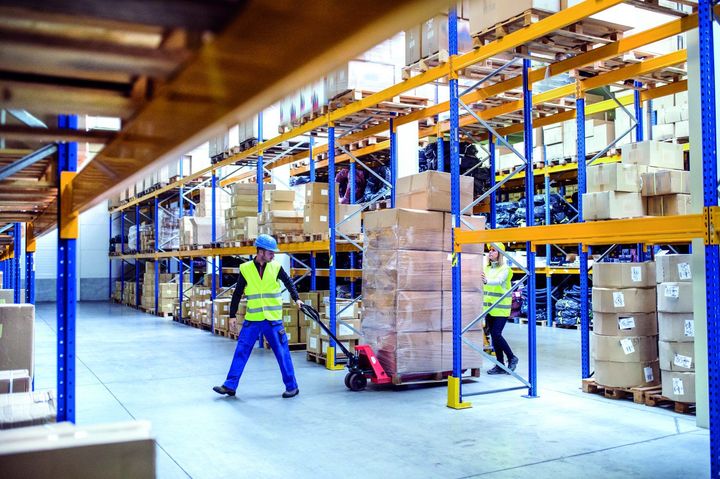
Pallet Trucks
Pallet trucks move palletised loads over relatively short distances.
They can be:
- Manual
- Electric
- Walk-behind
- Platform-operated
- Rider-operated
They are commonly associated with loading areas, warehouse aisles, staging zones, and internal transportation.
Cranes and Hoists
Cranes and hoists are designed for lifting and positioning heavier loads.
Examples include:
- Overhead cranes
- Gantry cranes
- Jib cranes
- Bridge cranes
- Electric hoists
- Wire-rope hoists
- Chain hoists
These systems are particularly relevant to manufacturing, heavy industrial operations, maintenance environments, and fabrication facilities.
Automated Guided Vehicles
Automated guided vehicles, or AGVs, move materials according to predefined navigation methods.
They can transport:
- Pallets
- Containers
- Components
- Production materials
- Finished goods
AGVs can reduce the need for repetitive manual transportation where workflows are predictable.
Autonomous Mobile Robots
Autonomous mobile robots, commonly known as AMRs, use sensors, software, and navigation technologies to move through changing environments.
Unlike traditional fixed-path systems, AMRs can dynamically determine routes around obstacles in many applications.
They can support:
- Warehouse transportation
- Picking workflows
- Production supply
- Inventory movement
- Sortation processes
Warehouse Storage Systems
Material handling is closely connected to storage.
A warehouse storage system determines how materials are positioned, accessed, identified, and retrieved.
Selective Pallet Racking
Selective pallet racking provides direct access to individual pallet positions and is widely used where product variety is high.
Drive-In and Drive-Through Racking
These systems allow material handling vehicles to enter storage lanes, increasing storage density compared with conventional aisle-based layouts.
Cantilever Racking
Cantilever systems are designed for long or irregular materials such as:
- Pipes
- Timber
- Metal sections
- Tubes
- Panels
Mezzanine Systems
Mezzanines create additional usable levels within a facility and can help utilise vertical space.
Automated Storage and Retrieval Systems
Automated storage and retrieval systems, or AS/RS, use automated mechanisms to store and retrieve materials.
Depending on the design, these systems can use:
- Cranes
- Shuttles
- Carriers
- Robots
- Vertical lifts
AS/RS can connect storage operations with warehouse software and automated transportation equipment.
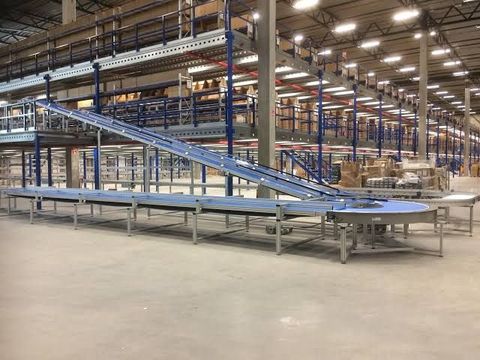
Conveyor Systems in Material Handling
Conveyors form an important part of many warehouse and manufacturing environments.
A conveyor system may transport products between:
Receiving → Storage → Picking → Packing → Sortation → Dispatch
Different conveyor technologies are selected according to product dimensions, weight, speed, handling requirements, and layout.
Roller Conveyors
Roller conveyors are commonly used for cartons, containers, totes, and pallet movement.
Belt Conveyors
Belt conveyors provide a continuous conveying surface and can handle many product shapes.
Chain Conveyors
Chain systems are often used for heavier loads or applications where a robust conveying mechanism is required.
Sortation Conveyors
Sortation systems automatically direct products toward different destinations.
They may use:
- Divert mechanisms
- Cross-belt technology
- Sliding shoes
- Pop-up rollers
- Tilt trays
Material Handling in Manufacturing
Material handling is not limited to warehouses.
Manufacturing plants also require continuous movement of:
- Raw materials
- Components
- Work-in-progress
- Tools
- Packaging materials
- Finished products
Poor material flow can interrupt production even when the manufacturing equipment itself is operating correctly.
For this reason, production planning often considers material movement alongside manufacturing processes.
Receiving and Inbound Material Flow
The receiving area represents an important starting point for warehouse material flow.
A typical inbound process may include:
- Vehicle arrival
- Unloading
- Quantity verification
- Identification
- Inspection
- System registration
- Storage allocation
- Transportation to the assigned location
Equipment such as dock levellers, pallet trucks, forklifts, conveyors, scanners, and automated unloading systems can support these activities.
Picking and Order Fulfilment
Picking involves retrieving products or materials from storage locations.
Common picking methods include:
- Piece picking
- Case picking
- Pallet picking
- Batch picking
- Zone picking
- Wave picking
- Goods-to-person picking
Material handling equipment can influence how quickly and accurately these processes operate.
For example, goods-to-person systems bring inventory to an operator rather than requiring the operator to travel repeatedly through storage aisles.
Packing and Dispatch Systems
After picking, products may move through packing and dispatch processes.
Material handling equipment can include:
- Packing conveyors
- Accumulation conveyors
- Scanners
- Weighing systems
- Dimensioning systems
- Sortation equipment
- Automated labelling equipment
- Loading systems
The objective is to create a controlled transition between order preparation and outbound transportation.
Warehouse Management Software
Modern material handling equipment increasingly interacts with software.
A Warehouse Management System, or WMS, can manage information related to:
- Inventory locations
- Product movements
- Receiving
- Picking
- Replenishment
- Dispatch
- Inventory status
The WMS may communicate with warehouse control and automation systems.
Warehouse Control Systems
A Warehouse Control System, or WCS, commonly coordinates automated material handling equipment.
It may manage equipment such as:
- Conveyors
- Sorters
- Automated storage systems
- Robotic equipment
- Automated vehicles
The WCS can act as an operational layer between warehouse-management software and equipment controls.
Warehouse Execution Systems
Warehouse Execution Systems, or WES, provide a broader approach to coordinating warehouse workflows.
A WES may consider:
- Work prioritisation
- Equipment availability
- Order requirements
- Labour availability
- Inventory conditions
- System capacity
This allows material movement to be coordinated dynamically rather than treating each machine as an isolated component.
Automation in Material Handling
Automation is one of the most significant developments in material handling.
Modern facilities may combine:
- Robotics
- Conveyors
- Automated storage
- AMRs
- AGVs
- Machine vision
- Sensors
- Warehouse software
- Automated sortation
Automation does not necessarily mean removing people from the process. In many facilities, technology is used to support workers by reducing repetitive transportation, improving information flow, and handling predictable movement tasks.
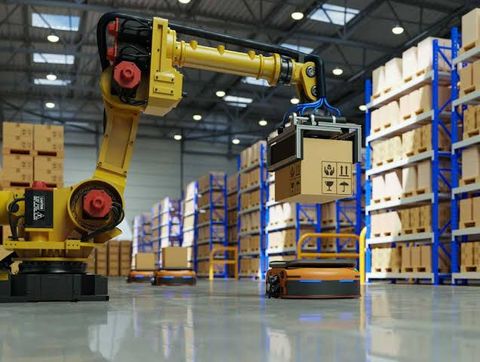
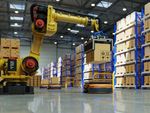
Robotics in Warehouses
Robots are increasingly used for material movement and warehouse activities.
Examples include:
- Mobile robots
- Robotic arms
- Palletising robots
- Depalletising robots
- Robotic picking systems
- Autonomous transport robots
Robotic systems can be integrated with conveyors, storage systems, scanners, cameras, and warehouse software.
Artificial Intelligence in Material Handling
Artificial intelligence can contribute to material handling through data analysis, prediction, optimisation, and machine vision.
Potential applications include:
- Demand forecasting
- Inventory analysis
- Route optimisation
- Predictive maintenance
- Vision-based identification
- Warehouse slotting
- Robotic navigation
- Anomaly detection
AI becomes particularly useful when large quantities of operational data are available.
Internet of Things and Connected Equipment
Industrial IoT allows equipment to communicate operational information.
Sensors can monitor:
- Equipment status
- Temperature
- Vibration
- Motor conditions
- Battery levels
- Operating cycles
- Location
- Load conditions
Connected equipment can help organisations understand how machines are being used and identify unusual operating patterns.
Barcode and RFID Technologies
Identification technologies are essential to accurate material movement.
Barcode Systems
Barcodes provide a practical way to identify products, cartons, pallets, and storage locations.
RFID
Radio-frequency identification can identify tagged objects without requiring direct visual alignment in many applications.
RFID can support:
- Inventory tracking
- Asset identification
- Automated receiving
- Location monitoring
- Movement verification
Warehouse Layout and Material Flow
Equipment selection should be considered alongside facility layout.
A warehouse layout may contain:
- Receiving docks
- Inspection areas
- Storage zones
- Picking areas
- Packing areas
- Staging areas
- Dispatch zones
- Equipment charging areas
- Maintenance areas
The movement path between these zones affects operational efficiency.
A well-designed layout attempts to minimise unnecessary travel while maintaining safe access and operational flexibility.
Vertical Space Utilisation
Warehouses often have significant vertical space that can be used for storage or equipment integration.
Solutions may include:
- High-bay racking
- Automated storage systems
- Vertical lifts
- Mezzanines
- Automated cranes
However, increasing storage height also introduces additional considerations involving structural design, equipment reach, fire protection, maintenance, and safety.
Material Handling Safety
Safety is a central consideration when planning material handling systems.
Important areas include:
- Equipment training
- Pedestrian separation
- Load stability
- Safe operating speeds
- Visibility
- Emergency controls
- Equipment inspection
- Guarding
- Safe aisle design
- Maintenance procedures
Facilities should follow applicable occupational safety regulations and equipment-specific standards.
Equipment Maintenance
Regular maintenance helps keep material handling equipment operating reliably.
Maintenance approaches can include:
Preventive Maintenance
Scheduled inspections and maintenance activities are performed at predetermined intervals.
Predictive Maintenance
Sensors and operational data can be analysed to identify signs of potential equipment problems before failure occurs.
Condition-Based Maintenance
Maintenance decisions are based on the actual condition of equipment rather than relying only on fixed schedules.
Energy Efficiency
Energy consumption has become an increasingly important consideration.
Electric equipment can play a role in reducing direct combustion emissions within facilities, depending on the application and electricity source.
Energy efficiency can also be influenced by:
- Motor selection
- Conveyor control
- Equipment utilisation
- Battery management
- Regenerative technologies
- Automated shutdown
- Efficient warehouse layouts
Sustainability and Material Handling
Sustainability can be considered throughout the equipment lifecycle.
Key areas include:
- Energy consumption
- Equipment lifespan
- Maintenance requirements
- Material selection
- Battery technology
- Packaging reduction
- Equipment refurbishment
- Recycling
- Operational efficiency
A system that reduces unnecessary movement may also reduce energy consumption and operational wear.
Key Performance Indicators
Material handling operations can be evaluated using several performance indicators.
Common KPIs include:
- Throughput
- Order accuracy
- Inventory accuracy
- Equipment utilisation
- Travel distance
- Picking productivity
- Dock-to-stock time
- Order cycle time
- Equipment availability
- System downtime
- Storage utilisation
KPIs should be selected according to the specific objectives of the facility.
How Companies Evaluate Material Handling Equipment
Equipment evaluation normally involves several technical questions.
Load Characteristics
Consider:
- Weight
- Dimensions
- Shape
- Fragility
- Packaging
- Stability
Operating Environment
The environment may involve:
- Ambient conditions
- Cold storage
- Dust
- Moisture
- Clean-room requirements
- Outdoor operation
- Hazardous areas
Throughput Requirements
The system should be capable of handling the expected material volume without creating unnecessary bottlenecks.
Facility Layout
Available floor area, ceiling height, aisle dimensions, dock configuration, and structural limitations all affect equipment selection.
Integration
Modern equipment may need to communicate with:
- WMS
- WCS
- WES
- ERP platforms
- PLCs
- Sensors
- Robotics
- Identification systems
Integration Challenges
Integrating multiple technologies can create technical complexity.
Common challenges include:
- Different communication protocols
- Software compatibility
- Legacy equipment
- Data synchronisation
- Cybersecurity
- Network reliability
- Operator training
- Maintenance coordination
System integration therefore needs to be considered from the planning stage.
Cybersecurity in Connected Material Handling
Connected warehouse equipment introduces cybersecurity considerations.
Systems may contain:
- Industrial controllers
- Network-connected sensors
- Warehouse software
- Robotic platforms
- User accounts
- Operational databases
Security practices can include:
- Network segmentation
- Access control
- Authentication
- Software updates
- Monitoring
- Backup procedures
- Incident-response planning
As warehouses become more connected, cybersecurity becomes part of operational reliability.
Industry Applications
Material handling equipment is used across many industries.
Manufacturing
Used for movement of raw materials, components, work-in-progress, and finished products.
Retail and Distribution
Supports inventory storage, order picking, sorting, and dispatch.
Food and Beverage
Material handling systems can support packaged goods, ingredients, cold-chain products, and production materials.
Automotive
Factories may use conveyors, AGVs, cranes, racks, and robotic systems for components and assemblies.
Pharmaceuticals
Material handling may involve controlled environments, traceability, automated storage, and specialised transportation.
E-Commerce
High-volume order processing often uses conveyors, sortation, robots, scanners, and automated storage systems.
Current Industry Direction
The material handling sector is moving toward increasingly connected and automated operations.
Important trends include:
- Flexible robotics
- Autonomous mobile robots
- AI-assisted warehouse planning
- Automated storage
- Digital twins
- Machine vision
- Cloud-connected systems
- Real-time inventory visibility
- Energy-efficient equipment
- Data-driven maintenance
The larger trend is toward integrated material-flow ecosystems rather than standalone machines.
Digital Twins for Material Handling
A digital twin is a digital representation of a physical system.
For warehouse operations, it can model:
- Storage locations
- Equipment
- Material flow
- Production processes
- Traffic
- Throughput
- Bottlenecks
Digital simulation can help planners evaluate possible layout or workflow changes before implementing them physically.
Future of Material Handling Equipment
Future material handling systems are likely to become more adaptive and data-driven.
Potential developments include:
- More autonomous transportation
- AI-based routing
- Smarter robotic picking
- Better machine vision
- Automated inventory counting
- Greater software integration
- More efficient energy management
- Real-time digital twins
- Flexible warehouse layouts
Rather than relying on a single technology, future systems are likely to combine multiple technologies into integrated workflows.
Frequently Asked Questions
What does a material handling equipment company do?
A material handling equipment company may develop, manufacture, integrate, distribute, or support technologies used for moving, lifting, storing, identifying, and controlling materials.
What are the main types of material handling equipment?
Major categories include conveyors, forklifts, pallet trucks, cranes, hoists, storage systems, AGVs, AMRs, automated storage systems, sortation equipment, and robotic systems.
What is the difference between AGV and AMR?
AGVs generally follow predefined navigation paths, while AMRs are designed to navigate dynamically using sensors, mapping, and software.
Why is warehouse automation important?
Automation can reduce repetitive movement, improve material-flow consistency, increase visibility, and help facilities manage high-volume workflows.
How does a WMS interact with material handling equipment?
A WMS manages warehouse information and workflows, while systems such as WCS or WES can coordinate automated equipment and translate operational instructions into equipment activity.
Conclusion
Material handling equipment companies play an important role in the development of modern warehouses, factories, distribution centres, and industrial facilities. Their technologies range from basic movement equipment such as pallet trucks and conveyors to advanced systems involving robotics, automated storage, machine vision, and intelligent software.
The most effective material handling approach depends on the facility's materials, workflow, storage requirements, throughput, layout, safety conditions, and technology environment.
As automation and connected systems continue to evolve, material handling is increasingly becoming a combination of mechanical equipment, software, data, robotics, and intelligent control. Understanding these technologies provides a useful foundation for analysing modern warehouse and industrial operations.
Disclaimer
This article is intended for general educational and informational purposes only. It provides a broad overview of material handling equipment, warehouse systems, automation, and related technologies. Equipment selection, facility design, workplace safety, regulatory compliance, and system integration should be evaluated by appropriately qualified professionals according to the specific operational environment and applicable standards. This content is not intended as brand-specific, promotional, commercial, engineering, legal, or safety advice.