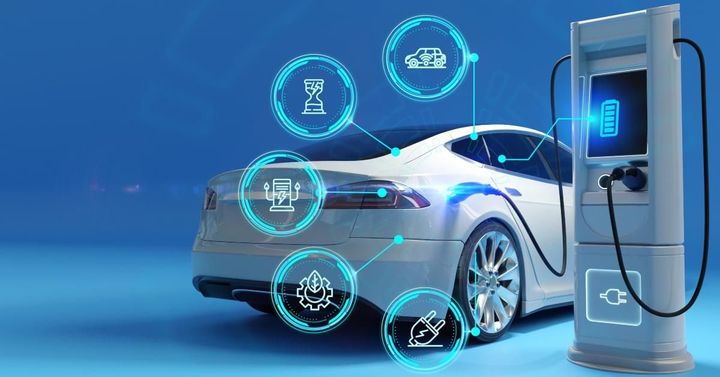
EV charging solutions include much more than a charging unit. The broader ecosystem can involve chargers, electrical systems, connectors, software, communication networks, energy management and renewable-energy integration.
Understanding these elements makes it easier to see how charging infrastructure supports the growing electric mobility ecosystem.
1. What Are EV Charging Solutions?
EV charging solutions are technologies and infrastructure designed to transfer electrical energy to an electric vehicle.
A basic charging system connects:
Electricity Supply → Charging Equipment → Vehicle → Battery
Modern charging systems can also communicate with vehicles and digital platforms to monitor charging status, manage energy use and provide operational information.
Depending on the application, EV charging can take place at:
-
Homes
-
Workplaces
-
Parking facilities
-
Commercial locations
-
Public charging areas
-
Fleet facilities
-
Highway corridors
-
Industrial sites
2. Why EV Charging Infrastructure Matters
The growth of electric mobility depends partly on convenient and reliable charging infrastructure.
A well-developed charging network can help address several practical requirements:
-
Vehicle energy replenishment
-
Long-distance travel
-
Fleet operations
-
Workplace charging
-
Residential charging
-
Commercial mobility
-
Public transportation electrification
Charging infrastructure also creates a connection between transportation and the electrical grid.
3. Main Types of EV Charging
EV charging is commonly discussed in terms of charging speed and electrical power.
Broad categories include:
-
AC charging
-
DC charging
-
Slow charging
-
Standard charging
-
Fast charging
-
High-power charging
The actual charging rate depends on the charger, vehicle, battery, electrical supply and operating conditions.
4. AC Charging
AC, or alternating-current charging, supplies AC electricity to the vehicle.
In many AC charging systems, the vehicle's onboard charger converts AC electricity into DC electricity that can be stored in the battery.
AC charging is commonly associated with:
-
Residential charging
-
Workplace charging
-
Long-duration parking
-
Destination charging
The charging speed varies according to the vehicle and charging equipment.
5. DC Fast Charging
DC charging supplies direct current to the vehicle's battery through dedicated charging equipment.
Because the AC-to-DC conversion is handled by the external charging system, DC charging can support substantially higher power levels than many AC systems.
DC charging is commonly used where shorter charging times are important.
Potential locations include:
-
Highway charging corridors
-
Public charging facilities
-
Fleet depots
-
Commercial transportation hubs
6. Charging Levels
Charging classifications can vary by market and standard, but charging is often grouped into broad levels.
Lower-Power Charging
Typically associated with residential or long-duration charging.
Medium-Power AC Charging
Commonly used for workplaces, destinations and residential environments with suitable electrical infrastructure.
High-Power DC Charging
Designed for faster energy replenishment and often used in public or fleet applications.
The appropriate level depends on the vehicle, battery and charging environment.
7. EV Chargers and Charging Stations
An EV charger is the equipment that manages the electrical connection between the power source and vehicle.
A charging station can include additional infrastructure such as:
-
Display systems
-
Communication hardware
-
Payment or authentication systems
-
Cable management
-
Safety equipment
-
Networking systems
The terms are sometimes used interchangeably, but a complete charging site can contain much more than the charger itself.
8. EV Charging Connectors
Different regions and vehicle manufacturers use different charging connector standards.
Examples include:
-
Type 1
-
Type 2
-
CCS
-
CHAdeMO
-
NACS
-
GB/T
Connector compatibility depends on the vehicle and charging infrastructure.
9. Type 1 Connector
Type 1 is a single-phase AC connector associated particularly with some vehicles and charging systems in North America and other markets.
Its use depends on regional standards and vehicle configuration.
10. Type 2 Connector
Type 2 is widely used for AC charging in Europe and many other markets.
It can support single-phase and three-phase AC charging depending on the equipment and vehicle.
11. Combined Charging System
CCS combines AC charging capabilities with additional DC charging contacts.
Two major variants include:
CCS has been widely adopted across different vehicle markets.
12. CHAdeMO
CHAdeMO is a DC charging standard developed in Japan.
It has historically been used by several electric vehicle models and charging networks.
Its presence varies by market as newer connector standards have become more widespread.
13. NACS
The North American Charging Standard, commonly known as NACS, uses a compact connector design for AC and DC charging.
Its adoption has expanded significantly in North America, making connector compatibility an important consideration for charging infrastructure.
14. Charging Speed
Charging speed depends on several factors.
Important variables include:
-
Charger power
-
Vehicle charging capability
-
Battery capacity
-
Battery temperature
-
Battery state of charge
-
Electrical supply
-
Charging conditions
A high-power charger does not automatically mean every vehicle will charge at its maximum rated power.
15. Battery State of Charge
EV charging speed can change as the battery becomes more full.
Many vehicles reduce charging power at higher states of charge to manage battery conditions.
This means:
Maximum Charger Power ≠ Constant Charging Power
The actual charging experience is influenced by the vehicle's charging curve.
16. EV Charging Curves
A charging curve describes how charging power changes during a charging session.
A simplified pattern may look like:
Initial Charging → High-Power Phase → Power Reduction → Final Charging
Understanding charging curves can provide a more realistic picture of charging time than looking only at maximum power ratings.
17. Home EV Charging
Home charging is an important part of everyday electric mobility.
Residential charging can involve:
-
Standard electrical outlets
-
Dedicated AC charging equipment
-
Smart charging systems
-
Solar-integrated charging
Home charging is generally associated with vehicles being parked for extended periods.
18. Workplace EV Charging
Workplace charging can provide charging opportunities while vehicles remain parked during working hours.
Potential benefits include:
-
Convenient daytime charging
-
Reduced dependence on dedicated public charging
-
Support for employee EV adoption
-
Integration with workplace energy management
Charging capacity should be planned according to parking duration and electrical infrastructure.
19. Public EV Charging
Public charging infrastructure can support drivers who cannot charge at home or need additional energy during longer journeys.
Public charging networks can include:
-
AC destination chargers
-
DC fast chargers
-
Highway charging stations
-
Urban charging locations
-
Parking-based charging
Availability, reliability and connector compatibility are important considerations.
20. Fleet EV Charging
Fleet operators may have different charging requirements from individual drivers.
Electric fleets can include:
-
Delivery vehicles
-
Taxis
-
Buses
-
Service vehicles
-
Commercial vans
-
Industrial vehicles
Fleet charging often requires coordinated scheduling and energy management.
21. Depot Charging
Fleet vehicles may return to a central depot where charging infrastructure is installed.
A depot charging system can coordinate:
Vehicle Arrival → Charging Schedule → Energy Allocation → Vehicle Departure
This approach can help manage multiple vehicles while considering electricity capacity and operational schedules.
22. Smart EV Charging
Smart charging uses communication and software to control when and how vehicles charge.
It can consider factors such as:
-
Electricity demand
-
Charging schedules
-
Vehicle departure times
-
Energy availability
-
Grid conditions
-
Renewable-energy generation
The objective is to use available electrical capacity more intelligently.
23. Load Management
Multiple EV chargers operating simultaneously can create substantial electrical demand.
Load management systems can distribute available power among vehicles.
For example:
Available Power → Charger A + Charger B + Charger C
The system can dynamically adjust charging power according to predefined priorities and electrical limits.
24. Dynamic Load Balancing
Dynamic load balancing continuously monitors electricity demand and adjusts charging power.
If another building load increases, the charging system may reduce EV charging power.
When available electrical capacity increases, charging power can be adjusted again.
This can help make better use of existing electrical infrastructure.
25. Solar-Powered EV Charging
EV charging can be combined with solar photovoltaic systems.
A simplified architecture is:
Solar Panels → Energy Management → EV Charger → Vehicle
Solar generation can supplement grid electricity when conditions allow.
Energy storage can also be incorporated into some systems.
26. Battery Energy Storage and EV Charging
Battery energy storage systems can store electricity and later provide energy for EV charging.
Potential applications include:
-
Managing peak demand
-
Supporting high-power charging
-
Increasing renewable-energy utilisation
-
Providing additional electrical flexibility
The technical design depends on site requirements and grid conditions.
27. Vehicle-to-Grid Technology
Vehicle-to-grid, or V2G, allows compatible electric vehicles to potentially send stored electrical energy back toward the grid.
A simplified concept is:
Grid → Vehicle → Grid
V2G requires compatible vehicles, charging equipment, communication systems and appropriate grid arrangements.
28. Vehicle-to-Home
Vehicle-to-home, or V2H, uses a compatible EV battery as an energy source for selected household loads.
The basic concept is:
Grid/Solar → EV → Home
This can potentially provide additional energy flexibility during certain situations.
29. Vehicle-to-Load
Vehicle-to-load, or V2L, allows an EV to supply electrical power to external devices.
Potential applications include:
-
Tools
-
Appliances
-
Temporary equipment
-
Outdoor activities
Availability depends on vehicle design.
30. EV Charging Software
Modern charging infrastructure increasingly relies on software.
Software can support:
-
Charger monitoring
-
Session management
-
User authentication
-
Energy management
-
Remote diagnostics
-
Usage reporting
-
Firmware management
This makes charging infrastructure more than a physical electrical connection.
31. Charging Networks
Charging networks connect multiple charging stations through a central software platform.
Networked infrastructure can provide information about:
-
Charger availability
-
Charging status
-
Equipment condition
-
Energy usage
-
Session history
This can help operators monitor distributed charging infrastructure.
32. Charging Communication
Communication protocols allow charging equipment, vehicles and software systems to exchange information.
One widely recognised protocol for charger-to-network communication is OCPP, or Open Charge Point Protocol.
Communication standards can help support interoperability between charging equipment and network platforms.
33. EV Charging Payments and Authentication
Public charging environments may use different methods to identify users and manage sessions.
These can include:
-
Mobile applications
-
RFID cards
-
Contactless authentication
-
Vehicle-based identification
-
Other digital methods
The exact approach depends on the charging network and region.
34. EV Charging Safety
Electrical safety is an essential part of EV charging infrastructure.
Important considerations include:
-
Proper electrical protection
-
Grounding
-
Overcurrent protection
-
Residual-current protection
-
Cable management
-
Equipment enclosure
-
Thermal monitoring
-
Emergency procedures
Charging infrastructure should be installed and maintained according to applicable electrical and safety requirements.
35. Weather and Environmental Protection
Outdoor charging equipment may be exposed to:
-
Rain
-
Dust
-
Heat
-
Cold
-
Humidity
-
UV exposure
Equipment should therefore be designed and rated appropriately for its installation environment.
36. EV Charger Installation Infrastructure
Installing charging equipment can involve more than mounting a charger.
Infrastructure may include:
-
Electrical distribution
-
Cables
-
Switchgear
-
Protection devices
-
Communication networks
-
Metering
-
Mounting systems
-
Civil works
High-power installations may require more extensive electrical planning.
37. Electrical Capacity
Before installing multiple chargers, the available electrical capacity should be assessed.
Important considerations include:
-
Existing electrical load
-
Available connection capacity
-
Charger power
-
Number of charging points
-
Simultaneous charging
-
Future expansion
Load management can sometimes help optimise available capacity.
38. EV Charging for Commercial Facilities
Commercial buildings can integrate charging infrastructure with broader energy-management systems.
Potential locations include:
-
Office buildings
-
Shopping centres
-
Hotels
-
Parking facilities
-
Industrial sites
The charging system can be coordinated with building energy consumption.
39. EV Charging in Parking Facilities
Parking facilities can provide an ideal environment for charging because vehicles may remain stationary for extended periods.
Different charging areas can be designed for:
-
Short stays
-
Long stays
-
Overnight parking
-
Employee parking
-
Fleet parking
The appropriate charging technology depends on expected parking duration.
40. EV Charging and Electric Mobility
Charging infrastructure is part of a broader electric-mobility ecosystem.
This ecosystem includes:
-
Electric vehicles
-
Batteries
-
Charging equipment
-
Electrical grids
-
Renewable energy
-
Software
-
Energy storage
-
Transportation systems
The interaction between these elements determines how effectively electric mobility can scale.
41. Charging Infrastructure for Electric Buses
Electric buses can require specialised charging approaches.
Common concepts include:
Depot Charging
Vehicles charge during extended periods at a depot.
Opportunity Charging
Vehicles receive shorter charging sessions during scheduled stops.
Pantograph Charging
Some electric buses use overhead charging equipment to transfer high electrical power.
The appropriate approach depends on route length, vehicle battery capacity and operating schedules.
42. EV Charging for Electric Trucks
Electric trucks can require higher-power charging infrastructure because of larger batteries and demanding operating schedules.
Important considerations include:
-
High charging power
-
Grid capacity
-
Depot design
-
Charging schedules
-
Vehicle utilisation
-
Thermal management
Heavy-duty electric transportation is driving continued development of higher-power charging technologies.
43. EV Charging Standards
Charging infrastructure is influenced by electrical, communication and connector standards.
Relevant areas can include:
-
Connector standards
-
Electrical safety standards
-
Communication protocols
-
Grid-interconnection requirements
-
Installation codes
Standards vary between countries and regions, so local requirements should always be reviewed.
44. EV Charging and Energy Management
EV charging can become part of a larger energy-management strategy.
A connected system may coordinate:
Grid + Solar + Storage + Building Load + EV Charging
Energy-management software can balance these sources and loads according to predefined objectives.
45. Charging Infrastructure Scalability
A charging site should ideally account for future demand.
Scalability can involve:
-
Additional charging points
-
Higher electrical capacity
-
Software expansion
-
Network connectivity
-
Load-management capabilities
Planning for expansion can be particularly important for commercial and fleet environments.
46. EV Charging Maintenance
Regular maintenance helps support charging infrastructure reliability.
Activities may include:
-
Cable inspection
-
Connector inspection
-
Electrical testing
-
Software updates
-
Communication checks
-
Cooling-system inspection
-
Physical enclosure checks
Maintenance requirements vary by charger type and installation environment.
47. Common EV Charging Problems
Slow Charging
Possible causes include limited charger power, vehicle limitations or battery conditions.
Connector Issues
Damaged or incompatible connectors can prevent charging.
Communication Errors
Networked chargers can experience software or connectivity problems.
Overheating
High electrical loads and environmental conditions can influence thermal performance.
Power Availability
Insufficient electrical capacity can limit charging performance.
48. Choosing an EV Charging Solution
The right charging approach depends on the intended use.
Consider:
Vehicle Type
Different EVs have different charging capabilities.
Charging Location
Home, workplace, public and fleet environments have different requirements.
Parking Duration
Longer parking periods may work well with AC charging, while short stops may require higher-power DC charging.
Electrical Capacity
Available power can influence charger selection.
Number of Vehicles
Multiple vehicles may require load management.
Software Requirements
Networked sites may need monitoring, authentication and energy-management features.
Future Expansion
The system should consider potential changes in EV adoption and charging demand.
49. EV Charging Infrastructure Planning
A structured planning process can help.
Step 1: Understand Vehicle Requirements
Identify vehicle types and charging capabilities.
Step 2: Analyse Usage Patterns
Determine when vehicles arrive, how long they remain parked and how much energy they typically require.
Step 3: Assess Electrical Infrastructure
Review existing capacity and potential upgrades.
Step 4: Select Charging Technology
Choose AC, DC or a combination according to operational needs.
Step 5: Plan Software and Communication
Determine monitoring and management requirements.
Step 6: Consider Safety
Review applicable electrical and installation requirements.
Step 7: Plan for Expansion
Allow for potential future charging demand.
50. Future Trends in EV Charging
Higher-Power Charging
Charging systems are continuing to evolve toward higher power levels for suitable vehicles.
Smart Charging
More charging infrastructure is expected to use intelligent energy-management systems.
Renewable Integration
Solar and other renewable-energy sources may increasingly interact with EV charging.
Bidirectional Charging
V2G, V2H and V2L technologies could expand the role of EV batteries beyond transportation.
Automated Charging
Robotic or automated charging concepts may become more relevant for certain fleets and specialised environments.
Charging Infrastructure Intelligence
Advanced monitoring and analytics may improve equipment management and energy optimisation.
FAQs
What are the main types of EV charging?
The main categories are AC charging and DC charging, with different power levels ranging from lower-power residential charging to high-power public and fleet charging.
What is the difference between AC and DC charging?
AC charging supplies alternating current to the vehicle, with the vehicle's onboard charger typically converting it to DC for battery storage. DC charging supplies direct current through external charging equipment and can support higher charging power.
How long does EV charging take?
Charging time depends on charger power, vehicle capability, battery size, battery state of charge, temperature and the vehicle's charging curve.
What is smart EV charging?
Smart charging uses communication and software to control charging according to factors such as vehicle schedules, electrical demand, available capacity and energy availability.
Can EV charging use solar energy?
Yes. EV charging systems can be integrated with solar photovoltaic systems and, in some configurations, battery energy storage.
Conclusion
EV charging solutions form a critical part of the modern electric-mobility ecosystem.
From home AC charging to high-power DC infrastructure, charging technologies are designed for different vehicle types, parking durations and operational requirements. Modern systems increasingly combine chargers, connectors, sensors, software, communication networks, energy management and renewable-energy technologies.
The future of EV charging is moving beyond simply supplying electricity to vehicles. Smart charging, load management, bidirectional energy flow, battery storage and intelligent network management are creating stronger connections between transportation and the wider energy system.
As electric mobility expands, well-planned charging infrastructure will remain an important foundation for reliable, flexible and connected transportation.