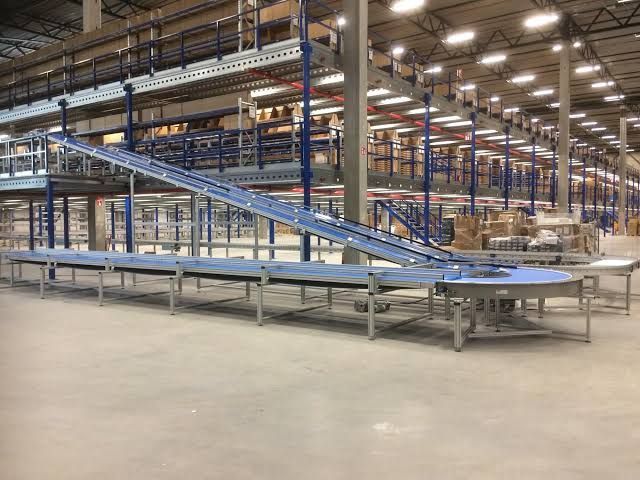
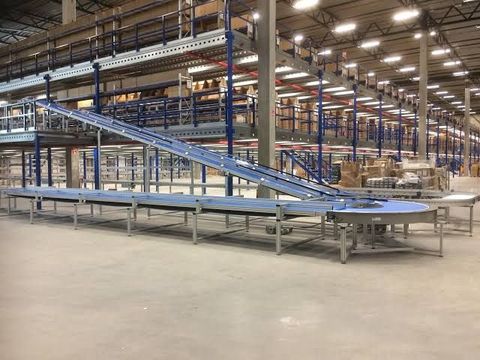
Instead of relying entirely on manual movement, conveyor systems create a structured path for transporting items between different stages of an operation.
Modern box conveyors can range from simple gravity-based designs to sophisticated automated systems connected with scanners, sensors, sortation equipment and warehouse management software.
Understanding their types, components and applications helps explain how conveyor technology supports efficient material movement.
1. What Is a Box Conveyor System?
A box conveyor system is a mechanical material-handling system used to transport boxes or packaged items from one location to another.
A basic system can include:
Loading Point → Conveyor → Transfer or Sortation → Destination
Depending on the application, boxes may move:
-
Horizontally
-
Upward
-
Downward
-
Around curves
-
Between different processing stations
-
Through automated sorting areas
The conveyor design depends on box dimensions, weight, speed requirements and the overall warehouse workflow.
2. Why Are Box Conveyor Systems Important?
Warehouses and distribution operations often handle large numbers of packages.
Conveyor systems can help organise these movements by:
-
Reducing manual transportation
-
Creating predictable material flow
-
Supporting continuous movement
-
Connecting different workstations
-
Improving workflow visibility
-
Supporting automated sorting
The objective is not simply to move boxes faster, but to create a coordinated material-handling process.
3. Main Types of Box Conveyor Systems
Different conveyor technologies are suitable for different operating conditions.
Common types include:
-
Roller conveyors
-
Belt conveyors
-
Powered roller conveyors
-
Gravity roller conveyors
-
Flexible conveyors
-
Chain conveyors
-
Slat conveyors
-
Accumulation conveyors
-
Sortation conveyors
-
Vertical conveyors
Each design has different characteristics.
4. Roller Conveyor Systems
Roller conveyors use a series of rollers to support and move boxes.
They can be configured as:
-
Gravity roller conveyors
-
Powered roller conveyors
-
Accumulation roller conveyors
Roller systems are commonly used for cartons, totes and rigid-bottom packages.
5. Gravity Roller Conveyors
Gravity conveyors use gravity to move boxes along inclined sections or allow operators to move packages manually.
Advantages can include:
-
Simple construction
-
Low mechanical complexity
-
Easy maintenance
-
No continuous drive motor in basic configurations
However, gravity systems require appropriate slopes and package characteristics.
6. Powered Roller Conveyors
Powered roller conveyors use motors to move boxes automatically.
They can support:
-
Controlled movement
-
Automated starting and stopping
-
Longer conveyor sections
-
Integration with sensors
-
Automated accumulation
Powered roller systems are commonly used when precise control over box movement is required.
7. Belt Conveyor Systems
Belt conveyors move boxes using a continuous belt.
They can handle a broad range of packages and are useful where stable, continuous movement is required.
Typical components include:
-
Conveyor belt
-
Drive pulley
-
Idler rollers
-
Motor
-
Frame
-
Tensioning system
Belt conveyors can also be designed for inclines and declines.
8. Accumulation Conveyors
Accumulation conveyors allow boxes to temporarily collect without necessarily stopping the entire conveyor system.
They can use sensors and control logic to maintain spacing between packages.
This is useful when different stages of a warehouse operate at different speeds.
9. Flexible Conveyor Systems
Flexible conveyors can be expanded, contracted or repositioned according to operational requirements.
They can be useful for:
-
Loading areas
-
Unloading operations
-
Temporary workflows
-
Variable layouts
Their flexibility makes them suitable for environments where conveyor positions may change.
10. Chain Conveyor Systems
Chain conveyors use chains to move products.
They can be suitable for heavier loads and specific industrial applications.
However, chain conveyors may not be appropriate for every type of box, particularly packages requiring a smooth or continuous supporting surface.
11. Slat Conveyor Systems
Slat conveyors use a series of connected plates or slats.
They are commonly associated with:
-
Industrial production
-
Packaging operations
-
Assembly processes
-
Controlled product movement
The rigid conveying surface can support specific package-handling requirements.
12. Vertical Conveyor Systems
Vertical conveyors move boxes between different elevations.
They can connect:
-
Ground floors
-
Mezzanine levels
-
Storage areas
-
Processing stations
Vertical conveying can help make better use of warehouse space.
13. Sortation Conveyor Systems
Sortation systems automatically direct boxes toward different destinations.
A simplified workflow is:
Package → Identification → Decision → Diverter → Destination
Identification may involve:
-
Barcode scanners
-
Cameras
-
RFID
-
Warehouse software
Sortation technology is particularly important in high-volume distribution environments.
14. Conveyor System Components
A box conveyor normally consists of multiple mechanical and control components.
Conveyor Frame
Provides structural support.
Rollers or Belt
Provides the conveying surface.
Drive System
Creates movement.
Motors
Supply mechanical power in powered systems.
Sensors
Detect package presence, position and movement.
Controllers
Coordinate conveyor operation.
Guards
Help protect operators from moving components.
15. Conveyor Motors
Powered conveyors commonly use electric motors.
Motor selection can depend on:
-
Load weight
-
Conveyor length
-
Required speed
-
Operating cycles
-
Incline
-
Duty requirements
Modern systems may use variable-speed drives to adjust conveyor speed according to workflow requirements.
16. Conveyor Sensors
Sensors play an important role in automated conveyor systems.
Common technologies include:
-
Photoelectric sensors
-
Proximity sensors
-
Optical sensors
-
Encoders
-
Weight sensors
Sensors can help determine whether a box is present and where it is located.
17. Barcode Scanning
Barcode scanners can identify boxes as they move through the conveyor system.
A scanner can capture information such as:
-
Package identification
-
Destination
-
Order information
-
Product category
The data can then be communicated to warehouse software.
18. RFID and Box Conveyors
RFID technology can identify tagged objects without requiring the same type of direct optical reading used by traditional barcodes.
Potential advantages include:
-
Automated identification
-
Tracking
-
Reduced dependence on line-of-sight scanning
The suitability of RFID depends on package materials, tag placement and system design.
19. Conveyor Sortation Technology
Different mechanisms can redirect boxes.
Examples include:
-
Pop-up rollers
-
Diverting arms
-
Belt transfers
-
Sliding shoe systems
-
Cross-belt systems
The appropriate technology depends on package dimensions, throughput and destination requirements.
20. Warehouse Automation Integration
Modern conveyor systems can operate as part of a larger automated environment.
They may connect with:
-
Warehouse management systems
-
Warehouse control systems
-
Barcode scanners
-
Robotic systems
-
Automated storage systems
-
Sortation equipment
-
Inventory platforms
This creates a connected material-flow network.
21. Conveyor Systems and Warehouse Management
Warehouse management software can coordinate information related to inventory and orders.
Conveyor control systems can use this information to determine where packages should move.
A simplified architecture is:
Warehouse Software → Control System → Conveyor Equipment → Package Movement
This integration can improve coordination between digital information and physical material flow.
22. Box Conveyor Applications
Box conveyors can be used across many industries.
Common applications include:
-
Warehousing
-
Distribution
-
E-commerce fulfilment
-
Manufacturing
-
Food packaging
-
Retail distribution
-
Pharmaceutical logistics
-
Parcel handling
-
Electronics
-
Automotive components
The conveyor configuration varies according to the industry and package characteristics.
23. E-Commerce Fulfilment
E-commerce warehouses process large volumes of individual orders.
Conveyors can connect different stages such as:
Picking → Packing → Scanning → Sortation → Dispatch
Automated conveyors can reduce unnecessary movement between these stages.
24. Manufacturing Applications
Manufacturing facilities can use box conveyors to move components, finished products and packaged goods.
Applications may include:
-
Production-line movement
-
Packaging
-
Inspection
-
Assembly
-
Storage transfer
-
Finished-goods handling
Conveyor systems can connect machines and workstations into a continuous workflow.
25. Pharmaceutical Applications
Pharmaceutical logistics requires careful handling and traceability.
Conveyor systems may support movement of:
-
Packages
-
Containers
-
Medical products
-
Laboratory materials
System design may need to consider cleanliness, traceability, package identification and regulatory requirements.
26. Food and Beverage Applications
Food and beverage environments may require conveyor designs that consider:
-
Hygiene
-
Cleaning
-
Moisture
-
Temperature
-
Product-contact materials
The specific conveyor design should reflect applicable food-safety requirements and the characteristics of the products being handled.
27. Conveyor Speed
Conveyor speed determines how quickly packages move through the system.
Speed selection depends on:
-
Package characteristics
-
Required throughput
-
Scanning requirements
-
Sortation technology
-
Operator interaction
-
Safety requirements
Faster does not always mean better. Excessive speed can create package instability and operational challenges.
28. Conveyor Capacity
Conveyor capacity refers to how much material the system can transport within a given period.
Capacity can be influenced by:
-
Conveyor width
-
Package dimensions
-
Package spacing
-
Conveyor speed
-
System layout
-
Loading and unloading rates
The entire system should be considered rather than evaluating only one conveyor section.
29. Box Size and Weight
Conveyor selection should account for package characteristics.
Important factors include:
-
Length
-
Width
-
Height
-
Weight
-
Bottom surface
-
Shape
-
Centre of gravity
Boxes with irregular shapes may require specialised conveyor configurations.
30. Conveyor Layout
A conveyor layout determines how material moves through the facility.
Common configurations include:
-
Straight conveyors
-
Curved conveyors
-
Inclined conveyors
-
Declined conveyors
-
Merged conveyors
-
Diverging conveyors
-
Multi-level conveyors
An efficient layout aims to reduce unnecessary travel and bottlenecks.
31. Conveyor Accumulation
Accumulation allows packages to wait temporarily between processes.
For example:
Packing → Accumulation → Sortation → Dispatch
Accumulation zones can help balance differences in processing speeds.
They may use:
-
Zero-pressure accumulation
-
Minimum-pressure accumulation
-
Sensor-controlled zones
The appropriate approach depends on package characteristics and system requirements.
32. Conveyor Safety
Conveyor systems contain moving mechanical components and should be designed with appropriate safety measures.
Safety considerations can include:
-
Emergency-stop systems
-
Guards
-
Warning systems
-
Safe access points
-
Maintenance procedures
-
Operator training
-
Lockout/tagout procedures
Relevant occupational safety requirements should be considered during design, installation and operation.
33. Conveyor Maintenance
Regular maintenance helps support reliable operation.
Maintenance activities can include:
-
Belt inspection
-
Roller inspection
-
Motor checks
-
Bearing inspection
-
Sensor testing
-
Chain inspection
-
Fastener checks
-
Cleaning
-
Lubrication where applicable
Preventive maintenance schedules should follow equipment specifications and operating conditions.
34. Common Conveyor Problems
Belt Misalignment
A belt may move away from its intended path.
Roller Failure
Damaged or worn rollers can affect package movement.
Motor Problems
Drive-system issues can stop conveyor sections.
Sensor Errors
Incorrect sensor readings can disrupt automated workflows.
Package Jams
Poor package spacing or unsuitable box dimensions can cause blockages.
Accumulation Problems
Incorrect control logic can create congestion between conveyor zones.
35. Smart Conveyor Systems
Modern conveyor systems are becoming more intelligent.
Features can include:
-
Sensors
-
Digital controls
-
Variable-speed drives
-
Remote monitoring
-
Automated diagnostics
-
Data collection
-
Predictive maintenance
These capabilities can provide greater visibility into conveyor performance.
36. AI and Conveyor Automation
AI can add advanced analytical capabilities to conveyor systems.
Potential applications include:
-
Predictive maintenance
-
Package recognition
-
Automated sorting
-
Throughput optimisation
-
Anomaly detection
-
Vision-based inspection
For example, AI-based vision could identify package characteristics and help determine the appropriate destination.
37. Robotics and Conveyor Systems
Conveyors often operate alongside robotic equipment.
Robots can perform tasks such as:
-
Picking
-
Palletising
-
Depalletising
-
Sorting
-
Packaging
-
Machine loading
The conveyor provides controlled material movement while the robot performs a specialised task.
38. Conveyor Systems and Autonomous Mobile Robots
Autonomous mobile robots can transport goods between different locations without being permanently connected to a conveyor line.
Some modern facilities combine:
Fixed Conveyors + Mobile Robots + Warehouse Software
This hybrid approach can provide greater flexibility than relying on a single transportation method.
39. Energy Efficiency
Energy consumption is an important consideration in large conveyor systems.
Potential strategies include:
-
Variable-speed motors
-
Efficient drives
-
Zone-based operation
-
Automatic shutdown
-
Optimised layouts
-
Preventive maintenance
Conveyors can be designed to operate only when material movement is required.
40. Choosing a Box Conveyor System
Selection should begin with the material being transported.
Consider:
Box Characteristics
-
Dimensions
-
Weight
-
Shape
-
Bottom surface
Throughput
-
Boxes per hour
-
Peak volumes
-
Operating schedule
Layout
-
Available floor space
-
Elevation changes
-
Turns
-
Loading and unloading points
Automation
-
Scanning
-
Sortation
-
Robotics
-
Warehouse software
Safety
-
Emergency stops
-
Guards
-
Access requirements
-
Maintenance procedures
Maintenance
-
Accessibility
-
Replacement components
-
Monitoring capabilities
41. Box Conveyor System Planning
A practical planning process can follow these stages:
Step 1: Analyse Package Flow
Understand where boxes originate and where they need to go.
Step 2: Define Throughput
Estimate normal and peak package volumes.
Step 3: Study Package Characteristics
Measure dimensions, weight and packaging type.
Step 4: Design the Layout
Plan straight sections, curves, transfers and elevation changes.
Step 5: Select Conveyor Technology
Choose belt, roller, chain, flexible or specialised systems according to requirements.
Step 6: Plan Controls
Determine sensor, scanning and control requirements.
Step 7: Integrate Software
Connect the system with appropriate warehouse and inventory platforms.
Step 8: Validate Safety
Review access, guarding, emergency controls and maintenance procedures.
42. Future Trends in Box Conveyor Automation
Several developments are shaping modern conveyor systems.
Intelligent Sensors
More sensors can provide detailed information about package movement and equipment condition.
Predictive Maintenance
AI and analytics can help identify equipment behaviour associated with potential failures.
Flexible Automation
Facilities may combine fixed conveyors with mobile robots to handle changing workflows.
Vision-Based Sorting
AI-powered cameras can help classify packages based on visual information.
Energy-Aware Operation
Smart controls can reduce unnecessary conveyor operation.
Connected Systems
Conveyors are increasingly integrated with warehouse software and other automation equipment.
FAQs
What is a box conveyor system?
A box conveyor system is a material-handling system designed to transport boxes, cartons, totes and packaged goods through warehouses, distribution facilities and industrial environments.
What are the main types of box conveyors?
Common types include roller conveyors, belt conveyors, gravity conveyors, powered roller conveyors, flexible conveyors, accumulation conveyors, sortation conveyors and vertical conveyors.
How are box conveyors used in warehouses?
They can transport packages between picking, packing, scanning, sorting, storage and dispatch areas.
Can AI be used with conveyor systems?
Yes. AI can support applications such as predictive maintenance, package recognition, automated sorting, anomaly detection and computer-vision inspection.
What factors should be considered when selecting a box conveyor?
Important factors include box dimensions, weight, package characteristics, throughput, conveyor layout, automation requirements, safety, maintenance and integration with warehouse systems.
Conclusion
Box conveyor systems are an important part of modern material-handling and warehouse automation.
From simple gravity rollers to intelligent powered conveyors, sortation systems and vertically integrated solutions, different conveyor technologies serve different operational requirements.
Modern systems can combine motors, sensors, scanners, software, robotics, machine vision and AI to create connected material-flow networks.
The right system depends on package characteristics, throughput, facility layout, automation requirements and safety considerations. Rather than selecting a conveyor based only on speed, organisations should evaluate the complete workflow—from the moment a box enters the system to its final destination.
As warehouses and manufacturing environments become increasingly automated, box conveyors are likely to become more connected, intelligent and adaptable, supporting the broader development of smart logistics and industrial automation.
Disclaimer
This article is intended for general educational and informational purposes only. Conveyor systems vary according to application, package characteristics, facility layout and operating conditions. The information provided does not constitute engineering, technical, safety or professional advice and does not recommend any specific conveyor manufacturer, model or system. Actual conveyor selection, installation, integration and operation should be evaluated by qualified professionals in accordance with applicable safety standards, regulations and manufacturer documentation.