Machine Tending Robot Discover Trends in Automated Manufacturing
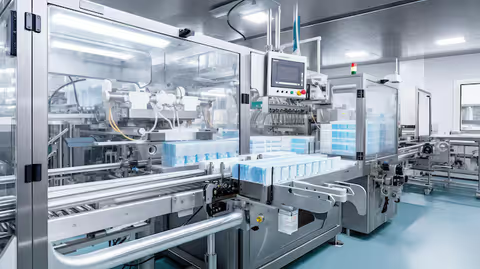
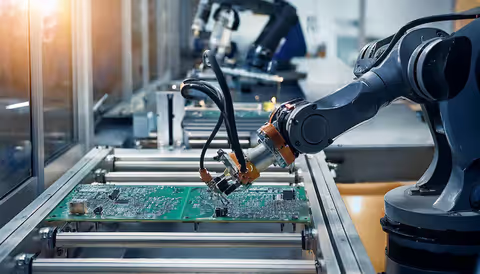
A machine tending robot is an industrial robot designed to load, unload, and manage materials for manufacturing equipment such as CNC machines, lathes, milling machines, injection molding systems, stamping presses, and grinding machines. These robots automate repetitive material-handling tasks that traditionally required manual intervention.
As manufacturing facilities continue to focus on productivity, consistency, and operational efficiency, machine tending robots have become an important part of industrial automation strategies. They help maintain continuous production while reducing human exposure to hazardous environments and repetitive tasks.
Machine tending technology is widely used in automotive manufacturing, aerospace production, electronics assembly, metal fabrication, medical device manufacturing, and many other industrial sectors.
How a Machine Tending Robot Works
A machine tending robot operates by interacting directly with production equipment. It picks up raw materials or components, places them into a machine, waits for processing to complete, and then removes the finished part.
The process generally follows these steps:
- Material pickup from a conveyor, pallet, tray, or storage area.
- Position verification through sensors or vision systems.
- Loading of the workpiece into the machine.
- Communication with the machine controller.
- Unloading of the finished component.
- Placement into a designated collection area.
- Preparation for the next production cycle.
Modern robotic systems often communicate with machine controllers using industrial networks, enabling synchronized and efficient operations.
Major Components of a Machine Tending Robot
Machine tending systems consist of several integrated technologies that work together to automate production processes.
Key Components
- Industrial robotic arm
- End-of-arm tooling (grippers)
- Vision inspection systems
- Sensors and safety devices
- Robot controller
- Human-machine interface (HMI)
- Conveyor systems
- Machine communication modules
- Safety fencing or collaborative safety systems
- Production monitoring software
These components help ensure precise movement, reliable handling, and consistent production quality.
Types of Machine Tending Robots
Different robot configurations are selected based on production requirements and workspace limitations.
| Robot Type | Characteristics | Common Applications |
|---|---|---|
| Articulated Robot | Multiple joints and high flexibility | CNC machining, welding, assembly |
| Collaborative Robot | Designed to work near operators | Small-batch manufacturing |
| SCARA Robot | Fast horizontal movement | Electronics and precision assembly |
| Cartesian Robot | Linear motion along multiple axes | Material handling and packaging |
| Delta Robot | High-speed pick-and-place operations | Food and consumer products |
| Gantry Robot | Large work envelope | Heavy industrial manufacturing |
Each type offers unique advantages depending on payload requirements, cycle times, and production layouts.
Importance of Machine Tending Robots
Manufacturers face increasing pressure to improve productivity while maintaining quality standards. Machine tending robots help address these challenges by automating repetitive operations.
Robotic systems can operate continuously with minimal interruptions, helping facilities achieve higher equipment utilization rates. They also reduce variability caused by manual handling and improve consistency across production runs.
Another important advantage is workforce support. Rather than replacing skilled personnel, machine tending robots often handle repetitive loading and unloading activities, allowing workers to focus on inspection, programming, maintenance, and process optimization.
Problems Solved by Machine Tending Robots
Manufacturing operations commonly encounter challenges related to labor availability, production consistency, and workplace safety.
Common Challenges Addressed
- Repetitive manual loading tasks
- Operator fatigue
- Production bottlenecks
- Inconsistent part handling
- Machine downtime
- Workplace injury risks
- Labor shortages
- Quality variation
- Inefficient material flow
- Limited production scalability
By automating these activities, machine tending robots help improve operational stability and manufacturing performance.
Real-World Applications
Machine tending robots are used across numerous industries where precision and repeatability are essential.
Automotive Manufacturing
- Engine component machining
- Transmission housing production
- Brake component processing
- Metal forming operations
Aerospace Production
- Precision milling
- Component finishing
- Composite material handling
- Quality inspection support
Electronics Manufacturing
- Circuit board handling
- Semiconductor processing
- Precision assembly operations
Medical Device Manufacturing
- Surgical instrument production
- Precision machining
- Sterile production support
Metal Fabrication
- Grinding operations
- Cutting systems
- Press tending
- CNC machining centers
These applications demonstrate the versatility of robotic automation across different manufacturing environments.
Features That Make Machine Tending Robots Effective
Modern machine tending solutions include advanced technologies that improve efficiency and flexibility.
Important Features
- High positional accuracy
- Multi-axis movement
- Vision-guided operation
- Automated tool changing
- Real-time monitoring
- Remote diagnostics
- Flexible programming
- Compact footprints
- Predictive maintenance support
- Integration with Industrial IoT systems
These capabilities allow robots to adapt to changing production requirements while maintaining consistent performance.
Machine Tending Robots and Industry 4.0
Industry 4.0 focuses on connected, intelligent manufacturing systems. Machine tending robots play a significant role in this transformation by serving as data-generating and data-consuming assets within smart factories.
Connected robots can exchange information with manufacturing execution systems, production scheduling platforms, and quality management systems. This integration enables real-time decision-making and production optimization.
Industrial IoT infrastructure allows manufacturers to monitor robot performance, machine status, maintenance requirements, and production metrics from centralized dashboards.
As a result, machine tending robots contribute to more responsive and efficient manufacturing operations.
Recent Trends and Developments (2025–2026)
The machine tending robot market has experienced significant technological advancements during the last year.
AI-Powered Vision Systems (2025)
Advanced artificial intelligence vision systems are improving object recognition, defect detection, and adaptive handling capabilities. These technologies allow robots to manage greater product variation with reduced programming effort.
Growth of Collaborative Machine Tending (2025)
Collaborative robots continue gaining popularity because they can operate in closer proximity to workers while maintaining safety requirements. Their flexibility makes them suitable for low-volume and high-mix production environments.
Digital Twin Integration (2025–2026)
Manufacturers are increasingly adopting digital twin technology to simulate robotic workcells before deployment. Virtual testing helps optimize workflows and reduce implementation risks.
Predictive Maintenance Expansion (2026)
Machine learning algorithms are being used to predict component wear and maintenance needs. This approach reduces unexpected downtime and improves operational reliability.
Increased Industrial IoT Connectivity (2026)
Connected robotic systems are becoming standard in smart manufacturing facilities, enabling enhanced production visibility and performance analytics.
Regulations and Safety Considerations
Machine tending robots must operate within established industrial safety frameworks.
Important Standards and Guidelines
- ISO 10218 for industrial robot safety
- ISO/TS 15066 for collaborative robot applications
- IEC 61508 functional safety standards
- Machinery safety requirements applicable within regional jurisdictions
- Workplace health and safety regulations
Manufacturers implementing robotic systems typically perform risk assessments, safety validation procedures, and operator training to ensure compliance and safe operation.
Safety features commonly include:
- Emergency stop systems
- Safety light curtains
- Area scanners
- Interlocked guarding
- Force and speed monitoring
- Safety-rated control systems
These measures help protect personnel while maintaining productive operations.
Useful Tools, Platforms, and Learning Resources
Professionals interested in machine tending robotics can benefit from various educational and industrial resources.
Software and Simulation Platforms
- RobotStudio
- RoboDK
- Visual Components
- Process Simulate
- DELMIA
- Gazebo Simulation
Learning Resources
- Industrial robotics training programs
- Manufacturing automation courses
- Mechatronics education platforms
- Robotics engineering certifications
- Industry 4.0 training materials
- Technical standards documentation
These resources help engineers, technicians, and manufacturing professionals understand robotic automation technologies.
FAQ
What is a machine tending robot?
A machine tending robot is an industrial robot that automatically loads and unloads materials or components from manufacturing equipment such as CNC machines, presses, and molding systems.
Can machine tending robots operate continuously?
Yes. Industrial robots are designed for extended operational periods and can support continuous production schedules when properly maintained.
Are machine tending robots suitable for small manufacturers?
Yes. Collaborative robots and flexible automation systems have made robotic machine tending accessible for smaller production facilities and mixed-production environments.
What industries use machine tending robots the most?
Automotive, aerospace, electronics, medical device manufacturing, metal fabrication, and precision machining industries are among the most common users.
How do vision systems improve machine tending?
Vision systems help robots identify part orientation, verify placement, inspect components, and adapt to variations in production materials, improving accuracy and efficiency.
Conclusion
Machine tending robots have become an essential component of modern industrial automation. By automating repetitive loading and unloading operations, these systems improve productivity, consistency, safety, and manufacturing efficiency. Their integration with Industrial IoT platforms, artificial intelligence, digital twin technology, and predictive maintenance solutions continues to expand their capabilities.
As smart manufacturing evolves throughout 2025 and 2026, machine tending robots are expected to play an even larger role in helping manufacturers achieve reliable, scalable, and data-driven production operations. Organizations that understand and effectively implement these technologies can benefit from improved process control, enhanced product quality, and stronger operational performance in increasingly competitive manufacturing environments.