Lathe Machines Explanation: From Basic Operation to Advanced CNC Systems
Lathe machines are fundamental tools in manufacturing and mechanical engineering used to shape, cut, and machine materials such as metal, wood, and plastic. Their primary purpose is to rotate a workpiece around a fixed axis while a cutting tool removes unwanted material to achieve the desired shape.
These machines are widely used in industries like automotive, aerospace, construction, and general fabrication because they offer precision, repeatability, and versatility. From simple cylindrical shaping to complex CNC-controlled machining, lathe machines remain one of the most essential tools in modern production systems.
Working Principle and Structure of Lathe Machines
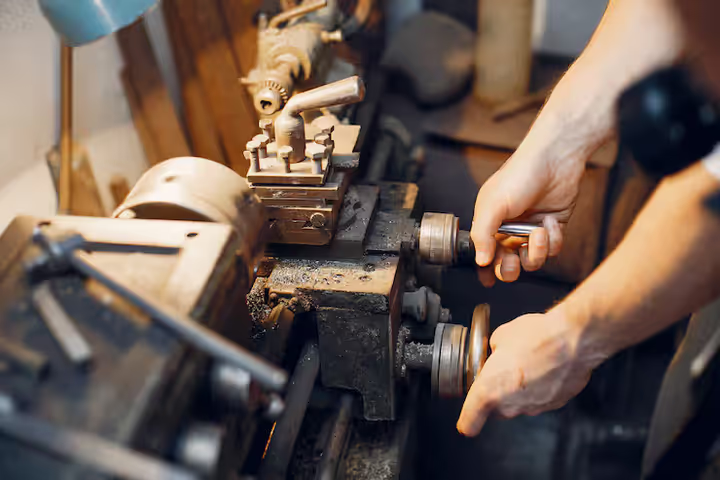
The working principle of a lathe machine is based on rotational motion. The workpiece is securely held and rotated at a controlled speed while a stationary cutting tool gradually removes material.
The machine consists of several key components that work together to perform machining tasks efficiently.
Key Components of Lathe Machines
- Bed: The rigid base that supports all machine parts and ensures stability
- Headstock: Houses the spindle and motor that rotate the workpiece
- Tailstock: Supports the opposite end of the workpiece for balance
- Carriage: Moves the cutting tool along the workpiece
- Chuck: Holds the workpiece firmly in place
- Feed Mechanism: Controls tool movement and cutting speed
The precision of machining depends on synchronization between rotational speed, feed rate, and tool positioning.
Types of Lathe Machines and Their Applications
Lathe machines come in different types depending on the complexity of operations and industrial requirements. Each type is designed for specific machining tasks.
Common Types of Lathe Machines
| Type | Description | Typical Use Cases |
|---|---|---|
| Engine Lathe | Standard manual lathe used for general machining | Workshops, training institutes |
| CNC Lathe | Computer-controlled machine for high precision | Aerospace, automotive production |
| Turret Lathe | Equipped with multiple tools for batch production | Mass production environments |
| Tool Room Lathe | High precision lathe for tool-making | Die and mold manufacturing |
| Bench Lathe | Small-sized lathe for light work | Jewelry, small parts manufacturing |
| Automatic Lathe | Fully automated machining system | Large-scale industrial production |
Each type plays a critical role in modern manufacturing depending on accuracy, production volume, and complexity.
Importance and Real-World Applications
Lathe machines are essential because they enable efficient production of cylindrical and symmetrical components. Their precision reduces material waste and ensures consistency across large production batches.
Industrial Applications
- Manufacturing engine shafts and gears in automotive industries
- Producing turbine components in aerospace engineering
- Creating surgical instruments in medical manufacturing
- Fabricating furniture parts in woodworking industries
- Producing pipes, bolts, and threaded components in construction
Problems Solved by Lathe Machines
- Difficulty in achieving uniform cylindrical shapes manually
- Low production speed in traditional shaping methods
- Inconsistent accuracy in repetitive machining tasks
- Limited capability for complex geometries without automation
Lathe machines resolve these challenges by offering controlled automation and high-precision machining.
Key Features and Functional Capabilities
Modern lathe machines are designed with advanced features that improve efficiency and accuracy.
Functional Features
- Variable speed control for different materials
- High precision spindle alignment
- Multi-axis movement in CNC models
- Automatic tool changing systems
- Digital control interfaces for programming operations
- Enhanced vibration control for smooth machining
These features help manufacturers achieve higher productivity with reduced operational errors.
Recent Trends and Technological Advancements (2025–2026)
The lathe machine industry has evolved significantly with the integration of digital manufacturing technologies.
Key Developments
- CNC Integration Expansion (2025): More industries are adopting CNC lathe systems for automated precision machining.
- AI-Based Predictive Maintenance (2025): Machines now use AI algorithms to detect wear and prevent breakdowns before they occur.
- Digital Twin Technology (2026): Virtual simulation of machining processes helps optimize production before actual operation.
- Energy-Efficient Motors (2025–2026): New models focus on reducing power consumption while maintaining high torque output.
- Smart Manufacturing Systems: Lathe machines are increasingly connected to Industry 4.0 networks for real-time monitoring and control.
These innovations improve productivity, reduce downtime, and enhance overall manufacturing efficiency.
Safety Standards and Regulations
Lathe machines operate at high speeds and require strict safety compliance to prevent accidents and ensure operational reliability.
Important Safety Guidelines
- Compliance with ISO 23125 standards for turning machines safety
- Regular maintenance and inspection schedules
- Proper training for machine operators
- Use of protective guards and emergency stop systems
- Adherence to workplace safety regulations in industrial environments
Following these standards ensures safe operation and long-term machine performance.
Tools, Platforms, and Learning Resources
Understanding and operating lathe machines requires both practical training and theoretical knowledge.
Useful Learning Resources
- Engineering textbooks on machining and manufacturing processes
- CNC programming courses available through technical institutes
- Simulation software for machining process modeling
- Online industrial training platforms for CNC and conventional lathe operation
- Manufacturer manuals for specific machine models
Software and Tools
- CNC programming software for automation
- CAD/CAM tools for design and machining planning
- Machine monitoring systems for real-time performance tracking
These resources help learners and professionals develop advanced machining skills.
Frequently Asked Questions
What is the main purpose of a lathe machine?
A lathe machine is used to shape and machine rotating workpieces by removing excess material to achieve precise dimensions.
What materials can be processed using lathe machines?
Lathe machines can process metals, wood, plastics, and composite materials depending on tool selection and machine capability.
How does a CNC lathe differ from a manual lathe?
A CNC lathe is computer-controlled and offers higher precision and automation, while a manual lathe requires direct operator control.
What industries commonly use lathe machines?
They are widely used in automotive, aerospace, medical manufacturing, construction, and woodworking industries.
What are the key maintenance practices for lathe machines?
Regular lubrication, alignment checks, tool inspection, and cleaning are essential for maintaining machine efficiency and accuracy.
Conclusion
Lathe machines remain a cornerstone of modern manufacturing due to their ability to produce precise cylindrical components efficiently. From traditional manual systems to advanced CNC and AI-integrated machines, their evolution reflects the growing demand for accuracy, automation, and productivity in industrial environments.
With continuous advancements such as digital twin modeling and smart manufacturing integration, lathe machines are expected to play an even more critical role in future production systems. Understanding their structure, types, and applications is essential for anyone involved in engineering, machining, or industrial production.