Industrial Membrane Filtration Systems: A Complete Guide to Technology, Types, and Applications
Industrial membrane filtration systems separate unwanted particles, dissolved substances, and selected contaminants from liquids by passing them through a specialized membrane. These systems are widely used in water treatment, food processing, pharmaceutical manufacturing, chemical production, and wastewater management.
A membrane acts as a selective barrier. Depending on its structure and operating method, it allows certain substances to pass through while retaining others. The filtered liquid that passes through the membrane is called the permeate, while the retained material is concentrated in the remaining stream, often called the concentrate or retentate.
Industrial membrane filtration exists because many production processes require consistent liquid quality. Conventional filtration methods can remove suspended particles, but they may not remove smaller dissolved substances. Membrane technologies can address some of these limitations when the correct membrane type is selected.
The performance of a system depends on several factors, including membrane material, pore size, operating pressure, temperature, liquid composition, and flow rate. No single membrane can remove every type of contaminant.
How Membrane Filtration Works
Most pressure-driven membrane systems use pumps to move liquid toward a membrane surface. The pressure difference helps water or other suitable liquids pass through the membrane, while selected particles and substances are retained.
A typical system includes:
Feed tank: Holds the liquid entering the filtration process.
Feed pump: Moves liquid through the equipment at the required pressure.
Membrane module: Contains the membrane elements that perform separation.
Control instruments: Monitor pressure, flow, temperature, and other operating conditions.
Permeate outlet: Collects the liquid that passes through the membrane.
Concentrate outlet: Removes retained substances and concentrated liquid.
Cleaning equipment: Supports membrane maintenance and recovery of performance.
Some systems operate continuously, while others use batch processing or periodic filtration cycles. The configuration depends on the liquid being treated and the required output quality.
Importance of Industrial Membrane Filtration
Why Membrane Technology Matters Today
Industries increasingly need reliable water management, consistent process liquids, and effective wastewater treatment. Membrane filtration can support these needs by separating contaminants with controlled physical and chemical processes.
In industrial water treatment, membrane systems may help prepare water for boilers, cooling systems, manufacturing processes, or further purification. In wastewater applications, they can help reduce suspended solids and certain dissolved contaminants before reuse or discharge, depending on the technology and treatment sequence.
Membrane filtration is also relevant to industries that must maintain strict product quality. Food and beverage manufacturers may use membranes to clarify liquids or concentrate selected components. Pharmaceutical and biotechnology facilities may use specialized membrane processes for purification, concentration, or sterile filtration where validated methods are appropriate.
Key benefits include:
Consistent separation performance when operating conditions remain controlled.
Reduced dependence on certain chemical separation methods.
Potential for water recovery and reuse in suitable applications.
Compact equipment configurations compared with some conventional treatment processes.
Integration with automated monitoring and digital process control.
Flexible treatment options for different liquid compositions.
However, membrane systems also have limitations. Membrane fouling, scaling, energy demand, and cleaning requirements can affect performance. A complete treatment plan should consider these factors rather than relying on membrane filtration alone.
Types of Industrial Membrane Filtration Technology
Different membrane technologies are selected according to the size and type of substances that need to be separated.
Membrane type | Main function | Common applications |
|---|---|---|
Microfiltration (MF) | Removes suspended particles and many microorganisms | Liquid clarification and pretreatment |
Ultrafiltration (UF) | Retains fine particles, colloids, and many larger molecules | Wastewater treatment and protein separation |
Nanofiltration (NF) | Separates selected dissolved substances and multivalent ions | Water softening and chemical separation |
Reverse osmosis (RO) | Rejects many dissolved salts and other substances | Desalination and high-purity water production |
Membrane bioreactor (MBR) | Combines biological wastewater treatment with membrane separation | Industrial and municipal wastewater treatment |
Microfiltration generally operates with larger pores than ultrafiltration. Nanofiltration and reverse osmosis use denser selective layers and different separation mechanisms. Actual removal performance depends on membrane design, operating conditions, and the composition of the feed liquid.
Membrane bioreactors are integrated treatment systems rather than a single membrane category. They combine biological processes with membrane filtration to separate treated water from suspended biological material.
Membrane Materials and Equipment Design
Industrial membranes can be made from polymeric materials, ceramics, or specialized composite structures.
Polymeric membranes: Common in water treatment because their structures can be designed for different separation requirements.
Ceramic membranes: Often considered for applications involving elevated temperatures, abrasive particles, or challenging cleaning conditions.
Composite membranes: Combine different materials to achieve specific separation characteristics.
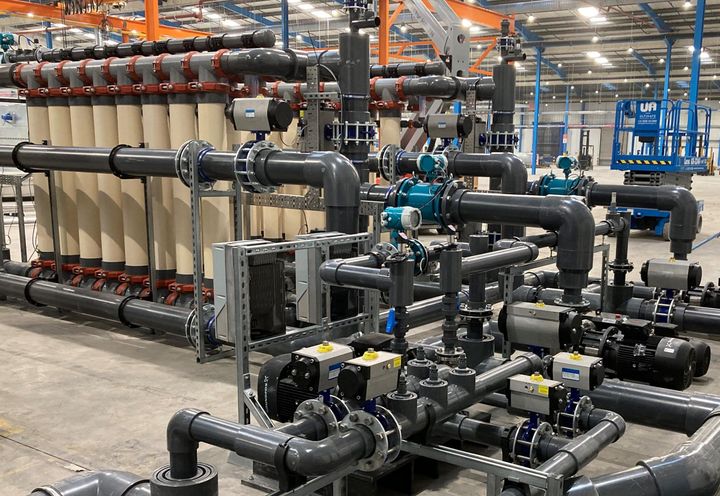
Hollow-fiber modules: Contain many narrow membrane fibers arranged in a compact unit.
Spiral-wound modules: Use membrane sheets separated by feed channels and rolled into a cylindrical element.
Selecting suitable materials requires an understanding of chemical compatibility, temperature limits, mechanical strength, and cleaning procedures. The equipment must also provide adequate flow distribution and allow operators to monitor performance.
Recent Developments in Membrane Filtration During 2025–2026
Membrane research has increasingly focused on improving separation performance, controlling fouling, and reducing the environmental impact of industrial water treatment.
Research published on 17 January 2025 reviewed developments in nanocomposite, thin-film composite, biomimetic, and forward-osmosis membranes for sustainable water treatment. It highlighted the potential of advanced membrane materials while noting challenges involving durability, scalability, and integration into existing facilities.
Antifouling membrane surfaces: Researchers are investigating surface modifications that reduce the accumulation of organic matter and microorganisms.
Artificial intelligence and machine learning: Data-driven models can help predict fouling, analyze operating trends, and support process optimization.
Digital twins: Virtual representations of treatment equipment can help engineers study operating scenarios and evaluate control strategies.
Advanced nanocomposite materials: Research explores ways to improve permeability, selectivity, and resistance to degradation.
Water reuse systems: Membrane filtration is increasingly studied as part of integrated treatment processes designed to recover water from industrial wastewater.
These developments are not equally mature. Some are already used in industrial settings, while others remain under investigation. Performance should be assessed using long-term operating data rather than laboratory results alone.
Laws, Policies, and Environmental Compliance
Industrial membrane filtration facilities must comply with applicable environmental, workplace safety, and wastewater regulations. Requirements vary by industry, location, and the composition of the liquid being treated.
Regulatory Considerations in India
In India, several regulatory frameworks may apply to industrial water treatment:
Water (Prevention and Control of Pollution) Act, 1974: Provides a framework for preventing and controlling water pollution.
Environment (Protection) Act, 1986: Establishes broad environmental protection powers and supports rules governing pollution and industrial activities.
Applicable effluent standards: Industries must follow the discharge limits and consent conditions relevant to their activities and location.
Hazardous and Other Wastes Rules, 2016: May apply to certain residues, concentrates, and waste streams depending on their classification.
Occupational safety requirements: Relevant workplace rules govern machinery operation, chemical handling, protective equipment, and worker safety.
On 28 January 2026, India's Ministry of Environment, Forest and Climate Change announced a rationalized regulatory framework for Common Effluent Treatment Plants. The announcement emphasized expanding industrial pollution-control infrastructure while retaining environmental safeguards.
Tools and Resources for System Planning
Engineers can use a combination of calculations, monitoring equipment, and maintenance records to evaluate membrane system performance.
Tool | Purpose |
|---|---|
Membrane flux calculator | Estimates permeate flow per unit of membrane area |
Water recovery calculator | Calculates the fraction of feed water recovered as permeate |
Pressure monitoring instruments | Track pressure differences across the membrane |
Water quality testing equipment | Measures parameters such as pH, conductivity, turbidity, and selected contaminants |
Process simulation software | Models treatment sequences and operating scenarios |
Maintenance checklist | Records inspections, cleaning cycles, and equipment faults |
Statistical analysis templates | Track performance trends and identify abnormal variation |
Two useful performance calculations are:
Membrane flux
Here, \(J\) is membrane flux, \(Q_p\) is permeate flow rate, and \(A\) is the active membrane area.
Water recovery
Here, \(R\) is water recovery, \(Q_p\) is permeate flow rate, and \(Q_f\) is feed flow rate.
For example, if a system receives 100 cubic metres of water per day and produces 75 cubic metres of permeate, its recovery is 75%. The remaining stream still requires appropriate management.
Useful learning resources include technical standards, water-treatment engineering textbooks, environmental regulations, scientific journals, and industrial process-control training materials.
Frequently Asked Questions
What is the main purpose of industrial membrane filtration?
Its main purpose is to separate selected particles, microorganisms, dissolved substances, or other contaminants from liquids. The result depends on the membrane technology and the liquid being treated.
Which membrane is best for industrial wastewater treatment?
There is no single best membrane for every wastewater stream. Microfiltration and ultrafiltration may remove suspended material, while nanofiltration and reverse osmosis can address selected dissolved substances. Complex wastewater may require several treatment stages.
What causes membrane fouling?
Fouling occurs when particles, organic compounds, minerals, or microorganisms accumulate on a membrane surface or within its structure. Suitable pretreatment, monitoring, and cleaning can help manage this problem.
Can membrane filtration make wastewater reusable?
Yes, in suitable applications. However, the required treatment depends on the original contaminants and the intended reuse. Additional biological, chemical, or disinfection stages may be necessary.
How often should industrial membranes be cleaned?
Cleaning frequency depends on feed-water quality, operating pressure, flux trends, membrane material, and manufacturer guidance. Cleaning should follow validated procedures that avoid damaging the membrane.
Conclusion
Industrial membrane filtration systems play an important role in water purification, wastewater treatment, product separation, and resource recovery. Their effectiveness depends on choosing the right membrane technology, maintaining suitable operating conditions, and monitoring water quality throughout the process.