Automated Assembly Machines: Advanced Manufacturing and Robotics Guide
Automated assembly machines are industrial systems designed to join, position, fasten, insert, or connect components with limited manual intervention. They help manufacturers assemble products in a repeatable and controlled manner. These systems are widely used in automotive production, electronics, medical equipment manufacturing, household appliances, and other industrial sectors.
Traditional assembly often depends on workers performing repeated tasks by hand. Although manual assembly remains useful for complex or low-volume products, it can become difficult to maintain consistent speed and accuracy when production requirements increase. Automated assembly technology addresses these challenges through programmed movements, mechanical fixtures, sensors, and computer-controlled operations.
A typical automated assembly system may include:
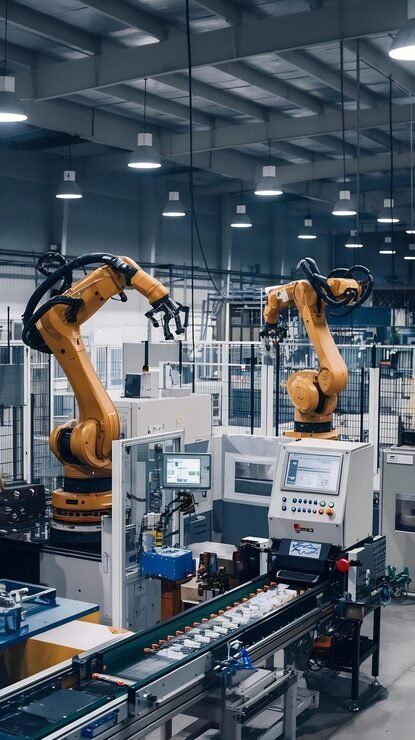
Industrial robots: Move components and perform repetitive assembly operations.
Conveyors and feeders: Transport and position parts throughout the production line.
Sensors: Detect component presence, position, distance, or other operating conditions.
Machine vision: Uses cameras and image-processing software to inspect parts and verify alignment.
Programmable controllers: Coordinate machine movements, timing, and production sequences.
Quality inspection equipment: Identifies defects and checks whether assemblies meet defined specifications.
These elements work together to create a coordinated manufacturing process. The exact configuration depends on the product, the materials being handled, the required production volume, and the complexity of the assembly.
How Automated Assembly Systems Work
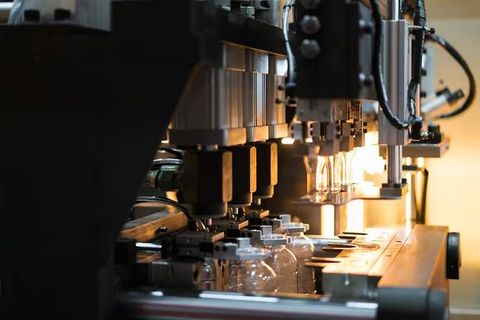
An automated assembly line generally follows a sequence of programmed operations. Components enter the system, are positioned correctly, and move through one or more assembly stations. Machines then perform specific tasks before the completed product undergoes inspection.
For example, an electronics assembly system may position a circuit board, insert selected components, secure connections, and inspect placement using cameras. A vehicle manufacturing line may use robotic arms to position structural components and perform joining operations.
The main stages usually include:
Component feeding: Parts are delivered from bins, magazines, reels, or conveyor systems.
Positioning: Fixtures and sensors establish the correct location and orientation.
Assembly: Robots or dedicated mechanisms perform fastening, insertion, joining, or fitting.
Inspection: Sensors and vision systems check selected quality characteristics.
Product transfer: The assembled unit moves to the next station or packaging stage.
Data recording: Controllers collect operating information for monitoring and analysis.
Not every system uses all these stages. Some machines perform one specialized operation, while larger production lines connect multiple stations into a single automated workflow.
Importance of Automated Assembly Machines in Modern Manufacturing
Why Industrial Assembly Automation Matters
Manufacturers face growing expectations for consistent product quality, reliable production schedules, and efficient use of materials. Automated assembly machines help address these requirements by carrying out repeatable tasks under controlled conditions.
Their importance extends beyond large factories. Small and medium-sized manufacturers can also use compact automation systems for specific operations, such as screw fastening, component insertion, labeling, and product inspection.
Key benefits include:
Consistent production quality: Programmed movements help maintain repeatable assembly operations.
Improved production efficiency: Machines can perform repetitive tasks with fewer interruptions when properly maintained.
Reduced manual handling: Automated equipment can limit exposure to heavy components, sharp edges, and repetitive movements.
Better quality monitoring: Sensors and inspection systems can identify missing components or incorrect assembly positions.
Production data collection: Digital controls help teams monitor machine performance and identify recurring faults.
Flexible manufacturing: Programmable systems can support different products when the equipment and tooling are designed for changeovers.
Automation does not remove every manufacturing challenge. Equipment still requires maintenance, operator supervision, process validation, and appropriate safety measures.
Industries That Use Automated Assembly Equipment
Different industries use assembly automation according to their product designs and production requirements.
Industry | Common application | Main objective |
|---|---|---|
Automotive | Component fitting and fastening | Repeatable assembly |
Electronics | Circuit board component placement | Accurate positioning |
Medical equipment | Instrument and device assembly | Controlled processes |
Electrical equipment | Switchgear and connector assembly | Consistent connections |
Consumer appliances | Housing, motor, and panel assembly | Standardized production |
Packaging | Container and closure assembly | Reliable operation |
Aerospace | Precision component integration | Traceability and accuracy |
The appropriate automation level depends on production volume, component complexity, inspection requirements, and the consequences of an assembly defect.
Comparing Manual, Semi-Automated, and Fully Automated Systems
Manufacturers can choose among several assembly approaches. Each has different operational characteristics.
Feature | Manual assembly | Semi-automated assembly | Fully automated assembly |
|---|---|---|---|
Human involvement | High | Moderate | Mainly supervision and intervention |
Process control | Primarily operator-led | Shared between operator and machine | Primarily programmed |
Production flexibility | Often high | Moderate to high | Depends on system design |
Repeatability | Depends on the task and operator | Improved for automated steps | High when properly configured |
Maintenance needs | Basic tools and equipment | Moderate | Specialized technical support |
Best suited for | Variable or small batches | Mixed production needs | Stable, repetitive operations |
There is no single best approach for every factory. A semi-automated system may be more suitable than a fully automated production line when products change frequently or assembly requires delicate human judgment.
Recent Updates in Assembly Automation and Robotics
Artificial Intelligence and Machine Vision
Artificial intelligence is becoming more relevant to industrial robotics. Modern machine vision systems can analyze images to locate components, recognize defects, and check whether parts are correctly positioned.
In suitable applications, these systems can handle variations in component orientation more effectively than conventional fixed-position inspection. However, their performance depends on camera quality, lighting, training data, and the conditions in which they operate.
Manufacturers should validate inspection accuracy before relying on automated decisions for critical product characteristics.
Collaborative Robots and Flexible Production
Collaborative robots, often called cobots, are designed for applications where people and robotic equipment may work in close proximity. They can assist with tasks such as fastening, component transfer, and repetitive assembly.
Their use still requires a proper risk assessment. A collaborative robot is not automatically safe for every task, especially when sharp tools, heavy loads, high speeds, or hazardous materials are involved.
Flexible robotic systems are also helping manufacturers manage shorter production runs. Interchangeable grippers, programmable movements, and modular workstations can simplify transitions between compatible products.
Digital Twins and Predictive Maintenance
A digital twin is a virtual representation of a physical machine, process, or production system. Engineers can use simulation to examine machine layouts, movement sequences, cycle times, and possible interference before making physical changes.
Predictive maintenance uses equipment data to identify signs of developing faults. Vibration measurements, temperature readings, motor current, and operating histories can help maintenance teams investigate potential problems.
These technologies do not guarantee that failures will be prevented. Their value depends on reliable data, appropriate models, and timely action.
Important Developments During 2025–2026
Recent developments show that robotics is becoming a broader part of advanced manufacturing.
September 25, 2025: The International Federation of Robotics published its World Robotics 2025 findings, providing updated information about industrial robot installations and adoption.
IFR International Federation of RoboticsOctober 29, 2025: NITI Aayog introduced a manufacturing roadmap highlighting technologies such as artificial intelligence, digital twins, advanced materials, and robotics.
Press Information BureauFebruary 3, 2026: India's Technology Advisory Group discussed the country's robotics ecosystem and a strategic roadmap for robotics development.
Press Information BureauMarch 31, 2026: Developments presented around physical AI highlighted efforts to enable robotic systems to perceive their surroundings and perform more adaptive physical tasks.
KUKA India
These developments indicate a growing focus on adaptable automation, intelligent inspection, and connected manufacturing. Their practical impact will vary by industry and application.
Laws, Safety Standards, and Manufacturing Policies
Machinery Safety in India
Automated assembly machines must be designed, installed, operated, and maintained with appropriate attention to worker safety and applicable legal requirements.
India's regulatory framework includes machinery safety requirements, industrial standards, and workplace legislation. The specific obligations depend on the equipment category, the manufacturing activity, and the regulations in force.
The Machinery and Electrical Equipment Safety (Omnibus Technical Regulation) Order, 2024, and its subsequent amendments have been part of India's machinery safety regulatory framework. However, the Ministry of Heavy Industries recorded a withdrawal of the 2024 order on January 16, 2026. Manufacturers should therefore verify the current legal position and any replacement requirements before making compliance decisions.
The Occupational Safety, Health and Working Conditions Code, 2020, became effective on November 21, 2025, according to the Ministry of Labour and Employment. Its requirements and applicable rules are relevant to workplace safety and working conditions.
International Machinery Safety Standards
Several international standards provide useful frameworks for machinery design and integration.
ISO 12100: Covers machinery risk assessment and risk reduction principles.
ISO 10218: Addresses industrial robot safety requirements.
ISO 11161: Covers safety considerations when integrating machinery into manufacturing systems.
Standards may be adopted or applied differently across jurisdictions. Their legal status depends on local regulations, product categories, and applicable conformity requirements.
Essential Factory Safety Measures
A responsible assembly automation plan should consider:
Physical guards around hazardous moving parts.
Interlocked access doors and suitable emergency-stop arrangements.
Safe procedures for cleaning, troubleshooting, and maintenance.
Training for operators, technicians, and supervisors.
Electrical protection and appropriate grounding.
Documented risk assessments and regular safety inspections.
Controlled access during robot programming and equipment adjustment.
Safety should be considered during system design rather than added only after installation.
Tools and Resources for Assembly Automation Planning
Useful Engineering and Monitoring Tools
Manufacturing teams can use several categories of tools to plan and manage automated assembly systems.
Tool category | Purpose | Typical use |
|---|---|---|
CAD software | Creates equipment and component designs | Fixture and layout development |
Robotics simulation | Models robotic movement | Reach and collision analysis |
PLC programming environments | Configures machine sequences | Control logic development |
Machine vision software | Processes camera images | Component inspection |
Manufacturing execution systems | Tracks production activity | Work-in-progress monitoring |
Predictive maintenance platforms | Analyzes machine condition | Fault investigation |
Energy monitoring tools | Measures electrical consumption | Efficiency analysis |
A Practical Selection Checklist
Before selecting automated assembly equipment, manufacturers should evaluate:
Product dimensions, weight, and material characteristics.
Required assembly accuracy and inspection criteria.
Expected production volume and operating schedule.
Compatibility with existing conveyors and factory controls.
Changeover requirements for different product models.
Machine guarding and workplace safety arrangements.
Operator training and maintenance capabilities.
Data collection, traceability, and cybersecurity needs.
A pilot project can help validate assumptions before automation is expanded across an entire production line. Teams should measure actual cycle times, defect rates, equipment availability, and maintenance requirements under realistic operating conditions.
Frequently Asked Questions
What Are Automated Assembly Machines Used For?
They are used to join, position, fasten, insert, and inspect product components. Common applications include automotive assembly, electronics manufacturing, electrical equipment production, and household appliance manufacturing.
How Do Automated Assembly Machines Improve Quality?
They use programmed movements, controlled tooling, sensors, and inspection systems to make assembly operations more repeatable. Their effectiveness depends on proper calibration, component quality, process design, and maintenance.
Can Small Manufacturers Use Assembly Automation?
Yes. Compact workstations and semi-automated equipment can support specific repetitive tasks without requiring an entirely automated factory. The suitable configuration depends on production needs, available space, and technical capabilities.
What Is the Difference Between Robotics and Assembly Automation?
Robotics refers to programmable machines that perform physical movements or tasks. Assembly automation is the broader concept of automating assembly operations and may include robots, conveyors, feeders, sensors, fixtures, and control software.
What Safety Standards Apply to Automated Assembly Machines?
Applicable requirements depend on the country, machine type, and intended use. Manufacturers should review relevant machinery safety standards, workplace regulations, electrical requirements, and risk assessment procedures before installation and operation.
Conclusion
Automated assembly machines are an important part of modern manufacturing. They combine robotics, sensors, machine vision, digital controls, and inspection equipment to support consistent production and better process monitoring.