Discover Advanced Industry 4.0 Equipment for Next-Generation Manufacturing
Manufacturing is evolving faster than ever. Modern factories are no longer dependent solely on traditional machinery and manual processes. Instead, they are becoming intelligent production environments powered by advanced Industry 4.0 equipment.
Industry 4.0 represents the integration of digital technologies, industrial automation, artificial intelligence, connected devices, and real-time data analytics into manufacturing operations. These innovations are helping businesses improve productivity, enhance operational efficiency, reduce downtime, and support long-term industrial growth.
As global competition increases, manufacturers are adopting smart factory technologies to remain efficient, agile, and responsive to changing market demands.
Understanding Advanced Industry 4.0 Equipment
Advanced Industry 4.0 equipment refers to manufacturing systems that can collect, analyze, and exchange data automatically. Unlike conventional machines, these systems communicate with other devices, monitor their own performance, and support data-driven decision-making.
Common examples include:
- Smart industrial robots
- AI-powered production systems
- Industrial Internet of Things (IIoT) sensors
- Automated quality inspection equipment
- Predictive maintenance systems
- Digital twin technology platforms
- Autonomous mobile robots
- Connected manufacturing machines
These technologies create a highly interconnected production environment where information flows seamlessly across operations.
Why Industry 4.0 Equipment Matters Today
Modern manufacturing facilities face increasing pressure to improve efficiency while maintaining product quality and sustainability. Advanced equipment addresses these challenges by enabling smarter production processes.
Several industry studies suggest that smart manufacturing technologies can significantly improve equipment effectiveness while reducing unplanned downtime. Data-driven maintenance strategies alone can help extend machine lifespan and optimize resource utilization.
Organizations that embrace industrial digital transformation often experience:
- Faster production cycles
- Better quality control
- Improved workplace safety
- Greater operational visibility
- Reduced maintenance interruptions
- Enhanced energy efficiency
These benefits are making Industry 4.0 technologies a major focus across manufacturing sectors worldwide.
Key Technologies Driving Smart Manufacturing
Industrial Internet of Things (IIoT)
IIoT devices serve as the foundation of connected manufacturing. Sensors installed on equipment continuously gather information about temperature, vibration, pressure, energy usage, and machine performance.
This real-time monitoring allows manufacturers to identify issues before they become costly problems.
Artificial Intelligence and Machine Learning
AI-powered manufacturing systems analyze large volumes of operational data to identify patterns and optimize production processes.
Machine learning algorithms can predict equipment failures, improve inventory management, and support intelligent scheduling decisions.
As AI adoption expands, manufacturers gain deeper insights into production efficiency and equipment performance.
Advanced Industrial Robotics
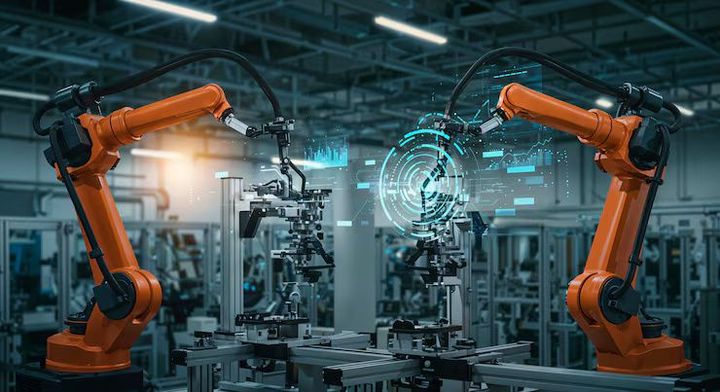
Industrial robots have evolved far beyond repetitive assembly tasks. Modern robotic automation systems can perform precision operations, collaborate with human workers, and adapt to changing production requirements.
Collaborative robots, often called cobots, are becoming increasingly common in modern manufacturing facilities because they improve flexibility and productivity.
Digital Twin Technology
Digital twins create virtual representations of physical manufacturing assets. Engineers can simulate production processes, test improvements, and monitor equipment performance without disrupting actual operations.
This technology supports faster innovation and more informed operational decisions.
The Role of Predictive Maintenance
Predictive maintenance has become one of the most valuable applications of Industry 4.0 equipment.
Traditional maintenance approaches often rely on fixed schedules or reactive repairs. In contrast, predictive maintenance systems use sensors, analytics, and artificial intelligence to identify early signs of equipment wear.
This approach provides several advantages:
- Reduced unexpected downtime
- Better asset utilization
- Increased equipment reliability
- Improved production continuity
- Enhanced operational planning
For large manufacturing facilities, even small reductions in downtime can generate significant efficiency improvements.
Smart Factory Equipment and Automation
The concept of a smart factory continues to reshape industrial operations. Smart factory equipment works together through connected networks, creating a highly responsive production environment.
Examples include:
Automated Quality Inspection Systems
Vision-based inspection technologies use cameras and artificial intelligence to identify defects with exceptional accuracy. These systems help maintain consistent product quality while reducing manual inspection requirements.
Autonomous Mobile Robots
Autonomous mobile robots transport materials throughout manufacturing facilities without direct human control. They improve logistics efficiency and streamline internal operations.
Intelligent Production Monitoring
Advanced dashboards provide managers with real-time visibility into machine performance, production output, and operational efficiency.
Instant access to manufacturing data supports faster decision-making and more effective resource management.
Emerging Trends in Industry 4.0 Equipment
Several important trends are influencing the future of manufacturing technology.
Edge Computing
Edge computing allows data processing to occur closer to manufacturing equipment rather than relying entirely on centralized systems. This reduces latency and improves response times.
Sustainable Manufacturing Technologies
Manufacturers are increasingly adopting energy-efficient equipment and intelligent resource management systems. Sustainability goals are becoming a major driver of industrial innovation.
Human-Machine Collaboration
Future production environments will focus on collaboration between skilled workers and intelligent machines. Rather than replacing employees, advanced equipment is designed to enhance human capabilities.
Cybersecurity for Connected Factories
As manufacturing systems become more connected, industrial cybersecurity becomes increasingly important. Protecting production data and operational networks remains a top priority for modern manufacturers.
Challenges Manufacturers Should Consider
While Industry 4.0 equipment offers substantial benefits, successful implementation requires careful planning.
Common challenges include:
- Integration with legacy systems
- Workforce training requirements
- Data management complexity
- Cybersecurity considerations
- Infrastructure modernization needs
Organizations that develop clear digital transformation strategies are often better positioned to maximize the value of advanced manufacturing technologies.
The Future of Next-Generation Manufacturing
Industry 4.0 is transforming manufacturing from a traditional production model into an intelligent, connected ecosystem. Advanced equipment powered by artificial intelligence, industrial automation, predictive analytics, and IoT technologies is creating more efficient and resilient factories.
As innovation continues to accelerate, manufacturers that embrace smart manufacturing solutions will gain stronger operational visibility, improved productivity, and greater adaptability in an increasingly competitive global market.