Chocolate Enrobing Machines Knowledge: Manufacturing and Industry Uses
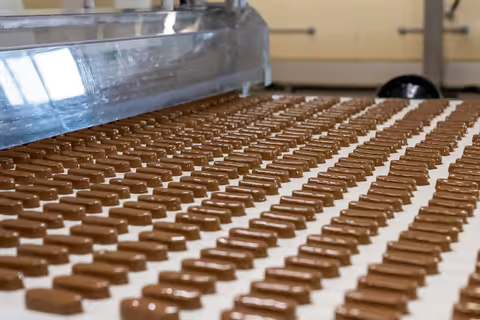
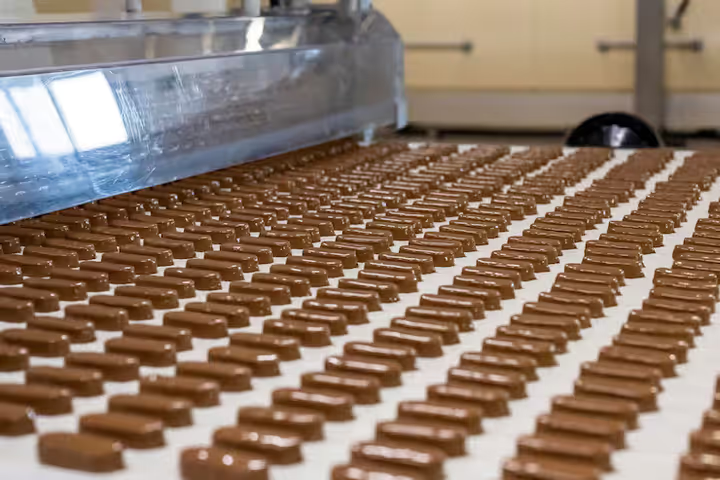
Chocolate enrobing machines are industrial food processing systems used to coat products with a uniform layer of chocolate. These machines are widely used in confectionery and bakery manufacturing to create products such as chocolate bars, biscuits, wafers, cookies, protein snacks, and pastries with a smooth chocolate finish.
The main purpose of these machines is to ensure consistent coating quality, improve production efficiency, and reduce manual handling errors in large-scale chocolate production environments. They are essential in modern food manufacturing systems where uniform appearance, texture control, and hygiene standards are important.
Chocolate Coating System Structure and Working Process
Chocolate enrobing machines operate through a continuous coating process where food products move through a controlled chocolate curtain or bath. The system is designed to regulate temperature, flow, and thickness of the coating layer.
Bulleted Lists Title: Working Flow Components
- Feeding conveyor system that carries products into the coating area
- Chocolate reservoir tank for melting and maintaining flow consistency
- Enrobing curtain system that coats products evenly from top and sides
- Bottom coating mesh or roller system for full coverage
- Cooling tunnel for solidifying chocolate layer
- Vibration unit to remove excess coating
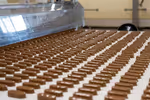
The process begins with melting chocolate in a controlled heating tank. The liquid chocolate is then circulated and formed into a continuous curtain. Products pass through this curtain and receive a uniform coating. Excess chocolate is removed using air blowers or vibration systems, ensuring precise thickness. Finally, the coated products enter a cooling tunnel where the chocolate solidifies into a stable layer.
Importance in Modern Food Manufacturing
Chocolate enrobing machines play a critical role in industrial food production systems due to their ability to standardize product quality and increase output capacity.
Bulleted Lists Title: Key Importance Factors
- Ensures consistent chocolate coating thickness
- Reduces manual labor dependency in production lines
- Improves hygiene and reduces contamination risk
- Increases production speed and scalability
- Supports mass production for global distribution
These systems are especially important in large confectionery factories where uniformity and efficiency directly impact product acceptance in global markets.
Industrial Applications and Use Cases
Chocolate enrobing machines are used in multiple food processing industries beyond traditional confectionery production.
Bulleted Lists Title: Application Areas
- Chocolate bar manufacturing units
- Biscuit and cookie coating industries
- Protein snack and energy bar production
- Bakery product finishing lines
- Frozen dessert coating systems
They are also increasingly used in health-focused food industries where protein-based snacks require controlled chocolate layering for nutritional branding and taste enhancement.
Types of Chocolate Enrobing Machines
Different types of enrobing machines are designed based on production scale, automation level, and product requirements.
| Type | Description | Typical Use |
|---|---|---|
| Semi-Automatic Enrober | Requires manual product feeding and partial automation | Small confectionery units |
| Fully Automatic Enrober | Continuous production with minimal human intervention | Medium to large factories |
| Industrial High-Capacity Enrober | Large-scale system with advanced cooling and flow control | Mass production facilities |
| Compact Tabletop Enrober | Small-scale machine for testing and boutique production | R&D labs and artisanal production |
Each type is designed to meet specific production requirements, ensuring flexibility across different industrial scales.
Key Components and Functional Systems
Chocolate enrobing machines consist of multiple integrated systems working together for precision coating.
Bulleted Lists Title: Core Machine Components
- Chocolate melting and tempering unit
- Conveyor belt system for product movement
- Enrobing curtain mechanism
- Air knife or blower system for excess removal
- Cooling tunnel for solidification
- Temperature control system for chocolate stability
- Stainless steel structure for hygiene compliance
Temperature control is one of the most critical components, as chocolate consistency depends heavily on stable thermal conditions. Even slight variations can affect texture and coating quality.
Recent Trends and Industry Developments (2025–2026)
The chocolate processing industry has seen several technological improvements in the past year focused on automation, efficiency, and food safety.
In 2025, manufacturers increasingly adopted AI-based monitoring systems to control chocolate viscosity and coating uniformity in real time. These systems help reduce waste and improve consistency across production batches.
In early 2026, there has been a growing shift toward energy-efficient enrobing systems that reduce power consumption in heating and cooling cycles. Manufacturers are also integrating IoT-based sensors for predictive maintenance, allowing factories to detect mechanical issues before breakdowns occur.
Sustainability has also become a key focus area, with newer machines designed to minimize chocolate wastage and improve recyclable material usage in machine construction.
Food Safety Standards and Regulations
Chocolate enrobing machines must comply with strict food safety and hygiene regulations to ensure product safety.
Bulleted Lists Title: Key Compliance Standards
- HACCP (Hazard Analysis and Critical Control Points) guidelines
- ISO 22000 food safety management standards
- FSSAI manufacturing hygiene requirements (India)
- EU Food Machinery Safety Directives for export systems
These regulations ensure that machines are built using food-grade materials, primarily stainless steel, and are designed for easy cleaning and contamination prevention.
Tools, Technologies, and Learning Resources
Modern chocolate processing systems are supported by advanced tools and digital technologies that enhance performance and control.
Bulleted Lists Title: Useful Tools and Technologies
- PLC (Programmable Logic Controller) automation systems
- IoT-based temperature and viscosity sensors
- Industrial SCADA monitoring platforms
- Food engineering simulation software
- Confectionery process training modules
These tools are widely used in industrial food engineering programs and technical training institutes focused on manufacturing automation and food technology.
Frequently Asked Questions
What is the main purpose of a chocolate enrobing machine?
It is used to coat food products with a uniform layer of chocolate in industrial production environments.
What types of products can be coated?
Biscuits, wafers, protein bars, cakes, pastries, and confectionery items can be coated using this system.
Is temperature control important in enrobing machines?
Yes, temperature control ensures proper chocolate flow, texture stability, and coating consistency.
Can these machines be automated?
Yes, modern systems can be fully automated with PLC and IoT-based control systems.
What materials are used in machine construction?
Food-grade stainless steel is commonly used to ensure hygiene and durability.
Conclusion
Chocolate enrobing machines are essential components of modern confectionery production systems. They provide consistent coating quality, improve production efficiency, and support large-scale manufacturing requirements. With advancements in automation, digital monitoring, and energy efficiency, these machines continue to evolve in alignment with modern food industry demands. Their role in maintaining hygiene standards and production accuracy makes them a core technology in industrial chocolate processing systems.