Surface Mount Technology Equipment: Process and Automation Insights
Surface Mount Technology, commonly known as SMT, is an electronics manufacturing method in which electronic components are mounted directly onto the surface of a printed circuit board. These components are called surface-mount devices, or SMDs.
Unlike traditional through-hole assembly, which places component leads through holes in a circuit board, SMT generally uses solder pads on the board's surface. This arrangement allows manufacturers to fit many components into a relatively small area.
SMT equipment combines mechanical precision, electronic controls, thermal processing, and inspection systems. Together, these machines transform a bare PCB into an assembled electronic circuit.
The technology became increasingly important as electronic products became smaller, lighter, and more complex. Devices such as smartphones, automotive control units, industrial sensors, communication equipment, and medical electronics depend on compact circuit assemblies.
A typical SMT production line includes several interconnected machines:
Solder paste printing equipment.
Automated pick-and-place machines.
Reflow soldering ovens.
Automated optical inspection systems.
Solder paste inspection equipment.
Board handling and material transportation systems.
Testing, repair, and rework equipment.
Each machine performs a specific task. The overall quality of the finished circuit board depends on how accurately these stages work together.
How the SMT Assembly Process Works
The SMT process follows a planned sequence. The exact workflow varies according to the circuit design, component types, soldering requirements, and production volume.
Step 1: PCB preparation
The bare printed circuit board is checked for cleanliness, surface condition, and alignment. Correct preparation helps ensure that components can be positioned accurately.
Step 2: Solder paste printing
A stencil printer applies solder paste to selected pads on the PCB. The paste contains solder particles and flux, which helps prepare metal surfaces for soldering.
Accurate paste deposition is essential. Too little paste can create weak connections, while excessive or misplaced paste can cause bridging between nearby pads.
Step 3: Component placement
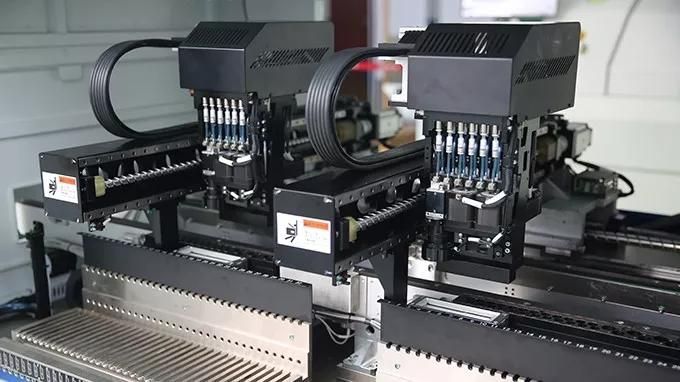
A pick-and-place machine uses programmed coordinates, feeders, cameras, and placement heads to position electronic components on the solder paste.
These machines can place many component types, including resistors, capacitors, integrated circuits, and miniature connectors. Their capabilities depend on the machine configuration and the components being handled.
Step 4: Reflow soldering
The populated PCB moves through a reflow oven. Controlled heating melts the solder paste, creating electrical and mechanical connections between components and the board.
The temperature profile must match the solder paste, PCB design, and component requirements. Excessive heat or unsuitable cooling conditions can damage components or affect joint quality.
Step 5: Inspection and testing
Inspection systems examine component placement, solder deposits, and visible solder joints. Electrical or functional testing may follow, depending on the product.
Defects identified during inspection are investigated so that the production team can correct the underlying process problem.
Importance of SMT Equipment in Modern Manufacturing
Supporting Compact and Complex Electronics
SMT equipment allows manufacturers to assemble circuit boards with high component density. Smaller electronic components help engineers develop compact products without sacrificing the functions required by the design.
This is important in several industries:
Consumer electronics: Smartphones, tablets, wearable devices, and home electronics.
Automotive electronics: Control modules, driver-assistance systems, sensors, and battery management circuits.
Telecommunications: Network equipment, signal processing boards, and communication devices.
Medical electronics: Monitoring equipment, diagnostic instruments, and electronic control systems.
Industrial automation: Programmable controllers, motor drives, sensors, and machine control boards.
Aerospace electronics: Specialized electronic assemblies that require careful quality control and traceability.
Each industry has different requirements. Automotive and medical electronics, for example, may require more extensive verification because electronic failures can affect safety or critical functions.
Improving Production Consistency
Automated equipment can repeat programmed operations across many circuit boards. Consistent printing, placement, soldering, and inspection help reduce variation between assemblies.
Automation also reduces dependence on manual handling for repetitive tasks. However, it does not eliminate human involvement. Engineers and technicians still need to prepare production programs, monitor machine performance, investigate defects, and maintain equipment.
Managing Different Production Requirements
Some facilities produce large quantities of the same circuit board, while others assemble many different designs in smaller batches. Flexible SMT lines can accommodate changing product requirements through programmable settings, adjustable feeders, and controlled changeover procedures.
The most appropriate equipment configuration depends on component size, board dimensions, production volume, inspection requirements, and the complexity of the assembly.
Recent Updates and Technology Trends
SMT manufacturing is evolving as circuit boards become denser and electronic components become smaller. Recent developments focus on connected production equipment, intelligent inspection, automation, and improved coordination between manufacturing stages.
AI-Assisted Inspection and Process Control
During 2026, electronics manufacturing discussions increasingly emphasized the use of artificial intelligence in automated optical inspection and solder paste analysis.
AI-assisted systems can help classify visual defects, identify unusual patterns, and support the investigation of recurring production problems. Their effectiveness depends on image quality, training data, inspection settings, and validation.
A particularly important development is the movement from detecting defects after they occur toward using inspection results to improve earlier production stages. For example, solder paste inspection data can help engineers identify printing variations before they affect component placement or soldering.
High-Precision Component Placement
Modern electronics increasingly combine miniature components with larger integrated circuits and complex board layouts. Placement equipment must accommodate different component dimensions, shapes, weights, and positioning requirements.
In August 2026, developments presented for the Indian electronics manufacturing market highlighted higher-performance placement platforms, sensor-based process control, and assembly requirements for AI computing boards. These developments illustrate the growing need to balance speed with placement accuracy and process flexibility.
Smart Material Management
Electronic components can be sensitive to moisture, electrostatic discharge, temperature, and storage conditions. Improved component tracking and automated storage systems help production teams maintain material identity and handling records.
This is especially relevant when a production line uses numerous component types or changes between board designs frequently.
SMT Technology Trends at a Glance
Development | Main purpose | Practical consideration |
|---|---|---|
AI-assisted inspection | Identify and classify defects | Requires validation and suitable data |
Connected equipment | Share production information | Needs reliable system integration |
Advanced placement controls | Position components accurately | Depends on board and component design |
Automated material tracking | Maintain component records | Requires accurate identification |
Predictive maintenance | Detect developing equipment problems | Depends on monitoring quality |
Energy-conscious production | Manage electricity and material use | Requires measurement and process review |
These trends do not guarantee identical improvements in every factory. Results depend on equipment capability, product design, staff training, and the quality of the production data.
Laws, Policies, and Quality Standards
SMT manufacturing is influenced by electrical safety requirements, workplace rules, environmental regulations, and standards for electronic assembly quality. The exact requirements depend on the country, industry, and intended use of the finished product.
Regulations in India
Electronics manufacturers operating in India should review applicable requirements under the Bureau of Indian Standards framework, electrical safety rules, occupational safety legislation, and environmental regulations.
The applicability of product certification, registration, or conformity assessment depends on the specific product category and current government notifications. Requirements for finished electronic products may differ from those applicable to the machines used to assemble them.
Manufacturers should also determine whether their products fall under relevant electronic waste, restricted-substance, or extended producer responsibility requirements.
International Quality Standards
Several widely used standards help organizations establish consistent electronics manufacturing practices:
IPC-A-610: Provides acceptance criteria for electronic assemblies.
IPC J-STD-001: Addresses requirements for soldered electrical and electronic assemblies.
ISO 9001: Establishes requirements for quality management systems.
ISO 14001: Provides a framework for environmental management systems.
These standards serve different purposes. Their applicability depends on the product, customer requirements, contracts, and relevant regulations. A standard should not be treated as a universal legal requirement for every SMT production line.
Workplace and Equipment Safety
Important precautions include:
Use suitable guards and emergency-stop controls.
Follow electrostatic discharge protection procedures when handling sensitive components.
Maintain safe temperatures around reflow ovens.
Use appropriate ventilation and follow chemical handling instructions.
Train operators in equipment setup, cleaning, and maintenance.
Keep inspection records, maintenance logs, and material traceability information where required.
Follow lockout and isolation procedures before authorized maintenance.
A documented safety program helps employees understand their responsibilities and supports consistent production practices.
Tools and Resources for SMT Manufacturing
Effective SMT production requires planning, monitoring, measurement, and documentation. General-purpose engineering tools help teams understand equipment performance and maintain consistent assembly quality.
Useful Manufacturing Tools
PCB design and layout software
These applications help engineers create circuit board layouts, position components, and check design requirements before production begins.
Solder paste inspection systems
These systems measure solder paste deposits and help identify problems such as insufficient paste, excessive volume, or incorrect alignment.
Automated optical inspection equipment
AOI systems use cameras and image-processing software to identify visible assembly defects, including missing components, polarity errors, and misalignment.
X-ray inspection equipment
X-ray inspection helps examine hidden solder connections and internal structures that ordinary optical inspection cannot directly see. It is particularly useful for certain ball-grid-array packages and other assemblies with concealed connections.
Statistical process control tools
These tools organize production measurements into charts and reports. Engineers can use the information to identify trends, investigate variation, and evaluate whether a process remains stable.
Maintenance and traceability templates
Standardized records help teams document equipment inspections, component batches, process settings, defect findings, and corrective actions.
Important Production Measurements
Measurement | What it helps evaluate |
|---|---|
Solder paste volume | Consistency of paste printing |
Placement offset | Accuracy of component positioning |
Reflow temperature profile | Suitability of the heating process |
Defect rate | Frequency of identified assembly problems |
First-pass yield | Percentage of assemblies passing a defined stage without rework |
Equipment downtime | Time when equipment is unavailable for production |
These measurements should be interpreted together. For example, a low defect rate during one production run does not automatically prove that the process will remain stable across different boards, components, or environmental conditions.
Frequently Asked Questions
What is SMT equipment used for?
SMT equipment assembles electronic components directly onto printed circuit boards. It includes printing machines, pick-and-place systems, reflow ovens, inspection equipment, and related handling systems.
What is the difference between SMT and through-hole technology?
SMT generally mounts components onto surface pads on a PCB. Through-hole technology places component leads through drilled holes in the board. Both methods remain relevant, and some electronic assemblies use a combination of the two.
Which machines are essential for an SMT production line?
A typical automated line requires solder paste printing equipment, pick-and-place machines, a reflow oven, and appropriate inspection equipment. Additional systems depend on the board design, component types, testing requirements, and production volume.
How does automation improve SMT assembly?
Automation supports repeatable component placement, consistent process execution, and rapid inspection. When machines share reliable production data, manufacturers can also identify process variations earlier. Proper setup, maintenance, and operator supervision remain essential.
What factors affect SMT assembly quality?
Important factors include solder paste condition, stencil design, component placement accuracy, reflow temperature, PCB cleanliness, component handling, and inspection methods. Process monitoring and root-cause analysis help teams address recurring defects.
Conclusion
Surface Mount Technology equipment is central to modern electronics manufacturing. It enables the precise assembly of compact printed circuit boards used in consumer electronics, automotive systems, telecommunications, medical equipment, and industrial automation.