Palletizing Machines Explained: Technology, Applications and Trends
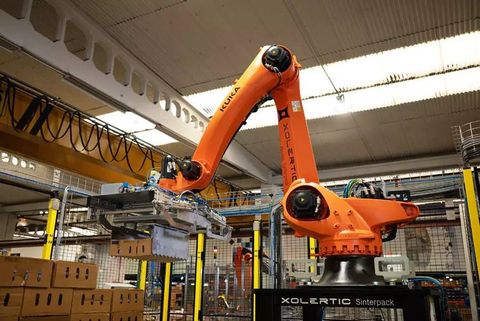
Palletizing machines are automated or semi-automated systems designed to place packaged products onto pallets according to a planned arrangement. The finished pallet can then move to storage, transportation, or another stage of the production process.
Palletizing exists because manually arranging large numbers of packages can be repetitive and physically demanding. A machine can follow a defined pattern and maintain a consistent arrangement across many pallets.
A typical palletizing system may include:
- Product conveyors
- Pallet conveyors
- Robotic or mechanical arms
- Grippers or vacuum tools
- Sensors
- Programmable controllers
- Safety equipment
- Pallet positioning systems
- Machine-vision cameras
- Control and monitoring software
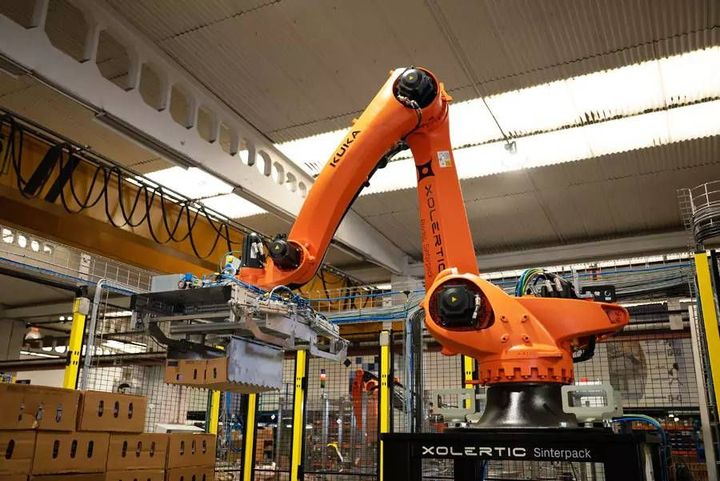
There are several common types of palletizing equipment. Conventional layer palletizers build complete product layers before placing them on a pallet. Robotic palletizers use programmable robotic arms to handle individual products or groups. Gantry systems move along fixed axes and are useful for particular production layouts.
The choice depends on product dimensions, package weight, production speed, available floor space, pallet patterns, and the level of flexibility required.
Why Palletizing Machines Matter Today
Palletizing is an important part of modern material handling because packaging operations often need to process products continuously and maintain predictable pallet patterns.
A well-designed palletizing system can help reduce repetitive manual handling and improve consistency. It can also coordinate product movement between conveyors, packaging equipment, pallet stations, and storage areas.
The technology affects several industries, including:
- Food and beverage production
- Consumer goods manufacturing
- Pharmaceutical production
- Chemical processing
- Paper and packaging
- Building materials
- Agricultural products
- Warehousing and distribution
Another important factor is product variety. Manufacturing environments may handle different package sizes, shapes, and weights during the same production period. Robotic palletizing systems can be programmed for multiple pallet patterns, making them useful where flexibility is important.
Pallet stability is also significant. Poorly arranged products can shift during transportation, creating damaged packages and handling risks. Proper pattern design helps distribute loads more evenly and can make pallets easier to handle.
Common Palletizing Methods
| Method | Main Characteristic | Typical Application |
|---|---|---|
| Conventional | Builds products in layers | High-volume packaging |
| Robotic | Uses programmable movement | Flexible production |
| Gantry | Uses linear-axis movement | Fixed production layouts |
| Collaborative | Designed for selected human-machine environments | Smaller or flexible operations |
| Vacuum-based | Uses suction for suitable products | Cartons and smooth surfaces |
The table provides a general comparison. Actual suitability depends on the product, packaging material, load characteristics, and safety assessment.
Recent Palletizing and Robotics Trends
Automation technology has continued to develop rapidly during 2025 and 2026. One major trend is the growing use of industrial robots across manufacturing.
The International Federation of Robotics reported in September 2025 that more than 542,000 industrial robots were installed worldwide during 2024. Asia accounted for 74% of new deployments, showing the strong connection between industrial automation and manufacturing activity.
More recent 2026 data reported by the same organization indicate that the global operational stock reached about five million industrial robots in 2025, while annual installations exceeded 600,000 units. India recorded almost 10,500 industrial robot installations in 2025, representing a 15% increase from the previous year.
These broader robotics developments are relevant to palletizing because palletizing is one of the applications where programmable robotic movement can handle repetitive material-handling tasks.
Artificial Intelligence and Machine Vision
AI and machine vision are also becoming more important in industrial robotics. In February 2026, the International Federation of Robotics highlighted AI-powered robotics as an emerging area, particularly in logistics and warehousing.
For palletizing applications, vision systems can help identify package position, orientation, dimensions, or selected product characteristics. This can support systems that need to respond to variations rather than simply repeat one fixed movement.
However, AI does not remove the need for engineering controls, risk assessment, or appropriate safety measures. A palletizing cell still needs to be designed for its specific operating conditions.
Greater Flexibility
Another trend is the development of more adaptable automation. Modern systems increasingly use programmable recipes, sensors, digital controls, and modular equipment.
This allows one palletizing cell to handle multiple product formats when the equipment and gripper system are designed for that purpose.
Laws, Standards, and Safety Policies
Palletizing equipment is industrial machinery, so safety requirements depend on the country, machine configuration, workplace environment, and intended use.
Internationally, ISO 10218 is an important reference for industrial robot safety. The 2025 editions of ISO 10218-1 and ISO 10218-2 address robot safety and the integration, commissioning, operation, maintenance, and decommissioning of industrial robot applications and robot cells.
Risk assessment is an important part of a palletizing system. Potential hazards can include unexpected robot movement, crushing points, falling loads, access to moving equipment, and interaction between people and automated machinery.
European Union Machinery Rules
The European Union is moving from the Machinery Directive framework toward Regulation (EU) 2023/1230. The new Machinery Regulation is scheduled to apply from 20 January 2027. It includes requirements related to machinery safety and also addresses areas such as AI-related safety functions and cybersecurity for relevant software and safety-control systems.
The transition is particularly relevant to organizations preparing machinery for the EU market during 2026.
India and Machinery Safety
India is also developing and updating standards connected with machinery integration and industrial automation. In July 2025, the Bureau of Indian Standards published a draft revision of IS 15296:2025, aligned with ISO 11161:2025, concerning safety requirements for integrating machinery into a system. The draft included additions related to risk assessment, space requirements, task zones, risk reduction, and integrated manufacturing system modes.
Organizations should check the current applicable Indian Standards, workplace regulations, electrical requirements, and other national rules before designing or operating an industrial palletizing cell.
Tools and Resources for Understanding Palletizing Systems
Several general tools can help engineers, operators, students, and manufacturing planners understand palletizing technology.
Pallet Pattern Calculators
Pallet pattern calculators can help estimate how cartons or containers fit within a pallet footprint. They can be used to compare arrangements and understand available pallet space.
Robot Simulation Software
Simulation programs can create a virtual representation of a robotic palletizing cell. They may help users study robot reach, movement paths, cycle sequences, and potential interference before physical installation.
Machine-Vision Tools
Vision-development software can be used to study object recognition, position detection, orientation, and inspection. These tools are particularly useful for applications involving variable package positions.
Safety Assessment Templates
Risk-assessment templates can help document hazards, protective measures, operating modes, maintenance requirements, and emergency procedures.
Pallet Pattern Templates
Simple spreadsheet templates can record:
- Product dimensions
- Product weight
- Pallet dimensions
- Number of products per layer
- Number of layers
- Total pallet height
- Layer orientation
- Estimated pallet load
These resources can support early planning, but they should not replace a professional machine safety assessment for an actual industrial installation.
Frequently Asked Questions
What does a palletizing machine do?
A palletizing machine arranges packaged products onto pallets according to a defined pattern. Depending on the design, it can handle individual products, groups of products, or complete layers.
What industries use palletizing machines?
Palletizing systems are used in food and beverage, pharmaceuticals, chemicals, consumer products, paper and packaging, building materials, agriculture, manufacturing, and logistics.
What is robotic palletizing?
Robotic palletizing uses a programmable industrial robot to pick products or groups of products and place them onto pallets. The robot can usually be programmed for different product patterns and pallet configurations.
Are palletizing machines safe?
Palletizing machines can be designed with safety measures such as guarding, interlocks, emergency-stop functions, sensors, controlled access, and risk-reduction measures. Safety depends on the complete system design, installation, operation, and maintenance.
What are the main factors when selecting a palletizing system?
Important factors include product size and weight, package material, required throughput, pallet dimensions, available floor space, desired pallet patterns, product variation, robot reach, integration requirements, and applicable safety rules.
Conclusion
Palletizing machines have become an important part of modern packaging and material-handling systems. Their main purpose is straightforward: organize products onto pallets in a consistent and controlled way.