Oil Filtering Machines Guide: Basic Information and Useful
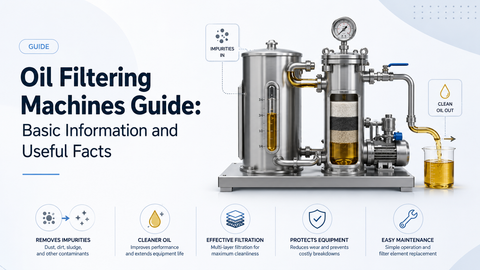
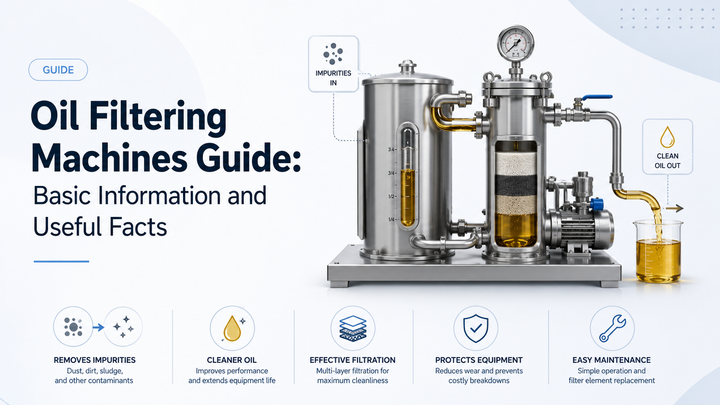
Oil filtering machines are equipment systems used to remove unwanted particles, sludge, moisture, carbon deposits, and other impurities from different types of oil. These machines are used in food preparation units, restaurants, edible oil processing units, workshops, factories, power systems, and engineering plants.
The basic purpose of an oil filtering machine is simple: oil becomes less clean after repeated use or long operation. Dust, metal particles, food crumbs, moisture, heat-related residue, and oxidation by-products can enter the oil. If these impurities remain, the oil may lose performance, affect food quality, damage machinery, or create safety concerns.
Oil filtering machines exist because manual filtering is often slow, inconsistent, and less suitable for controlled operations. A proper filtration system can separate fine particles more steadily and help maintain process discipline.
Common oil filtering machine categories include:
- Edible oil filtration machines
- Cooking oil filtration units
- Hydraulic oil filtration machines
- Transformer oil filtration units
- Lubricant filtration systems
- Vacuum oil purifier machines
- Centrifugal oil filtration systems
- Portable oil filtration carts
- Industrial oil purification machines
Oil filtering machines may use filter paper, cartridges, mesh filters, magnetic separators, centrifugal force, vacuum dehydration, or pressure-based filtration. The design depends on the oil type and the impurity level.
Why Oil Filtering Machines Matter Today
Oil filtering machines matter because oil is used in many daily and industrial processes. In food environments, cooking oil quality can affect taste, colour, hygiene, and safety. In factories, oil quality can affect machine life, hydraulic pressure, lubrication, heat transfer, and breakdown risk.
In edible oil and frying applications, repeated heating changes the chemical nature of oil. FSSAI states that repeated frying creates Total Polar Compounds, and oil should not be used beyond the 25% TPC limit. FSSAI also notes that monitoring vegetable oil quality during frying is important for public health.
In mechanical systems, oil filtering machines help reduce:
- Wear caused by metal particles
- Blockage in hydraulic valves
- Moisture contamination
- Sludge build-up
- Oxidation residue
- Reduced lubrication performance
- Transformer oil insulation weakness
- Unplanned machine downtime
Oil filtering affects several groups. Food business operators need cleaner frying practices and proper used oil handling. Industrial maintenance teams need stable lubricant and hydraulic oil performance. Electrical maintenance teams need transformer oil clarity and moisture control. Quality teams need records, inspection logs, and process checks.
The topic is also important because oil waste has both health and environmental implications. FSSAI’s RUCO initiative focuses on diverting used cooking oil away from the food chain and into approved biodiesel or soap manufacturing channels.
Basic Working Process of Oil Filtering Machines
| Stage | What Happens | Purpose |
|---|---|---|
| Oil intake | Oil enters the filtration machine | Starts controlled movement |
| Pre-filtration | Large particles are separated | Prevents filter overload |
| Fine filtration | Smaller impurities are trapped | Improves oil clarity |
| Moisture removal | Some systems use vacuum or heating | Reduces water content |
| Sludge separation | Heavy residue is removed | Improves oil condition |
| Output collection | Filtered oil moves to a clean tank | Supports controlled reuse or further handling |
| Record check | Readings and observations are noted | Helps process tracking |
Different industries use different filtration accuracy levels. For example, a food unit may focus on crumbs, carbon residue, and TPC monitoring. A hydraulic system may focus on micron rating, pressure drop, particle count, and moisture. A transformer oil unit may focus on dielectric strength, dissolved gases, and moisture level.
Recent Updates and Trends
Recent trends show stronger attention toward automation, oil quality monitoring, environmental responsibility, and digital traceability. In food environments, the focus is moving beyond simple visual checking. More units are using Total Polar Compound meters, daily oil logs, and structured disposal records.
In 2025 and 2026, local inspections in Indian cities continued to highlight used cooking oil monitoring. Reports from Ahmedabad noted action against food outlets for not maintaining proper oil usage records and not monitoring TPC levels. Another Ahmedabad report stated that food outlets using 50 litres or more oil daily were directed to install TPC tester machines and maintain daily records. These developments reflect rising enforcement attention around oil reuse and documentation.
The RUCO ecosystem has also become more visible. FSSAI describes RUCO as an initiative to collect used cooking oil and convert it into biodiesel, helping keep degraded oil away from the food chain.
In industrial oil filtration, recent attention is on:
- Vacuum oil purification for moisture reduction
- Portable filtration carts for maintenance teams
- Fine micron cartridge filters
- Condition monitoring sensors
- Oil particle counters
- Automated filter clogging alerts
- Energy-efficient filtration pumps
- Digital maintenance logs
- Used oil traceability systems
Industrial users are also paying more attention to circular economy rules. The CPCB Used Oil EPR portal states that Extended Producer Responsibility for Used Oil commenced from 1 April 2024 under the Hazardous and Other Wastes Second Amendment Rules, 2023. This applies to base oil or lubrication oil producers and used oil importers under specified obligations.
Simple Trend View
| Area | Earlier Practice | Current Direction |
|---|---|---|
| Food oil checking | Visual colour and smell checks | TPC meters and oil records |
| Industrial oil care | Reactive maintenance | Condition-based monitoring |
| Filtration method | Basic mesh filtering | Cartridge, vacuum, and centrifugal systems |
| Documentation | Paper notes or no record | Daily log sheets and digital records |
| Used oil handling | Informal disposal | Authorized collection and traceability |
| Compliance | Periodic review | Regular monitoring and documented proof |
Illustrative trend graph:
Oil quality monitoring focus
2021: Basic filtering ███
2022: More fryer oil checks ████
2023: Better maintenance logs █████
2024: Used oil EPR framework begins ██████
2025: TPC testing visibility grows ███████
2026: Traceability and compliance records expand ████████
This graph is illustrative and shows direction of attention, not a measured national index.
Laws, Policies, and Compliance Context in India
Oil filtering machines are influenced by different rules depending on the oil category. Edible oil, used cooking oil, lubrication oil, transformer oil, and industrial used oil do not fall under one single rule. Each area has its own compliance context.
For food-related oil, FSSAI rules are central. FSSAI has fixed the Total Polar Compounds limit at 25%, beyond which vegetable oil should not be used. From 1 July 2018, food business operators were required to monitor frying oil quality under the relevant framework described by FSSAI’s RUCO platform.
For used cooking oil, RUCO supports collection and conversion into biodiesel. FSSAI says the same cooking oil used repeatedly can create adverse health effects, while used cooking oil can also become biodiesel feedstock when handled through the RUCO ecosystem.
For industrial used oil, the CPCB portal explains that the Government of India notified the Hazardous and Other Wastes Second Amendment Rules, 2023, adding Chapter VII on Extended Producer Responsibility for Used Oil. The framework started from 1 April 2024.
CPCB’s used oil FAQ states that producers and used oil importers have recycling target obligations. It also lists registration requirements for producers, recyclers, importers, and collection agents on the Used Oil portal.
The Bureau of Indian Standards is also relevant because BIS develops and publishes Indian Standards and runs conformity assessment schemes. For machinery, materials, electrical safety, and process equipment, users often refer to relevant Indian Standards depending on the equipment type and application.
Compliance Checklist
| Area | Practical Check | Why It Matters |
|---|---|---|
| Food oil TPC level | Check with approved measuring device | Helps avoid unsafe frying oil |
| Oil usage record | Maintain date, quantity, and test reading | Supports inspection readiness |
| Filter condition | Track pressure drop and clogging | Maintains filtration efficiency |
| Cleaning schedule | Record filter cleaning and replacement | Reduces contamination |
| Used oil handover | Use authorized channel where applicable | Supports traceability |
| Machine safety | Check guards, wiring, and earthing | Protects operators |
| Oil storage | Use labelled and covered containers | Prevents mixing and contamination |
| Maintenance log | Record pump, seal, filter, and hose checks | Reduces process interruption |
Tools and Resources
Helpful tools and resources for understanding oil filtering machines include:
- FSSAI portal: For food safety rules, licensing references, and frying oil safety guidance.
- RUCO portal: For information on used cooking oil collection and biodiesel conversion.
- CPCB Used Oil EPR portal: For industrial used oil registration and EPR-related updates.
- BIS standards portal: For Indian Standards related to materials, equipment, and conformity references.
- TPC meter: A handheld device used to measure Total Polar Compounds in frying oil.
- Oil particle counter: Used in hydraulic and lubrication systems to assess oil cleanliness.
- Moisture meter: Helps identify water contamination in industrial oil.
- Filter pressure gauge: Shows filter blockage or flow restriction.
- Batch oil log sheet: Records oil usage, test reading, filtration timing, and disposal details.
- Preventive maintenance checklist: Covers pump, filter housing, gasket, hose, motor, and control panel checks.
- Oil condition monitoring template: Tracks particle level, viscosity, moisture, acidity, and visual observations.
- HACCP worksheet for food oil: Helps identify food safety hazards linked to oil reuse and frying temperature.
Simple oil log template:
| Field | Example Entry |
|---|---|
| Date | Daily record date |
| Oil type | Edible oil, hydraulic oil, lubricant oil |
| Machine area | Fryer, press, transformer, hydraulic unit |
| Filtration time | Start and end time |
| Reading | TPC, particle count, moisture, or pressure |
| Observation | Colour, smell, sludge, foam, clarity |
| Action taken | Filtered, separated, tested, or handed over |
| Supervisor note | Review comment |
FAQs
What is an oil filtering machine?
An oil filtering machine is equipment used to remove impurities from oil. It may remove food crumbs, dust, sludge, metal particles, moisture, or oxidation residue depending on the oil type and machine design.
Are oil filtering machines used only for cooking oil?
No. They are used for edible oil, hydraulic oil, transformer oil, gear oil, lubricant oil, turbine oil, and other industrial oils. Each application needs a different filtration method and cleanliness target.
What is TPC in cooking oil?
TPC means Total Polar Compounds. These compounds form when cooking oil is heated repeatedly. FSSAI has fixed a 25% TPC limit, beyond which vegetable oil should not be used.
Can filtering make degraded cooking oil safe again?
Filtering can remove crumbs and visible particles, but it may not reverse chemical degradation. If TPC is above the permitted limit, filtration alone should not be treated as a safety solution.
What records are useful for oil filtration?
Useful records include oil type, filtration date, filter condition, TPC reading, particle count, moisture reading, oil quantity, inspection notes, and used oil handover details.
Why is moisture removal important in industrial oil?
Moisture can reduce lubrication quality, cause corrosion, affect hydraulic performance, and weaken transformer oil insulation. Vacuum oil purifier systems are often used where moisture control is important.
Conclusion
Oil filtering machines are important in food preparation, manufacturing, maintenance, and electrical systems. They help remove impurities and support better control over oil condition. Their role changes by application: edible oil filtration focuses on food safety and oil clarity, while industrial oil filtration focuses on equipment protection and performance stability.
In India, the topic is linked with FSSAI rules for frying oil, RUCO guidance for used cooking oil, CPCB’s Used Oil EPR framework, and relevant BIS standards. Recent developments show stronger attention to TPC testing, used oil traceability, and documented monitoring.
A responsible oil filtration process depends on more than the machine. It also needs correct testing, clean handling, trained operators, inspection records, maintenance planning, and compliance awareness. For general readers, understanding oil filtering machines helps explain how cleaner oil handling supports food safety, equipment reliability, and environmental responsibility.