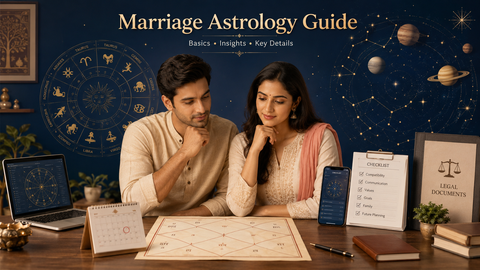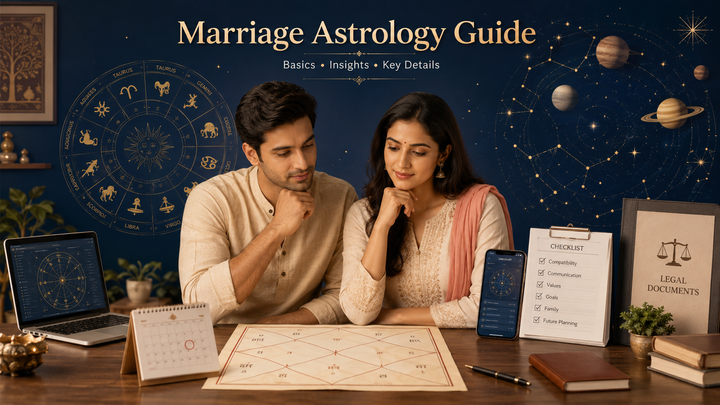
Marriage Astrology Guide: Explore Basics, Insights, and Key Details
Marriage astrology is a traditional system used in many cultures to study relationship compatibility through birth charts, planetary placements, lunar signs, houses, and timing indicators. In India, it is commonly connected with kundli matching, guna milan, manglik analysis, nakshatra matching, and family discussions before marriage.
The topic exists because marriage is not only a personal decision in many households. It can also involve family expectations, cultural customs, timing beliefs, long-term planning, and social traditions. Marriage astrology gives some families a familiar structure for discussing compatibility before moving ahead.
A neutral way to understand marriage astrology is to see it as a cultural and interpretive framework, not as a guaranteed prediction system. It may help some families organize conversations around compatibility, temperament, values, timing, and expectations. However, it should not replace consent, communication, legal registration, medical guidance, relationship counseling, or informed personal judgment.
Marriage astrology usually looks at:
- Birth date, birth time, and birth place
- Moon sign and nakshatra
- Seventh house and its planetary links
- Venus, Jupiter, Mars, and Saturn indicators
- Guna milan points in kundli matching
- Manglik or Kuja Dosha interpretation
- Dasha and transit timing
- Broader family and cultural traditions
Marriage astrology remains popular because it gives people a familiar language for discussing compatibility. The useful approach is to treat it as one layer of reflection, while keeping legal, emotional, financial, and personal factors at the center.
Importance
Marriage decisions affect individuals, families, finances, residence, legal rights, and future planning. For many people, astrology becomes part of the pre-marriage discussion because it gives structure to questions that are otherwise difficult to raise openly.
Today, the topic matters for three main audiences:
- Individuals exploring marriage timing or compatibility
- Families comparing traditional beliefs with modern decision-making
- Readers trying to understand kundli matching without exaggerated claims
Marriage astrology may help reduce a communication gap. For example, a chart discussion may lead to questions about emotional maturity, family roles, relocation, career goals, health routines, and financial planning. These are real-life topics, even though astrology itself is interpretive.
A balanced marriage decision should include both cultural context and practical checks.
| Area | Astrology View | Practical View |
|---|---|---|
| Compatibility | Guna milan, signs, planets | Communication, respect, values |
| Timing | Dasha, transit, muhurat | Readiness, family planning, law |
| Concern areas | Dosha, difficult placements | Counseling, discussion, consent |
| Long-term planning | Planetary periods | Finance, residence, health |
| Family context | Ritual traditions | Boundaries, support, clarity |
This table shows why astrology should be used carefully. It can raise questions, but it cannot verify character, commitment, safety, or legal eligibility. Those areas require real-world evaluation.
Recent Updates And Trends
The biggest change in the past year has been the shift from local consultations to digital astrology platforms, mobile apps, and automated kundli tools. In early 2026, an Indian digital astrology platform reported strong FY25 revenue, showing that online astrology continued to attract users seeking horoscope, kundli, and marriage-related guidance. This trend indicates rising interest in app-based astrology, chat-based consultations, and birth-chart automation.
Another important update is stronger attention on advertising accuracy. On March 11, 2026, the Central Consumer Protection Authority highlighted guidelines dealing with non-misleading advertising, disclaimers, and advertiser duties. For marriage astrology content, this means claims should be careful, clear, and not promise fixed outcomes.
Digital growth has also increased privacy concerns. Birth details can be personal because they may include date, time, place, and family context. Users should understand how an app or website handles data before entering sensitive details.
| Trend | Meaning For Readers |
|---|---|
| Astrology apps | More access to kundli and chart tools |
| Automated matching | Faster comparison of birth details |
| Regional content | More Hindi and local-language guides |
| Claim scrutiny | More focus on truthful wording |
| Privacy awareness | More need to protect birth data |
Simple Interest Graph
Digital kundli tools: ██████████ High
Traditional family matching: ████████ Strong
Legal registration awareness: ███████ Growing
Privacy checks: ██████ Rising
Scientific validation: ███ Limited
This graph is illustrative. It shows that interest in astrology may be high, but responsible use requires legal awareness, privacy checks, and practical discussion.
Laws And Policies
In India, marriage is governed by law and personal statutes, not astrology. The Hindu Marriage Act, 1955 includes conditions for a Hindu marriage and ceremonies for a Hindu marriage. The Special Marriage Act, 1954 includes conditions relating to solemnization, notice, objection, and marriage officer processes. These legal frameworks define eligibility and validity; horoscope matching does not create legal marriage status.
Marriage astrology also has no legal power to override consent, minimum age rules, prohibited relationships, registration requirements, or court procedures. The Prohibition of Child Marriage Act, 2006 is important because child marriage rules cannot be bypassed by cultural or astrological reasoning.
Advertising and public content around astrology should also be cautious. The National Consumer Helpline explains that misleading advertising can include false description, false guarantee, likely consumer confusion, unfair representation, or deliberate concealment of important information. ASCI’s advertising code also requires communication to be legal, decent, honest, and truthful.
For an educational marriage astrology article, safe wording matters. Avoid saying that astrology can guarantee marriage, prevent separation, remove all obstacles, or confirm a perfect partner. A compliant approach uses words such as “may indicate,” “traditionally believed,” “commonly interpreted,” “cultural view,” and “discussion point.”
Responsible content principles:
- Present astrology as belief-based or interpretive
- Avoid fixed predictions about marriage outcome
- Do not create fear around dosha or planetary placement
- Encourage consent and practical discussion
- Separate astrology from legal marriage status
- Mention official legal sources for registration questions
- Protect personal birth data
Tools And Resources
Marriage astrology learning becomes easier when readers use clear tools and reliable references. The goal is not to create blind dependence, but to understand terms and compare cultural interpretation with practical planning.
Helpful astrology tools:
- Birth chart creator for lagna, moon sign, and planetary houses
- Kundli matching calculator for guna milan points
- Nakshatra finder for lunar mansion details
- Panchang calendar for tithi, nakshatra, and muhurat awareness
- Transit tracker for broad planetary movement
- Compatibility worksheet for values, lifestyle, and expectations
- Personal journal template for pre-marriage questions
Helpful official and practical resources:
- India Code for marriage law text
- State marriage registration portal
- National Consumer Helpline for consumer awareness
- ASCI code pages for advertising standards
- Privacy policy pages of astrology apps
- Relationship counseling directories
- Family mediation information pages
- Financial planning worksheet for couples
Before using any app or website, readers should check:
- What personal data is collected
- Whether account deletion is available
- Whether claims sound exaggerated
- Whether human interpretation is clearly marked
- Whether legal and privacy notes are visible
- Whether the platform separates tradition from certainty
A simple pre-marriage worksheet can include:
| Question Area | Useful Question |
|---|---|
| Values | What does commitment mean to each person? |
| Finance | How will income, savings, and spending be discussed? |
| Family | What role will both families have? |
| Residence | Where will the couple live after marriage? |
| Career | How will career growth be supported? |
| Health | Are important health topics discussed openly? |
| Conflict | How will disagreements be handled? |
This worksheet is often more useful than only checking chart points. A chart may begin a conversation, but these questions test real compatibility.
FAQs
What is marriage astrology?
Marriage astrology is the study of relationship compatibility and timing through birth charts, planetary positions, lunar signs, nakshatras, and traditional matching methods. In India, it often includes kundli matching and guna milan. It is a cultural and interpretive practice, not a legally binding process.
Is kundli matching legally required for marriage in India?
No. Indian marriage validity depends on applicable marriage laws, consent, eligibility, ceremonies or formal procedures, and registration rules where applicable. Kundli matching may be followed by families as a tradition, but it is not a legal requirement.
What is guna milan in marriage astrology?
Guna milan is a traditional kundli matching method that compares factors linked with nakshatra and moon sign. It assigns points across categories such as temperament, harmony, health indicators, and family compatibility. It should be read as a traditional framework, not as a complete relationship decision tool.
What does Manglik mean in marriage astrology?
Manglik generally refers to certain Mars placements in a birth chart. Some traditions interpret it as an area needing careful matching. A balanced article should not create fear around it. Real compatibility depends on communication, consent, maturity, and practical life planning.
Can astrology predict a successful marriage?
Astrology cannot guarantee a successful marriage. It may provide symbolic insights for people who follow the tradition, but relationship quality depends on respect, communication, emotional maturity, trust, conflict handling, shared values, and legal clarity.
Conclusion
Marriage astrology continues to be relevant because it sits at the intersection of tradition, family discussion, relationship compatibility, and digital tools. For many readers, it provides a familiar way to explore marriage timing and kundli matching. For others, it is useful mainly as cultural knowledge.
The safest and most practical approach is balanced. Astrology can be treated as a discussion aid, not a guarantee. A strong marriage decision should include consent, emotional readiness, legal eligibility, registration awareness, personal values, financial clarity, and respectful communication.
In India, marriage law and consumer protection frameworks are important reference points. Horoscope matching may guide belief-based conversations, but legal validity comes from the applicable law. Readers should use official resources, avoid fear-based claims, protect personal data, and keep practical compatibility at the center.
A good marriage astrology guide should educate, explain, and clarify. It should not promise results. It should help readers understand tradition while making informed, responsible, and realistic decisions.