Google Ads Bidding Strategies Guide: Explore Basics, Key Details and Helpful Information
Google Ads bidding strategies are methods used to guide how campaigns participate in digital ad auctions. When someone searches on Google or interacts with eligible online placements, the ad system evaluates many signals before deciding which ads may appear. These signals can include the bid strategy, ad relevance, landing page quality, expected impact, user context, and campaign settings.
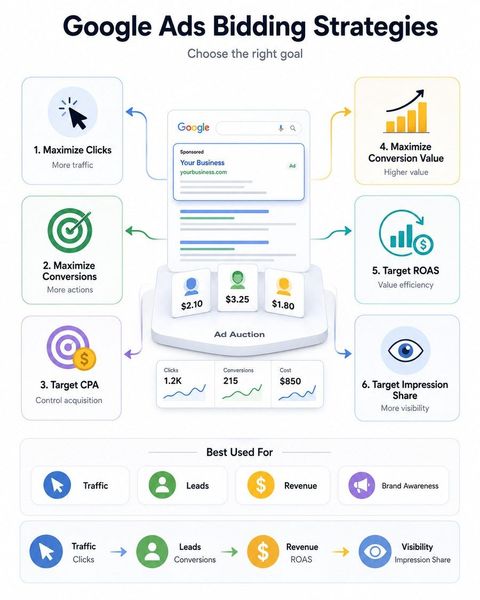
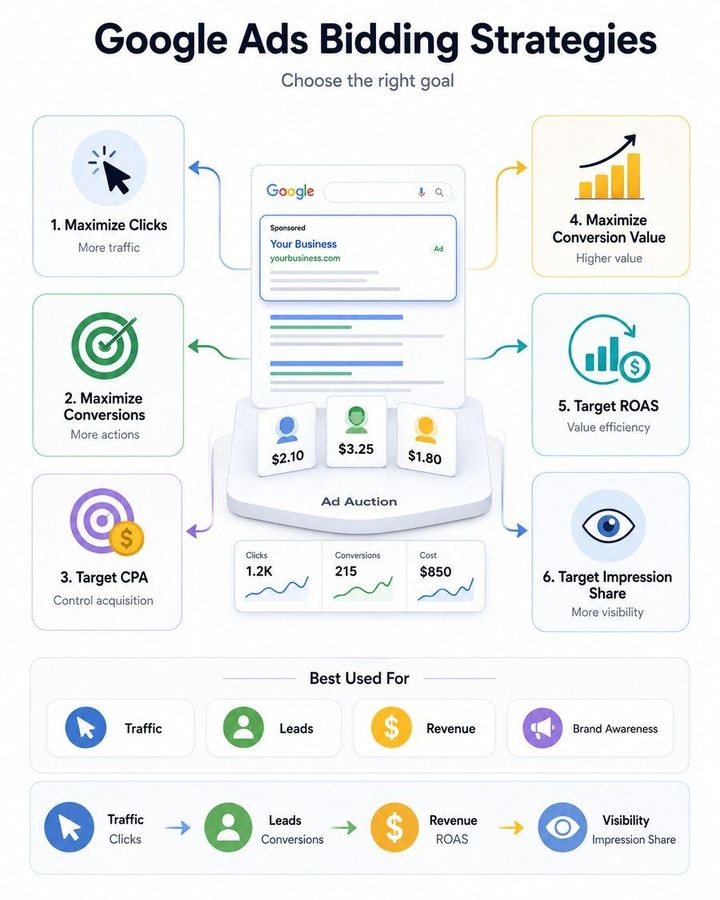
A bidding strategy helps advertisers define what result matters most. Some campaigns focus on website visits. Some focus on leads. Others focus on conversion value, visibility, video views, or engagement. Google explains that advertisers can choose bidding approaches based on clicks, impressions, conversions, views, or engagements depending on campaign type.
In simple terms, bidding answers one question: what should the system prioritize when entering an ad auction?
For example, a lead generation campaign may prioritize form submissions or phone calls. An ecommerce campaign may use conversion value and ROAS. A brand awareness campaign may focus on impression share. A content campaign may focus on qualified visits and engagement signals.
Google Ads now uses more automation than earlier manual systems. Smart Bidding is Google’s automated bidding technology that uses Google AI to optimize for conversions or conversion value during each eligible auction. Google lists Target CPA, Target ROAS, Maximize Conversions, and Maximize Conversion Value as Smart Bidding strategies.
Importance
Bidding strategy matters because it affects how ad spend is distributed across auctions. A campaign with an unsuitable bidding model may attract traffic that does not match the goal. A campaign with accurate conversion tracking and a relevant bidding model gives the system better signals.
This topic affects:
- Small businesses using paid search marketing
- Ecommerce websites tracking product value
- Lead generation websites using forms or calls
- Marketing teams managing PPC campaigns
- Agencies handling multiple ad accounts
- Finance, insurance, education, healthcare, software, and B2B advertisers using high CPC keywords
The main problem bidding solves is prioritization. Instead of adjusting every keyword or placement manually, automated bidding helps decide where ad spend should go. Google states that Smart Bidding can use a range of auction-time signals, including device, location, time, language, and browser context.
Bidding does not guarantee outcomes. Results can vary because of landing page quality, tracking setup, competition, account history, creative relevance, keyword intent, audience behavior, and policy status.
| Campaign Goal | Suitable Bidding Direction | Common Metric |
|---|---|---|
| Website visits | Click-focused bidding | Clicks, CPC |
| Lead generation | Conversion-focused bidding | CPA |
| Revenue value | Value-based bidding | ROAS |
| Brand visibility | Impression-focused bidding | Impression share |
| Video attention | View-focused bidding | View rate |
| Account testing | Manual or click-focused control | CPC, CTR |
Key Google Ads Bidding Strategies
Maximize Conversions
Maximize Conversions is an automated bidding strategy that aims to generate the highest possible number of tracked conversions within the campaign budget. It uses auction-time signals to adjust bids based on the likelihood of conversion.
This strategy can be useful when the main goal is lead volume, sign-ups, calls, form submissions, trial requests, or other measured actions. It works best when conversion tracking is accurate and the selected conversion actions represent meaningful user behavior.
Key points:
- It focuses on conversion count.
- It uses available campaign budget.
- It can work with a Target CPA when enough data is available.
- It may enter a learning period after major edits.
Target CPA
Target CPA is designed to help campaigns generate conversions near a selected average CPA goal. It does not mean every conversion will match that figure exactly. Some conversions may be above the target and others below it, while the system works toward an average.
This strategy is often used when each lead or action has a known business value. It is commonly used for form submissions, consultation requests, calls, account sign-ups, and lead capture pages.
A realistic target matters. If the target is too restrictive, the campaign may receive limited traffic. If it is too loose, the system may expand reach but reduce efficiency.
Maximize Conversion Value
Maximize Conversion Value focuses on total conversion value rather than only conversion count. It is useful when different conversions have different values.
For example, one action may represent a newsletter registration, while another may represent a high-value enquiry. In ecommerce, different transactions may carry different order values. For lead generation, advertisers may assign values to different lead types.
Google has expanded portfolio strategy support for Maximize Conversions and Maximize Conversion Value, allowing these strategies to work across multiple campaigns with shared budget structures.
Target ROAS
Target ROAS is used when advertisers want the system to optimize toward a selected return on ad spend target. It requires reliable conversion value tracking. Without accurate value data, the system may make weak decisions.
Target ROAS is commonly used by ecommerce advertisers, subscription platforms, SaaS websites, and lead generation accounts where different conversions have different estimated values.
The target should be based on real account data. A target that is too aggressive may reduce traffic. A target that is too broad may increase activity without improving business quality.
Maximize Clicks
Maximize Clicks is an automated bidding strategy focused on generating website visits within the selected budget. It does not directly optimize for conversion value.
This strategy may be useful during early campaign testing, keyword discovery, traffic analysis, and landing page evaluation. It should be reviewed carefully because more clicks do not always mean better outcomes.
Target Impression Share
Target Impression Share focuses on visibility. It allows advertisers to aim for specific visibility positions, such as the absolute top of the page, top of the page, or anywhere on the search results page.
This strategy is usually used for brand visibility, competitor monitoring, or awareness-focused campaigns. It is not primarily designed for conversion efficiency.
Manual CPC
Manual CPC gives advertisers direct control over keyword-level bids. It may be useful for advanced structures, narrow testing, or accounts where human control is preferred over automated bidding.
However, it requires regular monitoring. Manual bidding may not use the same auction-time signal depth as Smart Bidding.
Bidding Strategy Comparison
| Strategy | Main Goal | Best Input Data | Main Risk |
|---|---|---|---|
| Maximize Conversions | More tracked actions | Accurate conversion tracking | Weak lead quality |
| Target CPA | Controlled lead acquisition | Stable CPA history | Overly narrow target |
| Maximize Conversion Value | Higher total value | Conversion value data | Poor value mapping |
| Target ROAS | Value efficiency | Reliable revenue signals | Limited traffic |
| Maximize Clicks | More visits | Keyword and traffic data | Low-intent clicks |
| Target Impression Share | Visibility | Impression data | Spend pressure |
| Manual CPC | Direct bid control | Keyword-level insight | Higher manual workload |
Simple Bidding Decision Graph
| Goal Priority | Suggested Direction |
|---|---|
| Traffic | █████████ Maximize Clicks |
| Lead Volume | █████████████ Maximize Conversions |
| Lead Efficiency | ███████████ Target CPA |
| Revenue Value | █████████████ Maximize Conversion Value |
| ROAS Control | ███████████ Target ROAS |
| Brand Visibility | ██████████ Target Impression Share |
This graph is only a learning aid. A real account should be reviewed using tracking quality, campaign objective, keyword intent, landing page experience, budget level, and policy status.
Recent Updates
Google Ads bidding has moved further toward AI-assisted campaign management over the past year.
In May 2025, Google introduced AI Max for Search campaigns. Google described AI Max as a Search campaign feature suite using search term matching, text customization, and URL expansion to help campaigns match more relevant queries.
In April 2026, Google announced that AI Max for Search campaigns was moving out of beta, with legacy Dynamic Search Ads features scheduled to upgrade automatically to AI Max starting in September 2026.
In 2026, Google also published Ads Decoded discussions around bidding and budgeting, showing that AI-driven bidding, campaign budgets, and measurement quality remain major topics for advertisers.
At Google Marketing Live 2026, Google announced new AI-powered bidding and budgeting tools for Search and Shopping. Google positioned these updates around managing budgets and adapting to changing consumer behavior.
The broader trend is clear: bidding is becoming more automated, more dependent on first-party data, and more connected to campaign measurement quality.
Laws and Policies
Google Ads bidding strategies must follow advertising policy rules. Even a well-configured bidding model cannot fix disapproved ads, restricted landing pages, unclear claims, or category violations.
Google’s Advertising Policies explain that the platform is designed to support a transparent and trustworthy advertising ecosystem. These policies cover prohibited content, prohibited practices, restricted content, editorial requirements, technical standards, and destination quality.
For India, advertisers should also consider data protection and advertising transparency rules. The Digital Personal Data Protection Act, 2023 covers digital personal data processing in a way that recognizes both individual data rights and lawful processing needs.
This matters for Google Ads because conversion tracking, remarketing, Customer Match, audience lists, and analytics may involve personal data. Advertisers should collect, process, and store user data only through lawful and transparent methods.
Political advertising has additional restrictions. Google states that political and election ads have region-specific requirements, and in some regions election ads can run only after advertiser verification.
Influencer and paid digital content also require transparency in India. ASCI guidelines state that influencer advertisements should carry clear disclosure labels when a material connection exists.
For safer campaign management, advertisers should review:
- Google Ads policies
- Landing page transparency
- Restricted category rules
- Data collection notices
- Consent settings
- Claims and disclaimers
- Political and financial advertising requirements
- Country-specific legal obligations
Tools and Resources
Several tools can help advertisers plan and review bidding strategies.
- Google Ads Keyword Planner: Helps research search interest and keyword competition.
- Google Ads Performance Planner: Helps model campaign scenarios and budget changes.
- Conversion tracking: Essential for Smart Bidding accuracy.
- Google Tag Manager: Helps manage website tags and conversion actions.
- Google Analytics 4: Helps review user behavior after ad clicks.
- Attribution reports: Help understand which touchpoints support conversions.
- Bid strategy reports: Show learning status, signals, and bidding performance.
- Policy Manager: Helps review policy status and disapproval reasons.
- Google Ads Editor: Useful for bulk campaign changes.
- Looker Studio dashboards: Helpful for reporting CPC, CPA, ROAS, conversion rate, and impression share.
| Planning Area | What to Review |
|---|---|
| Tracking | Are conversion actions accurate? |
| Goal | Is the campaign focused on clicks, leads, value, or visibility? |
| Budget | Is the budget stable enough for learning? |
| Data quality | Are duplicate or weak conversions excluded? |
| Landing page | Is the page clear, relevant, and policy-safe? |
| Policy | Are claims, disclosures, and category rules aligned? |
| Review cycle | Are changes spaced out enough for learning? |
FAQs
What is a Google Ads bidding strategy?
A Google Ads bidding strategy is the method used to guide how campaigns enter ad auctions. It tells the system whether to prioritize clicks, conversions, conversion value, impressions, views, or engagement.
Which bidding strategy is useful for lead generation?
Maximize Conversions and Target CPA are commonly used for lead generation. The right choice depends on tracking accuracy, lead quality, account history, campaign structure, and available conversion data.
Is Smart Bidding fully automatic?
Smart Bidding automates bid decisions, but it still needs correct inputs. Conversion tracking, budget stability, landing page quality, audience signals, and policy compliance remain important.
What is the difference between Target CPA and Target ROAS?
Target CPA focuses on the average amount linked to each conversion. Target ROAS focuses on conversion value compared with ad spend. CPA is often used for lead goals, while ROAS is more useful when reliable value tracking is available.
How long does a bidding strategy need to learn?
Learning time can vary. Major edits to budget, bidding goals, conversion actions, campaign structure, or targeting can restart or extend the learning period. Bid strategy reports should be reviewed before making frequent changes.
Conclusion
Google Ads bidding strategies help align campaign delivery with measurable goals. The main options include Maximize Conversions, Target CPA, Maximize Conversion Value, Target ROAS, Maximize Clicks, Target Impression Share, and Manual CPC.
The right strategy depends on the campaign objective, conversion tracking quality, value data, budget stability, keyword intent, landing page relevance, and policy compliance. Smart Bidding can help automate auction-level decisions, but it cannot replace accurate measurement, clear goals, and responsible advertising practices.
For 2026, the main direction is greater use of AI in bidding and budgeting. Google continues to expand automation across Search and Shopping, making clean data and transparent campaign setup more important. Advertisers should use realistic targets, review policy status, monitor conversion quality, and avoid misleading claims when managing Google Ads campaigns.