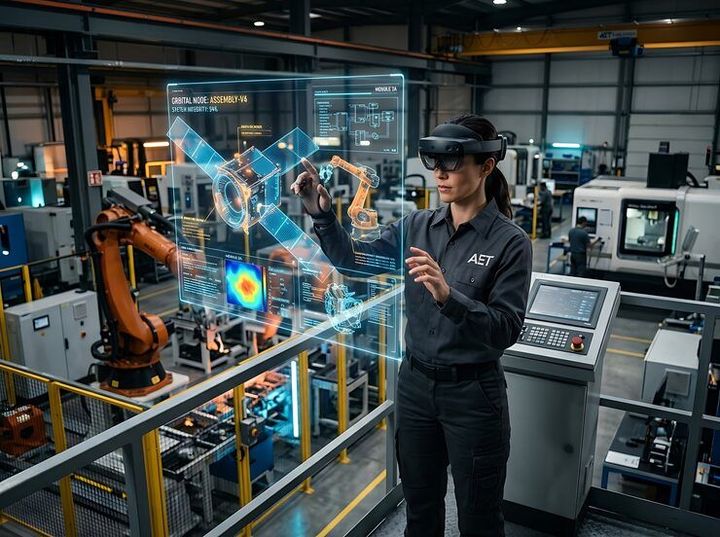
Industrial Automation Systems: Explore AI, IoT & Smart Manufacturing
Industrial automation systems are technologies that allow industrial equipment and production processes to operate with limited manual intervention. They can control machines, monitor production conditions, collect data, and help operators respond to changing situations.
Automation mainly focused on programmed control. Modern industrial automation is becoming more connected. Artificial intelligence (AI), the Internet of Things (IoT), robotics, machine vision, cloud computing, edge computing, and digital twins are increasingly being combined with established control technologies.
A typical automation system may include:
- Sensors for temperature, pressure, vibration, position, and flow
- Programmable logic controllers (PLCs)
- Human-machine interfaces (HMIs)
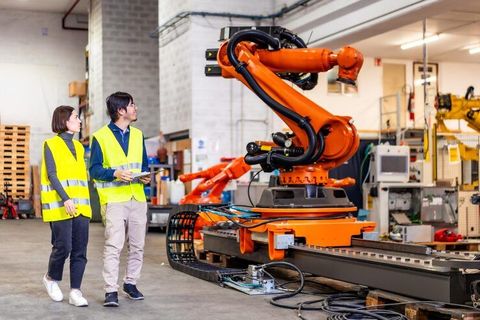
- Industrial robots and automated equipment
- Industrial networks and communication systems
- Supervisory control and data acquisition (SCADA)
- Manufacturing execution systems (MES)
- AI and machine-learning software
- Data storage and analytics platforms
The basic purpose is to create a controlled production environment where machines can perform repetitive activities consistently while people supervise, analyze, maintain, and improve operations.
From Automation to Smart Manufacturing
Earlier automation systems often operated as separate units. A modern smart manufacturing environment connects machines and systems so that information can move between production equipment, control systems, analytics platforms, and management applications.
The World Economic Forum's Intelligent Industrial Operations Outlook 2026, published in April 2026, describes a shift from traditional automation toward intelligent, connected, and increasingly autonomous industrial operations.
This does not mean every factory needs complete autonomy. Instead, many organizations are gradually adding digital capabilities to existing production systems.
Importance
Why Industrial Automation Matters Today
Industrial automation has become important because manufacturers need better visibility into production, equipment condition, energy use, quality, and operational risks.
Automation can help address several common industrial challenges:
- Repetitive production activities
- Inconsistent process control
- Equipment downtime
- Manual data collection
- Quality inspection difficulties
- Complex production scheduling
- Energy monitoring
- Workplace safety risks
- Increasing production complexity
Automation can also support faster access to operational information. Sensors can continuously collect data, while analytics systems can identify patterns that may not be obvious through occasional manual inspection.
AI and Predictive Maintenance
One important development is the use of AI for equipment monitoring. Machine-learning models can analyze information such as vibration, temperature, pressure, current, and operating cycles.
For example, unusual vibration patterns may indicate that a rotating component needs inspection. This does not guarantee that a failure will occur, but it can provide an additional warning signal for maintenance teams.
Predictive maintenance therefore works best when combined with engineering knowledge, physical inspection, maintenance records, and appropriate safety procedures.
IoT and Connected Equipment
Industrial IoT connects machines and sensors to communication networks. This allows production data to be collected and analyzed across different parts of an operation.
A connected system can help users understand:
| Area | Typical Information |
|---|---|
| Production | Output, cycle time, machine status |
| Quality | Defects, inspection results, process variation |
| Equipment | Temperature, vibration, pressure |
| Energy | Electricity and equipment consumption |
| Maintenance | Alarms, operating hours, condition indicators |
| Inventory | Material movement and availability |
The result is greater visibility into production rather than relying only on manual records.
Who Is Affected?
Industrial automation affects manufacturers, engineers, operators, maintenance teams, quality personnel, technology developers, researchers, and policymakers.
It also changes the skills needed in modern factories. Workers increasingly need familiarity with digital systems, industrial networks, data interpretation, robotics, cybersecurity, and machine control.
Recent Updates
AI Is Moving Closer to Industrial Operations
During 2025 and 2026, AI became a major focus in discussions about advanced manufacturing. The World Economic Forum's 2026 outlook highlights AI, physical AI, and other emerging technologies as factors reshaping industrial operations.
Physical AI is particularly relevant to manufacturing because it connects intelligent software with machines, robots, sensors, and physical environments.
India's Manufacturing Technology Focus
India has also increased attention toward advanced manufacturing technologies.
In October 2025, NITI Aayog released a roadmap for advanced manufacturing that identified AI and machine learning, digital twins, robotics, and advanced materials as important technology areas across priority manufacturing sectors.
In February 2026, a stakeholder consultation in Bengaluru examined a proposed Advanced Manufacturing Systems Mission and discussed ways to strengthen India's advanced manufacturing capabilities.
Another February 2026 development focused specifically on AI for Manufacturing Engineering Technology, with attention to responsible AI adoption, skills development, and wider industrial use.
More Attention to Cyber-Physical Systems
India's National Mission on Interdisciplinary Cyber-Physical Systems continues to support technologies including AI, machine learning, IoT, robotics, autonomous systems, data analytics, and cybersecurity. In August 2026, government information reported that the mission had established 25 Technology Innovation Hubs.
These developments show that automation is increasingly viewed as part of a wider digital manufacturing ecosystem rather than only as machine control.
Laws or Policies
India
Industrial automation in India can be affected by several areas of regulation and government policy. These may include workplace safety requirements, electrical standards, machinery requirements, cybersecurity considerations, data protection rules, environmental regulations, and sector-specific standards.
The Union Budget 2025-26 announced a National Manufacturing Mission covering small, medium, and large industries. Its focus areas include technology availability, future-ready skills, MSMEs, quality, and manufacturing development.
The policy environment therefore supports greater technology adoption while manufacturers still need to follow applicable technical, safety, environmental, and data-related requirements.
European Union
The European Union's AI Act is increasingly relevant when AI is incorporated into industrial systems. The first provisions began applying on 2 February 2025, including AI literacy requirements and certain prohibited AI practices.
The EU AI Act entered a further implementation stage in August 2026. Following the 2026 AI Omnibus changes, certain high-risk AI rules have later application dates, including 2 December 2027 for specified high-risk use cases and 2 August 2028 for certain AI systems embedded in regulated products.
For industrial organizations operating internationally, the exact obligations depend on the AI system, its purpose, the product involved, and where it is deployed.
Safety and Cybersecurity
Automation systems can interact with physical equipment, so cybersecurity is closely connected with operational safety. Unauthorized access, incorrect configuration, or compromised industrial networks can affect production and equipment.
Common safeguards include:
- Network segmentation
- Access controls
- Authentication
- Software updates
- Backup procedures
- Security monitoring
- Incident-response planning
- Regular system testing
Applicable national laws and technical standards should always be checked before implementing critical industrial systems.
Tools and Resources
Useful Automation Tools
Organizations and learners can use several categories of tools to understand and manage automation technologies:
- PLC programming environments for control logic
- HMI design tools for machine interfaces
- SCADA platforms for industrial monitoring
- IoT dashboards for connected equipment
- Data analytics tools for production information
- Digital-twin platforms for process modelling
- Simulation software for automation testing
- Machine-vision tools for inspection
- Energy-monitoring calculators
- Predictive-maintenance analysis tools
- Industrial cybersecurity assessment checklists
- Technical standards databases
- Engineering training materials
A Practical Learning Path
A beginner can approach industrial automation in stages:
- Learn basic electrical and control concepts.
- Understand sensors and actuators.
- Study PLC fundamentals.
- Learn HMI and SCADA concepts.
- Explore industrial communication protocols.
- Understand IoT architecture.
- Study basic data analytics.
- Explore AI and machine learning.
- Learn industrial cybersecurity fundamentals.
- Study digital twins and smart manufacturing.
This approach helps connect individual technologies to the larger manufacturing system.
FAQs
What is an industrial automation system?
An industrial automation system uses control equipment, sensors, software, networks, and machines to monitor and control industrial processes with reduced manual intervention.
How does AI improve industrial automation?
AI can analyze large amounts of operational data, identify patterns, support quality inspection, detect unusual equipment behavior, and assist with production decisions. Its results still require appropriate validation and human oversight.
What is the role of IoT in manufacturing?
Industrial IoT connects machines, sensors, and other equipment so operational information can be collected, transferred, and analyzed. It can improve visibility into equipment and production conditions.
Are industrial automation systems completely autonomous?
Not necessarily. Many systems combine automated machine control with human supervision. The level of automation depends on the process, equipment, safety requirements, technology, and operational objectives.
What skills are useful for learning industrial automation?
Useful areas include electrical fundamentals, PLC programming, sensors, industrial networking, robotics, data analysis, cybersecurity, AI, machine vision, and control engineering.
Conclusion
Industrial automation systems are evolving from isolated machine-control technologies into connected manufacturing environments. AI, IoT, robotics, digital twins, machine vision, and data analytics are becoming important parts of this transition.