HVAC Testing Equipment: Essential Tools for Accurate System Testing
Heating, ventilation, and air conditioning (HVAC) testing equipment refers to instruments used to measure, inspect, and evaluate the performance of heating and cooling systems. These tools help technicians, engineers, facility teams, and building managers understand whether an HVAC system is operating within expected conditions.
HVAC systems involve several measurable factors, including temperature, humidity, airflow, pressure, electrical performance, and refrigerant conditions. A single instrument cannot normally measure all of these factors. Different testing instruments are therefore used for different parts of the system.
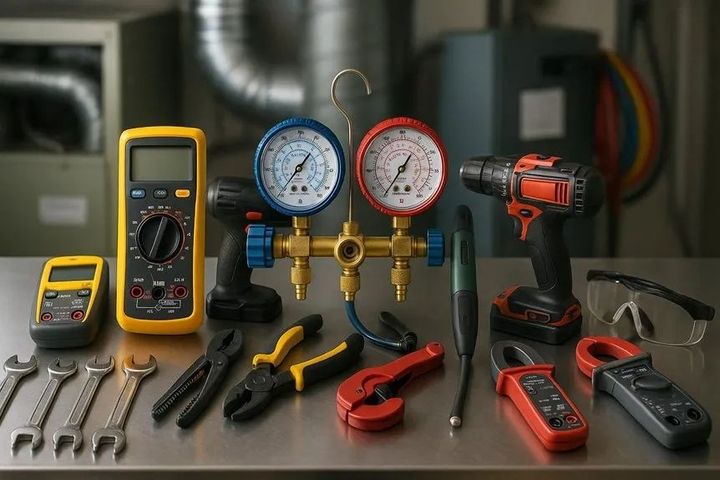
Common HVAC testing equipment includes:
- Digital thermometers for temperature measurement
- Hygrometers for humidity measurement
- Anemometers for air velocity
- Manometers for pressure measurement
- Refrigerant gauges for system pressure checks
- Clamp meters for electrical measurements
- Airflow meters for ventilation testing
- Leak detection instruments for refrigerant-related inspections
- Data loggers for recording measurements over time
- Combustion analyzers for applicable heating equipment
The main purpose of testing is not simply to collect numbers. Measurements provide evidence about how an HVAC system is performing and can help identify conditions that require investigation.
Accurate testing is particularly important during commissioning, preventive maintenance, troubleshooting, energy audits, and performance verification.
Why HVAC Testing Matters Today
HVAC performance affects indoor comfort, ventilation, energy use, equipment reliability, and indoor environmental conditions. Poor airflow, incorrect temperature control, pressure imbalance, or inadequate ventilation can affect the overall performance of a building.
Testing equipment helps turn observations into measurable information. Instead of relying only on symptoms such as uneven cooling or unusual equipment behavior, professionals can compare measured values with design requirements, manufacturer specifications, or applicable standards.
Accurate HVAC testing can help identify:
- Restricted airflow
- Incorrect temperature differences
- Excessive or insufficient system pressure
- Poor ventilation
- Electrical abnormalities
- Humidity control issues
- Refrigerant-related problems
- Control-system irregularities
- Fan and motor performance issues
- Air distribution imbalances
These measurements are relevant across residential buildings, offices, hospitals, educational facilities, hotels, laboratories, retail spaces, and industrial environments.
HVAC commissioning is another important application. The U.S. Department of Energy describes commissioning as a process for verifying that building systems are installed and operating according to design and engineering requirements. It notes that HVAC commissioning can uncover equipment and control problems affecting energy use and indoor air quality.
For energy management, measurement is equally important. Reliable data can help facility teams compare actual operating conditions with expected performance and identify areas requiring further assessment.
Essential HVAC Testing Instruments and Their Uses
Different HVAC testing tools measure different operating parameters. Selecting the appropriate instrument depends on the equipment being tested and the measurement required.
Temperature Testing Instruments
Digital thermometers, probe thermometers, and infrared instruments can be used to measure air, surface, supply, return, and equipment temperatures.
Temperature measurements are often compared across different points in a system. For example, comparing return-air and supply-air temperatures can provide useful information about cooling or heating performance.
Airflow and Air Velocity Meters
Anemometers and airflow meters measure air movement through ducts, grilles, diffusers, and other openings.
Airflow measurement is important because a system may have adequate cooling capacity but still provide poor comfort if air is not distributed correctly.
ASHRAE Standard 41.2-2026 specifies methods for air velocity and airflow measurement for HVAC and refrigeration systems and components.
Pressure Measurement Instruments
Manometers and differential pressure meters are used to measure pressure differences in ducts, filters, fans, and HVAC equipment.
Pressure measurements can help identify conditions such as excessive filter resistance, duct restrictions, or airflow-related issues.
ASHRAE Standard 41.3-2025 provides standard methods for pressure measurement under laboratory and field conditions for HVAC and refrigeration systems.
Humidity Measurement Instruments
Hygrometers and electronic humidity meters measure relative humidity and, depending on the instrument, may also provide dew-point information.
Humidity measurement is important in buildings where moisture control affects comfort, materials, indoor air quality, or specialized environmental requirements.
ASHRAE Standard 41.6-2025 covers methods for measuring humidity, including wet-bulb temperature, dew point, and relative humidity.
Electrical Testing Instruments
Clamp meters and multimeters can measure electrical parameters associated with HVAC equipment. Depending on the instrument, measurements can include voltage, current, resistance, and related electrical characteristics.
Electrical measurements should be performed using appropriate safety procedures and equipment ratings.
Refrigerant Testing Instruments
Refrigerant-related testing can involve pressure measurement, temperature measurement, leak detection, and other diagnostic instruments.
Because refrigerants and pressurized systems can present safety risks, testing should follow applicable regulations, equipment instructions, and professional procedures.
Selecting Equipment for Accurate Measurements
The quality of an HVAC test depends not only on the instrument but also on how the measurement is performed.
Important considerations include:
- Measurement range
- Accuracy and resolution
- Environmental operating limits
- Calibration status
- Probe type
- Response time
- Data-recording capability
- Compatibility with the HVAC application
- Electrical safety rating where applicable
- Ease of documentation
Calibration is especially important when measurements are used for commissioning, compliance documentation, laboratory testing, or performance comparisons.
Testing should also be repeatable. A measurement taken at an unsuitable location, under unstable operating conditions, or with an incorrectly positioned probe may not represent actual system performance.
Recent HVAC Testing and Measurement Developments
HVAC testing practices continue to evolve as buildings become more energy-conscious and ventilation requirements receive greater attention.
One significant development is the publication of updated measurement standards. ASHRAE lists Standard 41.2-2026 for air velocity and airflow measurement and Standard 41.3-2025 for pressure measurement. These standards reinforce the importance of consistent measurement methods.
Humidity measurement has also received an updated reference through Standard 41.6-2025. The standard addresses measurement across a broad range of temperature and humidity conditions.
Ventilation and indoor air quality remain important areas of HVAC evaluation. ASHRAE Standard 62.1-2025 includes updated requirements involving humidity control, air-density adjustments, demand-controlled ventilation sequences, emergency controls, exhaust airflow calculations, and filtration-related methods.
In July 2026, ASHRAE also announced a strategic direction for future editions of Standard 90.1, emphasizing commercial building energy efficiency and operational emissions considerations.
These developments indicate a broader movement toward more structured measurement, documentation, energy performance evaluation, ventilation assessment, and data-supported building management.
Laws, Standards, and Policies in India
In India, HVAC testing and performance evaluation can be influenced by building codes, energy-efficiency frameworks, safety requirements, and applicable state or local regulations.
The Bureau of Energy Efficiency (BEE) has developed building energy-efficiency frameworks covering building envelopes, mechanical systems, HVAC systems, lighting, electrical systems, and renewable energy. The Energy Conservation Building Code has specific provisions relevant to HVAC systems in applicable commercial buildings.
A newer development is the Energy Conservation & Sustainable Building Code 2024 (ECSBC 2024). BEE currently lists ECSBC 2024 among its building-energy resources. Its HVAC provisions address comfort systems and controls, including ventilation and temperature-control requirements.
The National Building Code of India and applicable state-level building regulations may also influence ventilation, mechanical systems, fire safety, electrical installations, and building operation requirements.
For organizations working with HVAC systems, the applicable requirements should be checked according to building type, location, project approval conditions, and the authority having jurisdiction. Standards and codes can change, so current editions should be verified before testing or compliance documentation is prepared.
Practical Tools and Resources for HVAC Testing
A structured testing process can make measurements easier to understand and compare. Useful resources include:
- Digital temperature and humidity measurement tools
- Air velocity and airflow measurement instruments
- Differential pressure meters
- Electrical measurement instruments
- Refrigerant pressure and temperature measurement tools
- Refrigerant leak detection equipment
- Portable data loggers
- Psychrometric calculation tools
- Airflow measurement worksheets
- HVAC commissioning checklists
- Equipment performance logs
- Calibration records
- Preventive inspection templates
- Building energy-monitoring dashboards
- Technical standards and measurement guides
A basic HVAC testing record can include the equipment identification, test location, date, operating condition, measured value, instrument identification, calibration information, and remarks.
Data logging is increasingly useful because HVAC performance can change throughout the day. A single measurement may not show the same operating pattern as measurements collected over several hours or days.
Common Testing Challenges
HVAC testing can produce misleading results when measurements are taken without considering operating conditions.
For example, outdoor temperature, building occupancy, equipment load, airflow configuration, control settings, and operating schedules can all influence measurements.
Common challenges include:
- Taking measurements before the system reaches stable operation
- Using an unsuitable measurement range
- Ignoring instrument calibration
- Measuring airflow at an unsuitable location
- Comparing measurements taken under different operating conditions
- Recording data without identifying the measurement point
- Using inconsistent testing procedures
A good testing process therefore combines suitable instruments with a consistent method and clear documentation.
Frequently Asked Questions
What is HVAC testing equipment?
HVAC testing equipment includes instruments used to measure temperature, humidity, airflow, pressure, electrical parameters, refrigerant conditions, and other operating characteristics of heating, ventilation, air conditioning, and refrigeration systems.
Which instrument is used to measure HVAC airflow?
Anemometers and dedicated airflow meters are commonly used to measure air velocity or airflow. The appropriate instrument depends on the measurement location and testing method.
Why is HVAC pressure testing important?
Pressure measurements can help evaluate duct conditions, filter resistance, fan performance, and other system characteristics. The correct measurement method depends on the HVAC application.
How often should HVAC testing be performed?
There is no single interval that applies to every system. Testing frequency depends on equipment type, building use, operating conditions, maintenance requirements, applicable standards, and the purpose of the measurement.
Why is calibration important for HVAC testing instruments?
Calibration helps confirm that an instrument's measurements remain within its specified accuracy. This is especially important when data is used for commissioning, compliance, performance verification, or engineering analysis.
Conclusion
HVAC testing equipment provides the measurements needed to understand how heating, ventilation, and air conditioning systems operate under real conditions. Temperature meters, airflow instruments, pressure gauges, humidity meters, electrical testers, refrigerant instruments, and data loggers each have specific roles.