How Generative AI Is Redefining Industrial Production and Automation
Generative artificial intelligence is becoming an important technology in the evolution of industrial production and automation. Unlike traditional software that follows predefined instructions, generative AI can create new text, designs, code, process suggestions, summaries, and other forms of digital content based on patterns learned from large datasets.
In manufacturing environments, this capability is being explored across engineering, production planning, quality management, equipment monitoring, documentation, and workforce support. Generative AI can also work alongside other technologies, including machine learning, robotics, digital twins, industrial sensors, and connected production systems.
Recent research from the National Institute of Standards and Technology highlights generative AI, foundation models, digital twins, robotics, advanced sensing, and autonomous systems as important areas in the development of smart manufacturing. At the same time, organizations continue to face challenges involving data quality, system integration, reliability, explainability, and trustworthy operation.
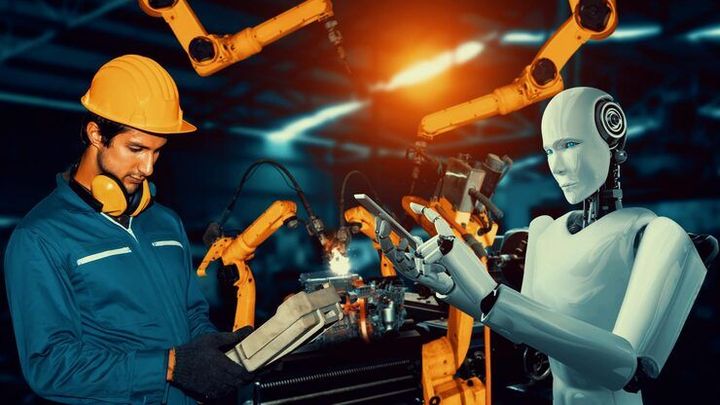
The result is not simply greater automation. Instead, industrial organizations are moving toward systems in which people and intelligent technologies work together to analyze information, improve processes, and support operational decisions.
What Is Generative AI in Industrial Production?
Generative AI refers to artificial intelligence systems that can create new content or outputs rather than only classifying existing information.
In industrial environments, these outputs may include:
- Production instructions
- Technical documentation
- Engineering concepts
- Maintenance summaries
- Process recommendations
- Software code
- Simulated scenarios
- Product or component designs
- Quality-control reports
- Natural-language explanations of machine data
Generative AI is often built on foundation models that can process large quantities of information. Industrial applications can further combine these models with domain-specific data, engineering rules, sensor information, and production constraints.
For example, an engineer could use an AI system to summarize historical machine data and identify recurring patterns that deserve investigation. Similarly, a design team could use generative methods to explore different component configurations while applying predefined engineering constraints.
NIST describes industrial foundation models as models adapted to manufacturing and engineering knowledge, including technical drawings, process parameters, material information, and production requirements.
This distinction is important because industrial AI must operate within real-world constraints. A generated answer may be useful for analysis, but it still needs appropriate engineering review before being applied to physical equipment or production processes.
How Generative AI Is Changing Manufacturing Workflows
Generative AI can influence several stages of the industrial production lifecycle.
Product and process design
Design teams can use generative AI to explore alternative concepts and identify possible improvements earlier in the development process.
A system can potentially analyze design requirements, material characteristics, manufacturing limitations, and previous engineering information to produce multiple design concepts for further evaluation.
This approach can complement computer-aided design and simulation rather than replacing engineering validation.
Production planning
Production planning involves coordinating machines, materials, workers, schedules, and production requirements.
Generative AI can help transform complex operational information into easier-to-understand recommendations. It can summarize production conditions, explain scheduling conflicts, and assist planners in evaluating different scenarios.
Research from NIST has also explored combining generative AI with planning technologies to help formulate manufacturing scheduling solutions.
Maintenance support
Maintenance is another area where AI can assist industrial teams.
Traditional maintenance programs may depend heavily on scheduled inspections and technician experience. AI systems can analyze sensor readings, maintenance records, machine histories, and operational information to identify patterns that may require attention.
Generative AI adds another layer by translating technical information into understandable summaries. For example, instead of reviewing multiple maintenance records manually, a technician could receive a structured summary of previous equipment issues and relevant observations.
It is important to distinguish AI-supported analysis from guaranteed failure prediction. Industrial equipment should continue to be monitored and maintained using appropriate technical procedures.
Quality control
AI-powered quality systems can analyze images, measurements, and production data to identify potential defects or unusual patterns.
Generative AI can complement these systems by explaining inspection results, organizing quality reports, and helping teams investigate recurring issues.
This can be particularly useful when production environments generate large volumes of quality information that would otherwise require significant manual review.
Technical documentation
Industrial organizations often maintain extensive documentation covering machine procedures, safety practices, maintenance instructions, engineering specifications, and process information.
Generative AI can help organize and summarize this information. It can also assist workers in locating relevant information through natural-language interfaces.
However, organizations should maintain controlled document versions and review AI-generated material before using it as an official technical instruction.
Generative AI and Industrial Automation
Traditional industrial automation is generally designed around predefined logic, programmed sequences, sensors, controllers, and robotics.
Generative AI introduces a more flexible information layer.
Instead of simply executing predefined instructions, an AI-enabled system can potentially interpret information, generate recommendations, and interact with workers using natural language.
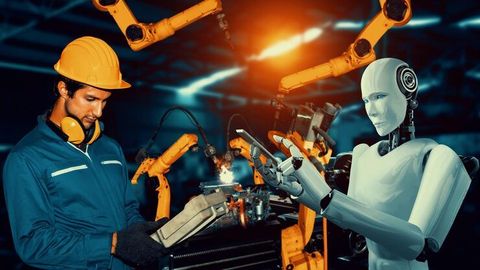
This creates opportunities for human-AI collaboration.
For example, an operator could describe an unusual production condition in ordinary language. An AI system could then organize relevant machine information, summarize historical events, and suggest areas for investigation.
The final decision can remain with qualified personnel, particularly when physical equipment, production safety, product quality, or other high-impact considerations are involved.
NIST's current manufacturing research specifically focuses on human-AI teaming, interoperability, trustworthy evaluation, and methods for determining whether AI systems are appropriate for specific manufacturing applications.
Key Applications of Generative AI in Manufacturing
| Application | Potential Role of Generative AI |
|---|---|
| Product design | Generate and compare design concepts |
| Process planning | Assist with process documentation and planning |
| Production scheduling | Explain scheduling conflicts and scenarios |
| Predictive maintenance | Summarize machine conditions and maintenance history |
| Quality control | Explain inspection results and organize reports |
| Robotics | Support programming and interaction workflows |
| Digital twins | Help interpret simulated production scenarios |
| Supply chain planning | Summarize operational information and potential disruptions |
| Technical documentation | Generate drafts and structured summaries |
| Workforce training | Create educational explanations and practice material |
| Data analysis | Convert complex datasets into understandable summaries |
| Engineering support | Assist with technical research and documentation |
These applications vary considerably in maturity. Some are already being investigated in practical industrial settings, while others remain active research areas.
Benefits of Generative AI for Industrial Operations
Generative AI can provide several potential advantages when it is implemented appropriately.
Faster access to information
Industrial environments can contain large amounts of technical information. AI-based interfaces can help employees locate and summarize relevant information more efficiently.
Better communication between technical systems and people
Manufacturing data is often presented through specialized dashboards and technical interfaces. Generative AI can provide a natural-language layer that makes complex information easier to understand.
Support for engineering creativity
Generative systems can produce multiple concepts that engineers can evaluate, refine, simulate, and validate.
Improved documentation workflows
AI can assist with drafting maintenance summaries, inspection reports, operating documentation, and training materials.
More responsive decision support
When connected to appropriate data sources, AI can help teams interpret changing production conditions and examine possible responses.
The World Economic Forum's 2026 Intelligent Industrial Operations Outlook describes a broader transition from traditional automation toward intelligent and increasingly autonomous industrial systems, with humans and intelligent technologies increasingly working together.
Challenges and Limitations
Despite its potential, generative AI should not be treated as a universal solution for industrial production.
Data quality
AI systems depend heavily on the quality and relevance of their data. Incomplete, inconsistent, outdated, or poorly structured industrial data can produce unreliable results.
Integration with existing systems
Factories may contain equipment from different generations and manufacturers. Connecting modern AI systems with legacy machinery, industrial control systems, databases, and sensors can be technically complex.
Accuracy and reliability
Generative AI can produce incorrect or incomplete information. In an industrial environment, such errors can have practical consequences.
AI-generated recommendations should therefore be evaluated against appropriate engineering requirements and operational procedures.
Cybersecurity and privacy
Connected AI systems may interact with operational data, engineering documents, production information, and connected equipment. Strong cybersecurity practices are essential when introducing AI into industrial environments.
Workforce readiness
Successful implementation requires people who understand both the technology and the production environment.
Recent industry discussion has highlighted workforce capability and organizational readiness as important barriers to achieving value from industrial AI initiatives.
Explainability
In many industrial applications, users need to understand why an AI system produced a particular recommendation.
This is especially relevant when decisions affect production quality, equipment operation, safety, or compliance.
Generative AI, Digital Twins, and Smart Manufacturing
Digital twins create digital representations of physical products, machines, processes, or production environments.
Generative AI can complement digital twins by helping users interact with complex simulations and operational information using natural language.
For example, a manufacturing professional could ask questions about a simulated production scenario and receive a structured explanation of possible outcomes.
The combination of digital twins, AI, sensor data, and simulation may support more informed planning and process optimization.
NIST identifies digital twins, generative AI, advanced sensing, robotics, and industrial foundation models among important technologies for the future development of smart manufacturing.
However, digital models should be validated against appropriate physical measurements. A digital representation is only useful when its assumptions and data accurately reflect the system being studied.
How Organizations Can Approach Generative AI Adoption
A practical approach starts with a clearly defined production problem rather than selecting AI simply because it is a new technology.
Organizations can consider the following steps:
- Identify a specific workflow problem.
- Review available data and its quality.
- Determine whether generative AI is appropriate for the task.
- Start with a controlled application.
- Define measurable performance criteria.
- Keep human oversight where appropriate.
- Test the system against realistic scenarios.
- Review cybersecurity and data-management requirements.
- Train employees who will interact with the system.
- Expand implementation only after suitable evaluation.
This approach helps organizations distinguish between genuine operational value and technology experimentation.
NIST's 2026 smart-manufacturing roadmap emphasizes trustworthy, explainable, reliable, and scalable AI integration, particularly because industrial environments often involve complex data and heterogeneous sensing and control systems.
What the Future May Look Like
The future of industrial AI is likely to involve several technologies working together rather than a single AI system controlling an entire factory.
Generative AI may increasingly interact with machine-learning systems, industrial sensors, robotics, digital twins, enterprise software, and automation platforms.
Agentic AI is another emerging area. These systems are designed to perform multi-step tasks by planning, reasoning, and interacting with tools or information sources. NIST research is examining agentic AI applications in manufacturing while also emphasizing the need for appropriate evaluation, safety, and performance measures.
This could lead to more adaptive production environments where AI supports planning, monitoring, troubleshooting, and optimization while humans remain responsible for important operational decisions.
The pace of adoption will likely differ between industries and organizations because factors such as data availability, existing infrastructure, workforce skills, cybersecurity practices, and regulatory requirements vary.
Tools and Resources for Learning About Industrial AI
Professionals exploring this field can use several types of resources:
- Industrial AI research papers — For understanding emerging applications and technical limitations.
- Smart manufacturing roadmaps — For learning about technology trends and implementation challenges.
- Digital twin platforms — For studying simulation-based production analysis.
- Industrial IoT platforms — For connecting and analyzing equipment data.
- AI model evaluation frameworks — For assessing accuracy, reliability, and suitability.
- Manufacturing training resources — For developing workforce knowledge around AI and automation.
- Engineering simulation software — For evaluating AI-assisted design and production scenarios.
These resources are most useful when combined with practical manufacturing knowledge and structured evaluation.
Frequently Asked Questions
What is generative AI in manufacturing?
Generative AI in manufacturing refers to AI systems that can create content or recommendations using manufacturing-related information. Applications may include design concepts, technical documentation, production planning support, maintenance summaries, quality analysis, and workforce assistance. Its usefulness depends on data quality, system integration, domain knowledge, and appropriate human review.
Can generative AI replace industrial automation?
Generative AI is more accurately viewed as a complementary technology to traditional automation. Conventional automation remains important for controlling machines and executing predefined processes. Generative AI can add capabilities such as natural-language interaction, information analysis, design assistance, and decision support. The appropriate balance depends on the application and operational requirements.
How does generative AI help manufacturing engineers?
Generative AI can assist engineers with research, documentation, design exploration, process analysis, technical summaries, and information retrieval. It may reduce repetitive information-processing work and help engineers explore alternatives more efficiently. However, engineering decisions still require appropriate technical validation, particularly when physical products, machinery, or production processes are involved.
Is generative AI reliable for industrial applications?
Reliability depends on the specific application, data, model, validation process, and operating environment. Generative AI can produce inaccurate information, so industrial users should not assume that every AI-generated output is correct. Testing, monitoring, human oversight, domain-specific validation, and clearly defined performance requirements are important for responsible deployment.
What is the future of AI in industrial production?
The future is likely to involve greater integration between generative AI, predictive AI, robotics, digital twins, industrial IoT, and automation systems. Human-AI collaboration is expected to remain important. Instead of completely removing people from industrial workflows, many applications are likely to focus on helping workers analyze information, make decisions, solve problems, and manage increasingly complex production systems.
Conclusion
Generative AI is becoming an important part of the broader transformation toward intelligent industrial production. Its ability to generate information, analyze complex data, support design activities, summarize technical knowledge, and interact through natural language creates new possibilities for manufacturing and automation.
However, industrial adoption requires more than connecting an AI model to production data. Organizations need reliable data, suitable infrastructure, cybersecurity practices, trained employees, measurable performance criteria, and appropriate human oversight.
Current research shows that the future of smart manufacturing will involve a combination of generative AI, machine learning, robotics, digital twins, advanced sensing, and human-AI collaboration.
For manufacturers and industrial professionals, the most practical approach is to begin with clearly defined problems and evaluate whether AI can provide meaningful support. With careful testing and responsible implementation, generative AI can become a useful component of modern production systems while complementing, rather than unnecessarily replacing, established engineering and automation practices.