Discover Wrapping Machines for Advanced Packaging Applications and Industrial Performance
Wrapping machines are specialized industrial systems designed to secure, protect, stabilize, and prepare products for transportation, storage, and distribution. These machines are widely used in manufacturing, logistics, food processing, pharmaceuticals, consumer goods, and warehousing operations. Their role has become increasingly important as industries focus on improving packaging consistency, operational efficiency, and product protection.
Modern packaging environments often require faster workflows, reduced material waste, and better integration with automated production lines. Wrapping machines help address these operational requirements by streamlining repetitive packaging tasks while supporting product safety and handling standards. Depending on the application, these systems may use stretch film, shrink materials, or protective coverings to stabilize products during movement and storage.
Over the past few years, industrial packaging technology has evolved significantly. Many organizations globally are adopting automation software, smart sensors, predictive maintenance systems, and data-driven monitoring tools to improve packaging performance. This shift has increased interest in advanced wrapping solutions capable of supporting scalable and flexible production environments.
For beginners, understanding wrapping machine systems can initially seem complex because of the wide variety of machine types, automation levels, and packaging methods available. The following sections explain how these machines work, where they are commonly applied, and why they continue to shape modern industrial packaging operations.
Who it affects and what problems it solves
Wrapping machines affect a broad range of industries and operational environments worldwide. Manufacturing facilities, warehouse operators, logistics providers, distribution centers, food processors, healthcare suppliers, and retail packaging teams all rely on packaging systems to maintain efficient workflows and product stability.
One of the primary challenges solved by wrapping machines is inconsistent packaging quality. Manual wrapping methods often produce uneven film application, unstable pallet loads, and excessive material use. Automated and semi-automated systems improve consistency by applying controlled tension, uniform coverage, and repeatable wrapping patterns. This helps reduce product movement during transport and minimizes packaging-related damage.
Another important issue involves operational productivity. In high-volume environments, manual packaging can slow production lines and increase repetitive labor demands. Advanced packaging automation systems support faster throughput while maintaining packaging reliability across different product sizes and shapes.
Many organizations also face challenges related to inventory handling, warehouse safety, and transportation efficiency. Poorly secured products may shift during handling, creating safety concerns and operational delays. Wrapping systems help stabilize loads and improve storage organization.
Common mistakes include selecting machines without considering scalability, underestimating maintenance requirements, or ignoring compatibility with existing conveyor systems and packaging software. Some organizations also overlook energy efficiency and material optimization features that can significantly influence long-term operational performance.
Understanding these factors helps businesses and operational teams make more informed decisions when evaluating industrial packaging equipment.
Recent updates and industry trends
Over the past year, wrapping machine technology has continued evolving toward higher automation and smarter operational control. Many organizations globally are integrating packaging systems with industrial software platforms that provide real-time monitoring, diagnostics, and production analytics. These developments support improved visibility across packaging operations and warehouse workflows.
Recent industry research suggests that predictive maintenance features are becoming increasingly important in industrial packaging environments. Smart sensors and connected monitoring systems can identify irregular machine behavior before major operational interruptions occur. This helps reduce downtime and improves equipment reliability.
Another major trend involves sustainability-focused packaging strategies. Many industries are exploring ways to reduce film usage, improve energy efficiency, and optimize material management without compromising packaging integrity. Modern wrapping machines increasingly include programmable settings that support material reduction and improved packaging precision.
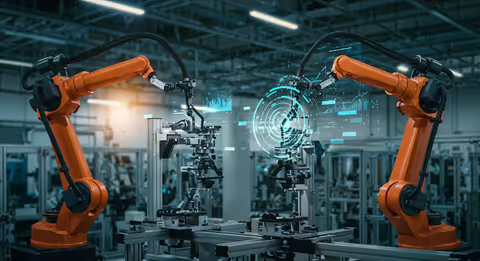
Automation integration has also accelerated. Wrapping systems are now commonly designed to connect with robotic palletizers, conveyor automation systems, warehouse management platforms, and industrial control software. These integrated environments help streamline production and reduce manual intervention.
Many organizations globally are also prioritizing flexible packaging systems capable of handling different product dimensions and packaging formats. Adjustable wrapping programs, touchscreen interfaces, and modular machine designs have become more common as operational environments demand greater adaptability.
As packaging technology continues advancing, digital monitoring, operational efficiency, and scalable automation remain central themes across industrial packaging developments.
Comparison of wrapping machine systems
Different wrapping machines are designed for different operational requirements. The following comparison highlights common features and performance considerations across several packaging system categories.
| Comparison Factor | Semi-automatic Wrapping | Fully Automatic Wrapping | Robotic Wrapping Systems | Shrink Wrapping Systems |
|---|---|---|---|---|
| Efficiency | Moderate | High | High | Moderate to High |
| Automation Level | Partial | Advanced | Advanced | Variable |
| Scalability | Medium | Strong | Flexible | Medium |
| Maintenance Needs | Moderate | Higher | Moderate | Moderate |
| Packaging Speed | Consistent | Very Fast | Adaptive | Fast |
| Flexibility | Good | Good | Excellent | Product Dependent |
| Energy Use | Lower | Moderate | Optimized | Higher Heat Usage |
| Integration Capability | Basic | Extensive | Extensive | Moderate |
| Space Requirements | Compact | Larger Footprint | Flexible Layout | Medium |
| Operator Involvement | Frequent | Minimal | Minimal | Moderate |
| Product Stability | Good | Excellent | Excellent | Good |
| Software Compatibility | Limited | Advanced | Advanced | Moderate |
Semi-automatic systems are often suitable for operations requiring controlled packaging volumes and moderate workflow demands. These machines generally provide easier implementation and simpler operational management for teams new to packaging automation.
Fully automatic and robotic systems are commonly used in larger industrial environments where throughput, integration capability, and scalability are priorities. Robotic systems also support flexible layouts and can adapt to changing operational needs more effectively than fixed-position equipment.
Shrink wrapping systems remain valuable for applications requiring protective sealing and compact product presentation. However, they may involve higher energy consumption due to heat tunnel operation and specialized material requirements.
Regulations and practical guidance
Industrial packaging systems are expected to follow internationally recognized operational and safety practices. While specific standards vary depending on industry requirements, many organizations adopt guidelines focused on equipment safety, electrical reliability, machine guarding, operator training, and environmental management.
Safety remains one of the most important considerations when operating wrapping machines. Proper training helps operators understand emergency stop systems, load handling procedures, film replacement methods, and maintenance protocols. Regular inspections also help identify wear, alignment issues, or component failures before operational disruptions occur.
Environmental concerns are increasingly influencing packaging decisions worldwide. Many industries are evaluating recyclable materials, reduced film consumption strategies, and energy-efficient machine designs. Preventive maintenance programs can also improve long-term efficiency by minimizing unnecessary material waste and equipment strain.
Operational guidelines typically recommend selecting wrapping systems that match production volume, packaging dimensions, and future scalability requirements. Organizations should also evaluate compatibility with warehouse automation software, conveyor systems, and inventory tracking platforms before implementation.
Routine maintenance remains essential for sustaining performance. Lubrication schedules, calibration checks, software updates, and sensor inspections all contribute to packaging consistency and equipment reliability.
Which option suits different situations?
Small operations often benefit from semi-automatic wrapping systems because they balance operational simplicity with improved packaging consistency.
Large-scale facilities typically require fully automated or robotic systems capable of supporting continuous production workflows and integrated warehouse automation.
Beginners may prefer systems with touchscreen interfaces, programmable presets, and simplified maintenance requirements to reduce operational complexity.
Growing organizations frequently choose scalable packaging systems that allow future automation expansion without replacing entire production lines.
Tools and resources
Several tools and systems can help organizations manage and improve industrial packaging operations more effectively.
- Packaging Management Software — Tracks packaging performance, production efficiency, and workflow monitoring.
- Conveyor Integration Systems — Connect wrapping machines with automated production environments.
- Predictive Maintenance Platforms — Monitor machine health and identify operational irregularities.
- Industrial Automation Controllers — Coordinate packaging equipment with warehouse systems.
- Energy Monitoring Systems — Analyze operational energy usage and equipment efficiency.
- Packaging Material Calculators — Estimate film usage and packaging requirements.
- Maintenance Scheduling Templates — Help organize preventive maintenance activities and inspections.
FAQ section
What is the primary purpose of a wrapping machine?
Wrapping machines are designed to stabilize, secure, and protect products during transportation, storage, and distribution. These systems improve packaging consistency and reduce the risks associated with manual wrapping methods. Many industries use wrapping equipment to streamline packaging workflows while improving operational efficiency and product handling reliability.
What is the difference between stretch wrapping and shrink wrapping?
Stretch wrapping uses elastic film that stretches around products or pallet loads to provide stability. Shrink wrapping uses heat to tighten specialized material around products after application. Stretch wrapping is commonly used for pallet stabilization, while shrink wrapping is frequently used for protective sealing and compact packaging presentation.
Are wrapping machines suitable for small businesses?
Many wrapping systems are designed for smaller operational environments. Semi-automatic machines can improve packaging consistency without requiring large-scale automation infrastructure. Small organizations often select compact systems that support manageable production volumes while allowing future scalability as operational demands increase over time.
What maintenance challenges are associated with wrapping systems?
Common maintenance considerations include sensor calibration, lubrication schedules, film tension adjustments, software updates, and component inspections. Preventive maintenance programs help reduce downtime and support long-term operational reliability. Neglecting routine inspections may lead to inconsistent packaging quality and increased equipment wear.
How are wrapping machines expected to evolve in the future?
Future developments are expected to focus on smart automation, sustainability improvements, predictive maintenance, and digital integration. Many organizations globally are adopting packaging systems with advanced analytics, remote monitoring, and material optimization features. Flexible automation and energy-efficient operation are also expected to remain major priorities across industrial packaging environments.
Conclusion
Wrapping machines continue to play a major role in modern industrial packaging operations. From improving product stability to supporting automated workflows, these systems help organizations manage packaging demands more efficiently across manufacturing, logistics, and distribution environments. As packaging requirements become more complex, businesses increasingly rely on scalable and adaptable wrapping technologies to maintain operational consistency and product protection.
Choosing the appropriate wrapping solution depends on several factors, including production volume, automation goals, operational flexibility, maintenance expectations, and integration capability. Semi-automatic systems may support smaller environments effectively, while fully automated and robotic solutions often align with large-scale industrial workflows. Understanding these differences helps organizations make more informed packaging decisions.
Looking ahead, global packaging trends are expected to emphasize sustainability, digital monitoring, predictive maintenance, and automation integration. Organizations evaluating wrapping systems should continue monitoring advancements in industrial software, energy optimization, and intelligent packaging technologies that may shape future operational standards worldwide.