Boring Machines Guide: Types, Working Principles, and Industrial Applications
Boring machines are precision machining tools used to enlarge, finish, and improve the accuracy of existing holes in different materials. Unlike drilling machines that create new holes, boring machines refine holes that have already been drilled or cast. Their main purpose is to achieve greater dimensional accuracy, smoother surface finishes, and precise alignment.
These machines have become an essential part of modern manufacturing because industries require components with tight tolerances and consistent quality. From heavy engineering to aerospace manufacturing, boring machines help produce parts that must fit together with exceptional precision.
The development of boring machines has evolved alongside industrial manufacturing. Early machines relied heavily on manual operation, while today's equipment often includes computer-controlled systems capable of producing highly accurate components with minimal variation.
Because industries continue to demand stronger, lighter, and more complex products, boring machines remain an important part of precision engineering and advanced manufacturing processes.
Importance
Boring machines play a significant role in industries where precision machining is essential. Even a small error in hole size or alignment can affect the performance of an entire mechanical assembly. These machines help reduce such inaccuracies while improving production consistency.
Several industries depend on boring machines every day, including:
- Automotive manufacturing
- Aerospace engineering
- Heavy equipment production
- Energy and power generation
- Oil and gas equipment manufacturing
- Railway engineering
- Shipbuilding
- Industrial machinery manufacturing
- Metal fabrication
- Defense manufacturing
High-precision boring improves the quality of machine components such as:
- Engine blocks
- Gear housings
- Hydraulic cylinders
- Machine frames
- Turbine components
- Pump casings
- Bearing housings
- Industrial molds
The use of precision boring offers several advantages:
- Improved dimensional accuracy
- Better surface finish
- Higher component reliability
- Reduced assembly errors
- Longer equipment lifespan
- Better operational efficiency
- Consistent manufacturing quality
These benefits make boring machines valuable wherever precision manufacturing is required.
Types of Boring Machines
Different manufacturing requirements call for different types of boring machines. Each design is suitable for specific workpieces and production environments.
Horizontal Boring Machine
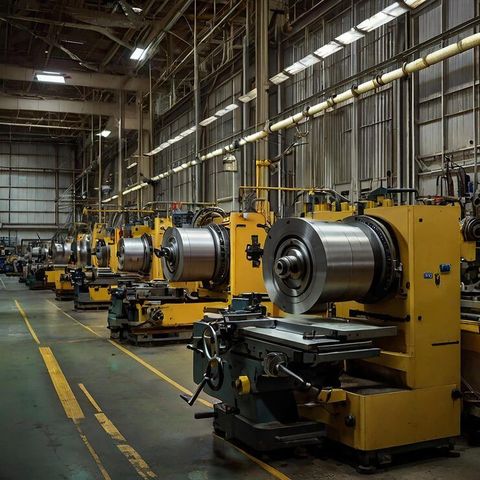
Horizontal boring machines feature a horizontally positioned spindle. They are widely used for machining large and heavy components that cannot easily be moved.
Common applications include:
- Engine blocks
- Gearboxes
- Heavy machinery frames
- Industrial equipment bases
Vertical Boring Machine
Vertical boring machines position the spindle vertically. Large circular workpieces are mounted on a rotating table while the cutting tool performs the boring operation.
Typical applications include:
- Turbine casings
- Large rings
- Flywheels
- Pressure vessels
Table Type Boring Machine
This machine moves the workpiece on an adjustable table while the spindle remains fixed. It provides flexibility for machining different surfaces.
Suitable for:
- Medium-sized industrial components
- Precision engineering parts
- Machine tool manufacturing
Floor Type Boring Machine
Floor-type machines are designed for extremely large workpieces that cannot fit on conventional machine tables.
They are commonly used in:
- Heavy engineering
- Shipbuilding
- Large industrial equipment manufacturing
CNC Boring Machine
Computer Numerical Control (CNC) boring machines automate the machining process using programmed instructions.
Benefits include:
- Higher precision
- Faster production
- Repeatable accuracy
- Reduced manual adjustments
- Complex machining capability
CNC technology has become increasingly important in industries requiring advanced manufacturing precision.
Working Principles
The working principle of a boring machine is straightforward but highly precise.
First, a hole is created using drilling, casting, or another manufacturing process. The workpiece is then securely clamped to prevent movement during machining.
A boring bar equipped with a cutting tool enters the existing hole. As the spindle rotates, the cutting edge removes a controlled amount of material from the internal surface.
The operator or programmed control system carefully adjusts:
- Cutting speed
- Feed rate
- Tool position
- Depth of cut
- Spindle rotation
Throughout the process, coolant may be applied to reduce heat generation and improve machining quality.
After machining, the finished hole is inspected to verify:
- Diameter accuracy
- Surface finish
- Roundness
- Straightness
- Alignment
- Dimensional tolerance
This precision process allows manufacturers to produce components that meet demanding engineering specifications.
Industrial Applications
Boring machines support numerous manufacturing industries because many mechanical systems require accurately machined internal holes.
Automotive Industry
Automotive manufacturers use boring machines for:
- Engine cylinder machining
- Transmission housings
- Brake components
- Suspension parts
Precise boring contributes to improved engine efficiency and component durability.
Aerospace Industry
Aircraft components require exceptional machining precision.
Applications include:
- Landing gear components
- Aircraft engine housings
- Structural assemblies
- Hydraulic systems
Energy Industry
Power generation equipment often contains large precision-machined parts.
Examples include:
- Turbine casings
- Generator housings
- Pump bodies
- Compressor components
Heavy Equipment Manufacturing
Construction and mining machinery depend on accurately machined components.
These include:
- Hydraulic cylinders
- Excavator frames
- Loader assemblies
- Industrial gearboxes
Railway Industry
Railway manufacturing uses boring machines to produce:
- Axle housings
- Wheel assemblies
- Gear components
- Brake systems
Recent Updates
Over the past year, several developments have influenced precision machining and boring machine technology.
Increased Manufacturing Automation (2025–2026)
Manufacturers continue expanding automation to improve productivity, reduce machining variation, and increase production efficiency. Automated boring systems are becoming more common in precision manufacturing environments.
Growth of Digital Manufacturing
Digital production planning and machine monitoring have become increasingly important. Many modern machining facilities now monitor equipment performance using connected production systems.
Improved Cutting Tool Materials
Recent improvements in cutting tool coatings and advanced tool materials have enhanced machining performance, allowing longer tool life and improved surface quality.
Greater Focus on Energy Efficiency
Industrial facilities are adopting energy-efficient machine designs that reduce electricity consumption while maintaining machining accuracy.
Expansion of Smart Manufacturing
Smart manufacturing continues growing during 2025 and 2026 through better production monitoring, predictive maintenance, and improved machine utilization.
These developments support more consistent manufacturing while helping industries improve productivity and product quality.
Laws or Policies
The use of boring machines is influenced by workplace safety regulations, industrial quality standards, and environmental requirements. Although regulations vary between countries, several common principles apply.
Important regulatory areas include:
Workplace Safety
Industrial facilities generally follow occupational safety requirements covering:
- Machine guarding
- Operator training
- Emergency stop systems
- Personal protective equipment
- Safe machine operation
Quality Management
Many manufacturers implement quality management systems that emphasize:
- Process consistency
- Product inspection
- Equipment calibration
- Continuous improvement
- Documentation
Environmental Compliance
Manufacturing operations increasingly focus on:
- Responsible coolant management
- Metal recycling
- Waste reduction
- Noise control
- Energy efficiency
Machinery Standards
Industrial machinery is often designed according to recognized engineering and manufacturing standards that support reliability and operational safety.
Organizations should always follow the applicable regulations and manufacturing standards within their country or industry sector.
Tools and Resources
Several general resources can help engineers, students, technicians, and manufacturing professionals understand boring machine operations.
Useful resources include:
| Tool or Resource | Purpose |
|---|---|
| CAD software | Create component designs |
| CAM software | Generate machining programs |
| CNC programming simulators | Practice machine programming |
| Engineering calculators | Calculate cutting parameters |
| Technical drawings | Understand machining dimensions |
| Maintenance checklists | Support preventive maintenance |
| Manufacturing templates | Standardize production planning |
| Training manuals | Improve machining knowledge |
| Measurement guides | Verify machining accuracy |
| Safety documentation | Promote safe machine operation |
Learning these resources helps improve machining quality and operational understanding.
FAQs
What is a boring machine used for?
A boring machine enlarges and finishes existing holes with high precision. It improves dimensional accuracy, surface finish, and alignment for industrial components.
How is boring different from drilling?
Drilling creates a new hole, while boring enlarges and refines an existing hole to achieve greater accuracy and smoother internal surfaces.
Which industries commonly use boring machines?
Automotive, aerospace, railway, heavy engineering, power generation, shipbuilding, oil and gas, and industrial machinery manufacturing all use boring machines extensively.
What are the advantages of CNC boring machines?
CNC boring machines provide higher accuracy, repeatability, automation, improved productivity, and consistent machining quality for complex components.
Why is precision important in boring operations?
Precise hole dimensions ensure proper assembly, reduce wear, improve equipment performance, extend component life, and maintain manufacturing quality.
Conclusion
Boring machines remain one of the most important precision machining technologies in modern manufacturing. Their ability to produce highly accurate internal dimensions makes them indispensable across industries ranging from automotive and aerospace to heavy engineering and energy production.