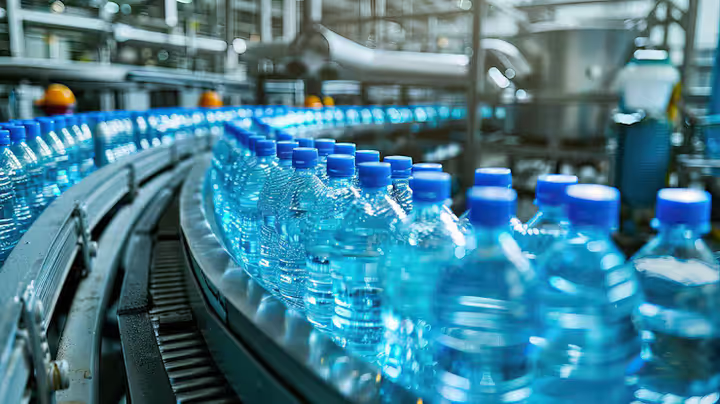
Water Bottling Industry: How Industrial Bottling Systems Work Guide
The water bottling industry is an important part of the global food and beverage sector. It involves a wide range of industrial activities, including water treatment, purification, bottling, packaging, quality testing, storage, and distribution.
Modern bottling facilities use automated equipment to transform treated water into packaged products that can be supplied to supermarkets, restaurants, offices, hotels, institutions, and other commercial customers.
For businesses planning a new facility, understanding industrial water bottling systems, equipment requirements, operating costs, and quality-control processes is essential.
What Is the Water Bottling Industry?
The water bottling industry refers to the commercial production and packaging of water in containers such as PET bottles, glass bottles, and larger reusable containers.
A typical facility may include several stages:
- Raw water collection
- Water filtration
- Water purification
- Storage
- Bottle manufacturing or bottle supply
- Bottle rinsing
- Water filling
- Capping
- Labeling
- Packaging
- Quality inspection
- Warehouse storage
- Distribution
The size of a bottling operation can range from a small production facility to a highly automated industrial plant capable of processing thousands of bottles per hour.
Why Industrial Water Bottling Matters
Demand for packaged water is influenced by population growth, urbanization, tourism, commercial development, and consumer preferences.
Businesses operating in this sector must maintain consistent product quality while controlling production expenses. Efficient water treatment equipment, automated filling machines, packaging systems, and quality-control procedures can help manufacturers improve operational consistency.
For investors and business owners, understanding the water bottling plant cost, equipment requirements, and regulatory obligations is an important part of evaluating a potential project.
How an Industrial Water Bottling Plant Works
A modern bottling plant generally follows a structured production process.
1. Raw Water Treatment
The first stage involves treating the incoming water according to its source and quality.
Depending on the characteristics of the water, a facility may use:
- Sediment filtration
- Activated carbon filtration
- Water softening
- Reverse osmosis
- Ultraviolet treatment
- Ozone treatment
- Microfiltration
- Ultrafiltration
The appropriate combination depends on the water source, local requirements, and intended product specifications.
2. Water Purification
Water purification is a critical part of the production process. Reverse osmosis systems are commonly used in industrial applications where dissolved minerals and other impurities need to be reduced.
Additional purification technologies may be incorporated to provide multiple treatment barriers.
A well-designed system considers factors such as:
- Feed-water quality
- Required production capacity
- Treatment efficiency
- Maintenance requirements
- Water recovery
- Energy consumption
3. Bottle Preparation
Bottles can be purchased from packaging suppliers or produced within the facility using PET preforms and specialized equipment.
A facility producing its own containers may use an industrial PET bottle blowing machine to manufacture bottles in different sizes and shapes.
Bottle production can provide greater control over packaging supply, although it also increases the plant's equipment, energy, maintenance, and capital requirements.
4. Bottle Rinsing
Before filling, bottles may pass through a rinsing or cleaning system.
Automated rinsing equipment helps prepare containers for the filling stage while reducing manual handling.
The design of the rinsing process depends on the type of bottle, production speed, packaging material, and facility hygiene requirements.
5. Water Filling
The filling machine transfers treated water into bottles at controlled volumes.
Industrial water filling machines can be configured for different bottle sizes and production capacities.
Common considerations when selecting filling equipment include:
- Bottling speed
- Bottle dimensions
- Filling accuracy
- Product-contact materials
- Cleaning requirements
- Automation level
- Equipment maintenance
- Integration with other production equipment
High-speed facilities often combine rinsing, filling, and capping operations into a single automated system.
6. Capping
After filling, bottles are sealed using automated capping equipment.
Proper closure is important because it helps protect the packaged product during storage and transportation.
The capping system must be compatible with the selected bottle and cap design.
7. Labeling and Packaging
Once bottles are filled and sealed, labels can be applied automatically.
Packaging equipment may then group individual bottles into multipacks or cases for transportation.
Common packaging formats include:
- Shrink-wrapped packs
- Cardboard cases
- Reusable containers
- Palletized loads
Efficient packaging automation can help reduce repetitive manual work and improve production consistency.
Water Bottling Equipment
A commercial water bottling plant may require a combination of treatment and packaging equipment.
| Equipment | Primary Function |
|---|---|
| Water filtration system | Removes suspended particles and selected contaminants |
| Reverse osmosis system | Reduces dissolved substances |
| UV water treatment | Provides additional microbial control |
| Ozone system | Supports water treatment and sanitation |
| Storage tanks | Stores treated or process water |
| Bottle blowing machine | Produces PET bottles from preforms |
| Bottle rinser | Prepares bottles before filling |
| Water filling machine | Fills bottles with treated water |
| Capping machine | Seals filled bottles |
| Labeling machine | Applies product labels |
| Shrink wrapping machine | Packages bottles into groups |
| Conveyor system | Transfers containers between stages |
| Quality-control equipment | Supports production testing |
The exact equipment configuration should be determined through an engineering assessment based on production capacity, water quality, packaging format, facility layout, and applicable regulations.
Water Bottling Plant Cost
One of the most important considerations for a new project is the water bottling plant cost.
There is no single price because investment requirements vary significantly.
Major cost categories can include:
Equipment Costs
Treatment systems, filling machines, bottle manufacturing equipment, conveyors, labeling machines, packaging equipment, storage tanks, and quality-control instruments can represent a substantial portion of capital expenditure.
Facility Costs
Land, building construction, electrical infrastructure, plumbing, drainage, ventilation, water storage, and warehouse space can influence the overall project budget.
Installation Costs
Industrial equipment often requires transportation, installation, commissioning, testing, and integration.
Operating Costs
Ongoing expenses can include:
- Electricity
- Water
- Packaging materials
- Labor
- Equipment maintenance
- Laboratory testing
- Transportation
- Waste management
- Insurance
- Facility expenses
Businesses should conduct a detailed capital expenditure (CAPEX) and operating expenditure (OPEX) analysis before investing in a bottling facility.
How to Improve Water Bottling Plant Efficiency
Efficiency is an important factor in industrial manufacturing.
Automate Repetitive Operations
Automated filling, capping, labeling, and packaging systems can reduce repetitive manual processes and provide more consistent production.
Monitor Water Consumption
Water recovery and process optimization can help facilities understand where water is being used and where improvements may be possible.
Maintain Equipment
Preventive maintenance can reduce unexpected equipment downtime and extend the useful operating life of machinery.
Optimize Energy Consumption
Pumps, compressors, motors, refrigeration equipment, and other electrical systems can contribute significantly to industrial energy consumption.
Energy monitoring can help identify inefficient equipment and opportunities for improvement.
Use Production Monitoring
Modern facilities may use industrial control systems and production monitoring software to track equipment performance, production volumes, downtime, and other operational indicators.
Quality Control in the Water Bottling Industry
Quality control is essential throughout the production process.
A bottling facility may monitor parameters such as:
- Water chemistry
- Microbiological characteristics
- Filtration performance
- Treatment-system operation
- Filling accuracy
- Container integrity
- Closure performance
- Packaging quality
Testing requirements vary depending on the product category, water source, jurisdiction, and applicable regulations.
Facilities should establish documented procedures for sampling, testing, sanitation, equipment maintenance, and corrective actions.
Food Safety and Hygiene
Because bottled water is a consumable product, hygiene and sanitation are major considerations.
A properly designed facility should consider:
- Hygienic equipment design
- Clean production areas
- Controlled personnel movement
- Appropriate sanitation procedures
- Regular equipment cleaning
- Proper storage conditions
- Pest-control measures
- Documented quality procedures
Following applicable food-safety requirements can help manufacturers maintain consistent production standards and protect consumers.
Choosing Industrial Water Treatment Equipment
Selecting water treatment equipment requires more than comparing purchase prices.
Businesses should evaluate:
Water Source
Groundwater, municipal water, surface water, and other sources can have different treatment requirements.
Production Capacity
The treatment system should be appropriately sized for the expected production volume.
Operating Cost
Energy use, filter replacement, membrane replacement, chemicals, cleaning, and maintenance can affect the long-term cost of ownership.
Equipment Reliability
Industrial facilities depend on reliable equipment to maintain production schedules.
Technical Support
Availability of spare parts, technical assistance, maintenance services, and operator training should also be considered.
Sustainability in the Bottled Water Industry
Environmental considerations are becoming increasingly important across the packaging and beverage industries.
Water bottling companies can explore several approaches to improving resource efficiency.
These may include:
- Reducing packaging material
- Improving water-use efficiency
- Increasing equipment efficiency
- Optimizing transportation
- Reducing production waste
- Improving recycling practices
- Monitoring energy consumption
The most appropriate sustainability strategy depends on the facility's location, production model, packaging materials, and local infrastructure.
Industrial Automation in Water Bottling
Automation has changed the way modern bottling facilities operate.
Sensors, programmable logic controllers, automated conveyors, filling systems, inspection equipment, and production-management software can work together to coordinate production.
Automation can provide benefits such as:
- Consistent filling volumes
- Reduced manual handling
- Improved production monitoring
- Faster packaging
- Better process control
- Easier data collection
However, automation also requires appropriate installation, maintenance, employee training, and safety procedures.
Common Challenges in the Water Bottling Industry
Water bottling businesses can face several operational challenges.
Increasing Production Costs
Energy, packaging materials, transportation, labor, and equipment maintenance can affect operating margins.
Equipment Downtime
Unexpected failures can interrupt production and create delivery delays.
Packaging Supply
Reliable access to bottles, caps, labels, cartons, and other packaging materials is important for continuous operations.
Regulatory Compliance
Manufacturers must understand and comply with applicable water-quality, food-safety, environmental, labeling, and business regulations.
Distribution
Because bottled water is relatively heavy compared with many other consumer products, transportation and warehouse management can have a significant effect on operating costs.
Frequently Asked Questions
Is a water bottling business capital intensive?
Yes. A commercial facility may require significant investment in water treatment, filling equipment, packaging machinery, buildings, utilities, quality-control systems, and working capital. The required investment depends on the project's scale and specifications.
What equipment is needed for a water bottling plant?
Typical equipment includes filtration systems, treatment equipment, storage tanks, bottle rinsers, filling machines, capping machines, labeling systems, conveyors, packaging equipment, and quality-control instruments.
What affects the cost of a bottling plant?
Production capacity, automation level, treatment technology, packaging format, building requirements, utilities, equipment specifications, installation, and regulatory requirements can all affect project costs.
How does reverse osmosis help in water treatment?
Reverse osmosis uses a semi-permeable membrane to reduce many dissolved substances from water. Its suitability depends on the characteristics of the incoming water and the required treatment objectives.
Is automation necessary for a bottling plant?
Automation is not necessarily required for every facility, but it can improve production consistency and efficiency, particularly as production volume increases.
Conclusion
The water bottling industry combines water treatment, industrial automation, packaging, quality control, logistics, and manufacturing management. A successful facility requires more than a filling machine; it needs an appropriately designed treatment process, reliable packaging systems, effective quality controls, trained personnel, and sound operational planning.
For anyone researching a water bottling plant, the most important considerations include production capacity, water quality, equipment selection, capital investment, operating expenses, regulatory requirements, maintenance, and long-term efficiency.
Careful planning and professional engineering assessment can help businesses make informed decisions before investing in industrial water bottling equipment.