Industrial Automation Solutions: A Complete Guide to Modern Manufacturing Systems
Industrial automation solutions are technologies and systems designed to automate manufacturing, production, material handling, monitoring, and other industrial processes. They combine hardware, software, sensors, control systems, networking, and data analytics to reduce repetitive manual work and improve operational consistency.
As manufacturers face increasing pressure to improve productivity, manage operating costs, maintain quality, and respond quickly to changing demand, industrial automation has become an important part of modern production environments.
What Are Industrial Automation Solutions?
Industrial automation solutions use control technologies to operate industrial equipment and processes with limited manual intervention. Depending on the application, an automation system may control a single machine, an entire production line, or multiple facilities.
Common technologies include:
- Programmable logic controllers (PLCs)
- Industrial robots
- Human-machine interfaces (HMIs)
- Supervisory control and data acquisition (SCADA)
- Industrial sensors
- Variable frequency drives (VFDs)
- Motion control systems
- Industrial networking
- Manufacturing execution systems (MES)
- Industrial Internet of Things (IIoT)
- Data monitoring and analytics
- Machine vision systems
These technologies can work independently or as part of an integrated automation architecture.
Why Industrial Automation Matters
Modern manufacturing requires consistent production, accurate process control, and efficient use of resources. Automation can help organizations achieve these objectives by controlling processes according to predefined instructions.
Improved Production Efficiency
Automated equipment can perform repetitive operations at consistent speeds and intervals. This can help manufacturers organize production workflows and reduce unnecessary process interruptions.
Automation does not necessarily eliminate human involvement. Instead, employees can focus on supervision, maintenance, quality management, programming, and other tasks that require human judgment.
Better Process Consistency
Automated systems can execute programmed operations with repeatable parameters. Sensors and control systems can continuously measure conditions such as temperature, pressure, speed, position, and flow.
Consistent process control can be particularly valuable in industries where product specifications need to remain within defined tolerances.
Reduced Operational Waste
Automation can provide better visibility into production processes. By monitoring equipment performance and material usage, businesses may identify inefficient processes, excessive downtime, or production bottlenecks.
Data-driven monitoring can support more informed decisions about equipment utilization and process improvements.
Major Types of Industrial Automation
Industrial automation can be categorized according to the flexibility and complexity of the production process.
Fixed Automation
Fixed automation is designed for repetitive production operations with relatively stable requirements.
It is commonly associated with high-volume manufacturing where machines repeatedly perform the same sequence of operations.
Advantages include:
- High production rates
- Consistent operation
- Reduced repetitive manual tasks
- Efficient processing of large production volumes
The main limitation is that fixed systems can be difficult and expensive to modify when production requirements change.
Programmable Automation
Programmable automation allows equipment and control systems to be reprogrammed for different production requirements.
This approach is useful when manufacturers produce different batches or product variations.
Examples include CNC machines and programmable industrial control systems.
Flexible Automation
Flexible automation is designed to accommodate product variations with relatively limited changeover requirements.
Robotic systems, programmable controllers, automated material handling equipment, and software-based production management systems can contribute to flexible manufacturing environments.
Integrated Automation
Integrated automation connects multiple machines, control systems, software platforms, and data sources into a coordinated production environment.
For example, machine data may be collected through industrial networks and transferred to monitoring or manufacturing management software for analysis.
Key Components of an Industrial Automation System
A complete automation solution usually contains several interconnected components.
Programmable Logic Controllers
A PLC is an industrial computer used to monitor inputs and control outputs according to programmed logic.
PLCs are widely used for controlling:
- Motors
- Valves
- Conveyors
- Pumps
- Sensors
- Production machinery
- Safety-related functions
Their industrial design allows them to operate reliably in demanding production environments.
Human-Machine Interfaces
An HMI provides an interface between operators and machines.
Operators can use an HMI to:
- Monitor machine status
- View process information
- Adjust permitted parameters
- Identify alarms
- Review operating conditions
- Start or stop approved processes
A well-designed HMI can make complex equipment easier to monitor and operate.
Sensors and Instrumentation
Sensors collect information from physical processes.
Examples include:
- Temperature sensors
- Pressure sensors
- Proximity sensors
- Flow sensors
- Level sensors
- Position sensors
- Vibration sensors
- Optical sensors
The collected information can be used by control systems to make operational decisions.
Industrial Robots
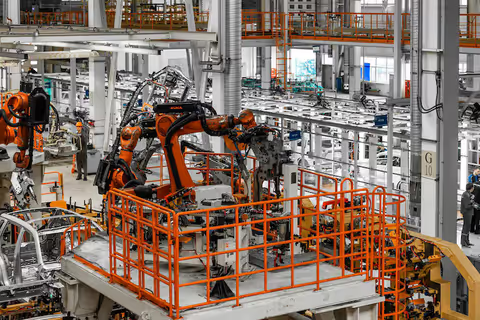
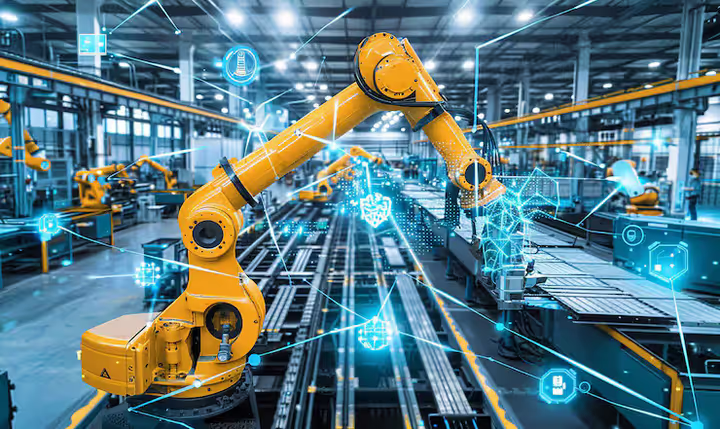
Industrial robots can perform repetitive or precision-oriented tasks such as material handling, welding, assembly, packaging, and machine tending.
Robotic automation can be particularly useful for processes that involve repetitive movements or controlled operating conditions.
Variable Frequency Drives
Variable frequency drives control the speed and operating characteristics of electric motors.
They can be used with pumps, fans, conveyors, compressors, and other motor-driven equipment.
Proper motor control can contribute to improved process management and, depending on the application, reduced energy consumption.
SCADA Systems
SCADA systems provide supervisory monitoring and control capabilities across industrial processes.
A SCADA environment can collect information from multiple devices and present it through centralized dashboards.
This can help operators identify:
- Equipment conditions
- Process deviations
- Alarms
- Production trends
- System events
Industrial Automation and IIoT
The Industrial Internet of Things connects industrial equipment, sensors, software, and networks so that operational data can be collected and analyzed.
How IIoT Works
A typical IIoT architecture may include:
- Sensors collect equipment and process data.
- Controllers process operational signals.
- Industrial networks transfer information.
- Edge devices or gateways process selected data.
- Software platforms store and analyze information.
- Dashboards provide operational insights.
This architecture can help organizations understand equipment performance and identify potential process improvements.
Predictive Maintenance
One important application of industrial data is predictive maintenance.
Instead of relying exclusively on fixed maintenance schedules, organizations can monitor indicators such as vibration, temperature, operating hours, and equipment performance.
When unusual patterns are detected, maintenance teams can investigate the equipment before a serious failure occurs.
Predictive maintenance does not guarantee that equipment failures will be prevented, but it can provide additional information for maintenance planning.
Applications of Industrial Automation
Industrial automation solutions are used across many sectors.
Automotive Manufacturing
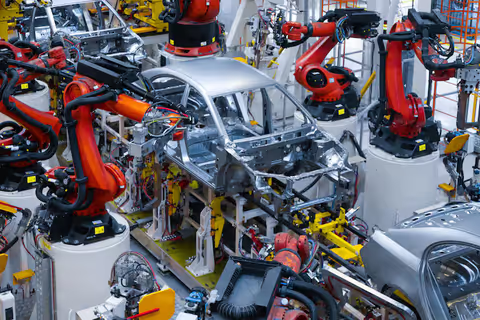
Automation is widely used for assembly, welding, painting, material handling, inspection, and component manufacturing.
Robots and automated production equipment can perform repetitive operations while control systems coordinate production processes.
Food and Beverage Processing
Automation can support mixing, filling, packaging, temperature monitoring, conveyor systems, and quality control.
Automated monitoring can help maintain defined processing parameters and improve production consistency.
Pharmaceutical Manufacturing
Pharmaceutical production requires controlled processes and careful documentation. Automation systems can assist with process monitoring, equipment control, environmental monitoring, and production data collection.
Chemical Processing
Chemical plants use automation for controlling variables such as pressure, temperature, flow, and chemical composition.
Because industrial processes can involve complex operating conditions, automated control and monitoring systems play an important role in maintaining defined process parameters.
Packaging and Warehousing
Automated conveyors, robotic systems, barcode technologies, machine vision, and warehouse control systems can support material movement and packaging operations.
Benefits of Industrial Automation Solutions
Organizations evaluating automation commonly consider several potential benefits.
Productivity
Automation can allow machines to perform repetitive processes continuously according to programmed operating requirements.
Quality Control
Automated inspection and process monitoring can help identify deviations from predefined specifications.
Operational Visibility
Connected automation systems can provide production data that helps managers understand equipment utilization, downtime, and process performance.
Workplace Safety
Automation can reduce the need for employees to perform certain repetitive or hazardous tasks. However, automated equipment must still be designed, installed, operated, and maintained according to appropriate safety requirements.
Energy Management
Monitoring equipment and energy consumption can help organizations identify areas where energy use may be optimized.
Challenges of Industrial Automation
Automation can provide significant advantages, but implementation also involves challenges.
Initial Investment
Automation projects can require investment in equipment, software, engineering, installation, training, and system integration.
A complete financial evaluation should consider both upfront costs and expected long-term operational benefits.
Integration With Existing Equipment
Older machinery may use different communication protocols or control architectures. Integrating legacy equipment with modern systems can therefore require gateways, interface hardware, or specialized engineering.
Cybersecurity
Connected industrial systems can introduce cybersecurity considerations. Industrial networks should be designed with appropriate access controls, network segmentation, monitoring, authentication, and security procedures.
Workforce Training
Employees need appropriate training to operate, maintain, troubleshoot, and manage automated systems.
Automation can change job responsibilities, making technical skills and continuous training increasingly important.
How to Choose an Industrial Automation Solution
Selecting an automation system requires an understanding of both technical and business requirements.
Define the Production Requirement
Start by identifying the process that needs improvement.
Consider:
- Production volume
- Cycle time
- Product variations
- Quality requirements
- Existing equipment
- Maintenance requirements
- Safety considerations
Evaluate Total Cost of Ownership
The purchase price is only one part of an automation investment.
Businesses should also consider:
- Installation costs
- Software licensing
- Maintenance
- Spare parts
- Training
- Energy consumption
- System upgrades
- Downtime during implementation
A total-cost-of-ownership approach can provide a more complete view of the investment.
Consider Scalability
Manufacturing requirements can change over time. A scalable automation architecture can make it easier to add machines, sensors, production lines, or software capabilities in the future.
Review Data and Connectivity Requirements
Organizations should determine what information needs to be collected, where it will be stored, and which systems need access to it.
This is particularly important when integrating PLCs, SCADA, MES, ERP systems, and IIoT platforms.
Future Trends in Industrial Automation
Industrial automation continues to evolve as manufacturers adopt connected technologies and data-driven processes.
Artificial Intelligence
AI can be used for applications such as visual inspection, anomaly detection, production analytics, and process optimization.
Its effectiveness depends on the quality of available data and the suitability of the application.
Edge Computing
Edge computing allows selected industrial data to be processed closer to machines and sensors rather than sending every data point to a centralized system.
This can support faster analysis and reduce unnecessary network traffic.
Digital Twins
A digital twin is a digital representation of a physical asset, process, or system.
Organizations can use digital models to study equipment behavior, analyze scenarios, and support engineering or maintenance decisions.
Collaborative Robots
Collaborative robots, often called cobots, are designed for applications where robots and people may work in close proximity under appropriate safety controls.
Their use is expanding in applications such as assembly, inspection, packaging, and material handling.
Conclusion
Industrial automation solutions are becoming an important component of modern manufacturing and industrial operations. From PLCs and sensors to robotics, SCADA, IIoT, and data analytics, automation technologies can help organizations improve process consistency, production visibility, equipment management, and operational efficiency.
However, successful automation requires more than purchasing equipment. Businesses should evaluate their production requirements, integration challenges, cybersecurity needs, workforce capabilities, maintenance strategy, and total cost of ownership before implementing an automation project.
As connected manufacturing, artificial intelligence, robotics, and industrial data analytics continue to develop, automation is likely to remain an important area of investment for organizations seeking more efficient and data-driven industrial operations.

You May Also Like