Industrial Robotics Company: Understanding Industrial Robots, Automation, and Business Applications
Industrial robotics has become an important part of modern manufacturing. Companies across automotive, electronics, food processing, logistics, pharmaceuticals, metalworking, and other industries use robotic systems to perform repetitive, precise, or physically demanding tasks.
An industrial robotics company may design and manufacture robots, develop robotic software, integrate automation systems, provide installation services, or maintain robotic equipment. The industry connects robotics with manufacturing automation, machine vision, artificial intelligence, sensors, industrial control systems, and data analytics.
This article explains how industrial robotics companies operate, the major types of industrial robots, their applications, benefits, costs, safety considerations, and factors businesses should evaluate before investing in robotic automation.
What Is an Industrial Robotics Company?
An industrial robotics company provides technologies and services that help businesses automate industrial processes.
Depending on its specialization, a company may offer:
- Industrial robotic arms
- Collaborative robots
- Robotic welding systems
- Pick-and-place automation
- Palletizing and packaging robots
- Machine-tending systems
- Robotic painting systems
- Automated inspection systems
- Machine vision solutions
- Robotic material handling
- Industrial automation software
- Robot installation and integration
- Preventive maintenance and technical support
The goal is generally to improve production consistency, workplace safety, process efficiency, and the use of manufacturing resources.
How Industrial Robotics Works
An industrial robotic system usually combines several technologies rather than operating as a standalone machine.
Robotic Arm
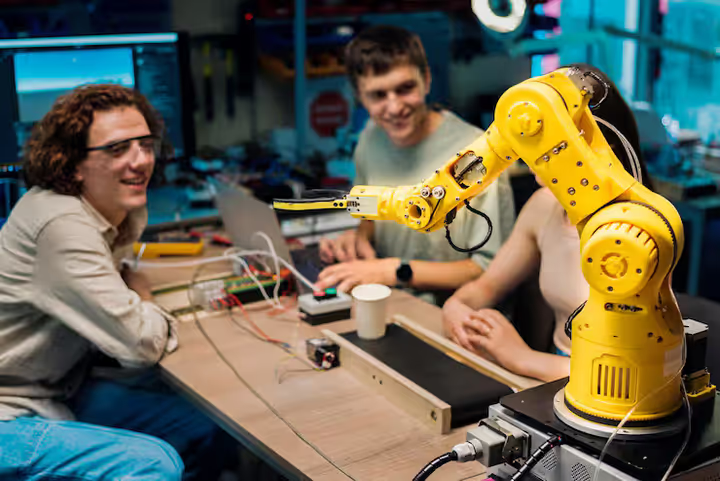
The robot provides controlled movement through multiple axes. Different configurations are suitable for different manufacturing applications.
End-of-Arm Tooling
The tool attached to the robot determines what task it can perform. Examples include:
- Grippers
- Welding torches
- Vacuum tools
- Cutting tools
- Screwdrivers
- Dispensing equipment
- Inspection cameras
Sensors and Machine Vision
Sensors provide information about the environment and production process. Machine vision can help robots identify objects, inspect products, measure components, or determine positioning.
Robot Controller
The controller manages movement, programs, communication, and other operating functions.
Industrial Software
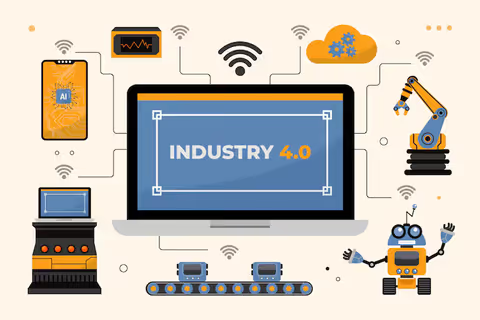
Modern automation systems can connect robots with programmable logic controllers, manufacturing equipment, production databases, and monitoring platforms.
This combination allows businesses to develop more connected industrial automation systems instead of isolated robotic machines.
Major Types of Industrial Robots
Different manufacturing requirements call for different robot designs.
Articulated Robots
Articulated robots use rotary joints and are among the most flexible industrial robots. They are commonly used for welding, assembly, material handling, painting, and machine tending.
SCARA Robots
SCARA robots are designed for fast horizontal movement and are frequently used for assembly, packaging, electronic component handling, and pick-and-place operations.
Cartesian Robots
Cartesian robots move along linear axes. Their relatively straightforward structure can make them suitable for applications requiring predictable movement across defined coordinates.
Delta Robots
Delta robots are designed for high-speed picking and sorting. They are often considered for food processing, packaging, and lightweight assembly applications.
Collaborative Robots
Collaborative robots, often called cobots, are designed for applications where people and robotic equipment may work in closer proximity under appropriate safety conditions.
However, the term "collaborative" does not mean that every application is automatically safe. A complete risk assessment and appropriate safeguarding are still important.
Common Applications of Industrial Robotics
Industrial robotics companies serve a wide range of manufacturing sectors.
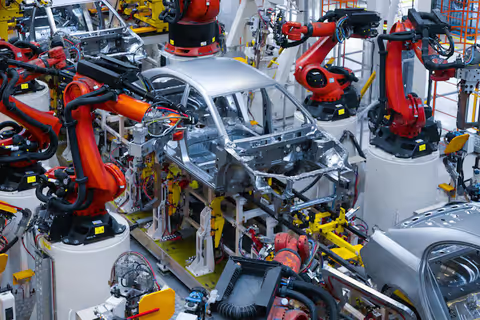
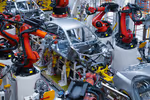
Automotive Manufacturing
Robots can be used for:
- Welding
- Painting
- Assembly
- Material handling
- Machine tending
- Quality inspection
Automotive manufacturing is particularly suitable for automation because many production processes involve repeatable movements and defined operating conditions.
Electronics Manufacturing
Electronics production may require high precision and consistent handling. Robots can assist with assembly, component placement, inspection, packaging, and material movement.
Food and Beverage Manufacturing
Robotic systems can support packaging, palletizing, sorting, product handling, and other repetitive operations.
Food applications may require additional considerations related to hygiene, materials, cleaning procedures, and the operating environment.
Pharmaceutical Manufacturing
Automation can support material handling, packaging, inspection, and other controlled processes. Businesses must evaluate applicable quality, environmental, and regulatory requirements for their particular application.
Metalworking
Robots can assist with welding, cutting, grinding, loading and unloading machine tools, and handling heavy components.
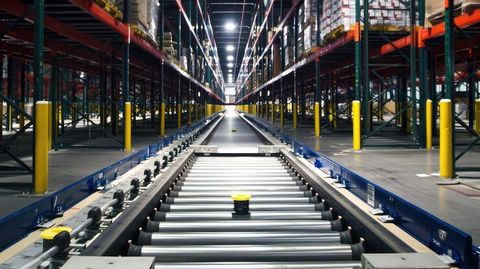
Warehousing and Logistics
Robotic automation can be used for:
- Pallet handling
- Sorting
- Picking
- Packaging
- Material transportation
- Inventory-related operations
Benefits of Industrial Robotics
Investing in robotics can provide several operational benefits when the application is properly designed.
Improved Production Consistency
Robots can repeat programmed movements with consistent parameters. This can help reduce variation in processes where repeatability is important.
Increased Productivity
Automation can allow certain processes to operate for extended periods with less dependence on manual repetitive work.
Better Workplace Safety
Robots can be assigned to tasks involving repetitive motion, hot surfaces, hazardous environments, or other potentially difficult working conditions.
Safety benefits depend on proper system design, guarding, training, maintenance, and risk assessment.
Improved Quality Control
Robotic systems can execute standardized processes and can be combined with machine vision and inspection technologies to identify manufacturing variations.
Reduced Repetitive Manual Work
Automation can reduce the amount of repetitive handling required from workers and allow employees to focus on tasks requiring judgment, supervision, troubleshooting, or other skills.
Industrial Robotics and Manufacturing Automation
Industrial robots are only one component of a larger manufacturing automation strategy.
A modern automated production line may include:
- Industrial robots
- PLC systems
- Sensors
- Machine vision
- Conveyors
- CNC machines
- Safety systems
- Manufacturing execution software
- Industrial networking
- Data monitoring platforms
This creates an integrated environment where different machines exchange information and coordinate production activities.
Industrial Robot Cost: What Determines the Investment?
The cost of industrial robotics varies substantially depending on the application.
A business should not evaluate the price of a robot alone. The total investment may include:
- Robot hardware
- Robot controller
- End-of-arm tooling
- Safety equipment
- Machine vision
- Programming
- System integration
- Installation
- Employee training
- Maintenance
- Spare parts
- Production-line modifications
- Software and connectivity
Understanding Total Cost of Ownership
A useful financial evaluation should consider the total cost of ownership (TCO) rather than only the initial purchase price.
Businesses can compare the expected investment with measurable operational factors such as:
- Production volume
- Labor requirements
- Downtime
- Scrap rates
- Product quality
- Maintenance costs
- Energy consumption
- Expected equipment life
- Utilization rate
A detailed return-on-investment analysis can help determine whether automation makes financial sense for a specific production process.
How to Choose an Industrial Robotics Company
Selecting a robotics provider requires more than comparing equipment prices.
Evaluate Technical Experience
Look for experience with the specific process you want to automate, such as welding, packaging, assembly, machine tending, or material handling.
Review Integration Capabilities
The provider should understand how robots interact with existing machinery, controls, safety systems, and production software.
Consider Maintenance Support
Industrial equipment requires ongoing maintenance. Ask about technical support, spare parts availability, training, troubleshooting, and service response.
Examine Safety Practices
Safety should be considered from the beginning of system design. ISO 10218-1:2025 covers safety requirements for industrial robots, while ISO 10218-2:2025 addresses industrial robot applications and robot cells.
In the United States, OSHA also references national consensus standards and safety guidance relevant to industrial robot systems.
Check Scalability
A robotics investment should ideally support future production requirements. Businesses can consider whether the system can accommodate additional stations, products, tooling, sensors, or software integrations.
Industrial Robotics Safety
Robot safety is an essential part of industrial automation.
Potential hazards can include:
- Unexpected robot movement
- Crushing and trapping points
- Moving machinery
- Tool-related hazards
- Electrical hazards
- Hot surfaces
- Welding hazards
- Improper maintenance procedures
A professional robotic installation should include appropriate risk assessment, safeguarding, emergency controls, operating procedures, and employee training.
The 2025 editions of ISO 10218-1 and ISO 10218-2 provide updated international requirements for industrial robots and robot applications.
Safety requirements can vary by country, industry, machine, and application, so businesses should consult qualified safety professionals and applicable regulations rather than relying on general online guidance.
Industrial Robotics and Artificial Intelligence
Artificial intelligence is increasingly connected with industrial automation.
AI-enabled systems can potentially support:
- Visual inspection
- Defect detection
- Object recognition
- Predictive maintenance
- Production monitoring
- Process optimization
- Robotic path planning
However, AI does not replace the need for conventional engineering controls. Industrial environments require appropriate validation, cybersecurity, safety engineering, and human oversight.
Predictive Maintenance for Robotic Systems
Maintenance is an important part of protecting an automation investment.
Traditional preventive maintenance uses scheduled inspections and servicing. Predictive maintenance can additionally use equipment data to identify unusual operating conditions.
Monitoring may include:
- Motor performance
- Temperature
- Vibration
- Cycle counts
- Error codes
- Component wear
- Operating hours
Early detection of abnormal conditions can help businesses plan maintenance and potentially reduce unexpected production interruptions.
Industrial Robotics Market Opportunities
Industrial robotics creates opportunities across several business areas, including:
- Robotics manufacturing
- Automation engineering
- Robot integration
- Industrial software
- Machine vision
- Safety engineering
- Robotics maintenance
- Automation consulting
- Industrial cybersecurity
- Predictive maintenance
- Workforce training
The growth of automation also increases demand for professionals who understand mechanical engineering, electrical controls, programming, robotics, data systems, and industrial safety.
Questions to Ask Before Buying Industrial Automation
Before selecting a robotics company, businesses can ask:
What process should be automated?
Clearly define the current production problem rather than starting with a specific robot.
What production volume is required?
Production volume affects robot selection, cycle time, tooling, and overall system design.
What level of accuracy is necessary?
Different processes require different levels of precision, repeatability, and inspection.
What existing equipment must be integrated?
Identify CNC machines, conveyors, PLCs, sensors, databases, and other equipment that the robotic system needs to communicate with.
What safety requirements apply?
Determine the relevant local regulations, industry requirements, risk assessment procedures, and applicable robotics standards.
What is the expected return on investment?
Estimate both direct and indirect benefits before approving a major automation project.
Frequently Asked Questions
What does an industrial robotics company do?
An industrial robotics company may manufacture robots, develop automation solutions, integrate robotic equipment with production machinery, provide programming, installation, training, maintenance, and technical support.
What industries use industrial robots?
Automotive, electronics, food processing, pharmaceuticals, metalworking, plastics, packaging, logistics, and many other manufacturing sectors use robotic automation.
Are industrial robots expensive?
Costs vary depending on robot type, payload, tooling, software, safety equipment, integration requirements, installation, and maintenance. A complete automation project can cost considerably more than the robot hardware itself.
Are industrial robots safe?
Industrial robots can be operated safely when the complete system is properly engineered, risk-assessed, safeguarded, maintained, and used according to applicable requirements. Safety should be evaluated for the specific application.
Can small businesses use industrial robots?
Yes. Smaller manufacturers may consider automation for repetitive processes such as machine tending, packaging, welding, inspection, or material handling. The financial case depends on production volume, labor requirements, process characteristics, and expected utilization.
Conclusion
An industrial robotics company plays an important role in modern manufacturing by combining robotic equipment with automation engineering, software, sensors, machine vision, safety systems, and industrial controls.
For businesses considering automation, the most important decision is not simply choosing a robot. It is designing a complete system around the production requirement, safety conditions, expected performance, maintenance needs, integration requirements, and long-term financial objectives.
Well-planned robotic automation can improve consistency, productivity, quality control, and workplace efficiency while supporting the development of more connected manufacturing operations.