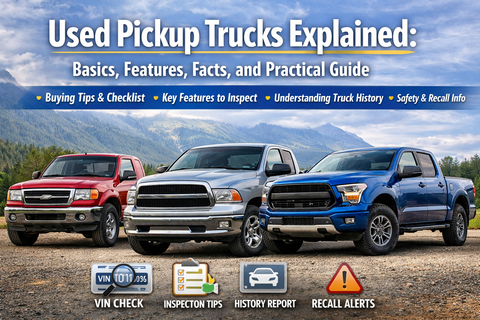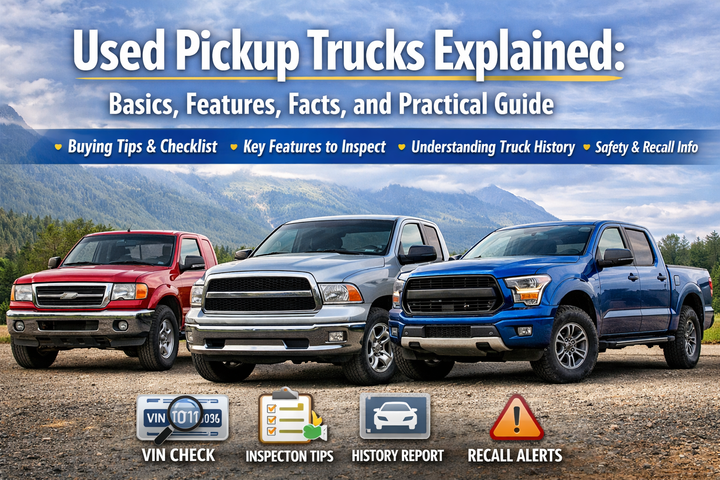
Used Pickup Trucks Explained: Basics, Features, Facts, and Practical Guide
Used pickup trucks are pre-owned trucks that continue serving drivers after their first ownership cycle. They exist because pickup trucks are built for utility, durability, and flexible transport.
What used pickup trucks are and why they exist
Used pickup trucks are pre-owned trucks that continue serving drivers after their first ownership cycle. They exist because pickup trucks are built for utility, durability, and flexible transport. Many remain useful for years, which makes the used segment an important part of the broader automotive market.
A pickup truck combines passenger space with an open cargo bed. That layout supports hauling tools, moving equipment, carrying outdoor gear, and towing trailers. In the used market, this same format becomes relevant to people who need utility without stepping into a brand-new model. The category covers compact, mid-size, full-size, heavy-duty, hybrid, and electric trucks, each with different strengths for payload, towing, off-road travel, or everyday commuting. Official safety and recall resources treat these vehicles as important long-life assets, which is one reason regulators emphasize VIN-based checks and defect disclosures.
The used pickup segment exists for another reason too: trucks often have longer practical lifecycles than many passenger cars. A well-maintained truck may continue to perform in agriculture, logistics, construction, recreation, or family use for many years. That creates a large secondary market where condition, mileage, maintenance records, drivetrain type, and safety history matter more than styling alone.
A simple way to understand the category is by use case:
| Used Pickup Type | Typical Purpose | Main Advantage |
|---|---|---|
| Mid-size truck | Daily driving, light towing, outdoor use | Easier parking and maneuvering |
| Full-size truck | Mixed family and utility use | Strong towing and cabin space |
| Heavy-duty truck | Trailer work, equipment hauling | Higher capability |
| Hybrid truck | Utility with better efficiency | Balanced performance |
| Electric truck | Quiet operation, strong torque, onboard power | New technology and lower tailpipe emissions |
Why used pickup trucks matter today
Used pickup trucks matter because they affect a wide range of drivers and industries. They are relevant to contractors, landowners, small business operators, delivery fleets, rural families, and people who need towing or cargo flexibility. In many areas, a pickup is not only a lifestyle vehicle; it is a working tool and a practical transport platform.
This topic matters even more now because the used-vehicle market remains tight. Cox Automotive reported on March 14, 2025 that used-vehicle inventory at the start of March was lower than a year earlier, while sales activity strengthened and days’ supply stood at 42. That kind of market pressure makes evaluation more important, because people are often comparing older trucks across different conditions, mileage bands, and feature sets.
Used pickup trucks also solve multiple problems at once:
-
They provide utility for hauling and towing.
-
They support business operations where durability matters.
-
They help households in rural or semi-rural regions manage rough roads and weather.
-
They give access to truck capability across a wider range of budgets and ownership needs.
-
They allow drivers to compare gasoline, diesel, hybrid, and electric options in one category.
The category also matters from a safety and compliance perspective. Older trucks may have open recalls, different crash-test outcomes, older lighting systems, or limited driver-assistance technology compared with newer models. NHTSA recommends checking recalls through VIN lookup, and IIHS continues to tighten safety standards for current vehicles, which indirectly raises awareness around how older models compare with newer ones in crash protection and pedestrian safety.
Recent updates and market developments
The last year brought several developments that shape how people evaluate used pickup trucks in the United States.
One important change is continued pressure on used inventory. Cox Automotive’s March 14, 2025 update reported that unsold used-vehicle inventory was down versus early March 2024. That matters because tighter supply often means more comparison across age, mileage, and condition rather than abundant choice within one narrow specification. In simple terms, people are more likely to consider a broader set of used trucks than they would in a looser market.
Another major shift is the rapid movement of technology from new trucks into the used market pipeline. Trucks launched or updated in recent years increasingly include large infotainment systems, towing cameras, hybrid systems, over-the-air software capability, onboard power features, and advanced driver assistance. As these vehicles age into the used market, shoppers and fleet operators need to evaluate not just engine condition but also battery health, software status, sensor calibration, and feature compatibility.
Safety standards also remained a major theme through 2024 and 2025. IIHS 2025 award criteria continued to emphasize stronger crash-test performance and pedestrian crash prevention systems. Even though these awards focus on current vehicles, they influence how people think about used models because they create a clearer benchmark for what newer safety engineering looks like. A used truck from a recent generation may differ meaningfully from an older truck in structure, headlight performance, and crash avoidance technology.
Electric pickups also moved from niche interest toward broader awareness. IIHS now includes electric large pickups such as the Cybertruck in its ratings database, and updated 2025 testing notes show structural revisions for newer builds. That signals a larger market reality: electric trucks are no longer theoretical future products. Over time, this will expand the used pickup segment to include more battery-electric and hybrid entries, which means future used-truck evaluation will increasingly include charging, battery warranty terms, and software-linked diagnostics.
A useful summary of current trends looks like this:
| 2024–2025 Trend | Why It Matters for Used Pickup Trucks |
|---|---|
| Tighter used inventory | Fewer easy comparisons, more emphasis on vehicle condition |
| More advanced safety tech in newer trucks | Bigger gap between older and newer used models |
| Growth of hybrid and electric trucks | More powertrain types entering the used market |
| Stronger recall awareness | VIN-based safety checks matter more |
| More digital features | Evaluation now includes software and electronics, not just engine and body |
Laws and policies that affect used pickup trucks
In the United States, used pickup trucks are shaped by federal and state rules.
A major federal rule is the FTC Used Car Rule. The FTC explains that dealers must display a window disclosure form on used vehicles they present for retail transactions, with limited state exceptions such as Maine and Wisconsin, which use similar requirements. This disclosure is important because it clarifies warranty status and key transaction details in a standardized format. For anyone researching used trucks through a dealer, this rule affects the information that must be visible at the point of inspection.
Safety recall rules are another major area. NHTSA maintains the official recall database and VIN lookup system. If a manufacturer or NHTSA determines that a vehicle creates an unreasonable safety risk or fails to meet minimum safety standards, a recall may be issued. This directly affects used trucks because an older vehicle can still carry an unresolved recall years after its original sale.
Federal fuel economy and emissions policy also shape the used market indirectly. EPA finalized Multi-Pollutant Emissions Standards on March 20, 2024 for future model years, and NHTSA finalized updated CAFE standards in 2024 for passenger cars and light trucks. These rules do not change an older truck overnight, but they influence which newer trucks enter the market, how powertrains evolve, and how quickly hybrid and electric pickups become common in the used pool later on.
State-level rules can also matter. Registration class, inspection requirements, emissions testing, title branding, and lemon-law scope vary by state. A used pickup registered for commercial use may face different treatment from one used only for personal transportation. That is why it is important to verify state DMV rules, title status, emissions inspection requirements, and road-use classifications before making any decision.
Tools and resources that help with used pickup truck research
Several tools make used pickup truck research much easier and more factual.
The most important starting points are:
-
NHTSA Recall Lookup for checking open recalls by VIN.
-
NHTSA VIN Decoder for confirming vehicle details such as plant and specification data.
-
NHTSA Vehicle Safety Resources for recall guidance and safety information.
-
IIHS Ratings Database for crash-test and safety information on many truck models.
-
FuelEconomy.gov for fuel economy comparisons across truck engines and powertrains.
-
Vehicle history report platforms for title history, accident records, odometer entries, and ownership events.
-
Insurance comparison tools for personal-use and commercial-use pickup coverage review.
-
Truck maintenance log templates for tracking oil changes, tires, brake work, battery replacement, and fluid intervals.
A practical research checklist can help keep the process objective:
| What to Check | Why It Matters |
|---|---|
| VIN and title status | Confirms identity and possible title issues |
| Open recalls | Identifies unresolved safety defects |
| Vehicle history report | Shows accident, title, and mileage records |
| Payload and towing rating | Confirms real truck capability |
| Tire, brake, and suspension condition | Important for safety and handling |
| Rust and frame condition | Critical on older trucks |
| Fuel economy data | Helps compare engine types |
| Safety ratings | Important for occupant and pedestrian protection |
Frequently asked questions
Are used pickup trucks mainly for commercial use?
No. Many are used for family transport, recreation, towing, farming, and daily commuting. Their role depends on cab size, bed length, drivetrain, and condition rather than one fixed purpose.
Why is VIN checking so important for a used truck?
A VIN helps confirm the truck’s identity and allows recall lookup through NHTSA. It also supports vehicle history checks and can help verify specification details through the VIN decoder.
Do older pickup trucks always have lower safety levels?
Not always, but safety technology and crash structure have improved over time. Newer trucks may include stronger crash avoidance systems, better headlights, and improved structural performance. IIHS award criteria have also become more demanding in recent years.
Are electric used pickup trucks likely to become more common?
Yes. As more electric pickups enter the market and age through their first ownership cycle, they will gradually appear more often in used inventory. Current IIHS testing and manufacturer updates show that this part of the truck segment is already established enough to be tracked formally.
What information should be reviewed first on a used pickup truck?
Start with VIN details, title status, open recalls, vehicle history, tire and brake condition, rust or frame corrosion, payload and towing specifications, and fuel economy information. Those factors provide a more reliable baseline than appearance alone.
Conclusion
Used pickup trucks remain important because they combine long-term utility with broad real-world usefulness. They help households, tradespeople, landowners, and fleets handle transport, towing, and cargo tasks in one vehicle format. In 2024 and 2025, the segment has been shaped by tighter used inventory, stronger recall awareness, tougher safety benchmarks, and the gradual arrival of more hybrid and electric trucks into mainstream consideration.
The clearest way to understand a used pickup truck is to look beyond appearance and focus on facts: VIN identity, title status, recall history, safety data, vehicle history, rust condition, payload, towing, and powertrain type. When those basics are covered carefully, the category becomes much easier to understand in a practical and informed way.