The Ultimate Guide to Commercial LED Video Walls: Types, Features, and Setup
Commercial LED video walls are large-format display systems. They combine multiple LED modules into one continuous visual surface.
These displays support high-impact communication across many professional environments.
Modern commercial LED video walls provide high brightness and flexible screen dimensions. They can display videos, graphics, live feeds, dashboards, and digital information. Their modular structure also supports many installation configurations.
Quick Answer: What Is a Commercial LED Video Wall?
- A commercial LED video wall combines multiple LED modules into one display.
- Each module contains many individual light-emitting diodes.
- Pixel pitch determines the distance between adjacent LED pixels.
- Smaller pixel pitches support closer viewing distances.
- Indoor and outdoor LED walls have different technical requirements.
- Controllers process and distribute visual content across LED modules.
- Modular construction supports different screen dimensions and shapes.
- Proper calibration helps maintain consistent brightness and color.
What Is a Commercial LED Video Wall?
A commercial LED video wall is a modular digital display system.
Individual LED cabinets or modules connect together. They create a much larger visual display without traditional panel bezels.
These systems are commonly used for:
- Corporate environments
- Control rooms
- Conference centers
- Transportation facilities
- Educational institutions
- Broadcast studios
- Entertainment venues
- Public information displays
- Exhibition environments
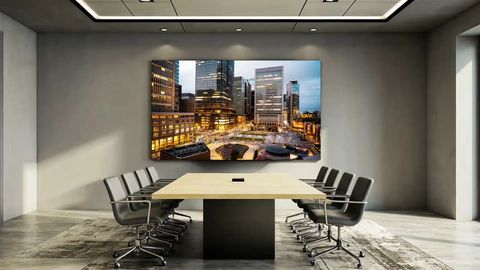
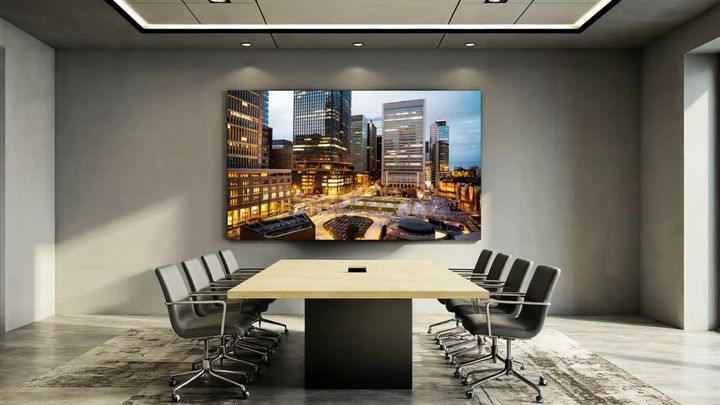
- Large meeting spaces
Display configurations depend on viewing distance and environmental conditions.
How Does a Commercial LED Video Wall Work?
LED video walls use thousands or millions of individual light-emitting diodes.
Each pixel produces controlled amounts of red, green, and blue light. Combining these colors creates the required image.
The basic process involves several components:
- A content source generates the visual signal.
- A video processor receives the signal.
- The controller distributes image data.
- Receiving electronics communicate with LED modules.
- LED pixels reproduce the visual information.
- Calibration maintains consistent image characteristics.
The complete process happens continuously during operation.
What Are the Main Components of an LED Video Wall?
Several components work together inside a commercial LED display system.
What Are LED Modules?
LED modules contain the individual pixels that generate visible images.
Multiple modules are installed within larger cabinets.
Modules commonly include:
- LED pixels
- Printed circuit boards
- Driver electronics
- Connectors
- Mounting components
Their dimensions vary between display designs.
What Are LED Cabinets?
LED cabinets provide structural support for individual modules.
Multiple cabinets connect to create the complete video wall.
Cabinet construction can influence:
- Alignment
- Installation accuracy
- Heat management
- Structural stability
- Maintenance access
Precise cabinet alignment helps create a seamless visual surface.
What Does an LED Controller Do?
The LED controller manages image information.
It receives visual data and distributes that information across the display.
Controllers can manage:
- Resolution
- Signal distribution
- Display mapping
- Brightness
- Color calibration
- Refresh behavior
Advanced systems may support several input sources.
What Does a Video Processor Do?
A video processor prepares incoming content for the LED display.
It can handle:
- Image scaling
- Signal conversion
- Source switching
- Multi-window layouts
- Resolution adjustment
- Image positioning
The processor helps match content with the wall's native resolution.
What Are the Main Types of Commercial LED Video Walls?
Commercial LED video walls can be classified by environment and construction.
How Do Indoor LED Video Walls Work?
Indoor LED video walls operate in controlled environments.
They usually require lower brightness than outdoor displays. Many also use smaller pixel pitches for closer viewing.
Indoor applications include:
- Corporate meeting spaces
- Control centers
- Auditoriums
- Broadcast environments
- Exhibition halls
- Educational facilities
Fine-pitch LED technology is especially important for close viewing.
How Are Outdoor LED Video Walls Different?
Outdoor LED walls must operate under changing environmental conditions.
They generally require greater brightness for daylight visibility.
Outdoor systems may include:
- Weather-resistant enclosures
- Higher brightness capability
- Thermal management
- Water-resistant construction
- Durable cabinet structures
- Environmental protection
Installation must also consider wind and structural loads.
What Is a Direct-View LED Video Wall?
Direct-view LED, commonly called DVLED, creates images directly from LED pixels.
It does not require a separate backlight.
Its modular construction supports large display surfaces with minimal visible separation between modules.
What Is a Fine-Pitch LED Video Wall?
Fine-pitch displays use very small distances between neighboring pixels.
They are designed for closer viewing environments.
Common applications include:
- Control rooms
- Boardrooms
- Broadcast studios
- Command centers
- Presentation spaces
Fine pixel spacing can improve perceived image detail at shorter distances.
What Is an All-in-One LED Display?
All-in-one LED displays integrate several system components into a standardized display format.
Depending on the design, they may combine:
- LED modules
- Processing electronics
- Audio components
- Control functions
- Connectivity
These systems are commonly designed for meeting and presentation environments.
What Is Pixel Pitch in an LED Video Wall?
Pixel pitch is the distance between the centers of adjacent LED pixels.
It is usually measured in millimeters.
A smaller pixel pitch places pixels closer together. This generally increases pixel density.
Pixel pitch affects:
- Viewing distance
- Image detail
- Pixel density
- Display resolution
- Content visibility
It is one of the most important LED wall specifications.
How Does Viewing Distance Affect Pixel Pitch?
Viewing distance influences how easily individual pixels can be noticed.
Closer audiences generally benefit from smaller pixel pitches.
Longer viewing distances can support larger pixel spacing.
However, pixel pitch should not be selected using distance alone.
Other considerations include:
- Content type
- Display dimensions
- Required resolution
- Installation environment
- Audience position
These factors should be evaluated together.
Why Is LED Video Wall Resolution Important?
Resolution describes the number of pixels available for displaying an image.
Higher pixel counts allow more visual information to appear.
Resolution depends on:
- Physical display dimensions
- Pixel pitch
- Module configuration
- Cabinet arrangement
A physically large display does not automatically provide higher pixel density.
Why Does Brightness Matter?
Brightness affects visibility under different lighting conditions.
Indoor displays usually operate under controlled artificial lighting.
Outdoor displays may encounter:
- Direct sunlight
- Reflections
- Changing daylight
- Artificial lighting
- Weather conditions
Brightness should match the intended environment.
Excessive brightness indoors can cause visual discomfort.
What Is Refresh Rate in an LED Video Wall?
Refresh rate describes how frequently the display updates its image.
It is typically measured in hertz.
Higher refresh performance can be particularly important for:
- Broadcast environments
- Camera recording
- Fast-moving graphics
- Live events
- Video production
Suitable refresh behavior helps reduce visible flickering.
Why Is Color Accuracy Important?
Color consistency affects the visual appearance of the complete wall.
Different modules should reproduce similar colors and brightness levels.
Calibration can help manage:
- White balance
- Brightness uniformity
- Color temperature
- Grayscale performance
- Module consistency
Accurate calibration is especially important for professional visual applications.
What Is Contrast Ratio?
Contrast describes the difference between dark and bright areas.
Strong contrast helps create depth and improve image readability.
Several factors influence perceived contrast:
- LED design
- Surface materials
- Ambient lighting
- Brightness settings
- Display processing
Environmental lighting should always be considered.
How Are Commercial LED Video Walls Installed?
LED video wall installation requires careful planning.
The process generally involves several stages.
How Is the Installation Location Evaluated?
The first stage examines the physical environment.
Important factors include:
- Wall dimensions
- Viewing distance
- Structural capacity
- Electrical infrastructure
- Ventilation
- Ambient lighting
- Maintenance access
- Signal routing
This assessment helps determine the appropriate configuration.
How Is the Support Structure Installed?
A mounting structure supports the LED cabinets.
The structure must remain level and properly aligned.
Common configurations include:
- Wall-mounted systems
- Ground-supported structures
- Suspended structures
- Freestanding installations
Structural requirements vary significantly.
How Are LED Cabinets Connected?
Cabinets are carefully positioned within the support structure.
Accurate alignment helps prevent visible gaps.
Technicians then connect:
- Power connections
- Data connections
- Receiving electronics
- Signal pathways
Connections should follow the system's technical requirements.
How Is the Display Configured?
After physical installation, the display requires digital configuration.
This process may include:
- Screen mapping
- Resolution configuration
- Signal routing
- Brightness adjustment
- Color calibration
- Module testing
The completed wall should display a consistent image.
What Should Be Considered When Planning an LED Video Wall?
Planning should begin with the intended application.
Important considerations include:
- Viewing distance
- Audience size
- Screen dimensions
- Pixel pitch
- Content resolution
- Ambient lighting
- Installation environment
- Maintenance accessibility
- Ventilation
- Power requirements
- Signal infrastructure
Technical planning helps avoid compatibility problems.
How Is Content Managed on an LED Video Wall?
Commercial LED walls can display many content formats.
Examples include:
- Videos
- Images
- Presentations
- Live camera feeds
- Information dashboards
- Data visualizations
- Digital signage
- Emergency information
Content systems send information to the video processor or controller.
Why Is Content Resolution Important?
Content should match the display's pixel dimensions whenever practical.
Incorrect scaling can reduce visual clarity.
Content creators should understand:
- Native display resolution
- Aspect ratio
- Pixel dimensions
- Video frame rate
- Graphic dimensions
Proper content preparation improves visual presentation.
How Is Heat Managed in LED Video Walls?
LED modules and electronic components generate heat.
Thermal management supports reliable operation.
Common approaches include:
- Passive ventilation
- Active cooling
- Air circulation
- Temperature monitoring
- Suitable installation spacing
Environmental temperature can also influence thermal performance.
How Are LED Video Walls Maintained?
Routine maintenance helps preserve display performance.
Typical activities include:
- Inspecting LED modules
- Checking cabinet alignment
- Cleaning display surfaces
- Monitoring ventilation
- Inspecting data connections
- Checking power components
- Testing display uniformity
- Reviewing system diagnostics
Maintenance procedures depend on display design.
What Is Front Maintenance?
Front-maintenance systems allow technicians to access modules from the viewing side.
This can be useful when rear access is limited.
Components may be removable from the front.
What Is Rear Maintenance?
Rear-maintenance systems provide access behind the LED wall.
They may require dedicated maintenance space.
Rear access can simplify certain component replacement procedures.
What Problems Can Affect LED Video Wall Performance?
Several technical issues can influence display quality.
Common problems include:
- Module misalignment
- Inconsistent brightness
- Color differences
- Signal interruption
- Failed pixels
- Power irregularities
- Excessive heat
- Loose connections
- Configuration errors
System diagnostics can help identify these conditions.
How Is LED Video Wall Technology Evolving?
Commercial LED technology continues to develop rapidly.
Important developments include:
- Finer pixel pitches
- MicroLED technologies
- Improved processing
- Advanced calibration
- Higher refresh performance
- Energy management
- Remote monitoring
- Real-time diagnostics
- Improved cabinet engineering
- Automated brightness adjustment
These technologies are expanding possible display applications.
Frequently Asked Questions
What is a commercial LED video wall?
It is a modular display combining multiple LED sections into one visual surface.
What does pixel pitch mean?
Pixel pitch measures the distance between neighboring LED pixel centers.
Are LED video walls suitable for indoor environments?
Yes. Indoor systems can support boardrooms, control rooms, studios, and presentation spaces.
Can LED video walls operate outdoors?
Yes. Outdoor systems use designs intended for environmental exposure and daylight visibility.
What is a fine-pitch LED display?
It is an LED display with closely spaced pixels for shorter viewing distances.
Why is calibration important?
Calibration helps maintain consistent brightness and color across the entire display.
Key Takeaways
Commercial LED Video Walls Summary
- Commercial LED video walls combine modular LED components into large displays.
- Direct-view LED technology produces images directly from individual pixels.
- Pixel pitch strongly influences pixel density and viewing requirements.
- Indoor and outdoor LED walls require different technical characteristics.
- Controllers and video processors manage visual content.
- Brightness should match the surrounding environment.
- Proper cabinet alignment supports seamless visual presentation.
- Calibration improves brightness and color consistency.
- Thermal management supports dependable operation.
- Front and rear maintenance designs provide different access methods.
- Careful installation planning improves overall system performance.
- Modern LED walls increasingly use advanced monitoring and processing technologies.