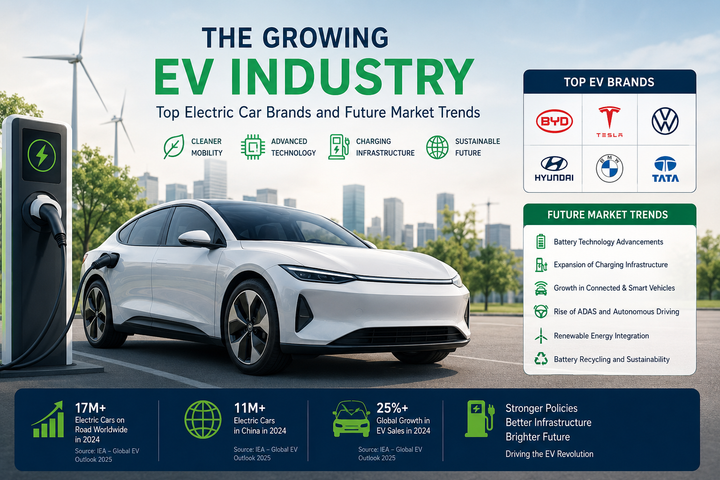
The Growing EV Industry: Top Electric Car Brands and Future Market Trends
The electric vehicle industry is growing because transportation is changing across many countries. For decades, most passenger vehicles depended on petrol or diesel engines. Electric vehicles use battery packs, electric motors, power electronics and charging systems instead of conventional fuel-based engines.
The main reason this industry exists is the need for cleaner mobility, lower tailpipe emissions, better energy efficiency and reduced dependence on imported fossil fuels. EVs are also connected to wider changes in renewable energy, smart cities, battery manufacturing, vehicle software and charging infrastructure.
The EV industry includes many parts. It is not limited to electric cars. It also includes battery cells, charging stations, vehicle insurance, telematics, connected vehicle platforms, fleet management systems, battery recycling, power electronics, safety testing and government policy.
Electric cars have become more visible because major automakers and new-age vehicle companies are developing EV platforms for different use cases. These include city hatchbacks, electric SUVs, premium sedans, commercial vehicles and performance-focused models. Some companies focus mainly on battery electric vehicles, while others use a mix of electric, hybrid and plug-in hybrid technologies.
According to the International Energy Agency, global electric car volume crossed 17 million units in 2024, rising by more than 25 percent compared with the previous year. China remained the largest EV market, with electric car volume above 11 million in 2024.
Why the EV Industry Matters Today
The EV industry matters because it affects consumers, automakers, energy companies, insurers, city planners, charging network operators and governments. It also changes how people think about mobility, energy use and long-term vehicle planning.
For consumers, EVs raise practical questions about charging access, battery warranty, real-world range, vehicle insurance and long-distance travel. For automakers, EVs require new platforms, software systems, battery sourcing, safety testing and charging partnerships. For governments, EV adoption is linked to air quality, energy security and climate targets.
Electric vehicles can help reduce tailpipe emissions in urban areas because they do not release exhaust gases while driving. However, the full environmental impact depends on how electricity is generated, how batteries are produced and how battery materials are recycled.
The growing EV industry also affects the electricity grid. More EVs mean higher demand for charging points, better grid planning, smart charging and renewable energy integration. In the future, vehicle-to-grid systems may allow some EVs to send energy back to the grid, although this depends on technology, regulation and vehicle compatibility.
| Area | Why It Matters |
|---|---|
| Battery technology | Determines range, charging speed and durability |
| Charging infrastructure | Supports daily use and longer travel |
| Vehicle insurance | Covers EV-specific parts such as battery and motor |
| Safety ratings | Help users understand crash protection |
| Software systems | Enable connected features and remote diagnostics |
| Renewable energy | Improves the environmental value of EV charging |
| Battery recycling | Reduces waste and material dependency |
A simple view of EV industry importance:
| EV Factor | Importance Level |
|---|---|
| Charging infrastructure | ██████████ High |
| Battery warranty | █████████ High |
| Real-world range | █████████ High |
| Safety ratings | ████████ Medium-High |
| Vehicle software | ███████ Medium |
| Battery recycling | ███████ Medium |
| Autonomous driving features | ██████ Medium |
Top Electric Car Brands
Several brands are important in the global EV market. Their position can change by region, technology focus and vehicle category.
BYD is one of the largest EV and plug-in hybrid companies globally. It has a strong presence in China and is expanding in several international markets. Industry data from Autovista24 shows BYD led the global plug-in vehicle brand table in 2025 with 3,967,070 plug-in vehicle registrations and about 19 percent share.
Tesla remains one of the most recognized EV brands globally. It is known for battery electric vehicles, charging network integration, over-the-air software updates and advanced driver-assistance features. In Europe, Tesla registrations rose in April 2026 after a weaker period linked partly to product transition, according to market reporting based on ACEA data.
Volkswagen Group is an important EV player in Europe. It has developed dedicated electric platforms and continues to expand its electric car portfolio across Volkswagen, Audi, Skoda and other group brands.
Hyundai Motor Group, including Hyundai and Kia, has become significant in the EV industry through dedicated electric platforms, long-range EVs and fast-charging capable models.
General Motors is developing electric vehicles across multiple segments, including SUVs, trucks and commercial-focused platforms.
BMW and Mercedes-Benz are active in the premium EV segment. Their electric vehicles focus on luxury features, performance, ADAS, connected technology and high-voltage battery systems.
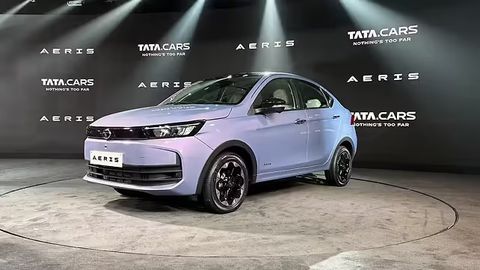
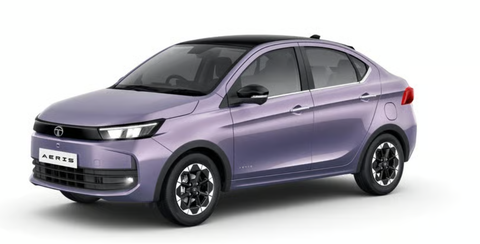
Tata Motors is one of the visible EV brands in India, especially in the passenger EV segment. Its EV portfolio has included models such as Tiago.ev, Tigor.ev, Nexon.ev, Punch.ev and Curvv.ev. India’s EV market is still developing, so charging access, local policy and vehicle category play a large role in adoption.
| Brand | Main EV Strength |
|---|---|
| BYD | Battery integration and large-scale electrified portfolio |
| Tesla | Software-led EV ecosystem and charging network experience |
| Volkswagen Group | European EV platforms and multi-brand reach |
| Hyundai-Kia | Dedicated EV architecture and fast-charging technology |
| BMW | Premium electric mobility and connected systems |
| Mercedes-Benz | Luxury EVs and advanced cabin technology |
| Tata Motors | India-focused electric passenger vehicles |
Recent EV Industry Updates
The past year has shown that EV growth is not happening in a straight line across all markets. Some regions are growing quickly, while others are seeing slower adoption due to economic conditions, charging gaps and policy changes.
In 2024, global electric car volume crossed 17 million units, according to the International Energy Agency. The additional volume added in 2024 was larger than the entire global EV market in 2020, showing how rapidly the industry has scaled.
In Europe, April 2026 data showed rising electrified vehicle registrations, while petrol and diesel registrations declined. Reuters reported that Europe’s car market grew by 7 percent in April 2026, with electrified vehicles making up more than two-thirds of new registrations. The report also noted strong growth for Chinese automakers in Europe, including BYD and Chery.
China remains the largest EV market, but competition has become intense. Reuters reported in May 2026 that China’s auto market has faced weaker domestic momentum, while EV makers continue investing in smart-driving technology, computing resources and model expansion.
Important industry trends include:
- Expansion of battery electric and plug-in hybrid models
- Higher focus on battery safety and warranty terms
- More investment in public charging infrastructure
- Growth of ADAS and smart-driving technology
- Greater attention to vehicle cybersecurity
- Development of battery recycling ecosystems
- Increased competition from Chinese EV brands
- Regional differences in EV adoption
Laws, Policies and Government Programs
EV policies differ by country. Since India is one of the important developing EV markets, its policy environment is useful to understand.
In India, the PM Electric Drive Revolution in Innovative Vehicle Enhancement scheme, known as PM E-DRIVE, was notified on September 29, 2024 and implemented from October 1, 2024. The scheme period runs until March 31, 2026, according to the official PM E-DRIVE portal.
PM E-DRIVE focuses on accelerating electric mobility through vehicle category support, public charging infrastructure and testing agency upgrades. For electric cars, the most relevant indirect impact is charging infrastructure development, because accessible charging stations can improve EV confidence.
Public charging is a major policy area. Government support for charging infrastructure helps reduce range anxiety and improves practical usability for electric cars. Charging stations are also relevant for fleet management, workplace charging and highway travel.
Safety rules are also important. Bharat NCAP is India’s vehicle safety assessment program. It provides safety rating information for eligible passenger vehicles, including ratings for adult occupant protection and child occupant protection. The Bharat NCAP rating page includes electric vehicles such as Tata Curvv EV in its rating listings.
Policy areas affecting EVs include:
- EV charging station development
- Battery safety standards
- Vehicle safety ratings
- State-level registration rules
- Electricity connection norms for charging
- Battery recycling regulations
- Vehicle insurance rules
- Roadworthiness and homologation requirements
| Policy Area | EV Industry Impact |
|---|---|
| Charging infrastructure | Improves usability and travel planning |
| Safety ratings | Helps compare vehicle protection levels |
| Battery standards | Supports thermal and electrical safety |
| Insurance regulation | Shapes EV-specific coverage terms |
| Recycling policy | Supports responsible battery end-of-life handling |
| Renewable energy policy | Improves clean charging potential |
Future Market Trends
The future EV market will likely be shaped by battery chemistry, charging speed, software, automation and local manufacturing.
Battery technology is one of the most important areas. Lithium iron phosphate batteries are widely used because they are known for durability and thermal stability. Nickel-based batteries are used in many long-range models because of energy density. Sodium-ion batteries are also being studied for smaller vehicles and certain urban applications, although adoption depends on performance, manufacturing scale and commercial readiness.
Charging infrastructure will continue to be a central trend. Users want reliable chargers, transparent availability, safe locations and predictable charging time. For cities, workplace charging and residential charging will be important. For highways, fast charging corridors will become more relevant.
Software will also shape the EV industry. Modern electric cars increasingly depend on connected vehicle platforms, battery management systems, over-the-air updates, telematics and cybersecurity. This makes EVs closer to digital mobility platforms than traditional mechanical vehicles.
Autonomous driving and ADAS will become more visible. Features such as adaptive cruise control, lane assistance, blind spot monitoring, automatic emergency braking and driver monitoring systems are expected to become more common across vehicle categories.
Future EV trends may include:
- More local battery assembly
- Wider charging station networks
- Better battery warranty transparency
- Higher use of renewable energy for charging
- Improved vehicle insurance products for EVs
- More connected vehicle data tools
- Growth in electric fleet management
- More focus on battery recycling and second-life batteries
- Stronger ADAS and vehicle cybersecurity standards
Tools and Resources
People studying the EV industry can use several tools and resources to understand brands, policies, charging and vehicle comparison.
Useful resources include:
- IEA Global EV Data Explorer for international EV statistics
- Bharat NCAP website for vehicle safety rating information
- PM E-DRIVE portal for India EV policy updates
- EV charging station locator apps for charger availability
- Vehicle insurance comparison tools for EV coverage review
- Range calculators for estimating practical driving distance
- Electricity usage calculators for charging planning
- Fleet management dashboards for commercial EV monitoring
- Battery warranty checklists for understanding coverage terms
- Route planning apps for long-distance charging planning
| Tool or Resource | Use Case |
|---|---|
| EV data explorer | Understand global EV trends |
| Charging locator app | Find nearby EV charging points |
| Range calculator | Estimate driving distance under different conditions |
| Insurance comparison platform | Review EV policy coverage terms |
| Safety rating website | Check crash protection information |
| Route planner | Plan charging stops for longer routes |
| Battery checklist | Track warranty and battery health details |
A basic EV evaluation checklist:
- Check daily travel distance
- Check nearby charging infrastructure
- Review battery warranty terms
- Compare safety rating information
- Understand vehicle insurance coverage
- Review real-world range reports
- Check software and connected features
- Study brand network and maintenance access
Frequently Asked Questions
What is the EV industry?
The EV industry includes electric vehicles, battery packs, charging stations, power electronics, connected vehicle systems, insurance products, battery recycling and related policy frameworks.
Which are the major electric car brands?
Major global EV brands include BYD, Tesla, Volkswagen Group, Hyundai-Kia, BMW, Mercedes-Benz and General Motors. In India, Tata Motors is one of the visible passenger EV brands.
Why is charging infrastructure important?
Charging infrastructure affects how easily people can use electric vehicles for daily travel and longer routes. Home charging, workplace charging and public EV charging stations all play different roles.
Are EVs affected by government policies?
Yes. EVs are affected by charging infrastructure programs, battery safety standards, registration rules, vehicle safety ratings, insurance regulations and recycling policies.
What are the main future EV trends?
Key trends include improved battery chemistry, faster charging, connected vehicle software, ADAS, battery recycling, renewable energy charging and electric fleet management.
Conclusion
The EV industry is growing because mobility, energy and technology are changing together. Electric cars are no longer limited to a small niche. They are now part of mainstream discussions about transportation, city planning, vehicle insurance, charging infrastructure, battery warranty and renewable energy.
Top electric car brands such as BYD, Tesla, Volkswagen Group, Hyundai-Kia, BMW, Mercedes-Benz, General Motors and Tata Motors are approaching the market in different ways. Some focus on scale, some on software, some on premium technology and some on regional mobility needs.
The future of the EV industry will depend on practical factors: battery reliability, charging access, safety ratings, insurance coverage, public policy and real-world usability. A neutral understanding of these factors can help readers follow the EV market without relying on exaggerated claims or promotional language.