Spiral-Welded Wind Turbine Towers: Advanced Manufacturing Explained
Wind turbine towers are structural components that support the nacelle and rotor at considerable height above the ground. Their main purpose is to provide stability while transferring the weight of the turbine and the forces created by wind, rotation, and changing weather conditions into the foundation.
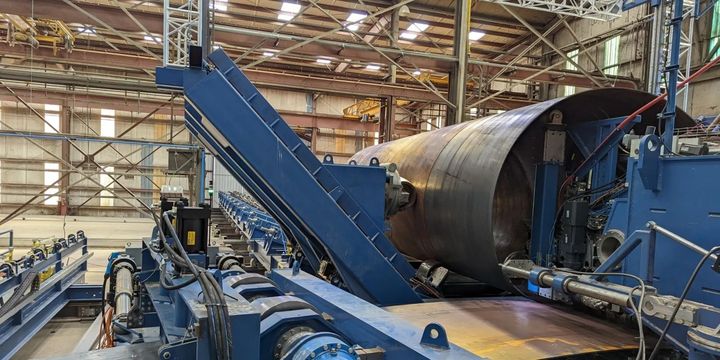
A spiral-welded wind turbine tower is produced by forming steel plate into a continuous spiral shape and joining the edges through welding. Unlike conventional towers made from several large cylindrical sections with circumferential seams, spiral manufacturing creates a helical seam along the tower.
This approach is part of modern wind turbine tower manufacturing and structural steel fabrication. It can provide manufacturers with greater flexibility in producing tower sections from steel plate while supporting efficient material handling and automated welding processes.
The manufacturing process generally begins with steel plates that are inspected and prepared for forming. The plates are gradually shaped into a cylindrical or tapered structure. The longitudinal edges are then joined using controlled welding technology.
Quality checks are carried out throughout production. Measurements can include plate thickness, weld dimensions, circularity, straightness, and overall tower geometry. Non-destructive testing may also be used to identify possible weld imperfections without damaging the structure.
The final tower must meet engineering requirements related to structural strength, fatigue resistance, wind loading, corrosion protection, transportation, installation, and long-term operation.
Why Spiral-Welded Tower Technology Matters Today
The growth of renewable energy has increased the need for large-scale wind turbine infrastructure. Modern turbines are becoming taller, while rotor diameters are increasing to capture stronger and more consistent wind resources at greater elevations.
This development places greater importance on wind turbine tower design, structural engineering, steel quality, welding accuracy, and manufacturing efficiency.
Spiral-welded construction can be particularly relevant where manufacturers need flexible production methods for large-diameter tubular structures. The continuous forming concept can also support automated production environments.
The technology affects several groups, including:
- Wind turbine manufacturers
- Structural engineers
- Steel fabrication companies
- Renewable energy developers
- Welding and inspection professionals
- Infrastructure planners
- Transportation and installation teams
One important challenge is the balance between tower height, structural strength, material use, transportation requirements, and installation conditions. A taller tower may provide access to stronger winds, but it also experiences significant structural loads.
Structural integrity is therefore a central consideration. Engineers evaluate stresses caused by wind, turbine operation, vibration, fatigue, temperature changes, and other environmental conditions.
Another important factor is fatigue. Wind turbines operate continuously and experience repeated loading cycles. Welded areas therefore require careful engineering, fabrication, inspection, and quality control.
Spiral-welded towers may also support manufacturing strategies where production flexibility is important. However, the appropriate manufacturing method depends on tower dimensions, material specifications, equipment capabilities, engineering requirements, and applicable standards.
Recent Developments and Industry Trends
Wind energy technology has continued to evolve during 2025 and 2026. One notable trend is the development of larger turbines designed to generate more electricity from individual installations.
The move toward taller towers and larger rotor systems has increased attention on advanced wind turbine tower manufacturing. Tower structures must accommodate greater loads while remaining practical to manufacture, transport, and install.
Automation is another important trend. Modern fabrication facilities increasingly use automated welding systems, programmable forming equipment, digital measurement tools, and production monitoring technologies.
Digital manufacturing systems can help track production parameters such as welding speed, heat input, forming dimensions, and inspection results. These records can support quality management and production traceability.
Another development is the increasing use of digital engineering and simulation. Structural analysis software can help engineers evaluate tower behavior under different wind loads and operating conditions before fabrication begins.
Sustainability is also becoming more important. Steel-intensive infrastructure is receiving greater attention regarding material efficiency, recycling, energy consumption, and environmental impact.
During 2025–2026, renewable energy planning in many markets continued to focus on expanding wind generation while improving grid integration and project efficiency. These trends indirectly increase the importance of reliable tower manufacturing and infrastructure planning.
At the same time, offshore wind development creates additional engineering requirements. Offshore towers and foundations face marine environments, wave loading, corrosion risks, and more demanding installation conditions. These factors require carefully selected materials, protective systems, inspection procedures, and structural designs.
Manufacturing Process and Quality Considerations
Spiral-welded tower production involves several controlled stages. Although the exact process differs between manufacturers, a typical workflow includes:
- Steel plate inspection: Raw material is checked against specified grades, dimensions, and quality requirements.
- Plate preparation: Edges and surfaces are prepared for controlled forming and welding.
- Spiral forming: The plate is progressively shaped into the required tubular geometry.
- Continuous welding: The formed edges are joined along the spiral seam using an appropriate welding process.
- Dimensional inspection: Engineers verify diameter, wall thickness, roundness, alignment, and other dimensions.
- Weld inspection: Visual and non-destructive examination may be performed according to applicable requirements.
- Surface preparation: Steel surfaces may be prepared for protective coatings and corrosion control.
- Final assembly and inspection: Components are checked before transportation and installation.
Welding parameters are particularly important because variations in heat input, travel speed, electrode or wire selection, and joint preparation can influence weld quality.
Wind turbine tower quality control therefore combines automated production with human inspection and engineering verification.
For large towers, dimensional accuracy is also important because tower sections must align correctly during assembly. Flange positioning, bolt-hole patterns, circularity, and section geometry can all influence installation.
Laws, Standards, and Renewable Energy Policies
Wind turbine tower manufacturing is influenced by structural engineering standards, welding requirements, environmental regulations, occupational safety rules, and renewable energy policies.
The exact requirements depend on the country where a tower is manufactured and where the wind project is installed.
In the United States, wind projects may be influenced by federal environmental requirements, occupational safety regulations, transportation rules, and applicable structural and welding standards.
In the European Union, wind energy projects operate within a broader framework involving renewable energy policy, environmental assessment, worker protection, and product and structural requirements.
India has continued to promote renewable energy development through national clean-energy targets and programs supporting increased renewable generation. Wind projects may also need to comply with environmental approvals, electrical regulations, land requirements, transportation rules, and applicable technical standards.
For manufacturers and project planners, compliance should be evaluated using the latest national and regional requirements. Engineering teams normally review applicable standards for structural design, welding procedures, material certification, inspection, corrosion protection, and turbine installation.
Government renewable energy programs can influence demand for wind infrastructure, but technical compliance remains essential regardless of market conditions.
Tools and Resources for Wind Tower Manufacturing
Several categories of tools can help engineers, manufacturers, students, and researchers understand spiral-welded tower technology.
Engineering and design tools
- Structural analysis software
- Finite element analysis tools
- CAD modeling platforms
- Wind-load calculation tools
- Fatigue analysis software
- Tower design calculators
Manufacturing tools
- Plate rolling and forming equipment
- Automated welding systems
- Welding parameter monitoring equipment
- Dimensional measurement instruments
- Material testing equipment
- Non-destructive testing equipment
Planning and documentation resources
- Welding procedure templates
- Inspection checklists
- Material traceability forms
- Quality control documentation
- Maintenance planning templates
- Structural calculation worksheets
For general learning, technical standards databases, engineering textbooks, renewable energy publications, academic research platforms, and government energy portals can provide useful background information.
Frequently Asked Questions
What is a spiral-welded wind turbine tower?
A spiral-welded wind turbine tower is a tubular steel tower formed from plate that is shaped into a spiral configuration and joined along a helical welded seam. It supports the turbine's upper structural components.
How is a spiral-welded tower different from a conventional tower?
A conventional tubular tower may use multiple steel plates formed into sections with circumferential or longitudinal welds. A spiral-welded tower uses a continuous helical seam created during the forming process.
Why are taller wind turbine towers being developed?
Greater hub heights can allow turbines to access wind conditions that may be stronger or more consistent at higher elevations. However, taller towers also introduce additional structural, transportation, and installation considerations.
What inspections are used for welded wind turbine towers?
Inspection methods can include visual examination, dimensional measurement, ultrasonic testing, radiographic testing, magnetic particle testing, and other techniques depending on the material, weld configuration, project requirements, and applicable standards.
Are spiral-welded towers suitable for every wind project?
No. Tower selection depends on turbine size, structural loads, site conditions, material requirements, manufacturing capabilities, transportation limitations, installation methods, and applicable engineering standards.
Conclusion
Spiral-welded wind turbine towers represent an important approach within modern structural steel and renewable energy infrastructure. By combining controlled plate forming with continuous welding, the technology provides an alternative method for producing large tubular structures.