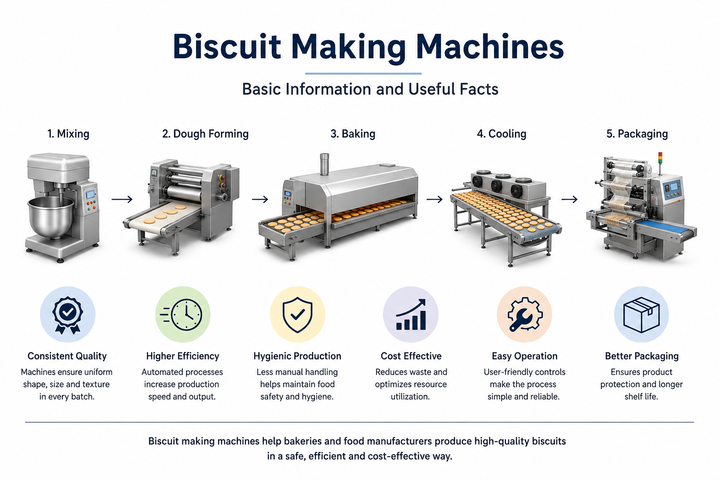
Biscuit Making Machines Guide: Basic Information and Useful Facts
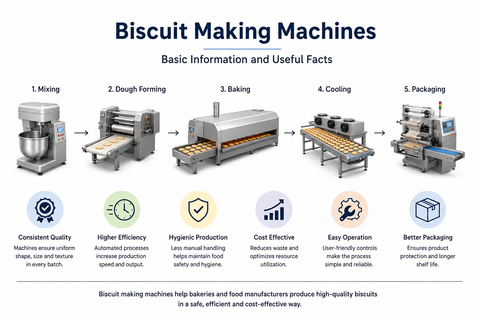
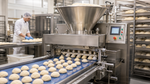
Biscuit making machines are part of food processing machinery used to prepare biscuits in a more consistent, organized, and hygienic way. These machines help with several stages of biscuit preparation, such as mixing dough, shaping, baking, cooling, and packing. In small bakeries, some steps may still be handled manually, while larger food manufacturing units often use automated biscuit production lines.
The main reason these machines exist is to improve repeatability. Biscuit preparation depends on dough texture, ingredient balance, temperature, baking time, and moisture control. When these factors are handled manually, the final product can vary from batch to batch. Machines help reduce such variation by following controlled settings.
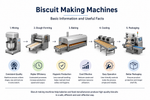
A typical biscuit making setup may include:
- Dough mixer
- Dough sheeter or laminator
- Rotary moulder or cutter
- Baking oven
- Cooling conveyor
- Packaging machine
- Metal detector or inspection unit
- Control panel for process monitoring
Biscuit making machines are not limited to large factories. Different machine types are used by small bakery units, medium food processing units, institutional kitchens, and industrial manufacturing plants. The scale, level of automation, and technical features may change depending on production needs.
Why Biscuit Making Machines Matter Today
Biscuit making machines matter because packaged bakery products are consumed widely by families, schools, workplaces, travel users, and institutional food providers. Biscuits are easy to store, easy to transport, and available in many forms such as plain biscuits, cream biscuits, cookies, crackers, digestive biscuits, and high-fibre variants.
For food processing units, machines solve several practical problems:
- Inconsistent shape and size
- Uneven baking
- Ingredient wastage
- Manual handling concerns
- Hygiene control issues
- Slow production flow
- Difficulty in maintaining batch records
- Limited process monitoring
In a modern bakery environment, food safety and quality assurance are central concerns. Machines help reduce unnecessary contact with dough and finished products. Conveyors, enclosed mixers, controlled ovens, and automated packaging units can support cleaner handling when used with proper sanitation practices.
Biscuit making machines also affect workers, supervisors, maintenance teams, quality control staff, packaging teams, and food safety managers. A well-managed machine setup can make production planning easier because output can be tracked through batch timing, oven temperature, line speed, and inspection data.
The importance of these machines has also grown because food processing in India is becoming more structured. The Ministry of Food Processing Industries highlights schemes and portals related to PMFME, PMKSY, PLISFPI, and investor support, showing continued policy attention toward food processing infrastructure.
Common Machine Flow in Biscuit Manufacturing
| Stage | Machine or Process | Purpose |
|---|---|---|
| Ingredient preparation | Weighing and dosing system | Helps maintain recipe accuracy |
| Dough preparation | Dough mixer | Mixes flour, fat, sugar, water, and other ingredients |
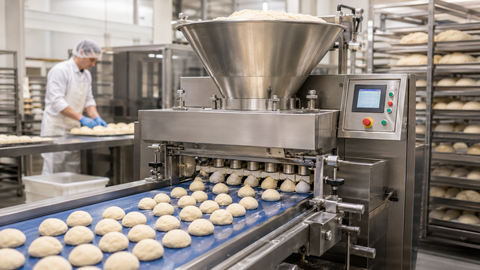
| Forming | Rotary moulder, cutter, or wire-cut system | Gives biscuit shape and thickness |
| Baking | Tunnel oven or rotary oven | Applies controlled heat |
| Cooling | Cooling conveyor | Reduces temperature before packing |
| Inspection | Metal detector, checkweigher, visual inspection | Helps detect quality or safety issues |
| Packing | Flow wrap or pouch packing unit | Protects finished biscuits from moisture and handling |
A biscuit line works best when each stage is balanced. For example, if the oven is faster than the cooling conveyor, product movement may become uneven. If the dough mixer produces dough faster than the forming section can handle it, the dough may rest for too long and change texture. This is why production planning and process control are important in biscuit manufacturing.
Recent Updates and Trends
The past year has shown stronger interest in automation, energy efficiency, and smarter bakery processing equipment. In August 2024, Bühler India launched DirectBake Smart and RotaMold Smart in India for biscuit manufacturers, with the aim of improving automation and energy efficiency in biscuit production.
A recent food processing machinery sector profile from the Ministry of Food Processing Industries noted that many food processing plants in India already have more than 50% automation, and this share is increasing. The same profile mentions contamination reduction and alignment with international food safety standards as important outcomes of improved machinery adoption.
Another broad trend is the move toward data-supported production. Modern biscuit making machines may include touch-screen control panels, programmable settings, temperature monitoring, recipe storage, conveyor speed control, and fault alerts. These features help operators track process conditions more clearly.
Key trends include:
- Greater use of automated dough handling
- More efficient ovens with better heat distribution
- Improved rotary moulding systems for uniform shape
- Compact machines for smaller food processing units
- Digital monitoring of temperature, speed, and batch timing
- Higher focus on hygienic design and easy cleaning
- Better integration between baking, cooling, and packing
The wider bakery processing equipment market is also expected to grow. One industry report estimated the global bakery processing equipment market at USD 15,681.2 million in 2025 and projected continued growth from 2026 to 2033, driven by demand for bakery products and changing consumer lifestyles.
Simple Trend View
| Trend Area | Earlier Approach | Current Direction |
|---|---|---|
| Mixing | Manual or semi-manual handling | Automated dough mixers with controlled timing |
| Baking | Basic oven settings | More accurate heat and airflow control |
| Inspection | Visual checking only | Metal detection, checkweighing, and records |
| Cleaning | Time-heavy manual cleaning | Hygienic design and easier access panels |
| Monitoring | Operator memory and paper notes | Digital process settings and batch data |
Text graph: Growth in automation focus
2021: Manual + semi-automatic systems ███
2022: Controlled process adoption ████
2023: More conveyor-based lines █████
2024: Smart bakery equipment interest ██████
2025: Higher focus on energy and monitoring ███████
2026: Integrated production and compliance tracking ████████
This graph is illustrative and shows the general direction of industry attention, not a measured production index.
Laws, Policies, and Compliance Context in India
In India, biscuit manufacturing is affected by food safety rules, hygiene requirements, packaging standards, labelling rules, and manufacturing practices. The most relevant authority is the Food Safety and Standards Authority of India, known as FSSAI.
FSSAI states that food business operators applying for licensing must have a documented Food Safety Management System plan and comply with Schedule 4 of the Food Safety and Standards Licensing and Registration Regulations, 2011. Schedule 4 is based on Good Manufacturing Practices and Good Hygiene Practices.
For biscuit making machines, this means equipment planning should consider hygiene, cleanability, safe material contact, pest control, waste handling, water quality, employee hygiene, and contamination prevention.
Important compliance areas include:
- Food contact surfaces should be suitable for food handling.
- Machines should allow proper cleaning and inspection.
- Lubricants and maintenance materials should be controlled carefully.
- Food processing areas should reduce dust, moisture, and pest entry.
- Batch records should support traceability.
- Finished product handling should avoid contamination.
- Packaging should protect biscuits from moisture and external exposure.
FSSAI also maintains food safety regulations covering licensing, product standards, additives, packaging, labelling, contaminants, and related areas.
Government policy also affects the food processing sector through development schemes. The Ministry of Food Processing Industries lists PMFME, PMKSY, and PLISFPI among its major portals and initiatives. A PIB release in April 2026 stated that PMKSY is operational up to 2025–26 with an outlay of ₹6,520 crore for the 15th Finance Commission cycle and that 1,607 projects had been approved across India till 31 December 2025.
The PMFME scheme was designed to assist micro food processing units and bring them into the organized sector. A September 2025 government note described the scheme period as 2020–21 to 2025–26 with an outlay of ₹10,000 crore.
Compliance Checklist for Biscuit Making Units
| Area | What to Check | Why It Matters |
|---|---|---|
| Hygiene design | Smooth surfaces, cleanable parts | Reduces contamination risk |
| Temperature control | Oven calibration and heat records | Supports consistent baking |
| Metal safety | Metal detector or screening process | Helps identify foreign material risk |
| Ingredient handling | Covered storage and measured dosing | Improves recipe control |
| Cleaning records | Cleaning schedule and verification | Supports food safety audits |
| Maintenance | Preventive maintenance log | Reduces breakdown and process variation |
| Labelling | Ingredient and allergen accuracy | Supports consumer information rules |
Tools and Resources
Readers exploring biscuit making machines can use several practical tools and official resources for better understanding.
Useful resources include:
- FSSAI website: For food safety regulations, licensing information, hygiene requirements, and food business compliance references.
- FoSCoS portal: For food license and registration workflow information connected with FSSAI.
- FoSTaC training resources: FSSAI-linked training material for bakery safety and hygiene learning.
- Ministry of Food Processing Industries website: For food processing schemes, sector information, and official updates.
- BIS publications: For Indian Standards mapping and food processing industry references.
- Production planning templates: Simple spreadsheets for batch timing, ingredient usage, oven settings, and output records.
- Preventive maintenance checklist: A machine-wise document covering lubrication, belt tension, motor inspection, cleaning, and safety guards.
- Quality control log sheet: A record for biscuit weight, size, colour, moisture observation, breakage rate, and packaging condition.
- Energy monitoring sheet: A basic tracker for oven running hours, temperature settings, and power consumption trends.
- HACCP worksheet: A hazard analysis document for identifying food safety risks at mixing, forming, baking, cooling, and packing stages.
A simple quality log may include:
| Parameter | Example Record Field |
|---|---|
| Batch code | Date and production batch number |
| Dough mixing time | Minutes per batch |
| Oven temperature | Zone-wise temperature reading |
| Line speed | Conveyor speed setting |
| Biscuit weight | Sample average |
| Breakage observation | Low, medium, or high |
| Packing seal check | Passed or needs review |
| Corrective action | Action taken by supervisor |
FAQs
What is a biscuit making machine?
A biscuit making machine is food processing equipment used to prepare biscuits through controlled stages such as mixing, forming, baking, cooling, and packing. It can be a single machine or a full automated biscuit production line.
What types of biscuit making machines are commonly used?
Common types include dough mixers, rotary moulders, sheeters, cutters, wire-cut machines, tunnel ovens, cooling conveyors, packing machines, checkweighers, and metal detectors. The right combination depends on biscuit type and production scale.
Why is temperature control important in biscuit manufacturing?
Temperature control affects colour, texture, moisture level, and baking consistency. If oven heat is uneven, biscuits may become under-baked, over-baked, or inconsistent across the same batch.
Are biscuit making machines affected by food safety rules?
Yes. In India, biscuit manufacturing units must follow applicable FSSAI licensing, hygiene, and food safety requirements. Schedule 4 focuses on Good Manufacturing Practices and Good Hygiene Practices for food businesses.
What records are useful for biscuit production?
Useful records include ingredient measurement logs, batch sheets, oven temperature records, cleaning schedules, maintenance logs, inspection results, packaging checks, and corrective action notes. These records help with process control and compliance review.
Conclusion
Biscuit making machines play an important role in modern bakery and food processing operations. They help make biscuit production more consistent, structured, and hygienic. From dough mixing to packing, each machine stage contributes to product quality and process control.
The topic matters today because food processing units are under greater pressure to maintain hygiene, reduce variation, improve efficiency, and follow regulatory expectations. Automation, energy efficiency, digital monitoring, and hygienic design are becoming more important in biscuit manufacturing.
In India, FSSAI rules, Schedule 4 hygiene practices, and food processing policy initiatives shape how biscuit manufacturing units plan machinery and production systems. For general readers, understanding these machines is useful because it explains how a common packaged food product is made through a controlled and regulated process.
A good biscuit making setup is not only about machines. It also depends on trained people, clean processes, documented checks, preventive maintenance, and steady quality control.