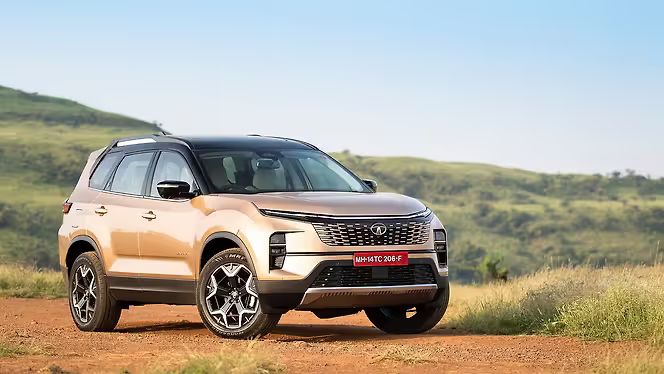
Upcoming Tata Safari EV 2026 Guide: Explore Expected Range, Features and Battery InformationFor Article
The upcoming Tata Safari EV 2026 is expected to be one of Tata Motors’ important electric SUV additions for the Indian market. The Safari name is already known as a large family SUV, and its electric version is expected to bring that familiar three-row format into the electric vehicle segment.
The Safari EV has not been fully revealed by Tata Motors through an official product page. However, recent road-testing updates suggest that development activity has moved forward. The Safari EV was reportedly spotted testing on Indian roads for the first time in early June 2026, and reports indicate that it may share several technical elements with the Tata Harrier EV.
The purpose of this model is simple: to create a larger electric SUV option for families, fleet users, long-distance travellers, and people who want an electric vehicle with more cabin space. Most electric SUVs in India are still focused on compact or five-seat layouts. A three-row electric SUV could help fill that gap.
The Safari EV is expected to sit above many existing Tata EVs and may become Tata’s flagship electric SUV in the mainstream passenger vehicle space. It is likely to focus on range, space, comfort, safety technology, connected features, and electric drivetrain efficiency.
Why the Tata Safari EV 2026 Matters
The Tata Safari EV 2026 matters because India’s electric vehicle market is moving beyond small city-focused cars. Early EV adoption in India was driven mainly by compact hatchbacks, compact SUVs, and urban commuters. Now, interest is expanding toward larger vehicles that can support family travel, highway use, and multi-passenger mobility.
A three-row electric SUV can affect several user groups:
- Families that need additional seating flexibility
- Urban users who want lower tailpipe emissions
- Highway travellers who need longer driving range
- Corporate mobility users looking at cleaner transport options
- EV learners comparing battery, charging, and range information
The Safari EV can also help explain how electric mobility is evolving in India. A few years ago, electric cars were mainly seen as short-distance city vehicles. Larger battery packs, faster charging, improved software, and stronger public charging networks are changing that perception.
A vehicle like the Safari EV may also help users understand key EV concepts such as:
- Battery capacity
- Real-world range
- ARAI-certified range
- DC fast charging
- Regenerative braking
- Home charging setup
- Battery warranty information
- EV platform design
- Motor layout and all-wheel-drive systems
Because the Safari EV is expected to be larger and heavier than the Harrier EV, range and energy efficiency will be important discussion points. Autocar India has reported that the Safari EV is expected to use similar battery and drivetrain choices as the Harrier EV, though its claimed range may be slightly lower due to the larger body.
Recent Updates
Recent updates from 2026 indicate that the Safari EV has entered a more visible testing phase. In June 2026, multiple automotive publications reported that the Tata Safari EV was spotted testing on Indian roads for the first time. The test vehicle appeared similar to the internal combustion engine Safari in body shape, while some reports noted design and hardware clues linked to its electric version.
Autocar India reported on June 1, 2026, that the Safari EV test mule showed signs of a Harrier EV-like rear suspension setup. The report also mentioned that the Safari EV is expected to become Tata’s flagship electric SUV and compete with upcoming three-row electric SUVs such as the Mahindra XEV 9S.
Earlier, in April 2026, Autocar India reported that the Safari EV was planned for a festive-season 2026 launch timeline. The same report noted that the Harrier EV’s 65 kWh and 75 kWh battery versions may provide a reference point for the Safari EV, although the Safari EV may have slightly lower claimed range because of its larger size and higher weight.
The Tata Harrier EV is already an important reference model. Tata’s official EV website presents the Harrier EV as an electric SUV with advanced technology, long driving range, and modern features. Since the Safari EV is expected to share several elements with the Harrier EV, the Harrier EV gives useful context for understanding the possible direction of the Safari EV.
Expected Battery, Range and Charging Information
Tata Motors has not officially confirmed final Safari EV battery specifications as of June 2026. However, industry reports suggest that the Safari EV may use battery and drivetrain options similar to the Harrier EV. Autocar India reports that the Harrier EV has 65 kWh and 75 kWh battery options, with ARAI-claimed range figures of 538 km for the 65 kWh version and up to 627 km for the 75 kWh rear-wheel-drive version.
Because the Safari EV is expected to be larger, its actual range may differ. Larger vehicles usually require more energy because of added weight, larger body size, and different aerodynamics.
| Area | Expected Information |
|---|---|
| Vehicle type | Three-row electric SUV |
| Battery reference | Likely similar to Harrier EV battery options |
| Possible battery sizes | 65 kWh and 75 kWh expected, not officially confirmed |
| Expected range logic | May be slightly lower than Harrier EV due to larger body |
| Charging reference | Up to 100 kW DC fast charging may be possible, based on reports |
| Drive layout | Rear-wheel-drive and all-wheel-drive versions may be possible |
The important point is that early range figures should be treated as expected information, not final data. Official certification, variant-wise range numbers, charging time, and battery details should be checked after Tata Motors releases confirmed specifications.
Expected Features and Technology
The Tata Safari EV 2026 is expected to include a mix of comfort, technology, safety, and EV-focused features. Since the Safari is a larger SUV, the electric version may focus on family usability along with modern digital functions.
Expected feature areas may include:
- Large touchscreen infotainment system
- Digital driver display
- Connected vehicle features
- Multiple drive modes
- Regenerative braking settings
- Advanced camera systems
- Panoramic sunroof
- Ventilated front seats
- Multiple airbags
- Advanced driver assistance features
- Vehicle-to-load function, if supported
- EV-specific display graphics
- Charging status information
- Battery temperature and range indicators
The Safari EV may also receive EV-specific design changes such as a closed front grille area, revised bumpers, aerodynamic wheels, and EV badging. Autocar India has reported that the Safari EV may receive styling changes such as a closed-off grille section, revised bumpers, EV badging, and aero-optimised alloy wheels.
A key feature expectation is all-wheel drive on selected versions. Reports suggest that the Safari EV may use similar drivetrain options as the Harrier EV, including AWD on some variants.
Simple Range Understanding Graph
Below is a basic educational comparison using reported Harrier EV range figures as a reference. The Safari EV numbers are not final, so this graph should be read only as a range-understanding guide.
| Reference Vehicle / Battery | Reported ARAI Range |
|---|---|
| Harrier EV 65 kWh RWD | 538 km |
| Harrier EV 75 kWh AWD | 622 km |
| Harrier EV 75 kWh RWD | 627 km |
| Safari EV | Official range awaited |
Text-based view:
Harrier EV 65 kWh RWD: ██████████████████████████ 538 km
Harrier EV 75 kWh AWD: ███████████████████████████████ 622 km
Harrier EV 75 kWh RWD: ███████████████████████████████ 627 km
Safari EV: Official range awaited
This table helps readers understand that range depends on battery size, motor layout, vehicle weight, driving conditions, tyre type, air-conditioning use, and road speed.
Laws and Policies Affecting Electric SUVs in India
The Tata Safari EV 2026 will be shaped by India’s broader electric mobility policy environment. Electric vehicles in India are affected by central and state-level rules, safety standards, taxation structures, battery norms, and charging infrastructure guidelines.
Important policy areas include:
- EV safety and battery testing standards
- Public charging infrastructure guidelines
- State EV policies
- Vehicle registration rules
- Roadworthiness and homologation requirements
- Battery recycling and environmental compliance
- GST framework for electric vehicles
- Charging connector and safety standards
For users, the most relevant policy points are usually charging access, registration rules, battery safety, and state-level EV benefits where applicable. These rules can vary by state and may change over time.
The growth of public charging networks also depends on government and private-sector coordination. For a larger electric SUV like the Safari EV, highway charging availability will be especially important. Long-distance users should understand charging locations, charger speed, connector compatibility, and backup charging options before planning intercity trips.
Battery safety is another important area. Modern EVs use battery management systems to monitor temperature, voltage, charging behaviour, and cell health. Users should follow manufacturer guidance for charging practices, parking conditions, and regular inspection schedules.
Tools and Resources
Readers exploring the upcoming Tata Safari EV 2026 can use the following tools and resources for better understanding:
| Tool or Resource | How It Helps |
|---|---|
| Tata Motors official website | Confirm final specifications after launch |
| Tata EV official pages | Understand current Tata EV platform and technology |
| Public charging apps | Locate nearby EV chargers and highway charging points |
| Range calculators | Estimate driving range based on speed, climate, and load |
| EV trip planners | Plan routes with charging stops |
| State transport portals | Check local EV registration rules |
| Battery health guides | Learn basic battery care practices |
| Owner manuals | Understand charging, safety, and maintenance guidance |
Helpful app categories include:
- EV charging locator apps
- Navigation apps with charging filters
- Range estimation tools
- Electricity consumption calculators
- Vehicle comparison tools
- State transport information portals
For educational research, readers should cross-check details from official Tata Motors sources once the Safari EV is formally revealed. Early reports are useful for understanding expectations, but final product data should always come from confirmed technical documents.
Practical Tips for Understanding the Safari EV
The Safari EV should be evaluated with a clear and practical mindset. Large electric SUVs are different from compact EVs because they need more energy and are often used for longer journeys.
Useful tips:
- Compare ARAI range with expected real-world range
- Check battery size and motor configuration
- Understand charging speed in kW, not only charging time
- Review boot space with all rows in use
- Check third-row comfort for adults and children
- Understand tyre size and replacement guidance
- Review safety features and crash-test data when available
- Check whether AWD is needed for your driving pattern
- Learn how regenerative braking works in city driving
- Use trip-planning apps before long highway journeys
For many users, the most important question will not only be “How far can it go?” but “How predictable is the range under real Indian conditions?” Factors such as summer heat, full passenger load, mountain roads, highway speed, and air-conditioning can affect driving range.
FAQs
Is the Tata Safari EV officially launched?
No. As of June 2026, Tata Motors has not fully launched the Safari EV through an official product page. However, recent reports say the vehicle has been spotted testing on Indian roads, and a festive-season 2026 timeline has been reported by automotive publications.
What range can be expected from the Tata Safari EV?
The official range has not been confirmed. Reports suggest the Safari EV may use battery options similar to the Harrier EV, which has reported ARAI range figures of up to 627 km depending on battery and drivetrain configuration. Since the Safari EV is larger, its range may be slightly lower.
Will the Tata Safari EV be a seven-seat electric SUV?
The Safari EV is expected to follow the three-row format of the Safari nameplate. Several reports describe it as a large electric SUV that may compete in the three-row EV segment. Final seating layout details should be confirmed from official specifications.
Will the Tata Safari EV have all-wheel drive?
Reports indicate that the Safari EV may get battery and drivetrain options similar to the Harrier EV, and AWD may be available on selected versions. This is expected information and not final confirmation.
What should readers check before relying on early Safari EV information?
Readers should check final battery capacity, certified range, charging speed, safety rating, warranty information, seating layout, boot capacity, and official feature list after Tata Motors publishes confirmed specifications.
Conclusion
The upcoming Tata Safari EV 2026 is expected to be an important model in India’s electric SUV market because it may bring a larger three-row electric SUV format to a wider audience. It is likely to build on Tata’s current EV experience while borrowing technical direction from the Harrier EV.
Current reports suggest that the Safari EV has entered road-testing visibility and may arrive around the 2026 festive period, but final specifications are still awaited. Until Tata Motors confirms official details, range, battery, features, and charging information should be treated as expected data.
For readers, the best approach is to follow verified updates, understand EV basics, compare range carefully, and use official resources once the vehicle is revealed. The Safari EV could become a useful reference point for how electric SUVs evolve in India, especially for families and users looking for more space, range, and electric mobility knowledge.