Upcoming Honda ZR-V Guide: Explore Expected Features, Design and Key
The Honda ZR-V is a premium hybrid SUV that has entered India’s automotive discussion as Honda expands its SUV portfolio beyond the Elevate. The ZR-V is positioned as a global model that sits between smaller urban SUVs and larger family SUVs. It is designed for users who want a practical five-seat layout, refined driving behaviour, advanced safety technology, and hybrid powertrain information in one package.
In India, Honda Cars India has listed the All New ZR-V on its official website, and the model is shown as part of the company’s current lineup with “Bookings Open” status. The official Honda India ZR-V page describes it as a premium sports hybrid SUV with a 2.0L e:HEV powertrain, e-CVT transmission, premium interiors, advanced infotainment, a spacious cabin, and Honda SENSING safety technologies.
The word “upcoming” is still useful in an informational article because many detailed ownership, delivery, variant, and long-term road-use details are still developing for the Indian market. For readers, this guide focuses on confirmed and expected information without making exaggerated claims.
The ZR-V is important because it represents Honda’s hybrid-first approach in a segment where many users are comparing petrol, hybrid, and electric vehicle technologies. Unlike a full battery electric vehicle, the ZR-V e:HEV uses a petrol engine and electric motor system together. This setup can support smoother city driving, improved efficiency, and lower running emissions compared with conventional petrol-only systems, depending on conditions.
Why the Honda ZR-V Matters Today
The Honda ZR-V matters because Indian car users are becoming more aware of fuel efficiency, emission standards, safety features, and long-term reliability. SUVs remain a strong category in India, but buyers are also learning more about hybrid technology, battery-assisted driving, and advanced driver assistance systems.
The ZR-V affects several reader groups:
- People learning about hybrid SUV technology
- Families comparing five-seat SUV layouts
- Users interested in Honda SENSING safety features
- Drivers who want better city efficiency information
- Readers comparing hybrid and electric mobility options
- Automotive learners studying vehicle platforms and emission norms
Hybrid SUVs can help bridge the gap between conventional internal combustion vehicles and full electric vehicles. They do not require external charging, but they still use electric motor assistance for certain driving conditions. This makes them useful for users who are not yet ready to depend on public charging infrastructure but still want to understand electrified vehicle technology.
The ZR-V also matters because Honda’s Indian portfolio has been more sedan-focused in recent years, with models such as the City and Amaze. The Elevate expanded Honda’s SUV presence, and the ZR-V adds a more premium hybrid SUV layer. Honda India’s official website currently shows the ZR-V alongside models such as the New City, New Amaze, Amaze second generation, and Elevate.
Recent Updates
The most important recent update is that Honda Cars India has officially listed the All New ZR-V for India. On the Honda India website, the ZR-V appears in the lineup section and is marked with “Bookings Open.” The same official source describes the model as using a 2.0L e:HEV powertrain and advanced e-CVT transmission.
Honda India’s official FAQ section also states that the ZR-V delivers fuel efficiency of 22.8 km/L. It lists colour options including Twilight Mist Black Pearl, Meteoroid Gray Metallic, Platinum White Pearl, and Crystal Black Pearl.
Another major update concerns safety technology. Honda’s official page lists Honda SENSING features such as Collision Mitigation Braking System, Adaptive Cruise Control, Low-Speed Follow, Lane Keeping Assist System, Road Departure Mitigation System, Lead Car Departure Notification System, and Auto High-Beam. It also mentions eight airbags, a 360-degree surround-view camera, Driver Attention Monitor, parking sensors, Hill Descent Control, Vehicle Stability Assist, Hill Start Assist, Electric Parking Brake with Auto Hold, Agile Handling Assist, ACE body structure, and ISOFIX rear seats.
International specifications also give useful background. Honda UK lists the ZR-V e:HEV as a five-seat full hybrid SUV with 184 ps output, 1,322 litres of maximum boot capacity using the VDA load-to-roof method, 4,568 mm length, 1,840 mm width, and 1,620 mm height. These figures provide a global reference, though India-specific details should be checked from Honda India documents.
Expected Features, Design and Technology
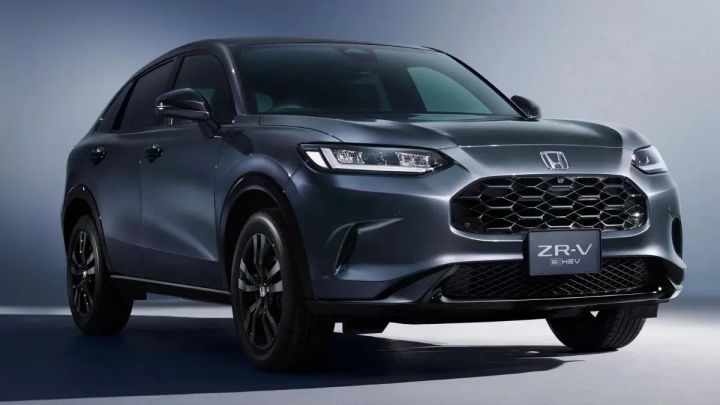
The Honda ZR-V is expected to focus on a clean SUV design, aerodynamic body lines, a hybrid powertrain, and a feature-rich cabin. The design language is different from boxy SUVs. It has a more crossover-like shape, with a low and wide stance, smooth side profile, and a cabin layout designed for daily usability.
The ZR-V’s expected design highlights include:
- Five-seat SUV body style
- Sporty front grille layout
- LED lighting elements
- Aerodynamic exterior surfaces
- Premium cabin materials
- Digital driver information display
- Advanced infotainment system
- Spacious second-row seating
- Practical luggage area
- Hybrid-specific drive information
The powertrain is one of the most important parts of the ZR-V. Honda India describes it as a 2.0L sports hybrid e:HEV system paired with an advanced e-CVT transmission. The e:HEV system generally allows the vehicle to switch between electric motor drive, hybrid drive, and engine drive depending on speed, load, and driving conditions.
A basic explanation of hybrid drive modes:
| Hybrid Mode | Simple Explanation | Typical Use Case |
|---|---|---|
| EV Drive | Electric motor moves the vehicle for short phases | Low-speed city movement |
| Hybrid Drive | Engine supports power generation while motor drives wheels | Mixed city and suburban roads |
| Engine Drive | Petrol engine directly supports movement | Steady highway cruising |
| Regeneration | Energy is recovered while slowing down | Traffic, slopes, braking zones |
This type of system is designed to improve efficiency in conditions where conventional engines often use more fuel, especially stop-and-go traffic. The final real-world result depends on traffic, driving style, road type, air-conditioning use, and vehicle load.
Honda ZR-V Key Information Table
| Category | Available / Expected Information |
|---|---|
| Vehicle type | Premium five-seat hybrid SUV |
| Powertrain | 2.0L e:HEV hybrid |
| Transmission | e-CVT |
| Fuel efficiency | 22.8 km/L stated by Honda India |
| Safety suite | Honda SENSING |
| Airbags | Eight airbags listed by Honda India |
| Camera system | 360-degree surround-view camera listed |
| Seating | Five-seat layout based on global and Indian positioning |
| Global length reference | 4,568 mm listed by Honda UK |
| Global width reference | 1,840 mm listed by Honda UK |
| Global height reference | 1,620 mm listed by Honda UK |
Simple Visual Overview
Below is a basic text graph showing the ZR-V’s major information areas. This is not a performance graph. It is a simple reader-friendly overview.
| Information Area | Relevance Level |
|---|---|
| Hybrid technology | ██████████ High |
| Safety features | ██████████ High |
| Interior comfort | ████████ Strong |
| Design appeal | ████████ Strong |
| Efficiency information | █████████ Strong |
| India-specific final details | ███████ Developing |
This helps readers understand where the ZR-V’s main informational value currently sits. The strongest areas are hybrid technology, safety features, and practical SUV design.
Laws and Policies
The Honda ZR-V is affected by India’s automotive regulations, emission rules, fuel efficiency expectations, safety standards, and hybrid vehicle classification. Since the ZR-V is a hybrid SUV and not a pure electric vehicle, it falls under different regulatory treatment than a battery electric vehicle.
Important policy areas include:
- Bharat Stage 6 emission norms
- Corporate Average Fuel Efficiency expectations
- Vehicle safety standards
- Roadworthiness certification
- Airbag and crash safety requirements
- Hybrid vehicle classification
- Fuel efficiency testing norms
- Registration and road transport rules
- End-of-life vehicle and recycling guidelines
For a hybrid SUV, emission norms and fuel efficiency standards are especially relevant. A strong hybrid powertrain can reduce fuel use in some driving conditions because electric motor assistance reduces the burden on the petrol engine. However, it still uses petrol, so it is not classified the same way as a zero tailpipe-emission battery electric vehicle.
Safety regulations are also important. Modern SUVs are expected to include stronger body structures, airbags, electronic stability systems, braking assistance, and driver-assistance features. Honda India’s official ZR-V page lists several safety features, including Honda SENSING technologies and ACE body structure.
Readers should also remember that rules and feature requirements may change over time. Final India-specific documentation from Honda and official transport authorities should be reviewed for the latest compliance details.
Tools and Resources
Readers can use different tools and resources to understand the Honda ZR-V more clearly. These resources are useful for learning, comparison, planning, and general vehicle knowledge.
Helpful resources include:
- Honda Cars India official ZR-V page
- Honda global specification pages
- Vehicle specification comparison tools
- Fuel efficiency calculators
- Hybrid technology explainers
- Emission norms information portals
- Road safety feature guides
- Owner manual resources after release
- Automotive glossary pages
- Vehicle dimension comparison tools
Useful learning topics:
- e:HEV hybrid system basics
- e-CVT transmission explanation
- Regenerative braking meaning
- Honda SENSING safety features
- ADAS function limitations
- Hybrid battery role
- Fuel efficiency testing methods
- SUV dimension comparison
- Real-world driving condition impact
A reader researching the ZR-V should focus on verified technical details. Official pages are more reliable than speculative posts. Automotive media can provide useful updates, but confirmed specifications should be checked from Honda India whenever available.
Practical Tips and Insights
When learning about the Honda ZR-V, it is useful to separate confirmed information from expected information. Confirmed details include the 2.0L e:HEV powertrain, e-CVT transmission, Honda SENSING technology, 22.8 km/L fuel efficiency figure, listed safety equipment, and colour options from Honda India’s official page.
Important tips:
- Read hybrid specifications carefully
- Understand that e:HEV is not a plug-in system
- Compare city and highway efficiency separately
- Learn how regenerative braking works
- Study Honda SENSING features and limitations
- Check India-specific dimensions when available
- Review safety equipment by variant when details are published
- Understand that global specifications may differ by market
- Use official sources for final feature confirmation
Hybrid SUVs are often misunderstood. Many people think every hybrid behaves like an electric vehicle, but that is not accurate. A strong hybrid can move using electric power in limited conditions, but it still depends on petrol and does not need external charging. The system decides the most efficient mode based on real-time driving needs.
This makes the ZR-V useful for users who want to learn about electrified mobility but do not want to depend entirely on charging infrastructure. It also makes the vehicle relevant for cities where traffic congestion can make hybrid systems more efficient than conventional engine-only setups.
FAQs
Is the Honda ZR-V available in India?
Honda Cars India has listed the All New ZR-V on its official website, and the model appears in the lineup with “Bookings Open” status. Readers should check Honda India’s official page for the latest India-specific information.
What engine does the Honda ZR-V use?
Honda India states that the ZR-V uses a 2.0L sports hybrid e:HEV engine paired with an advanced e-CVT transmission. This system combines petrol engine operation with electric motor assistance.
What is the fuel efficiency of the Honda ZR-V?
Honda India’s official FAQ section states that the Honda ZR-V delivers 22.8 km/L. Real-world efficiency can vary based on traffic, road speed, climate, driving style, and passenger load.
What safety features are available in the Honda ZR-V?
Honda India lists Honda SENSING safety technologies such as Collision Mitigation Braking System, Adaptive Cruise Control, Low-Speed Follow, Lane Keeping Assist System, Road Departure Mitigation System, Lead Car Departure Notification System, and Auto High-Beam. It also lists eight airbags, 360-degree camera, Driver Attention Monitor, parking sensors, Vehicle Stability Assist, Hill Start Assist, and ISOFIX rear seats.
Is the Honda ZR-V an electric vehicle?
No. The Honda ZR-V e:HEV is a strong hybrid SUV, not a full battery electric vehicle. It uses a petrol engine and electric motor system together and does not require external charging like a pure EV.
Conclusion
The upcoming Honda ZR-V is an important model for readers studying hybrid SUV technology, premium design, safety features, and Honda’s evolving India portfolio. It brings a 2.0L e:HEV hybrid system, e-CVT transmission, Honda SENSING safety features, and a practical five-seat SUV layout.
Its main value is educational as well as practical. It helps users understand how strong hybrid technology works, how driver-assistance features are becoming more common, and how SUV design is changing for efficiency and comfort.
For accurate understanding, readers should rely on Honda India’s official information and treat global specifications as reference material only. As more India-specific details become available, the ZR-V can be evaluated more clearly across design, features, safety, hybrid efficiency, and everyday usability.