Toyota Innova Hycross Facelift: Overview, Features Explained & Key Details
The Toyota Innova Hycross is a three-row multipurpose vehicle designed to accommodate passengers across different seating arrangements. The latest update combines revised styling with changes to cabin equipment and hybrid technology.
Toyota announced the updated Innova Hycross in India on 25 November 2026. A central development is its flex-fuel strong-hybrid system, which supports ethanol-petrol blends ranging from E20 to E85.
A facelift generally updates an existing vehicle during its model lifecycle. Changes may include lighting, interior materials, digital displays and equipment. The term does not automatically mean that the underlying platform or every mechanical component has changed.
Understanding this update involves looking beyond its appearance. Readers should examine how the hybrid system works, which equipment belongs to each variant and which fuel blends the specific vehicle can use.
These distinctions help prevent confusion between earlier Hycross models, the updated hybrid and other vehicles carrying similar technology descriptions.
Why This Update Matters
A three-row vehicle must meet several requirements simultaneously. Passenger comfort, luggage capacity, visibility and everyday usability can matter as much as engine output.
Families should consider how the cabin functions with all intended passengers seated. Comfortable second-row seating does not automatically establish adequate third-row space or sufficient luggage room.
The update also highlights two technologies that are sometimes confused: hybrid propulsion and flex-fuel compatibility.
Hybrid propulsion describes how an engine and electric motor move the vehicle. Flex-fuel compatibility describes the fuel mixtures an engine is designed to accept. One capability does not automatically establish the other.
For people without a dedicated charging point, a conventional strong hybrid presents a different operating arrangement from a plug-in vehicle. Its traction battery receives energy through the vehicle’s onboard system.
Practical questions include:
- How many passengers travel regularly?
- How much luggage accompanies them?
- Does the vehicle fit the available parking space?
- Which safety functions are included in the selected variant?
- Which approved fuel blends are accessible along regular routes?
These questions connect technical specifications with actual travel requirements.
Recent Updates and Confirmed Details
The November 2026 announcement confirms that the updated Hycross has moved beyond the preview stage. Earlier reports describing anticipated changes should therefore be checked against current model documentation.
Selected details from Toyota’s announcement are summarised below.
| Area | Confirmed information |
|---|---|
| Announcement date | 25 November 2026 |
| Hybrid engine | 2.0-litre TNGA flex-fuel engine |
| Hybrid generation | Fifth-generation strong-hybrid technology |
| Approved hybrid fuel range | E20–E85 |
| Combined maximum output | 147 kW |
| Stated hybrid efficiency | 22.58 km/l using E20 |
| Seating arrangements | Seven or eight seats, depending on configuration |
| Hybrid grades announced | G, GX, VX and ZX |
The efficiency figure is a manufacturer-stated reference under specified conditions. It should not be treated as a guaranteed result for every journey or applied to E85 without separate supporting information.
Readers comparing older and newer specifications should record the document date. An archived brochure or earlier model-year listing may describe a different equipment package.
The new hybrid fuel specification is particularly significant. It establishes an approved operating range for the updated system rather than a general statement covering every Hycross previously manufactured.
Exterior and Cabin Features Explained
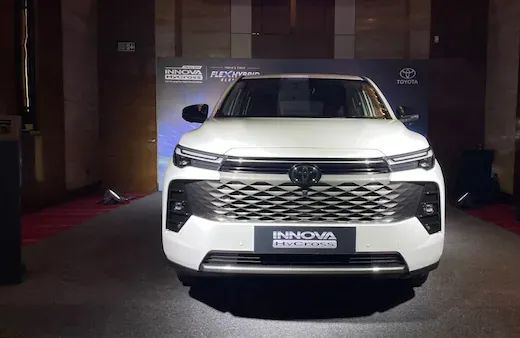
Toyota identifies a revised bumper and grille, redesigned projector LED headlamps and updated rear lamps among the exterior changes.
The updated model also introduces larger infotainment and driver-information displays. Individual features must still be matched to the relevant grade.
Equipment highlighted in Toyota’s current model information includes:
- A 31.2 cm touchscreen and TFT instrument display.
- A panoramic camera view.
- Dual-zone air conditioning.
- A powered driver seat with memory.
- A nine-speaker JBL audio system.
- A powered tailgate.
- Ottoman seating on relevant second-row configurations.
These features serve different purposes. The instrument display presents driving information, while the central touchscreen handles functions such as media and phone integration.
A camera system can help reveal nearby obstacles. Its usefulness depends on image clarity and surrounding conditions, so drivers should continue checking mirrors and the area around the vehicle.
When examining the cabin, assess access as well as seat comfort. Adjust the front seats to a realistic position before evaluating the rows behind them.
Check whether passengers can enter the third row comfortably, reach their seat belts and sit without awkward positioning.
For luggage assessment, use the seating arrangement intended for normal travel. Images showing folded rear seats do not establish luggage capacity with every seat occupied.
How the Strong-Hybrid System Works
A strong hybrid combines an internal-combustion engine, an electric motor and a traction battery. Electronic controls manage their contribution according to operating conditions.
The electric motor can propel the vehicle independently under suitable circumstances. During stronger acceleration, the engine and motor can contribute together.
Regenerative braking recovers part of the vehicle’s motion energy during slowing and stores it as electricity in the battery.
“Self-charging” describes this energy-management arrangement. Fuel supplies energy through the engine, while regenerative braking recaptures some energy during deceleration.
The following comparison explains common vehicle categories.
| Vehicle category | Main propulsion arrangement | External charging |
|---|---|---|
| Conventional petrol vehicle | Petrol engine | Not required |
| Strong hybrid | Engine and electric motor | Not required |
| Plug-in hybrid | Engine and electric motor with an externally rechargeable battery | Supported |
| Battery electric vehicle | Electric motor powered by a traction battery | Required |
The Hycross hybrid belongs to the strong-hybrid category. It should therefore be described accurately when discussing charging requirements and electric operation.
Electric-only operation depends on system conditions. Drivers should avoid assuming that the engine will remain switched off throughout a particular route.
The energy-flow display can help explain the system. Review it while safely parked, or allow a passenger to observe it during travel.
Understanding Safety Technology
Toyota’s current Hycross information lists driver-assistance functions including radar-based cruise control, pre-collision assistance, blind-spot monitoring, automatic high beams and lane assistance.
Availability and operating conditions require variant-specific verification.
Advanced driver assistance systems support particular tasks. The driver remains responsible for steering, braking, observing traffic and responding to changing conditions.
When reviewing safety equipment, separate three questions:
- Presence: Is the feature installed on this variant?
- Function: Which situations is it designed to address?
- Limitations: When might recognition or intervention be restricted?
A feature name alone cannot answer all three questions. Read the relevant manual instructions, including warnings about road conditions and system boundaries.
Camera views and electronic alerts should support normal observation. They should not encourage a driver to proceed without checking the surroundings.
Similarly, a crash-test result should be matched to the tested vehicle details. Avoid automatically applying a rating from another model year or configuration to every updated vehicle.
Indian Laws and Policies
India’s changing fuel framework makes manufacturer-approved compatibility particularly relevant.
On 26 October 2026, the Ministry of Road Transport and Highways announced amendments supporting certification provisions for E85 and E100 flex-fuel vehicles.
The announcement explains that E10 or E20 compatibility alone does not establish suitability for E85. It also states that existing vehicle owners are not required by that notification to switch to E85 or modify their vehicles.
E20 indicates approximately 20% ethanol in the blend. E85 refers to a high-ethanol mixture containing up to 85% ethanol.
Toyota specifies E20–E85 compatibility for the updated Hycross flex-fuel hybrid. This should not be extended to earlier vehicles or other engines without confirmation.
A practical fuel check includes:
- Reading the vehicle’s fuel compatibility label.
- Consulting the correct owner’s manual.
- Checking the dispenser’s fuel identification.
- Following manufacturer guidance if information appears inconsistent.
Car insurance coverage is another relevant legal consideration. Section 146 of the Motor Vehicles Act requires third-party motor insurance for vehicles operating on Indian roads.
Other policy elements should be examined separately. Hybrid classification alone does not establish the scope of protection for every component.
Government incentives also require careful interpretation. In August 2026, the Ministry of Heavy Industries stated that it had not formulated a separate phased national policy specifically incentivising flex-fuel vehicles operating above 20% ethanol.
Helpful Tools and Resources
Official model documentation
Start with current Toyota Bharat model information and the relevant specification sheet. Record the grade, document date and seating configuration alongside your notes.
Toyota i-Connect
Toyota i-Connect explains and supports compatible connected functions. Availability depends on vehicle capabilities and connected hardware. Network and GPS conditions can affect certain functions.
Review account permissions and emergency-contact details during setup. Keep access credentials secure, particularly when multiple people use the vehicle.
Fuel-consumption worksheet
A spreadsheet can record distance travelled, litres added, fuel blend and driving conditions. Divide distance by litres to calculate observed km/l.
Compare several consistently recorded tank intervals. One short journey may provide a limited picture of normal consumption.
Vehicle finance calculator
A vehicle finance calculator helps compare loan amount, interest rate and repayment tenure. Keep assumptions identical when comparing results.
Examine the complete repayment schedule alongside the monthly instalment. A smaller monthly payment alone does not explain the full financial commitment.
Car insurance comparison checklist
Record third-party protection, own-damage terms, deductibles, exclusions and declared vehicle details. Read policy wording to understand the treatment of hybrid components.
Hybrid battery warranty documents
Review the written time limit, distance limit, exclusions and maintenance requirements. Warranty duration should not be treated as a prediction of the battery’s eventual lifespan.
Frequently Asked Questions
Has the Toyota Innova Hycross facelift launched in India?
Yes. Toyota announced the updated model on 25 November 2026. Current official information should take priority over earlier previews describing anticipated changes.
Is the Hycross hybrid a plug-in vehicle?
No. Its strong-hybrid arrangement uses onboard energy management and regenerative braking. It does not require an external charging connection. A plug-in hybrid has a different charging arrangement.
Can every Innova Hycross use E85?
That assumption should not be made. Toyota’s E20–E85 statement applies to the newly announced flex-fuel hybrid. For another vehicle, check its fuel label, owner’s manual and manufacturer guidance before selecting a higher ethanol blend.
Does every variant include identical equipment?
Equipment should be checked grade by grade. Seating arrangements, displays, cameras and driver-assistance functions may differ. Promotional photographs can show a configuration different from the particular vehicle being examined.
Will every driver achieve the stated efficiency figure?
No single figure establishes every driver’s result. Record actual distance and fuel consumption consistently, including the blend used. A dashboard estimate or isolated journey provides limited evidence of long-term efficiency.
Conclusion
The Toyota Innova Hycross facelift combines revised design and cabin technology with a significant change in hybrid fuel compatibility.
Understanding the update starts with the exact variant, approved fuel range and current documentation. Seating practicality, driver-assistance limitations, car insurance coverage and hybrid battery warranty conditions deserve attention alongside engine specifications.
Consistent comparisons and accurate terminology help readers assess the vehicle clearly and distinguish confirmed information from assumptions