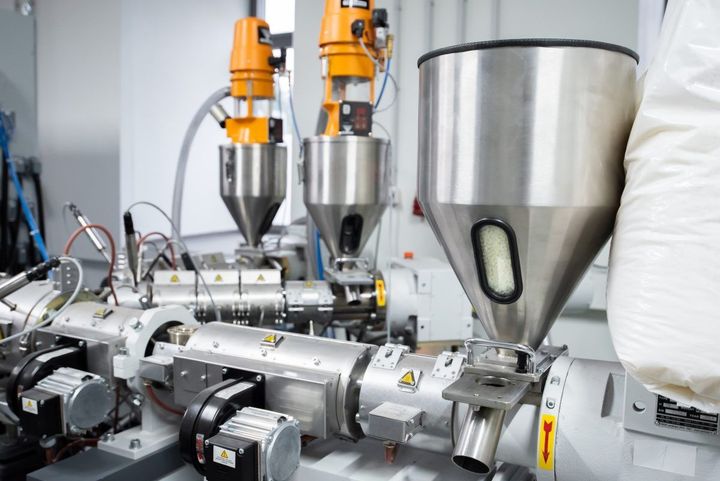
Plastic Extrusion Machines: Complete Guide to Manufacturing Processes and Industrial Applications
Plastic extrusion machines are among the most widely used manufacturing equipment in modern industry.
They produce continuous plastic products with consistent shapes, sizes, and quality by melting raw plastic material and forcing it through a specially designed die. This manufacturing process supports industries such as construction, packaging, automotive, agriculture, healthcare, electronics, and consumer goods.
From plastic pipes and tubes to window profiles, cables, sheets, films, and protective packaging, extrusion technology plays an important role in everyday manufacturing. Modern plastic extrusion machines combine precision engineering, automation, and energy-efficient production to improve productivity and product consistency.
This guide explains plastic extrusion machines, their working principles, major types, industrial applications, advantages, and future developments in simple language.
Understanding the Concept
A plastic extrusion machine is industrial equipment designed to transform plastic raw materials into continuous products with a uniform cross-section. The process begins by feeding plastic pellets or granules into a heated barrel, where a rotating screw melts and moves the material forward.
Once fully melted, the plastic passes through a die that determines the final shape of the product. After leaving the die, the material is cooled, sized, and cut or wound depending on the application.
Plastic extrusion is suitable for producing large quantities of identical products while maintaining consistent dimensions and quality.
Common products manufactured using extrusion include:
- Plastic pipes
- Plastic tubing
- Packaging films
- Plastic sheets
- Window profiles
- Cable insulation
- Medical tubing
- Garden hoses
- Plastic rods
- Edge trims
Key Types or Categories
Plastic extrusion machines are available in several configurations depending on production requirements.
Single Screw Extrusion Machines
Single screw extrusion machines are widely used for standard plastic processing.
They are suitable for:
- Pipe manufacturing
- Plastic sheet production
- Film extrusion
- Profile extrusion
These machines are known for reliable operation and continuous production.
Twin Screw Extrusion Machines
Twin screw extrusion machines contain two rotating screws inside the barrel.
They are commonly used for:
- Engineering plastics
- Plastic compounding
- Masterbatch production
- Recycling applications
- High-performance polymer processing
Twin screw systems provide improved material mixing and temperature control.
Pipe Extrusion Machines
Pipe extrusion machines produce plastic pipes used in:
- Water distribution
- Irrigation systems
- Drainage networks
- Industrial fluid transport
- Electrical conduit applications
Different dies allow production of various pipe diameters.
Sheet Extrusion Machines
These machines manufacture flat plastic sheets used in:
- Packaging
- Automotive interiors
- Construction panels
- Thermoforming
- Signage
Thickness and width can be adjusted based on production requirements.
Film Extrusion Machines
Film extrusion equipment produces thin plastic films for:
- Food packaging
- Stretch wrapping
- Agricultural films
- Protective coverings
- Industrial packaging
Modern film extrusion lines deliver excellent thickness consistency.
Important Subsections
Extruder Screw
The screw is one of the most important components.
Its responsibilities include:
- Moving raw material forward
- Melting plastic
- Mixing material evenly
- Building pressure
- Delivering consistent output
Different screw designs are selected according to the material being processed.
Extrusion Die
The die shapes molten plastic into the required profile.
Different die designs produce:
- Round pipes
- Flat sheets
- Hollow profiles
- Tubes
- Custom industrial components
Die precision directly influences product quality.
Heating System
Multiple heating zones gradually melt the plastic.
Accurate temperature control prevents overheating and maintains consistent material flow.
Cooling System
After leaving the die, products enter cooling systems using air or water.
Controlled cooling helps maintain dimensional accuracy.
Haul-Off Unit
The haul-off continuously pulls the finished product through the production line while maintaining stable speed.
Consistent pulling prevents deformation.
Cutting Equipment
The finished product is cut into required lengths or wound into rolls depending on production needs.
Automatic cutting improves efficiency and accuracy.
How It Works
Plastic extrusion follows a continuous manufacturing process.
Step 1: Material Feeding
Plastic pellets or granules are loaded into the hopper.
Different polymers may include:
- Polyethylene (PE)
- Polypropylene (PP)
- Polyvinyl Chloride (PVC)
- Polystyrene (PS)
- ABS
- PET
Step 2: Material Melting
The rotating screw moves the material through heated zones.
The combination of heat and mechanical friction melts the plastic evenly.
Step 3: Material Mixing
As the material moves forward, it becomes uniformly mixed.
Proper mixing ensures consistent color, strength, and product quality.
Step 4: Shaping Through the Die
Molten plastic passes through the extrusion die.
The die determines the product's final profile.
Step 5: Cooling
The newly formed product enters cooling tanks or air cooling sections.
Cooling stabilizes the product before further processing.
Step 6: Pulling and Cutting
The haul-off maintains production speed while cutting equipment prepares finished products according to required dimensions.
Benefits and Advantages
Plastic extrusion machines provide several manufacturing advantages.
Continuous Production
Extrusion supports uninterrupted manufacturing for long production runs.
This improves production efficiency.
High Product Consistency
Computer-controlled processing maintains uniform dimensions throughout production.
Consistent quality reduces material variation.
Material Flexibility
Many thermoplastic materials can be processed using extrusion technology.
Manufacturers can select materials based on application requirements.
Efficient Manufacturing
Modern extrusion equipment combines automation with precise process control.
This supports stable production while reducing manual intervention.
Product Customization
Changing the extrusion die allows manufacturers to produce different shapes without replacing the complete production line.
Industrial Automation
Automation systems monitor:
- Temperature
- Pressure
- Screw speed
- Production output
- Material flow
Continuous monitoring improves operational stability.
Real-World Examples or Applications
Plastic extrusion supports numerous industries.
Construction Industry
Extruded products include:
- Water pipes
- Window profiles
- Cable conduits
- Drainage systems
- Decorative trims
Packaging Industry
Manufacturers produce:
- Flexible films
- Protective packaging
- Shrink films
- Industrial wrapping materials
Automotive Industry
Extruded plastic components include:
- Door seals
- Interior trims
- Wire insulation
- Protective tubing
Medical Industry
Medical manufacturers use extrusion for:
- Catheters
- Medical tubing
- Fluid transfer lines
- Laboratory components
High precision is essential for healthcare applications.
Agriculture
Agricultural products include:
- Irrigation pipes
- Greenhouse films
- Drip irrigation tubing
- Protective crop coverings
These products improve farming efficiency.
Important Factors to Understand
Several factors influence extrusion performance.
Material Selection
Different polymers require different processing temperatures and screw designs.
Selecting suitable material improves final product performance.
Temperature Control
Stable temperatures prevent product defects such as uneven surfaces or dimensional variation.
Die Maintenance
Regular inspection keeps dies clean and maintains product accuracy.
Production Speed
Higher speeds increase productivity, but production parameters must remain balanced to maintain quality.
Quality Inspection
Manufacturers inspect:
- Product dimensions
- Surface finish
- Wall thickness
- Strength
- Color consistency
Continuous inspection supports reliable manufacturing.
Future Trends and Industry Insights
Plastic extrusion technology continues advancing through automation and smart manufacturing.
Smart Manufacturing
Modern production lines use intelligent monitoring systems that collect real-time production data for improved process control.
Artificial Intelligence
Artificial intelligence helps optimize machine settings, detect production variations, and improve maintenance planning.
Energy-Efficient Extrusion
Manufacturers increasingly adopt energy-efficient motors, improved heating systems, and optimized screw designs to reduce power consumption.
Sustainable Plastic Processing
Recycled polymers and environmentally responsible materials are becoming more common in extrusion manufacturing.
Advanced filtration and material preparation improve recycled material quality.
Industry 4.0 Integration
Connected extrusion machines exchange production information with factory management systems.
Real-time monitoring improves productivity, maintenance planning, and manufacturing efficiency.
Conclusion
Plastic extrusion machines remain one of the most important technologies in modern manufacturing. They enable continuous production of high-quality plastic products used across construction, packaging, healthcare, agriculture, automotive, and many other industries.
By combining precision engineering, automation, efficient material processing, and advanced quality control, extrusion technology supports reliable manufacturing with consistent results. Understanding how plastic extrusion machines work helps manufacturers select appropriate equipment, improve production efficiency, and meet evolving industrial requirements.
As smart manufacturing, artificial intelligence, sustainable materials, and Industry 4.0 continue to develop, plastic extrusion machines will become even more intelligent, efficient, and adaptable, supporting the future of industrial production worldwide.